Monday, 5 March 2007

Theaker's Quarterly Fiction #15

pdf | print UK | print US

The latest issue of Theaker's Quarterly Fiction is now out! Now you can get back on with your daily life, and stop waiting for the sirens to sing out: at last it's here, a month later than planned, but with more than ever to say!

In contrast to issue fourteen, which presented just one long tale, this issue has dozens of the things – well, one dozen, and another eleven, but that's still a lot of different ideas for one magazine! There was no room for an editorial, for news, or for reviews - it is packed to the rafters with sf, fantasy and horror!

This is one you can dip into whenever you have a spare minute or twenty, one to keep in your bag at work to keep you occupied during a break, or one to take on a long trip to keep you reading all the way.

With this issue we went all out, cramming as many stories as was typesettingly possible into the magazine. For full author credits see the key on page 40, but of especial note: this issue of TQF sees the long-awaited return of Ben Chadwick to the literary fray! – SWT


The Strange Story of Roland Parsimony ~ The Return of Jak Perceval: Death in the Darkness! ~ The Crumbling Time ~ Insight ~ Shadowplay ~ Zombie Beach Party Kids ~ In The Colony ~ Ice Age ~ Big Ben ~ New Dawn Fades ~ The Great Quatroon ~ The Secret Destination ~ The Wizard Who Chose to Wait ~ Wilderness ~ The Infinity Puppets ~ Glass ~ The Lodger ~ A Mistake At the Fancy Dress Shop ~ I Remember Nothing ~ The Rubber Plant ~ After All ~ Otherwise Detritus ~ Master Zangpan’s Resolution

Sunday, 28 January 2007

Theaker's Quarterly Fiction #14

pdf | print UK | print US |

This New Year special of Theaker’s Quarterly Fiction is devoted to a lengthy self-contained portion of Michael Wyndham Thomas’s journey into speculative fiction: Valiant Razalia. We were previously able to bring you the prologue to this tale six issues ago, in TQF#8, but if you didn’t catch it then, don’t worry – like literary quicksand – in a good way! – this is a tale that will suck you in wherever you set foot on it for the first time. Elsewhere, >Walt Brunston offers reviews of the latest in US telefantasy. – SWT


Editorial

Back to the World of Fractured Time

News

J.K. Rowling in Time Travel Danger Warning! ~ Next Issue News ~ Where to Find Your Recommended Viewing

Valiant Razalia

The Stealthy Craving

Michael Wyndham Thomas

The Quarterly Review

Jericho ~ Heroes

The Back Cover

Helen and Her Magic Cat

Steven Gilligan

Monday, 8 January 2007

Theaker's Quarterly Fiction #13

pdf |

This issue we welcome new contributors and new ideas to the publication, as well as an uncanny host of parasitic lifeforms!

Walt Brunston is from Austin, Texas, home of independent cinema and, even more significantly, Ain’t It Cool News! For the last couple of issues Walt has been supplying us with the hilarious cartoon strip, Robots, in a Spaceship, as well as the occasional review of US television. If you have been concerned that he has been palming us off with the same Robots artwork for an issue or two, prepare to make some allowances, because in this issue he presents us with the beginning of what is sure to be seen as his first major work, his first adaptation of an episode from Space University Trent. (Work on this has left him with little time for anything else, but he has tried his best to meet all obligations, hence the shoddy recyling of artwork.)

Because of its patchy transmission record, we realise that many readers will be sadly unaware of this series at all – indeed, it seems to be a glaring omission in a number of encyclopedias of science fiction and tv, not to mention its baffling absence from many online reference sites – and so Walt has gone the extra mile to bring us through freshers’ week safely, providing both an episode guide and an introduction to this most unlucky of programmes.

Vicki Proserpine is something of a mystery to us, but we know this much: she is the writer of "Ellenore", a historical short story with a twist, based upon Benjamin Constant’s classic novel of misogyny, Adolphe. It isn’t the usual type of thing we publish, and all the better for it!

Just in case there isn’t room at the end of the editorial, I must of course welcome back an old friend – Newton Braddell, who is now well-established as our most frequent flyer!

Finally, I must talk briefly about the amazing discovery that has been made of a hitherto unsuspected collection of Silver Age Books, novels from all time and space, brought back from another dimension for your enjoyment, that you may savour what might have been. I give you, the Lost Classics of the Silver Age! Guaranteed to amaze and astonish! – SWT


Editorial

Welcome to the Family

News

Possible Space University Revival? ~ Alien Beast Injures Galactic Philanthropist

Robots, in a spaceship

A Call to Metal Arms!

Walt Brunston

Space University Trent

An Introduction to the Show ~ Episode Guide ~ Hyperparasite (Episode 2x09)

Walt Brunston

Lost Classics of the Silver Age

The Mushrooms from Infinity

J.B. Greenwood

Ellénore

After Adolphe, by Benjamin Constant

Vicki Proserpine

Newton Braddell And His Inconclusive Researches Into The Unknown

Tyranny of the Fungal Overlord

John Greenwood

Helen and Her Magic Cat

Steven Gilligan

Monday, 11 September 2006

Theaker's Quarterly Fiction #12

pdf |

The Autumn 2006 edition of our magazine is devoted to Newton Braddell, whose incomparably inconclusive researches have appeared in a number of our previous issues. They continue here, as remarkably as ever, and meander through the entire issue.

As one saga continues, another begins – that of Helen and Her Magic Cat, written and drawn by master cartoonist Steven Gilligan. We hope this hilarious strip will be a permanent fixture on the back cover (or thereabouts) for many issues to come.

We also welcome what I expect to be the first of many reviews from our transatlantic cousin-in-arms, Walt Brunston. His cartoon began running in issue eleven, his reviews in this one, and next issue? Well, let's just say I'm fighting a rearguard action to prevent this becoming Brunston's Quarterly Fiction.

To read the issue, either just click on the cover to the right to open the document within your browser, or, and this is what we would recommend, right click and save it to your hard drive, where you can read it at your leisure. – SWT


Editorial

Newton Braddell Rides Again!

News

Lost Skies of Agramennon ~ Strange Pets of History ~ New Doctor Who Companion Confirmed

Robots, in a Spaceship

Robots Are Surprised!

Newton Braddell And His Inconclusive Researches Into The Unknown: the Saga Continues

Captured by the Punggol ~ The Great Traitor ~ Peculiar Habits of the Rumbia Beetles ~ Awaiting Trial in the Rumbia Colony ~ An Android’s House Guest ~ Electric Brain Parasites ~ An Awkward Cohabitation ~ New Hope and a New Friend ~ In Search of the Red Hill Clementi

The Quarterly Review

Cars ~ The Descent ~ Three Moons Over Milford ~ Pirates of the Caribbean: Dead Man’s Chest

Cars – reviewed by Howard Phillips

In this belated sequel to Stephen King’s underrated directorial debut, Maximum Overdrive, humanity is long gone – the resistance displayed by the survivors in that movie utterly forgotten, and the cars given autonomous life by a freak cosmic accident rule the world.

However, in a horrifying echo of George A Romero’s mall-shopping zombies in Dawn of the Dead, the cars continue to perform the mundane duties they undertook when mankind still lived, so we see them travelling along motorways, going on touring holidays, attending sports events, and so on. They lack the imagination to come up with new activities for themselves, now that their erstwhile masters are gone. Worst of all, like public schoolboys who grow up to beg a madam’s cane, they throw themselves into life-threatening high speed races, struggling to recapture excitement in what once was torture.

In common with other recent children’s films, such as Ice Age and Robots, and of course with the aforementioned George A Romero, Cars takes an uncommon interest in entropy, and its ultimate expression, death.

In Cars, to be built is to begin to rust; to turn on your engine is to become outdated – there will always be a newer model, and from the moment you are created you begin the fight against decrepitude. A depressing topic for an adult film, and even more so for a film made for children.

And so, although the marketing for Cars betrays little of its origin, its themes perhaps stay closer to the horror of Stephen King’s work than you might imagine.

It is highly recommended.

Cars, directed by John Lasseter / Joe Ranft (dirs). Film, US, 121 mins. Originally published in Theaker's Quarterly Fiction #12. NB: Howard Phillips is a fictional character.

Monday, 31 July 2006

Theaker's Quarterly Fiction #11

pdf |

For this issue, we decided to give the old quarterly another little makeover, as well as adding a few new bits and bobs – a news section, a review section, and a new comic strip.

The goal of all the changes is to make it a bit easier to start reading. The font is a little bigger than it was, each page is a bit less text-heavy, and there are shorter items for the times when you just aren't in the mood for reading the latest instalment of Howard's extravagant adventures.

None of the changes are huge, and deliberately so, but the sum total of them should be palpable.

Our raison d’etre has not changed one bit, though – every issue will provide a great read from start to finish.

As for the contents – this issue brings Howard Phillips' momentous first novel to a conclusion – but feel free to jump in at this point, even if you haven't read a single word of what went before. Very deliberately, it is designed in the manner of an old-fashioned comic strip or film serial, to be picked up and enjoyed at any point.

There is also a rather silly play, originally intended for inclusion in issue five of New Words. That issue never saw the light of day, but now, at last, the play has, and applications from amateur dramatics societies are both welcome and guaranteed to be granted. SWT


EDITORIAL

A New Look

NEWS

Controversy as “Quarterly Published Six Times a Year” ~ Last Days on Earth? ~ Artsfest 2006 ~ Alec Abernathy’s Meat Search

THE SATURATION POINT SAGA: HIS NERVES EXTRUDED

Our Plans Are Up in the Air ~ The Pit of a Pendulum ~ Captives of the Mongoose-Men ~ Deep Red Sea ~ The Denizen  ~ The Blank Tower ~ Love’s Last Laugh ~ The Extruded One ~ The Weaponeers ~ The Zuvanos Gambit ~ Back to Sadness, Back to Music

ROBOTS, IN A SPACESHIP

Saying Hello

KLOTHE AND MELENKIUS TAKE CENTRE STAGE: A ONE-ACT PLAY

Scene One ~ Scene Two ~ Scene Three ~ Scene Four

THE QUARTERLY REVIEW

World on a Plate ~ Black Holes and Revelations ~ Jennie Rindon’s Cosmic Machine

Tuesday, 27 June 2006

Theaker's Quarterly Fiction #10

pdf |

Once again we find ourselves without room for a longer editorial, but thanks for dropping by! In this issue, we present in its entirety John Greenwood’s exciting novella of mechanical co-habitation, "Living with Mister Robot", together with another lengthy and thrilling instalment of Howard Phillips’ Saturation Point Saga – the serialisation of His Nerves Extruded, the first novel in the sequence to be actually written, continues.

Contents

  • Living with Mister Robot, by John Greenwood
  • The Saturation Point Saga: His Nerves Extruded, by Howard Phillips: A Princess of Envia ~ The Way to a Man’s Heart ~ The River of Wrath ~ Laughable Aria ~ A Loquacious Tormentor ~ Love Rears Its Ugly Head ~ Bad Luck Comes In Trees

Tuesday, 16 May 2006

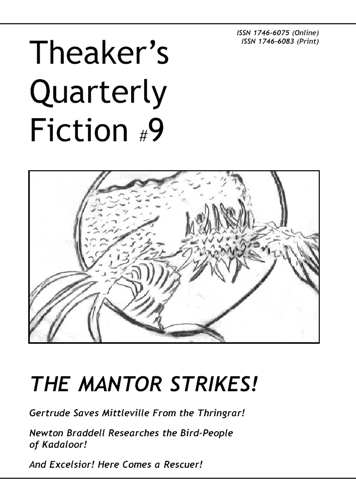
Theaker's Quarterly Fiction #9

pdf |

There's not enough room in this issue for a real editorial – we have far too much material to fit in! But in the little space we have [inside the magazine, that is] I would like to welcome John Greenwood, one of our consistent contributors, as co-editor, and congratulate Howard Phillips on actually completing a novel. More of His Nerves Extruded will appear next issue. Thanks to all readers and contributors! – SWT


Contents

Newton Braddell And His Inconclusive Researches Into the Unknown

  • The Bird-People of Kadaloor, by John Greenwood

The Saturation Point Saga: His Nerves Extruded, by Howard Phillips

  • The Beautiful Beautiful Palanquinettes
  • A Struggle to Breath
  • Ferry Worrying
  • We Fight Back. For Love, For Victory, For Honour!
  • Heist You Later
  • Action Is Mine!
  • Eggshell in the Void
  • Tears in Transit
  • First Steps on a Far-Off World
  • The Mantor Strikes!
  • Laugh While the Iron’s Hot!

Gertrude and the Thringrar

  • By Ranjna Theaker

Excelsior

  • Rescuer, by Steven Gilligan

Saturday, 1 October 2005

Theaker's Quarterly Fiction #8

pdf |

This is the eighth issue of my magazine, and just like every issue so far, it is the best yet. But it is slightly unusual, in that it contains no less than four distinct tales, by four entirely different authors, whereas in the past I have been more likely to present my readers with one or two long pieces. It is very interesting, I feel, that I launched this magazine mainly in order to encourage myself to sit down to write at least four times a year, only to be eventually pushed out of it by the submissions of other people. I would vow to ruin them all for stymieing my plans were it not for their stories being so much better than anything I would have been likely to write.

If there is a theme to this issue, it is probably highlighted best by “The Hidden Game”, intended by the author, John Greenwood, the editor of our sister journal, November Spawned, to be the first in a series – Newton Braddell And His Inconclusive Researches Into the Unknown. Planned to be of indefinite length, John has promised, if it is within his writerly power, to send an instalment for several issues to come. Let’s hope that he does not waver in that resolution after seeing that, in my guise as illustrator, I decided to clothe his character in a costume rather similar to that of Elvis in his Vegas years. I have no explanation – I am only a beginner when it comes to art, so I am as yet at the mercy of my muse.

Anyway, back to the theme I mentioned. The key word in John’s story, so far as this issue is concerned, is Inconclusive. None of this issue’s items reaches a conclusion. I hope that nevertheless the issue will stand alone, as a good read in itself, but it is worth alerting the reader to the fact before he or she plunges in.

As already mentioned, Newton Braddell's adventures are intended to be an ongoing series. The story submitted by my sometime friend Howard Phillips is the beginning of an autobiographical epic, in which he will, step-by-step, take us through the assembly of what some claim to be the greatest rock band of all time, Howard Phillips and the Saturation Point. This is the beginning of The Saturation Point Saga – mark this moment well! This first, introductory, story deals with the fate of his former band, The Sound of Howard Phillips (who he discussed at some length in last issue’s editorial), and with this published, he then plans to assault us with a series of novels and stories, each of which will report how he recruited one or another of the band. Now, longtime Silver Age readers will be fully aware of the number of projects Howard has undertaken but not completed, but he seems very enthusiastic, so I will not be the one to discourage him. He has all the makings of a multi-media triple threat, at the very least, so if I am nice now maybe he will tip his hat to the SAB at some opportune time in the future.

Steven Gilligan has blessed us with the first half (or less, depending on how the rest of the story plays out) of "Excelsior", the heartwarming tale of a young man and his giant robot. The eponymous metal star can be seen on the cover of this issue, as interpreted by your hard-working editor. He ended up looking quite a bit like Jet Jaguar, but was that in Steven’s descriptions of the robot, or was that just how I interpreted his words? Resolve this conundrum by reading it now! Steven also created the hilarious cartoon that graces the back cover.

The fourth piece in this issue is the fascinating prologue to Valiant Razalia, the first science fiction novel by Michael Wyndham Thomas, better known as a poet and historical novelist. I have never read anything quite like it. In all honesty, from someone writing their first science fiction novel, I expected a certain amount of reinventing the wheel, being hit over the head with the hoariest of old tropes (that’s the role my fiction plays in this magazine!), and a story that struggled to breathe through the condescension to genre, but that is not what we have here. This is a unique piece of writing – dense and atmospheric, yet wilful, whimsical and playful. Initially perhaps somewhat forbidding in its tumult of adjectives and similes, to the careful reader it reveals a rich bounty of laughter and mystery. It might take you a few paragraphs or pages to settle into its rhythms, but take the time, make the effort, and at the end ask yourself when the rest of the novel will be available to read. The author has said he may submit further instalments to this journal, but I can only hope to be so lucky.

Observant readers may notice that the format of the publication has had a revamp this issue. It was not by choice – all our files were lost in a hard drive failure, and so, starting again, we decided to make a few changes. I hope you like them. – SWT


Editorial

The Issue With No Resolution

Stephen William Theaker

The Saturation Point Saga: MY RISE AND FALL

Howard Phillips

A Dream ~ The Sound and the Saturation ~ My Career Takes Off ~ Meditation and Self-Medication

Newton Braddell And His Inconclusive Researches Into the Unknown

The Hidden Game

John Greenwood

Valiant Razalia

Prologue

Michael Wyndham Thomas

Excelsior

Steven Gilligan

Prisoner ~ Visitor

Friday, 12 August 2005

Theaker's Quarterly Fiction #7

pdf |

It falls once more to me, Howard Phillips, to introduce the reader to Theaker’s Quarterly Fiction, since the Editor likes to avoid writing about his own work, where possible. It is not a happy day for me, so I will not go out of my way to make it a happy day for you. This seems to be a penance I have to serve. I am, they say, indentured to the magazine, or at least obligated to its editor.

True, he found me stumbling along beside the canal in Birmingham’s city centre, desperately begging for money for alcohol from passers-by, drinking the dregs from abandoned glasses, and generally making a fool of myself, but I had had a difficult few years. My writing had not progressed in the direction which I would have wished, my poetry had stalled, and my plays had fallen into the ditch, unperformed.

True, he allowed me to write once more for his family of publications. He gave me another chance, knowing that in doing so he was taking one himself.

But it isn’t for any of those things that I owe the editor of this magazine. The thing for which I truly owe him is that he showed me music. He lent me an old Yamaha keyboard, told me to download Audacity for the PC, and put a microphone in my hands. In a matter of days I had formed a band, and that band was called The Sound of Howard Phillips. You might have heard of us, listened to one of our songs, or dreamed of going to one of our gigs, but have you been introduced to the band yet?

I, Howard Phillips, sing. You may know me as a letter-writer to New Words, a writer of unfinished novels, and a poetry of not enough repute, but till you have heard my falsetto, we have not properly met.

On the keyboard is Jack “The Space” Tom. They call him The Space because the gaps between notes are as meaningful as the notes themselves. Perfectly suited to the Sound, Jack “The Space” Tom rarely comes to the studio, preferring to conceptualise the music at home. He says he cannot concentrate on music unless his grey cat, Harry, is there with him, and unfortunately I detest cats. We have been able to work around Jack’s absence from the studio by jerry-rigging a fax machine to receive his incoming jams.

On guitar we have Quids McCall, a genius who was all set for stardom in the 1970s till he broke up his band, The Crazy Quids. He does attend the studio, so I have tried to ask, now and again, what happened, why did he throw it all away?

He simply shrugs and says, “Howard, if you are ever in the same position, and with these amazing songs you might well be one day, then you will have to make a decision too. You might make the same decision I made, or you might not. You might change your life, or you might not. I can’t tell you what to do, Howard, and I can’t tell you what I did.”

He says that every time. I am trying to persuade him to dig some of the old Crazy Quids songs out of the attic, but he won’t hear of it.

“If The Sound of Howard Phillips ever does cover versions,” he always says, “then before you get to my stuff, there’s a whole world of classics to do first.”

He is remarkably self-effacing, as you can tell.

On drums, and other percussion as needed, we have the amazing Lumley Clark. There is nothing I can tell you about him that will still be true by the time I have finished writing this editorial. He is the ultimate chameleon of fashion, leading the pack by day, chasing it back to the kennel at night. He drums like the wind, and plays the tambourine like he was born with one stitched to his hand.

That just leaves our bassist, saved till last because I cannot remember his name, but he is very good.

So, till we meet again, perhaps I in the stage, and you in the audience, stay true!

Howard Phillips
Editorialist and Edutainer

Monday, 30 May 2005

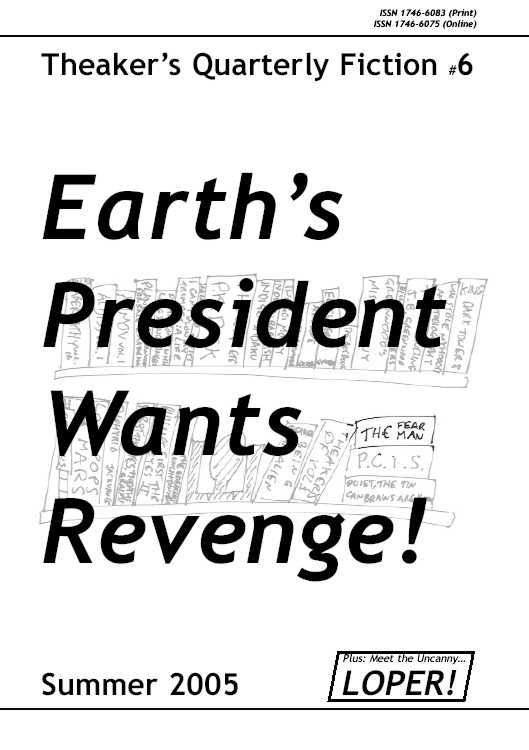
Theaker's Quarterly Fiction #6

pdf |

I am sure most readers will join me in commiserating that this issue is devoted to the feeble-minded fool of a writer who has placed his name in the title of this magazine. More to the point, next issue will follow suit, featuring the second half of his addle-brained semi-fascistic power fantasy, The Fear Man. He has tried and failed to earn himself such an appellation among the staff at the Silver Age offices, resulting only in lowering their opinion of him to such levels that astound even such a confirmed enemy of Theaker as I.

Should I make allowances for him having published my transcript of a motion picture dream in issue four? I think not – look at the way he chose to introduce it! "Stink has not faded", indeed! And here, in The Fear Man, while choosing to quote large passages of one of my unfinished novels, First the Eyes, Then the Brains, he describes me as a hack, and my novel as one that a reader of the future would be ashamed to be seen reading!

Were that not enough to earn the squat-faced ninnyhammer my opprobrium, consider his editorial to the previous issue, where he talks of "the maggot-ridden corpse of verse" in such disparaging terms. I thank the reader who took umbrage at this appalling display of ignorance on the part of Theaker.

This gentleman wrote as follows:

"Dear Sir,

Thank you for informing me of the appearance of the latest issue of Theaker’s Quarterly Fiction. However, I must take issue with the editorial comments contained therein, particularly as regards the negative comments directed at the field of poetry and the practitioners thereof. Only if one is to take, for example, the so-called ‘science-fiction poetry’ of Howard Philips as representative of the form, can the editor's scorn of verse be justified.

I remain,

A Reader."

Perhaps I should have read that letter to the end before committing it to paper! Never mind, this typewriter goes only forward, ever on, and obstacles of that kind will be met with the crushing force of intelligence they deserve. And if my intelligence fails me, I shall find the writer of that letter and confront him, bottle in one hand and an epee in the other, and we shall see whose scorn is justified.

Thank goodness, then, that we can leave that matter to one side for the moment, to look forward to the final piece to appear in this issue. You must wade through page after tedious page of Theaker to get there, but at the end of this issue you will find a wonderful short story by the hand of John Greenwood, "The Loper". Should we call it Lovecraftian? It is in many ways, and the story’s "halls of academia" opening may seem distressingly similar in tone to that of The Fear Man, but persist and you will be rewarded.

And so my stewardship of this column comes to a perhaps temporary end. In three months time, given the chance, I will return, to help build your strength in preparation for another thirty pages of Theaker. If it becomes too much, retreat to last issue, where you were graced by Gilligan’s pure adventure, or the issue before that, where you were able to step into my nightmares.

If I may, I will end with a short poem:

"Ending come / And we are done / Finished in the eyes of June

But stay a while / Remember to smile / And we will meet again soon."

Regards and friendship, always ours to share, Howard Phillips

Saturday, 9 April 2005

Theaker's Quarterly Fiction #5


pdf |

In many ways, I believe this issue of Theaker’s Quarterly Fiction to be our finest yet. Entirely new, it features a single long story from Steven Gilligan, author of Elsewhere (published by Silver Age Books). This story, "Sabaku", is the opening salvo of his novel-in-progress, The Indigo Skies of Home. Having read "Sabaku", I can only hope that said progress becomes more actual than metaphorical, as I’m keen to discover what befalls these fascinating characters in the future.

It seems I need some more to fill out this page, and so I will drift in one of my ever more frequent reveries. The sun shines upon all the readers of Theaker’s Quarterly Fiction, and we have that in common. What else do we have in common? A love of story, an adoration of tall tales, a softness for genre, and a pleasure in poetry. Not, of course, the kind of poetry that rhymes and rambles in equal measure, not the maggot-ridden corpse of verse, but the poetry of prose, the poetry that comes from a simple soul expressing itself through the tropes of spaceships, laser guns, planets, stars and time travel. What other kind of literature can hope to compete? So let’s not stamp upon verse, as might normally be our (entirely natural) inclination, but instead let us all hie from here to try a little Tennyson, borrow some Byron, or sample a little Swinburne. And talking of Swinburne, here is Steven Gilligan’s latest story, which begins upon a ship of that name…

Monday, 7 February 2005

Theaker's Quarterly Fiction #4

 | pdf |

This is the fourth issue of this marvellous magazine, and I have yet to meet a single person who has disliked it. That I have yet to meet a single person who has read it is entirely beside the point – the potential is there!

As mentioned in previous editorials, this is our first non-reprint issue, and so you may be surprised by what is on offer. Did you think our writers had stagnated during the long hibernation of the super S.A.B.? More fool you! They are back and firing on all the cylinders they have! Would that they had more, but beggars cannot be choosers, and since I prefer to remain a chooser I chose the stories within, rather than submitting to the humiliation of begging real writers to submit something worthwhile!

I joke, but it is at my own expense – it costs me nothing save dignity, and that is a reasonable price for the entertainment of my readers – since the second story to feature in this issue is my own tale of the Terrible Trio, a set of youthful adventurers whose exuberance, inventiveness and refusal to give up take them from one exciting incident to the next as if they were careering through a child’s waking dreams. Originally intended as an early instalment in a biography of the great hero Rolnikov, Mad Knight of Uttar Pradesh, these tales overspill with such innocent vim and vigour that the rest of his life may well have to wait its turn. Readers are allowed their own opinions, of course, but remember whose name stands guard at the front of the magazine, all too ready to bar entry to those looking to make trouble for my creations! All are welcome within, but doff your hats and scrape your forelocks on the floor.

Our first story is something of a bizarre experiment by Howard Phillips, a man slowly feeling his way back to the light. It is a transcript of a film he made while sleeping. Some may find its unusual style off-putting, but try to make some allowance for the poor man’s state of mind. Once a promising young poet, he has spent more than one year since in the embrace of old father booze, and the stink has not yet faded. With this publication we hope to give him a little encouragement, and if you do not feel he has earned it, remember the times when good turns were done for you, and take pity on a man who can get so much from so little.

Lots of love,

The Editor!

Monday, 4 October 2004

Theaker's Quarterly Fiction #3

pdf |

This issue, with the second instalment of Quiet, the Tin Can Brains Are Hunting!, brings to an end our three retrospectively-created issues of reprints. I hope you have enjoyed them. From this point on, this publication will provide all-new material (unless the deadline is crashing over my head). We shall see how it goes.

In theory, this is the Autumn issue of TQF, and I am in fact writing this at the end of September, so for once my editorial is contemporaneous with our supposed date of publication. No need to falsely cast a scrying eye into the future – I can just throw it out of the window to see brown leaves, grimy skies and drizzling rain. It doesn’t look kind out there, reader, so stay inside and snuggle up with Theaker’s Quarterly Fiction! This issue, as will many in the future, ends with a traditional slap-up dinner, so you are guaranteed a warm feeling in your tummy when you get to the end. To get the most from this issue, I recommend that you take it to a nice place to eat, perhaps your favourite pub on a Sunday afternoon, and ask your friends to meet you there, perhaps friends that you have not seen for a few months, who have travelled just to see you, and when everyone is sitting comfortably, having filled their bellies to the utmost extent, get to your feet and read a few chapters out loud. I recommend that it be read in a pseudo-declamatory style, with a touch of pomposity and self-importance. If other diners can hear you, take a moment to gauge their mood. If they appear receptive, kind, open-hearted, sweet-natured and intelligent, read a little louder, and when you are done, accept their plaudits and tell them where to purchase a subscription. If, on the contrary, they seem pugnacious, unpleasant and uneducated, walk over to their table and raise your voice even more; it will do them good. – The Editor

Theaker's Quarterly Fiction #2

pdf | 

This issue concludes the story of Professor Challenger in Space, and begins that of Quiet, the Tin Can Brains Are Hunting!

Originally, this second novel was to be a more direct sequel to the first, and it would have featured Malone’s eyes being stolen by aliens. As a novice novelist, this device appealed to me because describing what each of his eyes saw would allow me an excuse for describing galaxy-wide events in the easy-to-write first person. In the event, I did not rely upon this crutch, but I still like the idea that the first part of the novel would have recounted what the left eye saw, the second part would have told what the right eye saw, and the third part would have been seen through a mechanical eye crafted for Malone by Professor Challenger as they battled to rescue Malone’s other eyes and save the universe.

At one point I also considered revealing the Grim Thinker, who will appear in the portion of this story reprinted next issue, to be actually a far-future version of Malone himself – this idea was dropped, as was that in the above paragraph, due to Malone not featuring in the novel.

If he had appeared in it, the following scene would have been used at an early point. It is included here for completeness. – The Editor


A few years following the adventure of Rarraak-Ra, Professor Challenger and I were taking a rest in the park. He was sitting beside me on the park bench, as usual, scratching away at the junction of his head and his body.

“Is it still bothering you,” I asked.

“What do you think?” he asked, as if I were an idiot asking the way to his own nose… “A severed head is never pleasant.”

“I imagine not,” I said, taking him not at all seriously. I was not in the mood for one of his tantrums. The sun was shining far too brightly for that! “Especially when soup pours out of the joint, ha ha!”

He clouted me on the back of the head.

“Ow!” I exclaimed.

“How do you like those apples?” he asked.

“I don’t like them very well at all,” I replied. “Please keep them to yourself in future.”

“Ha ha,” he laughed.

I decided not to pursue the matter. At least he was smiling.

“Do you see much of the Mechanical Housewife these days?” he enquired, after a few moments’ reverie.

The Mechanical Housewife was an extremely delightful creature with whom I had been fortunate enough to forge an acquaintance during our adventure in space. Sadly, the demands of living in different dimensions, and different eras of history, had made it difficult to continue the relationship.

“I’m afraid not, Challenger. How are things going with Anna and yourself?”

“Well, she is pretty busy nowadays,” he replied. “She often has universes to save, that kind of thing… She is always back in time to cook Sunday dinner, mind.”

“Well, of course,” said I. “There are limits, after all…”

“If only there were,” said Challenger. “I used to feel one step ahead of things, you know,” he said ruefully. “I used to be the man in charge, the fellow making all the running. Look at me now, nothing to do but sit wasting the day away with an idiot like you…”

Theaker's Quarterly Fiction #1

| Free pdf |

This first issue of Theaker’s Quarterly Fiction is dedicated to anyone who ever cried because they felt sad.

Being sad is a feeling, and the stories in this magazine will often be about feelings. Feelings. The way people feel, and the way that some people don’t. If you have ever had a feeling you will understand what I am talking about. If you have never had a feeling maybe the stories in this magazine will awaken one in you. That feeling might be disgust, boredom or ennui, but it might just as well be desire, excitement or amity. We shall find out together.

In this first issue of TQF I am pleased to present the first portion of my second-favourite ever novel, Professor Challenger in Space. It is not the first time it has seen publication, having previously seen print as a special folderback edition, then as a paperback, and then as a rocket ebook. But I make no apologies for recycling the same old material – this is after all one of three issues of TQF being produced retrospectively for the year of 2004, in order to bed down the format and give us all a running start at the first issue proper.

I could have course have pretended that these issues had been produced at the appropriate points of the year gone by, and thus given myself the opportunity to be regarded as a great prognosticator in the mould of Arthur C. Clarke. For example, in this spring issue, I could predict that, against all the odds, the European Championships this year will be won by footballing minnows Greece. But I won’t, because the theme of this issue is honesty – honesty and trust – and feelings.

I have another excuse for re-using my crusty old Professor Challenger novel, and that is that it finally went out of print last year, and so is at the moment only available second-hand (there are usually a couple of copies available via Amazon.co.uk).

I will not go into too much detail here about the aims of this magazine – that should really be saved for the first bona fide issue – but this issue might still be the first for someone, and to that person I say, “Hello. This is a slightly silly magazine, full of stories which may not be to your taste, and for that I make no apology. The only true purpose of TQF is to make me smile. If it makes anyone else smile (for whatever reason), that is wonderful. Smiling and happiness are good things, as long as they are not at another’s expense. But I make no allowances for you, either in my writing or in my editing of the stories selected for publication herein.”

One might hope that the person in question has the patience for long expository speeches, but that would of course be to set us on the road of making the allowances proscribed by my own exposition. Perhaps I have been too harsh. – The Editor

This issue is also included in the bound volume of the 2004 issues: Theaker's Quarterly Fiction: Year One (#1-4), available to buy now!

Friday, 10 October 2003

Ring of Red

Ring of RedIn Ring of Red you take control of a group of heavy robot fighting machines - and at this point I have to admit to the possibility of having mixed up some elements of this game with those of Front Mission 3, which I played to death at about the same time.

I think I am right in saying that it is set after a World War Two in which robot fighting machines were developed, resulting in Japan ultimately being divided between the US and the USSR. The game includes very atmospheric faked-up footage of the robot machines marching alongside WWII troops.

Unlike Front Mission 3, Ring of Red does not allow for much customization of your robots - you are restricted to choosing the type of ammunition (standard, incendiary, etc) and assigning support units. However, the small focus of your decisions accentuates the tactical effect of each of them.

Once battle is joined, movement is turn-based, over a traditional map of cells. When enemy fighting machines meet, the action switches to a real time view. Neither side can take action until its attack meter has built to a certain level, which creates a lot of tension. Successfully attack the personnel manning the enemy robot, and their meter will build up more slowly (they take longer to reload).

A key element is ensuring that you meet the enemy on your own terms, to give yourself the initiative, at the range that best suits your weapons.

Your options in combat are quite limited - move the robot forward, back, fire, perform a special move, or do the same with your two support units of foot soldiers. Yet in these small decisions lies the game's core - leave your foot soldiers forward too long, and they'll be exposed to the fire of the enemy machine, keep them back in relative safety, and the enemy support units will be free to attack your machine.

The game's great interest lies in achieving the ideal balance of anti-personnel and anti-machine weaponry and ammunition among your force. One highly satisfying tactic is to develop some units into pure personnel killers, arming your machine with incendiaries and your foot soldiers with rifles, retreating as soon as the robot's support units are destroyed, leaving them wide open for the pounding attack of an anti-machine machine accompanied by bazooka-wielding soldiers.

Overall, this is a very enjoyable game, and in a distinct difference from most strategy games, it is especially suitable for playing in short bursts. A typical face-to-face battle between robots takes just a few minutes, making it easy to dip in for a quick fight. Though some will find the lack of options to be far too limiting, the gameplay to be repetitive, and the game overall to be far too easy, I found it despite those things to be very addictive and satisfying.

Graphics and sound are generally stunning. When hit the robots stagger, and the soldiers squirt blood high into the air. (Given the convincing screams when incendiary weapons are used on personnel, avoid playing this game in the company of the squeamish!)

My main criticism would be a slight disappointment that as the game progressed, no new types of ammunition, soldiers or special moves became available, and that at no point do more than two robots enter battle together.

(Originally published on the Old Age Playstationers website in 2003. I'm very disappointed that there was never a sequel to this excellent game, leaving aside obvious jokes about the Xbox 360…)

Ring of Red, Konami, Japan, PS2.

Saturday, 20 May 2000

Teenager of the Year by Frank Black, reviewed by Stephen Theaker

I don't imagine there'll be many people out there who'll agree with me, but this is one of the finest records it is my privilege to own. Frank's writing songs purely to please himself, putting stuff in them just cause it's cool, and making a beautiful sound. None of the Pixies records can match it for breadth, style or vision. In fact, no other records at all match it for those things. Buy it, listen to it, think it's a bit dodgy in places. Six months later you'll be listening to it again, all the pieces of the weird multi-dimensional jigsaw will fall into place, and you'll be glad you listened to me today. Frank was never quite this good before, and so far he hasn't been quite this good again; credit has to go partly to Eric Drew Feldman, whose eerie keyboards create a perfect atmosphere for every song, giving the vocals, drums and guitars something to play off. Some people say there are too many songs. For me, that just gives Frank time to bring you around to his way of thinking. And every single one of those songs has a dozen new ideas to offer...

Originally posted on Amazon.co.uk.