Friday, 5 May 2023

Carnival Row, Season 2 | review by Rafe McGregor

Triumph of the Franchise.

The COVID-19 pandemic put paid to the traditional twentieth century distinction between the big and the small screen, making the ontological identity of the two types of art and entertainment obvious. Feature films and television series belong to a single mode of representation – representation by displays of moving pictures – and the context of their production and consumption have become increasingly similar in the last twenty-five years. Twenty-first century cinema has adopted the franchise model to minimise risk and maximise profit, films are increasingly watched in the comfort of our own homes, and mainstream films have been produced by streaming services since the pandemic. I take the franchise model to include sequels, prequels, remakes, reboots, and retcons (short for ‘retroactive continuity’), in which case Box Office Mojo’s Worldwide Box Office statistics for the last decade are revealing – if not startling. The highest-grossing standalone films were ranked as follows: sixteenth (Elvis, 2022), sixteenth (Encanto, 2021), fifth (Tenet, 2020), twenty-first (Alita: Battle Angel, 2019), sixth (Bohemian Rhapsody, 2018), eleventh (Coco, 2017), fourth (Zootopia, 2016), seventh (Inside Out, 2015), tenth (Interstellar, 2014), and eighth (Gravity, 2013). If one removes the children’s films, which have always been disproportionately lucrative, this leaves a total of five standalone films in the top 10 from 2013 to 2022: Interstellar, The Martian (tenth in 2015), Bohemian Rhapsody, Tenet, and Uncharted. Franchises have become so big that it’s difficult to keep track of each instalment. The Marvel Cinematic Universe (MCU), for example, includes thirty-one films at the time of writing and there are at least another nine due for release in the next three years.

A franchise is, of course, little more than a licensed series and this movement from standalone to serial film has been complemented by the evolution of television into a serious and mature art form. Twenty-first century television is revelling in a golden age that began at the turn of the century, series are being watched on increasingly bigger screens with increasingly higher resolution graphics, and Hollywood A-listers are almost as likely to appear in a television series as they are in a franchise feature film. This merging of the big and small screens into one another doesn’t even take franchises that include both into account, like the MCU, Star Wars, the DC Extended Universe, Star Trek, and many others. Television shows like The Sopranos (1999–2007), Band of Brothers (2001), 24 (2001–2014), The Wire (2002–2008), and Carnival Row (2019–2023) were unthinkable in the eighties. The monotonous desire of the audience for (much) more of the same is matched by the production of sequels, prequels, and tie-ins and Martin Scorsese published in article in the New York Times in 2019 in which he argued that superhero films are simply not cinema. They are, in other words, a distinct type of art and entertainment, one which is crucially – perhaps even essentially – shaped by the franchise model. Television series in particular (although film franchises as well) are routinely run into the ground, with seasons continuing until the diminishing qualitative returns produce diminishing financial returns. When the last season was so poor in terms of quality that the risk of loss is increased beyond an acceptable level, the series is finally euthanised. There are many exceptions, but the pursuit of profit by means of open-ended series has to at least some extent undermined the golden age of television, which is much the same point that Scorsese is making about feature films.

This is the artistic economy within which the first season of Carnival Row was released in 2019. It was one of the most innovative and compelling television series I’d watched in a long time and I immediately reviewed it for Theaker’s Quarterly, exploring its allegorical depth by focusing on its character as a work of occult detective fiction. As regular readers of the magazine will know, occult detection is one of my favourite genres and the subject of several of my reviews, the most comprehensive of which are of Alan Parker’s 1987 feature film, Angel Heart, and William Hjortsberg’s 2020 novel, Angel’s Inferno. Occult detective stories usually begin in imitation of crime fiction, with a private or police detective investigating a murder or missing person, but are able to deploy plot devices that are unavailable without the intrusion of the supra-human. Where the mundane detective is restricted to investigating someone else, the occult detective can also investigate another occult detective or even him or herself. Carnival Row 1 was an example of the former in pitting two occult detectives – Piety Breakspear (played by Indira Varma) and Inspector Rycroft Philostrate (played by Orlando Bloom) – against each other. Angel Heart was an example of the latter, pitting Harry Angel (played by Mickey Rourke) against himself, concluding with his discovery that he tried to renege on a deal with the devil. I had intended to explore Carnival Row 1’s dual detective structure in more detail, but turned my attention to the ways in which the season’s multiple and intervolved layers of representational and extra-representational meaning shed light on the complexity of urban life instead, publishing an article in an academic journal in 2020 and developing that article into a short monograph called Critical Criminology and Literary Criticism in 2021.

The depth of meaning and value in Carnival Row 1 is quite incredible, which brings high expectations for the second and final series, whose production and release were delayed by COVID-19. As the setting of season 2 is established by the conclusion of season 1, a brief summary of the latter is necessary. Carnival Row 1 is set against the battle for Tirnanoc, the land of the Fae, which is fought between two human powers, the Burgue and the Pact. As the war progresses, the Fae flee to the Burgue for safety and the stream of refugees increases with the Pact’s victory. When the series opens, many of citizens of the Burgue, spanning all social strata, are displeased by the influx of ‘Critch’, a derisive term used to describe all Fae regardless of their species, and pursue some combination of making their lives as miserable as possible, proposing anti-immigration legislation, and using all available means to keep them offshore. The series takes its name from a street in the Burgue that is the centre of what has become a Fae inner city, populated by faeries, fauns, centaurs, trolls, kobolds and other refugees. There are two protagonists: Philo, a mixed-species police detective who conceals his origins in order to avoid falling foul of the Burgue’s speciesist laws; and Vignette Stonemoss (played by Cara Delevingne), a faerie refugee. Philo investigates a series of murders committed by a Darkasher, which was created by Piety – wife to the Chancellor of the Burgue – to discover the identity of her husband’s illegitimate son. Unbeknownst to Philo, he is that son and the competition between the two occult detectives is for Philo to identify Piety as the murderer before she can identify him as the son. Meanwhile, Vignette escapes her indentured labour to find that she has only two options for survival, sex work or crime, and joins the Black Raven, a Fae organised crime group. Philo outwits Piety, but the season ends with a magnificent reversal of fortune in which Piety is revealed to have been manipulated by Sophie Longerbane (played by Caroline Ford), the Leader of the Opposition, for the purpose of appointing Jonah Breakspear (played by Arty Froushan), Piety’s weak-willed and irresponsible son, as Acting Chancellor. Jonah and Sophie join forces in the bedroom and in parliament, passing emergency legislation to intern all the Fae in Carnival Row, which is sealed off from the rest of the city and transformed into a ghetto.

Carnival Row 2 consists of ten episodes, as opposed to the first season’s eight, each of which are between 48 and 60 minutes in length. The season attempts to reproduce the allegorical depth of its prequel, developing themes at both the psychological and political levels and linking them by means of an occult detective plot. ‘Subplot’ is probably a better description because the series of murders fades almost completely into the background for several episodes. Similarly, there is little integration of the personal with the public because the global politics in which the Burgue has become embroiled quickly takes a centre stage that it never relinquishes. While Sophie was setting her ultra-conservative takeover of parliament in motion, the Pact was collapsing in the face of a civil war, following a revolution by a communist movement called the New Dawn. The Pact is, in consequence, unable to complete the colonisation of Tirnanoc or continue the war with the Burgue and seeks to withdraw from the former and enter into an alliance with the latter. The Pact was widely despised for its perpetration of genocide in Tirnanoc, but the New Dawn does not recognise international borders and most of the Burgue’s elite are happy to ally with the Pact if it prevents their own proletariat from revolting. There is a really interesting development in episode 3, ‘The Martyr’s Hand’, which almost made me forgive the CGI-heavy extended action sequences of episode 1 and gave me hope that season 2 might almost achieve the thematic richness of season 1.

At this point, there is a class-based revolution being led by the New Dawn, narrated in the Pact port of Ragusa, from the perspective of Agreus Astrayon (played by David Gyasi) and Imogen Spurnrose (played by Tamzin Merchant), who have fled the Burgue. In Carnival Row, Vignette has renewed her allegiance to the Black Raven, whose popularity is in the ascendence as the only organisation capable of defending the ghetto’s inmates. The Black Raven is debating whether to start a revolution of their own, which will be species- rather than class-based, uniting all Fae against their human oppressors. As I discussed in my academic writing on Carnival Row 1, ‘species’ is symbolic of ‘race’ (or ethnicity) in the series such that the Fae on screen symbolise people of colour off screen. The proposed Fae revolution is thus a revolt for racial justice. The third and final development is in the Burgue’s corridors of power and concerns Sophie. Her ultra-conservative speciesism (racism) always seemed to be a means to an end rather than a heartfelt conviction, an expedient exploitation of interspecies (interracial) hatred for the purpose of securing dynastic rule. It is now revealed that Sophie’s Machiavellian machinations were not in fact selfish, but part of a revolution for women’s rights whose goal is the inauguration of a woman as Chancellor. She is actually pro-Fae and has maintained a close friendship with her faun maid, Jenila (played by Sinead Phelps). Sophie and Jenila are prepared to do anything and everything it takes to put a woman in charge – regardless of whether that woman is human or Fae or rich or poor – and are planning a revolt for gender justice. From this point onwards, there are thus three revolutions either being planned or already in progress, each striving for its own model of social justice and prioritising class, race, and gender respectively. What is so interesting is that the fictional world holds a mirror and a microscope to our own, where well-motivated struggles for social justice often cut across – and sometimes even undermine – one another. Once all three revolutions were in motion, I expected a sophisticated and nuanced comparison and contrast of the merits and flaws of each and was intrigued by which the narrative would ultimately endorse. Alas, the answer is none, as all three are soon represented as misguided at best and morally reprehensible at worst. Given Amazon’s role in shaping the artistic economy and world-system in which we live and its track record with its own employees, I probably shouldn’t have been surprised that its studio warns us against the dangers of meaningful socioeconomic change. But I was – surprised and disappointed.

As already mentioned, the occult detective subplot is eclipsed by the global politics of the season and fails to suture the personal to the public. Aside from the pressure created by the narrative imbalance between politics and psychology, the murder mystery is perfunctory when compared to its counterpart in Carnival Row 1. In episode 5, ‘Reckoning’, the murders are disclosed to have been committed by a sparas, a Fae shapeshifter whose species was decimated during the Pact-Burgue war for Tiranoc. The mystery is then what identity the shapeshifter has assumed and what his motivation for the murders is. Sparas are one of the new species of Fae somewhat gratuitously introduced in the second season, along with minotaurs and (I think) goblins. I suppose the sparas has a purpose in sustaining the mystery, but I couldn’t see the point of minotaurs and goblins suddenly appearing on Carnival Row when they had never been there before. Also, they seem to have appeared at the expense of the disappearance of other species – gone, for example, are the centaurs (unless I missed them, which seems unlikely given their size). The reshuffling of the Fae is nearly as random as the sparas’ choice of victims and there is a sense of arbitrariness that detracts from any mounting tension as to whodunit – or whydunit. Unlike its predecessor, this occult detective story fails to stage any conflict between the anthropocentric and the supra-human and keeps any commentary on ecocide as a mass harm firmly at what film critic Mark Bould calls the Anthropocene Unconscious in his 2021 monograph of the same name. The best thing I can say about Carnival Row 2 is that for all my criticism, it does at least bring the series to a conclusion. If nothing else, this bucks the increasingly-common pattern with which I began this review, the never-ending-franchise or the franchise-ever-at-the-point-of-euthanasia. All of which to say, I’m not sure whether Carnival Row 2 is a missed opportunity or just completely gratuitous.**

Sunday, 30 April 2023

Blood Relations by Kristopher Triana (Grindhouse Press) | Review by Douglas J. Ogurek

Short story collection shifts impressively from gore and smut to grief and nostalgia.

The first Kristopher Triana story I read involved a home invasion. The violence was so over the top that I still remember where I was when I read it. I presumed that Triana was an extreme horror one-trick pony… a blood and guts conjurer whose sole aim was to make the reader cringe at the brutality of his characters’ actions. Blood Relations, Triana’s family-themed (but not family-friendly) collection of short horror stories, proved me wrong. 

Yes, there are the gruesome, flesh-mangling, bone-crunching, and sexually depraved entries. “Womb”, for instance, involves an incestuous brother and sister using the bodies of murder victims to recreate the place they felt safest. In “Jailbait Frankenstein”, a Lolita tale-turned-horror story, a man in his forties who rationalises his attraction to underage girls learns a painful lesson. He grows smitten with a teenage girl who’s a “butterface”, meaning beautiful in every way but her face. Her repulsive facial appearance becomes an embodiment of his shameful attraction. 

The collection, however, also features less graphic though equally entertaining stories, such as the Steven Kingesque “We All Scream”, which comments on children’s need for immediate gratification. This one puts a new spin on the dangerous ice cream truck trope by offering a much subtler and creepier scenario. Children who hear the ice cream truck playing “Turkey in the Straw” know it’s time to return home immediately. Things get out of hand when little Tommy decides to flout that warning and approach the truck. 

Some stories involve characters unearthing shocking secrets about their relatives. In “My Name Is Chad”, for instance, a young man mourning the death of his mother finds disturbing video footage that reveals something about him and his deceased sister. “Kin” is a country bumpkin piece in which a West Virginia family makes an awful discovery about a young man in the family. 

“The Solution”, about a lusty mother and apathetic daughter who use sexuality to extract something from teenage boys, offers such an exaggerated take on the mother’s libido that it is at times laugh-out-loud funny. Look for the hilariously overindulgent similes and metaphors in which Triana compares the sounds the mother makes in the throes of ecstasy to those of animals. 

The details that Triana offers in “The Solution” speak to his skill as a writer – the smells of tobacco and microwave pizza within the mother’s home, for example, or her “layer of trashy desperation” that resembles bacon grease. 

Another curious element within the story is the boy the teenage protagonist sees glued to the TV each time he enters the mother’s home. The boy watches horrific programs like The Texas Chain Saw Massacre or autopsies in which a mortician scoops brains from a corpse. Though he plays no major role, the boy helps set the mood for the oddities the protagonist encounters. 

Did you think those boys in Lord of the Flies had a tough time? Maybe you thought the kids in The Hunger Games were violent? Read “Dog Years”, a story both bloody and nostalgic, and you’ll reconsider both. All the adults are gone, and now gangs of children roam the streets. They are afflicted by a disease that makes their lifespans comparable to those of dogs. Kids in their late teens are in the throes of dementia. Sixteen-year-old narrator Skye reflects on her survivalist father whose advice on female empowerment proves valuable. During one of the more poignant scenes, the children, forced to exist in a world where social media is absent, reflect on the things they miss. Chapstick, for instance. 

When one character in Blood Relations enters a basement to discover a relative doing something sickening to another human being, her response is, “Hey.” The reader will find several such instances of indifference to human suffering within this collection, but the reader will also experience a wide range of the emotions that make us human.—Douglas J. Ogurek *****


Monday, 24 April 2023

Evil Dead Rise | review by Stephen Theaker

Evil Dead Rise is the fifth of the Evil Dead films, following Sam Raimi's brilliant original trilogy and a so-so remake directed by Fede Alvarez. Neither a reboot nor really a sequel, this is a new story set in a universe where reading from the wrong book can open the way for capricious, malevolent entities to enter our world and take over our bodies.

In this film, an earthquake breaks open a secret vault hidden beneath an apartment block. The block is due to be demolished soon, but not everyone has found a new place to live, and the boy from one flat emerges from the vault with a book bound in human skin and vinyl recordings made by those who hid it there. He starts to play the records, with horrific consequences.

The boy's mother (Alyssa Sutherland) is possessed by the evil dead (or is she, having died, now the evil dead herself? I've never been quite sure), and mayhem ensues. The three kids turn to their aunt (Lily Sullivan) for help. Bodies are mangled, blood is spilled, neighbours pop around, and there comes a time when nothing but a shotgun and a chainsaw will do.

Before I go on to explain why the film was for me mildly disappointing, it's only fair to mention that I saw it on a Cineworld screen that was not particularly bright. I saw two other films the same day, and so I saw how much more effective the trailer of The Boogeyman was on a better-lit screen. That said…

The biggest problem for this film is that it doesn't follow Evil Dead, the tepid 2013 remake, it follows Ash vs Evil Dead, which took the insanity of Evil Dead 2 and Army of Darkness and turned it up to 11. That show took things to such bizarre extremes that Mrs Theaker told me off for waking up the children with my unconscious expostulations.

This film does not do that. Compared to some horror films, it's not understated: horrific things happen to the kind of people who do not usually get seriously hurt in horror films, for example, and everyone still gets soaked in blood. It's an 18-rated film. But it never hits the heights of delirium that is this franchise's raison d'ĂȘtre.

And it's not funny. Nor was the original film, but it is part of what makes the sequels so special. There are a couple of amusing moments – the very first shot is a gag – but I didn't hear anyone in the cinema laugh.

Was it the evil dead that made the films so beloved? Or was it Bruce Campbell's reactions to them? I think perhaps the actions of the evil dead are so random, their powers so unlimited, that they don't lend themselves particularly well to a traditional horror film structure. They could win at any moment if they chose to – the only reason they don't is that they're having too much fun torturing everyone.

It's definitely not a bad film, though. It is quite literally hair-raising at times, and there are some very striking images. The moment when the title appears on screen is superb – and perhaps raised my expectations for the film too much.

On television, with every gruesome detail visible to the eye, perhaps it would make it to a fourth star. ***

Friday, 21 April 2023

Theaker's Quarterly Fiction #73 is now out in paperback and ebook!


free epub | free pdf | print UK | print USA | Kindle UK | Kindle US

Welcome to Theaker's Quarterly Fiction #73, edited by Stephen Theaker and John Greenwood!

This issue contains an eighty-page novella – "The Frog and the Scorpion" by Patrick Whittaker – and four short stories: "An Absence of Ghosts" by Andrew Hook, "The Arrival of an Acquaintance" by Charles Wilkinson, "The Scorpion" by Harris Coverley and "BNR" by Ross Gresham.

It also contains reviews by Douglas J. Ogurek and Stephen Theaker of A Cosmology of Monsters by Shaun Hamill, Dirty Rotten Hippies and Other Stories by Bryan Smith, Vampire Hunter D by Hideyuki Kikuchi, Bad Candy, Black Adam, Blood Red Sky and She-Hulk: Attorney at Law, Season 1.

The cover art is the third of our covers by Steve Upham.

Friday, 14 April 2023

The Black Phone | review by Douglas J. Ogurek

Child abduction story dials in supernatural element but avoids calling up fashionably exuberant characters.

The individual whose name graces this ezine liked the horror film The Black Phone so much that he saw it in the theatre twice and almost went back a third time. Hold on – was this film, directed by Scott Derrickson and based on a Joe Hill short story of the same name, that good? Let’s find out.

The year is 1978. A boy named Finney (Mason Thames) and his much rowdier and crasser younger sister Gwen (Madeleine McGraw) – she’s the one who isn’t afraid to clobber a bully – are being raised by alcoholic and physically abusive father Terrence (Jeremy Davies). Their mother, who had a gift of seeing things in her dreams that Gwen seems to have retained, is gone, and a kidnapper nicknamed the Grabber (Ethan Hawke) is abducting boys in the family’s Denver suburb. Naturally, the Grabber grabs Finney.

Here’s where the story diverges from the typical: while he’s confined in the Grabber’s basement, Finney gets a series of calls on a disconnected black phone mounted on the wall. The callers, who are the villain’s previous victims, offer pointers about how Finney can survive. Meanwhile, Gwen has dreams that may or may not lead the authorities to the Grabber. 

Recent horror productions such as Stranger Things and the remake of It feature child protagonists who are outspoken, brash, funny and in some cases, supremely confident. However, Finney, the boy protagonist of The Black Phone, is much more serious and reserved. He comes across as a thoughtful boy known by his friends for his ability to take a beating and keep getting up. His weakness: he doesn’t fight back. That’s going to be put to the test, of course. 

The film’s biggest strength is Hawke’s portrayal of the menacing villain. The devil-like mask he always wears – sometimes the whole face, other times just the top or the bottom – underscores his unpredictability and his lack of a backstory. Particularly unsettling are the games the Grabber plays with his victim. When he exits the basement, for instance, he deliberately leaves open the door to the stairs and, by implication, to freedom. But it’s not so easy. Furthermore, Hawke’s tone shifts from silly commentary to vivid descriptions of how he’ll punish Finney for being disobedient.  

My biggest gripe with The Black Phone involves the presentation of the ghosts, shown with all their Grabber-inflicted bruises and scars. Their lips move in tandem with their phone voices as they communicate with Finney. Thus, the viewer sees Finney’s predecessors, but he does not. The viewer would have been much more aligned with the protagonist (and the film would have been more frightening) had the filmmakers elected to only focus on the voices and leave out the visuals that add a jarring campiness to an otherwise serious film. Another shortcoming of the ghosts is inconsistency – either give Finney cryptic or straightforward clues, but don’t do both. The film also misses an opportunity to capitalize on parallels between Finney’s father and the Grabber. 

Another observation: much of the film, especially the beginning, feels as if it is moving in slow motion… even a fight between two boys. And except for Gwen, none of the kids shows much enthusiasm. This strangeness, however, oddly adds to the film’s aura by giving it a more authentic vibe. Moreover, its gritty feel underscores its moment in time and creates a sense of creepiness. The film also introduces comic relief in a cocaine-fuelled theorist who thinks he can help the police pinpoint the location of the Grabber. 

This all brings us back to our initial question: is The Black Phone worthy of two trips to the theatre? I’m not sure – I’ll have to watch it again.—Douglas J. Ogurek ****

Monday, 3 April 2023

Children of Men | review by Rafe McGregor

Climate change allegory.

Children of Men is Alfonso CuarĂłn’s adaptation of P.D. James’s dystopian novel, The Children of Men. CuarĂłn was initially uninterested in the project, which he described as “a science-fiction thing about upper classes in a fascist country”, and his adaptation replaces James’s Christian themes with a rich and rewarding exploration of the compatibility of the free market and authoritarian nationalism. The novel was published in 1992 and set in 2021, the film released in 2006 and set in 2027, and both narratives take place in England during an extended global pandemic of human infertility. The film was a critical success and commercial failure (the latter relatively minor, recouping 93% of its budget at the box office). Its critical and cult following rose steadily over the next decade and a half, reaching a wider audience with the coincidence of the novel’s setting and the COVID-19 pandemic. The late music critic Mark Fisher opened his 2009 bestseller, Capitalist Realism: Is There No Alternative, with a discussion of the film’s representation of a dystopia unique to late capitalism, in which “internment camps and franchise coffee bars co-exist” without contradiction. As we approach 2027, the UK is increasingly resembling CuarĂłn’s depiction, led by a self-selected elite that seems to delight in cruel and unusual punishments of the poor and displaced as much as it delights in exploiting its public service for financial reward. Praiseworthy though this prescience is, the film’s contemporary value lies elsewhere.

As Fisher notes, Children of Men is not simply what Amitav Ghosh would later call disaster fiction set in the future in The Great Derangement: Climate Change and the Unthinkable. The film is neither about adapting to post-apocalyptic conditions nor about anticipating the apocalypse to come. The apocalypse is, rather, already in progress, ‘being lived through’. Creating a compelling and convincing narrative that is neither pre- nor post-apocalyptic is notoriously difficult, challenging enough in a novel or television series but even less likely to be achieved in a two-hour feature film (Children of Men is only 100 minutes from opening to closing credits). Octavia Butler is one of the few narrative artists to succeed, with her peerless 1993 novel, Parable of the Sower. For all Butler’s literal genius (she was awarded a MacArthur Fellowship in 1995), she was unable to continue as successfully in the sequel, Parable of the Talents, and unable to complete the trilogy with Parable of the Trickster, which was unfinished at the time of her death in 2006. Parable of the Talents relies on a conspicuously artificial compression of several decades for credible closure and Butler’s multiple attempts at writing Parable of the Trickster never reached more than fifty pages. CuarĂłn’s success is akin to Parable of the Sower and his mastery of the multiple temporalities of cinema is exemplary, perhaps even unique.

The fertility crisis in the film is approaching its second decade and the global response has been economic and political collapse, which have only been averted in the UK by the election of an authoritarian government and the establishment of a police state. Refugees are detained on site in streetside cages and transported to sprawling concentration camps like Bexhill-on-Sea, where they are largely left to their own devices. The police have been militarised, a new paramilitary force created, and the Armed Forces placed on internal security duties, providing three overlapping levels of counter-terror and social control. The narrative initially seems to deploy the mythic mode of storytelling characteristic of Hollywood, proceeding from an inciting incident through an initial objective, watershed, and nadir to an unpredictable but inevitable zenith. In retrospect, CuarĂłn both deploys and subverts the archetype of the hero’s journey, exploiting it to prioritise a specific engagement with the apocalypse that I cannot reveal without spoiling the film’s final few minutes. That hero is Theo (played by Clive Owen), a former activist who is called to action when his estranged wife, Julian (played by Julianne Moore), recruits him to the Fishes, a resistance movement led by Luke (played by Chiwetel Ejiofor). Theo’s mission is to escort a young refugee, Kee (played by Clare-Hope Ashitey), to the south coast, where she will be picked up by a mysterious international organisation known only as the Human Project. Theo has become a cynical alcoholic since his split from Julian, but remains useful to the Fishes because his family connections are sufficient to secure transit papers for himself and Kee. Theo acquires the papers, meets Kee, and then discovers that she is pregnant, about to give birth to the first human baby in eighteen years. The watershed is his decision to complete the mission, in spite of the exponentially increased risk, Julian’s death, and betrayal by Luke.

Children of Men’s style is as nuanced as its form and its cinematography and mise-en-scĂšne are routinely praised by critics and theorists. With respect to the former, philosopher Slavoj ZiĆŸek has analysed the film’s apparently inexhaustible visual density, the totality of a world represented with meticulous attention to detail in every aspect, which is both a reflection and critique of the post-9/11 culture of control. With the respect to the former, the narrative is threaded between two magnificent long takes, one of 247 seconds and the other of 379 seconds. The first, which takes place approximately a quarter of the way through, depicts a car chase in which Luke tries to save Theo and Julian from homicidal bikers. The second, which takes place approximately three-quarters of the way through, depicts Theo’s attempt to rescue Kee when Bexhill-on-Sea erupts into a tripartite battle among Islamist revolutionaries, a Romani militia, and the British Army. Together, the two takes constitute a seamless combination of film style and film form, which are deliberately and brilliantly understated to produce a very familiar – and very British – dystopia. The understatement also facilitates the integration of the mythic with the everyday (to which I shall return below): Children of Men is about both ordinary people and the end of the world.

CuarĂłn’s reproduction of the lived experience of an apocalypse-in-progress is the film’s greatest achievement. But if it is to be anything other than a purely aesthetic accomplishment, then it must matter in some way and Children of Men’s extra-aesthetic values are not immediately obvious. In A Critique of Postcolonial Reason: Towards a History of the Vanishing Present, which was published in 1999, literary critic Gayatri Chakravorty Spivak argues for the ethical and political value of what she refers to as the literary imagination. She focuses on language, reading and literature, but her thesis can be extrapolated from the literary mode of representation to hybrid modes of representation that combine the linguistic with the pictorial, such as cinema. The literary imagination frees the reader from the constraints of truth without severing the text from the world, which is why one is moved by a literary text without believing in it. As such, the literary imagination is a paradigm for value without a commitment to truth and trains one to reconsider, reappraise, and reconceptualise social reality as socially constructed rather than naturally extant. Drawing on a tradition that began in the Romantic era, Spivak calls this training aesthetic education, demonstrates how it transforms the individual by indirect, implicit and figurative means, and concludes that it is “an excellent instrument for a slow transformation of the mind”. The transformation is achieved by a detranscendentalisation of elitism, sexism, homophobia, xenophobia, and other forms of oppression that exposes them as political and plastic and thus susceptible to being dismantled as part of the reconstruction of a more just and sustainable social reality.

The experience of watching Children of Men is the experience of living through the late capitalist apocalypse with Theo, Julian and Kee and recognising that the sequence of events narrated are both fictional and relevant to our own lives. Returning to Fisher (not to be confused with the fictional Fishes), the particular and peculiar relation between the reality of the film and the reality of the world in which we watch the film is the shared experience of what sociologist Jason Moore refers to as the Capitalocene in Capitalism in the Web of Life: Ecology and the Accumulation of Capital. The Capitalocene is the geological epoch during which capitalism has had a significant impact on the Earth’s ecosystems and climate. Capitalist world-ecology began in 1450, drove climate change for over five centuries, and is currently self-destructing in consequence of the copious amounts of waste it generates. Children of Men detranscendentalises the Capitalocene in the way Fisher suggests, by dramatising, exaggerating and anticipating the epoch’s final decades. The relevance of the film’s reality to our own is all too easy to identify – it is what lies ahead in a few decades or in a few years, during another global pandemic, one far more destructive than COVID-19. Sadly, this world is much easier to identify in 2023 than it was in 2006, which was after 9/11 but before the Great Recession. The crucial point, however, is that we are already living in and through this more destructive pandemic and the relations among our reality, the film’s reality, and the Capitalocene are articulated by the figurative element in Spivak’s aesthetic education.

The setting of Children of Men is an extended fertility crisis at the literal level of narrative meaning and a foreclosure of human futures that represents climate change at the symbolic level of narrative meaning. The fictional fertility crisis is the real climate crisis: both will destroy the human species if they are not averted or ameliorated; both occur across rather than within generations; and both create contemporaneous economic, social, and political crises. They are also both turning points in the web of life, the response of an overpopulated and exhausted planet to the numbers of people it is required to sustain and – much more importantly – the concurrent and exponential increase in resource consumption. In the fiction, this response is human infertility, which will reduce consumption by reducing the population. In reality, this response is climate change, which Moore describes as capital being forced to internalise the cost of its own waste, which is in turn the beginning of the end of the Capitalocene. The significance of this symbolism to the narrative’s thematic content means that Children of Men is best understood as an allegory. Traditionally, allegories took religion as their subject, integrating the real, material, and everyday with the figural, spiritual, and divine, which recalls the centrality of Christianity to James’s original novel and the way in which CuarĂłn combines formal and stylistic devices to portray the everyday experience of the apocalypse-in-progress. Allegories do not impose a single or even twofold meaning on a narrative, but function so as to reveal a structure of multiple and intersecting representational and extra-representational levels of meaning. They are, in consequence, ideal vehicles for the detranscendentalisation of the complexities of the late Capitalocene, in which multiple crises combine to exacerbate multiple inequalities and multiple injustices. All of which is to say, I cannot recommend this film enough. If nothing else, it helps us make sense of the complicated, confusing, and contradictory world in which we find ourselves in the first quarter of the twenty-first century. As such, Children of Men exemplifies the great writer Samuel Johnson’s criterion for poetry, that its purpose is ‘to instruct by pleasing’: CuarĂłn has provided us with one of the most pleasurable lessons we are ever likely to receive on one of the most unpleasant subjects possible. *****

Sunday, 26 March 2023

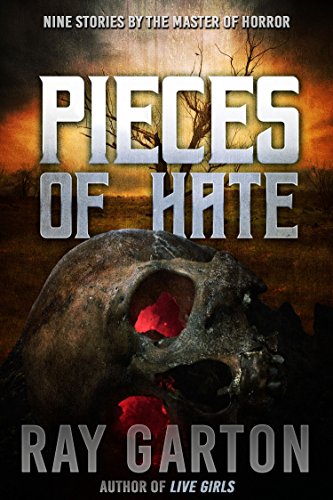
Pieces of Hate by Ray Garton (Crossroad Press) | Review by Douglas J. Ogurek

Horror collection shows gorging on hatred has stomach- and mind-churning consequences 

Most of the stories within this horror collection feature characters who hate something: cats, homosexuals, bullies, heavy metal, themselves. There’s even a guy who’s not sure why he’s so full of hatred. And most of the time, the hatred does not pay off. 

Garton has a talent for transforming a seemingly inane situation – a talk show interview or hospital room interaction, for instance – into an attack of ancient Roman barbarity. Some stories have all the subtlety of a hook through the cheek, while others go out on (or detach) a limb to show the repercussions of abuse, moral rigidity, and herd mentality. 

In “Bait”, one of my favourite splatterpunk (and extremely controversial) stories, a nine-year-old boy and his younger sister living in a seaside town discover what’s been happening to the missing children seen on milk cartons (yes, that used to be a thing). The short but terrifying read shows mankind’s potential for cruelty. It also slips in an ecological message, as well as a warning about taking the focus off our children.

The heavy metal musician protagonist of “The Devil’s Music” dies and meets Satan but refuses to believe it’s him. The story, reversing the common belief that the devil likes heavy metal, takes a shot at censorship and politicians who take a moral high ground. 

“A Gift From Above” starts like a Hallmark Channel film and warps into a bloodbath worthy of early Stephen King. Margaret, once spurned by her classmates and living in her sister Lynda’s shadow, has reinvented herself as an attractive and successful advertising agent. Then she receives a supernatural gift of healing but is warned it could “sour” her. The story offers a supernatural take on the ramifications of holding on to grudges. 

In “Cat Hater”, a feline version of Alfred Hitchcock’s The Birds, Clive Allen Trumbles (note the initials) has always hated cats. He thinks them conniving, snobby, and even intent on taking women’s attention away from him. When he accidentally kills one, he starts to believe the cats in his neighbourhood are conspiring against him. 

“Ophilia Raphaeldo” – the name is a clever mixture of once-popular talk show hosts – takes a jab at exploitative talk shows. Four women watch a show hosted by the titular character. An interview with a novelist devolves into an indictment against him for not calling a woman back after a first date and an attack on his chauvinistic writing. Though the author’s explanations seem perfectly rational, Raphaeldo fans the flames growing within her female audience. The story comments on how groupthink can cause one to abandon one’s beliefs and even rationality. 

The lead character in “Choices” embraces capital punishment, rails against abortion, and shames those who think differently from him. A severe electrical storm projects him into a bleak future, where he discovers his way of thinking may have consequences. 

In “Pieces,” Garton substitutes the typical psychological impact of sexual abuse with a physical one. The resulting short tale achieves a surprisingly moving outcome. 

“God’s Work” is a story that every Christian (or anyone who aspires to be a good person) should read at least once a year. Paster Gill Freeman – that surname is no coincidence – is new to his congregation, whose members like to cast judgment on others who clash with their ideals. The story, flipping between Freeman’s sermon about acceptance and the congregation’s protest of a horror author doing a signing at a bookstore, offers a rare Christian argument for free speech. 

Though neither victim nor perpetrator is likely to escape unfazed in Garton’s tales, the reader will likely emerge with more to chew on than flesh – that’s something that doesn’t always happen in horror.—Douglas J. Ogurek*****


Saturday, 11 March 2023

The World-Ecology of Climate Change Cinema – Rafe McGregor

Climate Fiction

‘Cli-fi’ is an abbreviation of ‘climate fiction’, which was popularised in the last decade and refers to a category of genre or literary fiction that takes global warming or climate change as its subject. The prototype is probably Jules Verne’s Sans dessus dessous (1889, translated as The Purchase of the North Pole), an uncannily prescient novel involving a conspiracy to change the Earth’s climate to make more fossil fuel available to a corporation. Cli-fi includes novels, novellas and short stories featuring natural as well as anthropogenic climate change and J.G. Ballard’s early contribution, a quartet in which human civilisation was destroyed by all four of the classic elements, deployed both causes: The Wind from Nowhere (1961, air), The Drowned World (1962, water), The Burning World (1964, fire, later published as The Drought), and The Crystal World (1966, earth). Richard Fleischer’s Soylent Green (1973) is an early example of cinematic cli-fi and although it was a commercial and critical failure at the time of its release, it was regarded with greater respect in the year in which it is set – 2022 – in consequence of its critique of the capitalist mode of production. Ballard’s quartet provides a convenient heuristic for selecting a characteristic sample of the cinematic genre as it emerged at the end of the 20th century: Kevin Reynolds’ Waterworld (1995, water), Roland Emmerich’s The Day After Tomorrow (2004, air), George Miller’s Mad Max: Fury Road (2015, fire), and Adam McKay’s Don’t Look Up (2021, earth). Climate change is anthropogenic in all four cases, although the cause is implied in Waterworld and complicated in Don’t Look Up.

Cinematic World-Ecologies

Sociologist Jason Moore opens his magnum opus, Capitalism in the Web of Life: Ecology and the Accumulation of Capital (2015), by defining capitalism as a way of organising nature rather than an economic or social system. He warns against the separation of capitalism or modernity from nature or ecology because the two have been inextricably linked in a relation of life-making since the long sixteenth century. As such, Moore adopts a world-system approach he refers to as capitalist world-ecology. Capitalist world-ecology is not an interaction of world-economy and world-ecology: world-economies just are world-ecologies. He regards human exceptionalism, the view that human beings are independent of the spatiotemporal web of interspecies dependencies, as deeply misguided because human agency has always been a part of nature and his inquiry begins with the co-production of human and nonhuman animal life and the environments that maintain them. Capitalist world-ecology has been converting energy into capital in increasingly innovative and expansive ways since the coincidence of the Dutch agricultural revolution, Central European mining revolution, and Madeiran sugar-slave nexus in 1450. This year marks the beginning of the ‘Capitalocene’ (Age of Capital), in contrast with and in opposition to the ‘Anthropocene’ (Age of Man). The Anthropocene is used to describe the geological epoch during which humanity has had a significant impact on the Earth’s ecosystems and climate and is usually dated to either the Industrial Revolution (1760-1840) or the First Agricultural Revolution (10000 BCE). In Moore’s assessment, the current epoch is characterised by the impact of capitalist civilisation, which was inaugurated between the two revolutions, rather than by the impact of humanity as a species.

My elemental quartet of climate change cinema are the product of either the Hollywood film industry or Netflix’s streaming service and, as such, inextricably bound up with capitalist world-ecology, both constituting and mediating a market reliant on cheap labour and free nature to hundreds of millions of consumers across the globe. In each of the films, the narrative moves from an unstable inaugural condition to a retrospectively inevitable condition and the transition from inaugural to closural order both represents and evaluates an imagined world-ecology. The quartet and its genre can be subdivided on the basis of whether climate catastrophe is part of the story’s setting (Waterworld and Fury Road), exploring themes of adaptation and recovery, or a diegetic event (The Day After Tomorrow and Don’t Look Up), exploring themes of anticipation and mitigation.

Narrating Climate Change

Both Waterworld and Fury Road establish their respective postapocalyptic settings very quickly and very concisely, the former as a world with nothing but water and the latter as a world where everyday life has become a hunt for water. At exactly a minute into the opening sequence of Waterworld, the Universal Pictures logo disappears and the camera moves to a position above the north pole of the rotating Earth. As it zooms in, the ice cap melts, the sea levels rise, and a brief voiceover explains what the audience is seeing. The whole exposition takes less than forty seconds. The voiceover in Fury Road begins at eighteen seconds into the opening sequence, with Max (played by Tom Hardy) introducing himself and providing all the audience need to know about his world as consisting entirely of ‘fire and blood’. His voiceover, which is interrupted by the contributions of anonymous others, continues for another forty seconds, during which a great deal is explained quickly: the apocalypse was anthropic in cause, the Earth can no longer sustain human life, and the global ecological collapse is mirrored on the personal level by Max’s psychological breakdown.

In contrast, The Day After Tomorrow and Don’t Look Up open in a world that seems almost identical to our own. This signals that the catastrophic event has not yet happened and that either it or its threat will be one of the sequence of events that constitute the plot of the narratives. Both films begin with scientific teams, one on the Larsen B Ice Shelf in Antarctica and the other at an observatory at Michigan State University. In The Day After Tomorrow, the ice shelf cracks and breaks away, the significance of which is explained in the following scene when protagonist Professor Jack Hall (played by Dennis Quaid) tells the United Nations Conference on Global Warming in New Delhi that another Ice Age may be imminent. In Don’t Look Up, postgraduate student Kate Dibiasky (played by Jennifer Lawrence) discovers a new comet and she and her supervisor, Professor Randall Mindy (played by Leonardo DiCaprio), determine that it will strike the Earth in six months. This immediately sets the plot in motion as the two scientists try to communicate their discovery to those in a position to take action.

The plot of each of the four films moves through the unstable inaugural condition to a closural order that is unforeseeable but retrospectively inevitable. Each closural order represents a world-ecology that is politically, morally and aesthetically ‘right’ because it is consequent on the responses of the protagonists, antagonists and other characters to the inaugural condition. Don’t Look Up closes with the destruction of the Earth by the comet, which is an inevitable consequence of the power elite’s decision to abort a perfectly feasible plan to destroy the comet in favour of an incredibly high-risk plan to exploit its mineral resources for profit. Fury Road closes with the literal ascension of Imperator Furiosa (played by Charlize Theron) to power, following the overthrow of a male supremacist hierarchy by a revolution with a firm basis in economics – the communal distribution of the Citadel’s currency, water. The Day After Tomorrow closes with an inversion of power relations that reverses the polarity between the Global North and Global South, establishing a more just (but not obviously more sustainable) world-ecology. Waterworld closes with the Mariner (played by Kevin Costner) delivering a small group of people to Dryland, a Garden of Eden in which humanity can flourish and create a new world-ecology.

The world-ecology represented in the closural order is either represented as desirable (Waterworld, The Day After Tomorrow, and Fury Road) or undesirable (Don’t Look Up) and the audience’s desire is enlisted by a complex and manifold combination of narrative form, cinematic style, and thematic content. The desire that drives Waterworld is stimulated relatively late in the narrative as it is only after Helen (played by Jeanne Tripplehorn) makes a deal with the Mariner that the audience’s ambition becomes focused on the three of them reaching Dryland. The quest for Dryland is both reflected and complicated in Fury Road, where it takes a circular shape. The audience’s desire is for Max to assist Furiosa to achieve her goals, which change from taking the Five Wives to the Green Place to turning the tables on their pursuers, attacking the Citadel, and transforming its sexist and elitist political economy. The desire that drives The Day After Tomorrow is also stimulated relatively late, at the halfway point when Hall sets off to New York to rescue his son from the climate catastrophe in progress. From the very beginning of Don’t Look Up, the audience desire that the imminent catastrophe Dibiasky and Mindy have discovered be averted, which requires first that the scientists communicate their discovery to the authorities, then that the authorities believe the prediction they have made, and finally that the authorities take preventative action.

Shaping Desire

As already mentioned, Hollywood and Netflix are part of capitalist world-ecology, exploiting both labour and nature to make massive profits with their films, in spite of paying grotesque salaries to selected stars. All four of my quartet sustain this world-ecology by means of their contribution to the global world-system and promote that global world-system by providing audiences of millions of people with distraction, diversion, and dissipation. What I mean is that time spent watching the films is time spent not doing anything about climate catastrophe and perhaps – given how enjoyable they are all – taking a perverse pleasure in the greatest (more accurately, ultimate) mass harm humanity has ever inflicted on itself. The quartet can, once again, be subdivided, into those that are complicit in capitalist world-ecology (Waterworld and The Day After Tomorrow) and those that are both complicit in and resistant to capitalist world-ecology (Fury Road and Don’t Look Up).

Waterworld’s driving desire is simply for the status quo, finding that last remaining piece of Earth – Dryland – that has not yet been exploited to ruin and can sustain what is left of humanity (before we inevitably destroy it too). The Day After Tomorrow subsumes the desire for a world-ecology that is not devastated by climate catastrophe into a personal quest – Hall’s rescue of his son (and his son’s rescue of his love interest) – prioritising the individual and the family above the collective and failing to integrate the private with the public. The same two criticisms can be made of Ballard’s original quartet, with The Wind from Nowhere aspiring to the status quo and The Drowned World, The Burning World, and The Crystal World subsuming the political under the psychological. Fury Road is more successful, establishing a convincing link between more equitable modes of production and more just social structures and Max’s intervention succeeds where the Mariner’s fails – in transforming the existing world-ecology into something better. Don’t Look Up is even more successful, achieving its impact in a different way, with a downbeat rather than uplifting ending. While the Earth is destroyed, it is destroyed by human greed rather than the deus ex machina of the comet.

Changing world-ecology requires a reconstruction of the global economy and indeed Moore predicts that capitalist world-ecology is reaching its own closural order, although he is not optimistic about what the replacement will be. A reconstruction of the global economy will not, however, be achieved by top-down measures alone – if it all. One only needs to recall the very recent memory of resistance to relatively minor impositions like social distancing, mask-wearing and lockdowns to see how reluctant human beings are to give up any freedoms whatsoever, even when there is overwhelming scientific evidence in its favour. If world-ecology is to be changed completely, it must be from the bottom-up, which will require a reconfiguration of human consciousness to desire different things, such as sustainability over consumption. Culture shapes desire and cinematic narratives are a sizeable and significant part of our culture. Climate change cinema thus has an important role to play and films like Don’t Look Up and Fury Road have demonstrated the shape that role might take.—Rafe McGregor


Published online ahead of its appearance in Theaker's Quarterly Fiction #75, due in June 2023.

Thursday, 9 March 2023

Survivor Song by Paul Tremblay (William Morrow) | Review by Douglas J. Ogurek

Plague novel explores the power of friendship amid the delicate dance between life and death

A rabies-like outbreak has invaded the world of Natalie Larsen and Dr. Ramola “Rams” Sherman. After a deranged man bites Natalie, who is eight months pregnant, the longtime friends go on a short but harrowing journey to find her the appropriate care. 

Author Paul Tremblay tones down the ambiguity for which he is known, opting instead to keep the reader wondering whether Natalie received her vaccination in time to prevent major complications. Are her symptoms merely attributable to late pregnancy? Or will she succumb to the infection that has reduced so many to slavering, enraged wanderers?

Natalie comes across as self-centred and irritating. Rarely does she reflect on the fate of her recently deceased husband, and throughout her journey, she uses her phone to record voice messages for her unborn child. Though likely meant to sound spontaneous, these rambling passages fringe on the annoying talky fiction in which a first-person narrator spews colloquialisms and reveals little that contributes to the plot. 

These criticisms are not to suggest that Survivor Song fails as a novel. Once again, Tremblay proves he’s a horror author to be reckoned with. He kicks off the action quickly by killing off a key character named Paul – interesting name choice – perhaps signalling that the author will deviate from his typical path.

Ramola, the more intelligent and less abrasive half of the duo, is a paediatrician who has never wanted a child of her own. Still, she exemplifies resilience and heroism by doing everything in her power to help her annoying friend and her unborn child. 

The book also introduces adolescent buddies Luis and Josh. Their boyish banter – they call each other “guy” – and the juxtaposition between their love of apocalyptic movies and the reality of what is happening prove both humorous and charming. Romala must repeatedly remind the boys that they are not warriors fighting against zombies.

Though there is nothing groundbreaking about this story, Tremblay’s storytelling skills shine through, particularly in his depictions of the infected: their ferocity, their unpredictability, their jibber jabber, their awkward gait, and even their attempts to return to humanity. An early scene involving the observation of a figure and the sound of its feet on gravel illustrates the author’s knack for stretching out an approaching threat. 

Survivor Song, published in the thick of the COVID-19 pandemic, also echoes many of the polarizing issues that emerged at that time. 

More than once, the author states that this story is not a fairy tale but rather a song. If this is the case, then there are several skippable parts, but there are also goosebump-inducing passages like the greatest songs have. These scenes involve non-traditional “dances” in which healthy individuals attempt to help those in the throes of the disease while trying to avoid getting hurt.—Douglas J. Ogurek***


Sunday, 19 February 2023

Just to See Hell by Chandler Morrison (Independently Published) | Review by Douglas J. Ogurek

People suck, and evil wins the day: collection mixes up a nihilistic cocktail of addiction, depression, and violence.

One character in Just to See Hell watches a gull repeatedly plunge into water and come out empty-beaked. The image reinforces the sense of futility and hopelessness permeating this short story collection that merges the horrors of everyday life with supernatural horror. Author Chandler Morrison takes the symbol one step further, commenting that humans, prone toward laziness, would not have the gull’s perseverance. 

Morrison’s protagonists run the gamut from disillusioned and suicidal to delusional and homicidal. Among the subjects readers will encounter are the torture of revered religious figures, theatrical suicide, and even infanticide. 

Flowing throughout these stories is alcohol… alcohol blocking emotions, alcohol distorting thoughts, alcohol ruining relationships. Moreover, the volume is not going to get a thumbs-up from the local Catholic church book club – mixed in with the alcohol is the idea that the world is awful, and God is to blame. Too bad such a pessimistic perspective shadows an otherwise well-written and thought-provoking collection of stories. Some stories are more on the subtle side, while others elicit an “I can’t believe I’m reading this” response, which is always impressive. 

Desperation and a desire to hurt themselves or others unite Morrison’s characters. An alcoholic man gets sent to space, finds “the answers,” and returns home to discover misery. A severely alcoholic woman’s addiction manifests a sometimes glamorous and sometimes hideous doppelganger. A psychologist who wants to wash off “the grime” unravels. A serial killer boy plunges his hands into a deer’s innards and unleashes a string of vulgarities.

From a genre standpoint, Just to See Hell straddles the line between splatterpunk and literary fiction. Rarely does the same collection cover an alcoholic’s struggle to accept his role in a problematic relationship and an individual rubbing a cheese grater on his face. Despite the extreme violence, Morrison’s mostly first-person narrators are deeply contemplative, judgmental, and conflicted. They’re hard to pin down, and that’s a good thing. Yes, many stories have outrageous premises and there’s a bit too much stream of consciousness, but Morrison knows how to write tersely and keep his stories moving.—Douglas J. Ogurek****


Friday, 27 January 2023

The Rack and Cue by David Owain Hughes (Plumfukt Press) | Review by Douglas J. Ogurek

Motorcycle gangs, bounty hunters, and sadomasochistic killers: nobody’s safe at The Rack and Cue. 

Full disclosure: Plumfukt Press has published my work. Therefore, I will not give this novel a star rating. If I did, however, it would be many. 

Get ready for shattered bones, broken teeth, torn skin, and mashed genitals. Oh, and there are billiards. David Owain Hughes’s The Rack and Cue contains two longer works loosely connected by one character and the titular pub located in the wilds of northern England.

In the first story, lashing rain drives various commuters to the pub, where its ostensibly gregarious proprietor Porky encourages them to participate in a single-elimination billiards tournament. If the winner defeats Porky’s son the Champ (nowhere to be seen), that individual walks away with two thousand pounds of prize money. Supposedly. 

Competitors glimpse hints of maliciousness within Porky’s avuncular exterior for good reason — what they don’t know is that two of his deranged relatives lurk within the bowels of the pub and wait to brutalize their unsuspecting victims. Doc enjoys dismantling bodies for a Sweeney Todd-inspired motive that Hughes makes no secret of. More imposing is Baby, whose name belies her “beastly” appearance and sadomasochistic yearnings. Like the classic cinematic monster, Baby, covered in a skin-tight dominatrix outfit, kills indiscriminately. She resembles a Rob Zombie character, minus the indulgent, trying-too-hard-to-be-weird-and-threatening dialogue — Baby speaks through her merciless actions. Hughes’s visceral descriptions of the violence she enacts are sure to elicit teeth clenching and leg crossing among readers. 

This first story is not solely a barrage of brutality; Hughes also proves himself a master of tension. Beyond the ever-thickening dramatic irony stemming from the competitors’ obliviousness to imminent danger, there’s also the conflict amid competitors, especially between a gruff trucking duo, a motorcycle gang called the Boas, and an undercover cop. Diesel, a top-ranking Boa, intends to walk away with the cash prize, regardless of whether one of his underlings wins. 

The second tale slightly reins in the slaughter but maintains the tension by detailing an impending confrontation at The Rack and Cue. A legendary Boa named Venom, his girlfriend Toni, and one character from the first tale hunker down at the pub and prepare to do battle with an approaching enemy. Venom and Toni possess a gift; it won’t take the reader long to discern what that gift is. 

The jailed head honcho of the Huns (the Boas’ arch enemies) hires soldier of fortune Johnson and equips him with an army of thugs to take down Venom. The action alternates between the two parties, neither of which has a single candidate for humanitarian of the year. Johnson and his goons will do anything to claim their prize. In one particularly vicious scene, Hughes assaults the reader with the sights, sounds, and even smells of a torture-fuelled interrogation. 

Hughes also makes The Rack and Cue itself a character, endowing it with a Dr Jekyll/Mr Hyde appearance that heightens its occupants’ uncertainty. The pub’s rundown exterior – one character calls it “the Munster’s weekend cottage” – and chimneys pumping out black smoke contrast with its warm, clean interior atmosphere. 

The characters who occupy The Rack and Cue are not the most insightful, nor are their actions the wisest. Rather, these are hard-drinking brawlers and unhinged tormentors, and when they collide, it isn’t just billiard balls that will get racked and broken.—Douglas J. Ogurek


Saturday, 21 January 2023

The Cabin at the End of the World by Paul Tremblay (William Morrow) | Review by Douglas J. Ogurek


Ambiguity infiltration: a home invasion story unlike any you’ve encountered.

The typical home invasion story involves a group of malicious individuals who physically and psychologically torment their victims. The motivation might be economic, or it could be simply to have fun. In Paul Tremblay’s The Cabin at the End of the World, however, the intruders and their purpose are much more complicated… and elusive. 

The opening scene in which seven-year-old Wen, the adopted daughter of Eric and Andrew, collects grasshoppers in a jar foreshadows what Tremblay does with his seven characters (and the reader): he stuffs them into a remote cabin in New Hampshire. It’s appropriate that the girl’s name is Wen because we as readers wonder when? When will this come to a head? When will the truth behind what’s happening be revealed?

The leader of the invading foursome is 24-year-old Leonard, whose calm and rational approach makes the barbarity of his request that much more perplexing. The fear he provokes comes not from righteous indignation or anger – he has neither – but rather from the strength of his conviction. Leonard models a new kind of villainous leader… if a villain is what he is. 

The trespassers, and especially Leonard, frequently checking his watch and the news, want this family to do something unspeakable for a reason that seems senseless. Just as they hold the family captive, Tremblay holds the reader bound to a question: is what Leonard and his cohorts want pure insanity, or is it legitimate? 

The differences between Eric’s and Andrew’s shifting perspectives compound the ambiguity. While one constantly considers ways of escape, the other, absorbing the extremity of the situation, starts to lose touch with reality. Or maybe not. The backstory, which provides some explanation of the two men and their motivations, may or may not involve one of the invaders. Even the intruders’ strange implements, long wooden poles with sharp objects at the end, lead one to wonder whether they are tools or weapons.

The point of view shifts between that of Eric, Andrew, and Wen. At one point, a jarring, though no doubt purposeful shift into first-person collective point of view (i.e., “we,” “us”) underscores a united understanding between key characters. 

Tremblay has a talent for stretching out scenes to maximize tension. The porch showdown early on, for instance, becomes a master lesson in tension. The visitors withhold their motives, which makes the situation even more alarming. 

The protagonists in the distorted love story that is The Cabin at the End of the World confront a question that all of us will encounter at some point in our lives: when it feels as if the world is crashing down, will we give in, or will we keep fighting?—Douglas J. Ogurek*****

Saturday, 31 December 2022

Texas Chainsaw Massacre | review by Douglas J. Ogurek

Idealism impaled: latest instalment in Texas Chainsaw Massacre die-nasty is a gore extravaganza populated by cardboard characters.

If you find millennials and Texans getting their brains bashed in entertaining, then you’ll enjoy Texas Chainsaw Massacre directed by David Blue Garcia. Though this is far from the worst of the many films spawned by The Texas Chain Saw Massacre (1974), it further proves the impossibility of achieving the shocking rawness and brutality of the original. The latest iteration of Leatherface, whether he’s strapping on a human skin mask, bludgeoning someone with a sledgehammer, or doing his maniacal chainsaw dance, can only exist as a distilled version of his inaugural performance. 

In this Netflix-produced version, four idealistic teens from the progressive city of Austin, Texas decide to invest in the all-but-abandoned town of Harlow, also in the Lone Star State. Chefs Dante and Melody want to open a restaurant, Dante’s fiancĂ© Ruth dreams of launching an art gallery, and Lila (Melody’s sister) is consumed by a troubled past. The quartet plans to host a party for young urbanites who are presumably considering making an investment in the town. When something happens to the caregiver of a large, mentally unstable man—guess who—he does what any sane mourner does: goes on a killing spree. 

An element of absurdity rips through this film. Leatherface’s chainsaw cleaves bodies as if they were butter. He can easily elevate his victims over his head or snap limbs like twigs. And most perplexing, his young and ostensibly fit victims allow him to annihilate them without fighting back. 

The film does have a few things going for it. First, it clocks in at just 81 minutes and quickly gets to the meat of the matter. It’s clear from the beginning that Harlow locals aren’t thrilled about these young city people invading their town. 

Another of the film’s strengths (for the gore aficionado) is that it holds nothing back. You’ll see torn-open faces, protruding bones, and limbs doing things they shouldn’t. And the ending holds up as an exhilaratingly theatrical tribute to slasher brazenness. You want subtlety? This is not the film for you.

The continuing popularity of the slasher subgenre suggests there must be something satisfying about watching dumb young adults get killed. In earlier decades, victims mostly focused on scoring and getting high. Here they seem more ambitious, but don’t be fooled – they’re still dumb. Case in point: Ruth, as she walks through a ghost town that seems more amenable to a poncho-wearing Clint Eastwood character, considers where she might locate her art gallery.   

This film also pulls a common horror movie stunt by bringing back The Texas Chain Saw Massacre final girl Sally Hardesty, now a world-weary older woman who’s been hunting Leatherface her whole life. With her cowboy boots and denim, Sally is the silly Texas version of Sarah Connor. 

Texas Chainsaw Massacre, with its characters hiding in the typical places and succumbing to the typical violations, offers nothing new. It does, however, stay true to the brand.–Douglas J. Ogurek***

Sunday, 11 December 2022

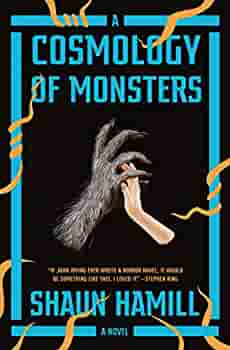
A Cosmology of Monsters by Shaun Hamill (Vintage) | Review by Douglas J. Ogurek

Small-town kid confronts cape-wearing wolf and traverses the dark corridors of mental illness.

A Cosmology of Monsters tackles many elements of the typical dysfunctional family story: sexuality hurdles, financial struggles, unrequited love, adultery, parent/child quarrels, and suicide. Oh, and it has one more thing: a relationship between the narrator boy Noah Turner and a wolf-like creature, which may or may not be the only one of its kind.

The connection between Noah and the monster – it initially communicates by writing terse messages in chalk – becomes more complex (and even weird) as Noah ages. The creature becomes a comfort to Noah as he deals with his own conflicts and those between his mother and his two sisters. Considering Noah’s family’s history of mental illness, is this monster, with its orange eyes and red cape, really visiting Noah? Is it a hallucination? Is it a physical manifestation of a mental illness? 

Author Shaun Hamill indulges in a fair amount of narrative sleight of hand. Noah narrates, for instance, how in 1968 his father Harry (whom he never knew) meets and courts Noah’s mother Margaret. Noah reflects on her decision to choose his father over a safer, more financially stable prospect. Harry, a local with a passion for paperbacks, pulp magazines, and comic books, particularly horror and Lovecraftian fiction, admits he lives with his mother, who is contending with paranoid schizophrenia. Moreover, what a jarring experience when Noah details Margaret contemplating the abortion of a child that turned out to be him. 

Much of the story revolves around The Wandering Dark, a haunted house the Turners build in their Texas town. Noah, assuming the role of a wolf – now there’s something to think about – learns how to move through the facility’s secret corridors to achieve the maximum scare. 

The book also details Noah’s interactions with his family members. Most compelling is the relationship with his sister Eunice, who serves as a second mother while battling her own demons. 

The Wandering Dark, reconstructed based on Harry’s old drawings, is a haunted house, but it is also a symbol of the life that Noah, existing in the shadow cast by mental illness, must navigate. Though the novel resorts to dream/nightmare sequences that I found abrasive, Hamill redeems himself with some impressive world-building.—Douglas J. Ogurek ***


Sunday, 27 November 2022

Bad Candy | review by Douglas J. Ogurek

Unsavoury horror anthology mostly lives up to its name

Chilly Billy (Corey Taylor of Slipknot fame) and his sidekick Paul (Zach Galligan) host a Halloween-themed radio show at 666 on the dial. Clever. People call in and ask Billy to spin horror tales, which are portrayed in the short films that make up Bad Candy, directed by Scott B. Hansen and others. 

The lack of cohesion, clichéd content, subpar CGI and poorly drawn characters give one the impression that these pieces were cooked up by high school boys. Among the one-dimensional scumbags who populate the film like so many rotting confections are a beer-guzzling deadbeat dad, a creepy old man who taints candy, a drug dealer, a would-be rapist and a sexy, acid-dropping mortician who finds herself attracted to one of her male specimens. Through each of the stories wanders Bad Candy, a creepy clown who enjoys showing his long fingers and mindlessly killing bad people.

The best tale in the batch involves three military vets who play a yearly Halloween game involving rabbits and pumpkins. This one has humour, intriguing dialogue and some impressive makeup. It also offers a unique take on the close-up shot of the man inside the mask, a filming technique made famous in the Iron Man series. 

Another of the film’s shortcomings are the unrealistic and lifeless representations of children. A young boy, looking forward to trick-or-treating, says, “This is going to be awesome” as if reading out of a book. A little girl trips and looks up to see Bad Candy looming over her. Rather than going into conniptions as one would, she unhurriedly jogs off without making a sound. Don’t be like that little girl – run away from Bad Candy as quickly as you can.–Douglas J. Ogurek*   


Saturday, 12 November 2022

Blood Red Sky | review by Douglas J. Ogurek

Hm. They already did a plane with venomous snakes on the loose. So how about… vampires?

This vampire version of Snakes on a Plane (2006) gets a bit silly with all the hissing and thrashing and baring of fangs, though it does create tension by confining two threats (vampires and hijackers) in one inescapable place.

Blood Red Sky, with its intriguing German/English language hybrid, asks the question that consistently turns up in vampire flicks: can a person who is inherently good resist the evil that vampirism draws them toward once they are infected? A less typical question that the film asks is whether desperate people can join forces with a would-be enemy to take on an even greater enemy. As expected, some people will act completely out of self-interest, while others will emerge as heroes. Then there’s the more obvious question: how are these people going to get out of this?

Director Peter Thorwarth creates a partnership with the viewer by opening the film with an awkward emergency landing in Scotland. Snipers train their rifles on the plane. Hostage negotiators attempt to assess the situation. Elias (Carl Anton Koch), the film’s boy protagonist, climbs out of the plane. We know, therefore, that the plane has landed and the boy is safe – what we don’t know is what’s happening inside. Everything else in the film will build to this moment. 

Peri Baumeister effectively portrays Elias’s mother Nadja. Before boarding and as the flight begins, the skittish and sickly Nadja struggles to keep something at bay. During the flight, the film offers a series of flashbacks, some of them a bit on the sappy side, to tell the story of how she acquired her affliction. 

The most entertaining of the characters is maniacal hijacker Eightball (Alexander Scheer), who revels in bloodshed. As Eightball bullies and threatens the passengers – he’s not afraid to target the weakest and youngest – his co-conspirators repeatedly refer to him as a “psycho” and suggest that he’s taking things too far. But those who take things too far often make the best villains. 

Does this film do enough to separate it from the mountain of other vampire movies out there? Yes, to an extent. It does lead one to wonder… what’s the next threat filmmakers are going to put on a plane? – Douglas J. Ogurek***