Sunday, 29 May 2022

Emerging Horizons, edited by Allen Ashley (The British Fantasy Society)

I have a story in this anthology, so it would be unethical for me to rate and review it, but I will talk about it a bit. My history with this book goes back a long way. In September 2015 the British Fantasy Society's publishing schedule was running late, as usual, and so I proposed producing a quick anthology. No need, said the society's chair, because one is already in the works. And this is it, published in December 2021, a mere six years later! Part of the problem was a change of chairs at the society: an incoming chair apparently didn't fancy publishing it, and then the chair who took over in 2021 didn't want to have it printed either, so it crept out at last as an ebook-only publication.

Reading it was an odd experience, then, because I was on the alert for clues as to why successive chairs declined to publish a print anthology that members had been promised so long ago, and to which members had been asked to contribute, especially when the society's publishing programme has been so threadbare. (I'm writing in May 2022, and this is the only BFS publication, ebook or otherwise, to have been released since July 2021, and that one (BFS Journal #22) was the only print publication the society has released in the 17 months since December 2020. Were the stories in this terrible? Was it badly edited? (Obviously not, with the ever-conscientious Allen Ashley in charge, but I knew that certain other BFS publications had been delayed for that reason.) Was there something problematic about the book?

Now obviously I'm biased, as a contributor, but I thoroughly enjoyed it. The premise of the anthology is that all the authors are at the beginning of their fiction writing careers, including me (I've written and published quite a lot of fiction, but only in my own magazines, and for the purposes of this anthology self-publishing didn't count), but the stories are, on the whole, as good as anything I've read in other BFS publications. None of the stories offered any clues as to why the anthology hasn't seen print.

The only story I could imagine anyone classing as problematic was "The Hanging Tree" by Kim Gravell. It's about hanged witches and the desire of their descendants for justice, but I suppose that, looked at from another angle, you might say it's about a woman who realises she is in love with the man strangling her to death and afterwards says to him that "love and hope are strong enough to conquer anything". But it's still an interesting story and I can't imagine anyone would think it so problematic as to compromise the anthology.

I suppose there isn't much sword and sorcery for a fantasy anthology, but "The Uninvited" by Nicola Gifford offers some as valkyrie battle the Devil, his wyvern and an army of zombies. The sword in "The Giant's Rib" by Elliott Simpson only ever gets used against a couple of trees, rather than the half-giants the protagonists encounter. Another story that leans more towards the fantastical end of fantasy is "The Mysterious Mister Fox" by Liz Tuckwell, a fairy tale about Betsy Heysham, who can see through the wiles of a handsome soldier, while her smitten sisters cannot.

"Wayland" by Mark A. King is written in an unusual, declamatory style that I found rather appealing. It's about a magical place where children who died young get to live for a lifetime in the course of a single day. "The Return of the Zookeeper" by Robin Lupton is about a chap with psychic powers who uses them to control his troupe of performing animals; it all starts to go wrong after he wears them out and finds himself in a pool with two uncontrollable crocodiles. "Archon Joe's Creation" by Nigel Robert Wilson is another story with mythical and biblical elements, this time about the guy who kept working on what seems to be our planet after the original Creator left.

Darker stories include "Skin" by Suzy A. Kelly, about mother and daughter selkies held captive by a drunken man, and "The Conveyor of Souls" by Dolly Garland, about Maithli, who almost died and can now communicate with troubled souls to uncover the grievances still binding them to our world. In "The Darkness Inside" by Michael J. Nicholson a curtain-twitcher and her husband see something peculiar happening out on the street. A good story, but I wasn't sure about its characteristation of a "typical marriage" as one in which the husband fantasises about killing his wife! "Eyeballs" by Michael Button is about two chaps whose favourite hobby is to pick a person each to stalk for the day and then meet up to compare notes. Although it is very good – perhaps my favourite in the book – and extremely creepy, it's not a fantasy story so far as I could tell, so perhaps an odd inclusion in a fantasy anthology.

My story, "The Reader-Queens of Tranck", is wisely placed at the end. I say wisely for a couple of reasons. Firstly, because the goofy tone of it is completely different to the rest of the book, which tends to be very serious, whatever the subject matter. I think it's also the only story that doesn't take place on Earth. And secondly, because the premise of the story is that as typos start to creep into the text, the protagonists notice and realise that the integrity of their world is crumbling. If it had been the first story in the book, readers might have assumed from the first few typos that the book was poorly edited, but by the end of the anthology it will have earned their trust.

I submitted the story for the anthology so long ago that (a) I have since written three entire novels about the main characters and (b) I had forgotten about the deliberate typos myself. So as I reached the first one I thought, oh my god, how did I miss this? How did Allen Ashley miss this? But as it went on it I realised what was happening and it really tickled me. There were many bits that made me laugh out loud, a few very nice turns of phrase, and even some excellent advice for proofreaders. I'm not ashamed to say that I'm one of my own favourite writers: what's the point of being a writer if it's not to write exactly the stories you want to read, with the sort of jokes that really make you laugh?

Overall, one of the best BFS publications I've read in a while, even if I am biased. If more anthologies were this length, instead of rambling on for five or six hundred pages, I'd read a lot more of them.

If you like the sound of it, the way to get the anthology is by joining the British Fantasy Society. Their monthly bulletin for members includes a Dropbox link to a selection of past publications, including this one.

Monday, 23 May 2022

Till Death | review by Douglas J. Ogurek

Makeup on a robot: it’s Home Alone 6, starring Barbie! 

There are two things you can be certain about in Till Death, starring Megan Fox as Emma, a chilly trophy wife who spends most of the film dragging around her husband’s corpse and dropping f-bombs. First, despite all the trials that Emma undergoes in a remote cabin in the middle of the winter somewhere in New York, her makeup will not get ruined. Second, no matter what the plot throws at Emma, her tepid responses will fail to gain the sympathy of a discerning viewer.

Emma’s lawyer husband Mark (Eoin Macken), whom she met when he successfully prosecuted the man who attacked her, is the controlling type – he tells her what to wear and what to order off the menu. Mark, who gives no indication he’s aware she’s having an affair with one of his employees, takes her on an ostensibly conciliatory getaway to a remote lake house to celebrate their eleventh anniversary. Then he dies.   

The film, directed by S.K. Dale, offers some of the mysterious note-leaving and brutality of Saw and some of the suspense of the typical home invasion story in which an underdog uses her ingenuity to try to outwit would-be killers. However, Till Death seems to be so focused on maintaining Fox’s Barbie-like complexion that it falls short in other factors. Her robotic performance leaves her cold to her husband, cold to her lover, and unfortunately, cold to the viewer. Moreover, as antagonists pursue Emma within the lake house, one wonders how hard it is for able-bodied men to find a barefooted woman handcuffed to a bloody corpse.

Most log lines about Till Death say something about a woman awakening to find herself shackled to her dead spouse. Not only does the film take too long to build up to that inciting incident, but that description leaves out a technicality that plays into the way the story evolves. Rather than building up to this scenario, a more compelling structure might have started with the handcuffed spouse discovery, then shifted between Emma’s more well-defined past and her attempts to escape. 

The most interesting, albeit weakly explored, facet of this film is the concept of the beautiful young woman kept as an object by an older, wealthier man. Perhaps Till Death would have been much better if its makers dropped the horror aspirations and injected Emma with more backstory, depth, and life.—Douglas J. Ogurek **

Sunday, 1 May 2022

SHINE: An Anthology of Optimistic Science Fiction (Solaris) edited by Jetse de Vries | Review by Douglas J. Ogurek

A hopeful change: anthology turns the tables on dystopic sci-fi to shine a light on technology’s role in global healing.

If you’re a little tired of dystopic sci-fi, then awaken to SHINE, for which editor Jetse de Vries challenged writers to explore more hopeful outcomes. Though we hear a great deal about the negative effects of technology, this anthology shows how it can be a means of connecting people and healing our ailing environment. And despite its being more than a decade old (published in 2010), the anthology holds up to the test of time.

Some of the stories might be harder to grasp for the reader who, like me, isn’t much of a tech wizard. I suspect that devoted readers of hard sci-fi will have less trouble with these stories. Nevertheless, the anthology introduces a variety of intriguing inventions. Examples range from ocean bots programmed to collect garbage and robot spiders that help women ascend in a chauvinistic West African village to techwear and nanoparticle soil that uses solar energy.

One theme that repeatedly emerges is control—in particular, mankind’s ability to use technology versus being controlled by it. Eva Marie Chapman’s “Russian Roulette 2020” proposes a flip from using technology for the “Just Nowism” of shallow pursuits to applying it for the benefit of society. The author takes the current dependence on technology to the next level by introducing a group of American kids addicted to devices called ZiSleeves. They visit a special school in Russia that has used technology to benefit the surrounding community. Protagonist MV is the American embodiment of instant gratification, whether that means playing with technology or scoring with young women. Then he meets Rada, a beautiful Russian tech whiz who also likes doing cartwheels and spending time outdoors. Rada, disappointed by Americans for exploiting the planet, advocates taking time to break away from attention-demanding technology to be still. 

Though it’s hard to tell what’s happening at certain points in Gord Sellar’s “Sarging Rasmussen: A Report (by Organic),” the story brings up the idea of control again. The men in it begin by using an elaborate digital game to manipulate and bed women, then discover their ability to manipulate people’s minds can make a more meaningful, ecological impact. 

Another theme that repeatedly surfaces in SHINE is the critical role that children play in the future of our earth and how teaching them correctly will make an impact. “Castoff World” by Kay Kenyon, for instance, introduces a girl and her grandfather who live on an island floating on recycled plastic bottles while they try to reconnect with humanity. A third major character is Nora (nanobotic oceanic refuse accumulator), the nanobots that recycle materials that pollute the ocean. 

Ken Edgett’s “Paul Kishosha’s Children” shows the role art and storytelling can play in teaching children to respect the environment. A scientist gives up his NASA job to move home to Tanzania, where he resurrects a sci-fi children’s story he created at age nine, then uses it to teach children about science, animals, and ecology. 

Holly Phillips’s “Summer Ice” is a near-future story that deftly combines art and ecological preservation. The protagonist is a female artist who, in her own way, combats climate change in the unnamed city to which she moves. “During the years of awkward transition from continental wealth to continental poverty,” writes Phillips, “the city’s parks were abandoned to flourish or die.” The artist-protagonist’s creation symbolizes a resurgence of hope in humanity doing its part to improve the environment and instil these values in the next generation. 

“Overhead” by Jason Stoddard involves a moon community of 1,300 people who wanted to get away from earth and start a new life. It’s a tense story that shows the benefits of raising youth appropriately. 

If you’re fed up with stories about artificial intelligence taking over mankind, then check out “The Church of Accelerated Redemption” by Gareth L. Powell and Aliette de Bodard. Lisa is an American in Paris doing programming for a church that uses AIs to take prayer requests. She meets a Bedouin protestor focused on the liberation and uplifting of AIs. The story also explores the complexities that might occur when a human has feelings toward an AI. Yes, that’s been done before, but the authors here handle it well.

Another impressive story is Jason Andrew’s “Scheherazade Cast in Starlight,” in which an Iraqi narrator reveals how technology can connect people across borders and oceans to fight oppressive governments that restrict people’s views.

“Twittering the Stars” by Marie Ness covers a four-year space exploration to mine iridium for batteries to power millions of vehicles for fifty years on Earth. It’s told in Twitter fashion with the latest tweet at the beginning. The reader is best served by starting at the end and moving backwards. The stream reveals a botanist/microbiologist’s struggles with love, death, and alien life forms. 

No story in this anthology has as much over-the-top fun as Alastair Reynolds’s “At Budokan.” 

Robots. Dinosaurs. Heavy metal. Is there a better combination? The 12-year-old boy in many male readers will rejoice when he reads this one about how genetic engineering achieves the next level of heavy metal.—Douglas J. Ogurek****


Sunday, 27 March 2022

Candy Coated Madness by Jeff Strand (Independently Published) | Review by Douglas J. Ogurek

Sweetly preposterous: comedy horror collection offers cartoonish violence, linguistic mischief, and eccentric characters

After causing a horrific death, a murderer in one Candy Coated Madness story says, “Nice.” When the corpse’s loved one walks into the room and can’t see the body, the murderer moves to offer a better view. Such scandalous flippancy and blatant sadism are the hallmarks of Jeff Strand’s fiction, and thankfully, they emerge repeatedly within this collection of comedic horror. 

No surprise that within his fourth short story collection, Strand keeps the reader entertained with his patented characters ranging from dumb to sociopathic and, in many cases, indifferent to the suffering of others. And what do these characters want? To kill a family while in human (versus werewolf) form. To score with a date by showing bravery on a haunted ride. To stab a thousand people with candy canes. To rob a bank while wearing green suits that are too small. The ludicrousness of these objectives alone solidifies Strand’s reign as the foremost comedy horror author. 

Like its predecessors, Candy Coated Madness puts new spins on the typical horror fare (e.g. cannibalism, stabbing, delimbing). Sometimes, Strand’s characters completely strike out and end up humiliated, their objectives foiled. Other times, they achieve what they set out to do, but still don’t get what they really want. 

The reader gets treated to major doses of Strand’s characteristic snappy dialogue, whether his characters are using rational arguments to persuade irrational people or arguing whether you blow a person’s brains or brain out. In “Captain Pistachio’s Charming Rampage”, the titular character, made of pistachios, encourages a woman’s children to eat the nuts. She points out that it’s strange he’s encouraging people to eat what he is. That doesn’t make him happy.

Then there are the amusingly abrupt violent deaths. A character, weary of talking, stabs someone in the neck. A man can’t reply to another character because he’s been eaten by something. 

The idiocy of many of Strand’s characters knows no bounds. When a character uses a slingshot to fire a silver bullet at a neighbour he suspects is a werewolf, the bullet bounces off the neighbour’s chest. A performance artist puts his own spin on popular ’80s songs by playing the original version on his phone and singing his slightly altered lyrics over the vocalist. Leave it to Strand to transform such an innocuous hobby into a bloodbath. 

The ultimate ignoramuses make their appearance in “Giant Mutant Cockroaches in the Old West Versus Zombies”. When Doc Rollins Jr. asks the townsfolk how to defeat the zombies, for instance, one character suggests dinosaurs.

Typically, it’s a no-no to use characters prone to deep reflection. But Strand’s contemplative players pull it off because of the absurdity of what they’re thinking. In “Faerie”, the mentally unstable narrator questions himself whether the faerie he sees is real or a figment of his imagination. 

The collection has several stories I read in other venues. No problem. They were a pleasure to reread… and will be a pleasure when I read them yet again. One such work is “Pointy Canes”, the story that made me aware of the sweetly piercing personality of Strand’s short prose. The first-person narrator’s Uncle Jack wants to start a “blood ritual” for a nefarious purpose. His means of doing so is delightfully illogical. 

Another familiar story, “Beware! The! Beverage!”, introduces two teenagers discussing Rocketship, an energy drink made of Martian blood… from the planet of Martia, of course. When one tries Rocketship for the first time, he feels incredibly powerful. Violence ensues.

If you asked me what happens in a story and I told you, “Two guys talk,” you’d likely want to avoid that story at all costs. And yet, “Dismemberment Fraud” is one such story that manages to be engaging from start to finish. In it, an unscrupulous lawyer speaks with a prospective client who has wanted to kill somebody since he was eight… and who has killed a prostitute because he couldn’t bring himself to kill a dog. Not a problem for this lawyer – if everyone was the same, he reasons, life would be dull. 

No Strand collection would be complete without a hearty measure of selfish jerks. Candy Coated Madness doesn’t disappoint. Readers get a commitment-avoiding fellow whose girlfriend starts making connections between the gross sore on his back and the Book of Revelation, a young man who wants to smash someone’s head in like a pumpkin, a doctor with a flagrant disregard for his patient’s well-being, and many more. 

Another enjoyable aspect of this collection is its attention to language, particularly the thoughtless or contradictory things that people say or the things that other horror authors gloss over. Strand even has fun at his own linguistic expense. One character mentions the “weird, indescribable – except for calling it weird – sound of” something. Another psychopath realizes he’s repeating himself, then proclaims, “I’ll be as redundant as I want in my own narrative.”

Stories pay tribute to films both classical and contemporary. They include a warped version of West Side Story involving grotesque lab experiments, an anticlimactic take-off on the Hostel film series, and a fantasy-infused tribute to the “Great Stone Face” Buster Keaton of silent film fame.

A couple of stories offer more serious – as serious as Strand gets in this collection – subject matter. “The Fraud” introduces the goings-on within an asylum while a sandstorm brews outside. In “Rotten Eggs”, a girl tells her younger siblings if they don’t find some buried Easter eggs, the Easter Bunny, who has fangs, will be angry and hurt them. 

Not a Dud in the Batch

The author-protagonist of “Gave up the Ghost” has fourteen unpublished novels and a high opinion of himself… so high he thinks his latest magnum opus is going to get a Nobel Peace Prize. Something goes to extreme (and hysterical) lengths to prevent the distribution of the novel. 

Fortunately, this author-protagonist is not Jeff Strand. Every story in Candy Coated Madness is a hit, whether it involves a character who wants to avoid tomatoes on his burger or a serial killer who compares sawing off arms to eating cake. The author never lets the language get the better of him by resorting to million-dollar words. And if he ever did such a thing, he’d surely call himself out. 

Warning: after you read this, any attempts at serious horror fiction might seem a little silly to you. – Douglas J. Ogurek *****


Sunday, 20 February 2022

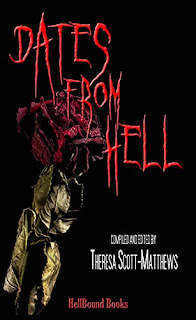
Dates from Hell, ed. Theresa Scott-Matthews (HellBound Books Publishing) | Review by Douglas J. Ogurek

Make a date with this anthology… just watch out for jealousy, unrequited love, fanaticism, and blue goats.  

This is an anthology of horror stories loosely connected by the concept of dating. Sometimes it’s two people (or otherwise) going on a date. Other times it’s an individual’s experiences in the wake of a date… or even an extended love triangle. The characters range from jilted lovers, call girls and drama queens to trash-talking reanimated corpses and demons who steal faces.

Some of the stories don’t pass muster. Stories that info dump and overindulge in details are the biggest culprits. I don’t care how tall something is, what colour a person’s hair is, the distance between x and y, or (God forbid) what the weather is doing… unless it contributes to the story. One story reads more like a dull history essay, while another abounds in characters thinking and even talking to themselves merely to reveal information to the reader. Another spends too much time building up to an outcome that the reader already knows. Then there are the stories that withhold the identity of the characters in the first few paragraphs. Just say who the person is.

And now for the good news: while there are a few duds in here, most of the works are entertaining and a few are astounding. The anthology further solidifies one of my contentions about horror fiction: when authors take their stories too seriously and/or attempt to write a scary supernatural story by drawing from horror tropes, their work often feels silly… like an undergraduate poetry student trying to write something scary for the first time.

Conversely, the writers in Dates from Hell who exploit the inherent humour in merging horror and dating offer the most impressive works. In Carlton Herzog’s “Out of Town Strange”, for instance, a mortician takes a reanimated corpse possessed by a wisecracking Wendigo on a wild date in his ’65 Mustang. This corpse is a feisty Alabaman who in some places fits in, but not so much in others. Her words and actions are exaggerated and vibrant. In exchange for going places, she dangles the carrot of letting the forty-year-old virgin narrator “poke” her. She gives a new meaning to the phrase “expose oneself” and encourages him to think of her as his “date from hell”. The story, rich in wordplay and witticisms, leaves one wanting more. I could see a whole book with these two going on various adventures. 

Another comedic favourite, “She Has My Heart” by Sonny Zae, is about Nash, a lowly zombie from Putrefaction Palms in Hollywood. He falls in love with Carolanna, a female zombie who has literally stolen his heart by reaching into his chest and snatching it. There is a problem with them seeing each other because she’s part of the most powerful zombie family in LA: the Corpsicana Cannibals. Like Herzog’s piece, this one is full of verbal acrobatics and invention, such as the zombie holiday called ThanksLiving, during which they eat a roasted Turk and open gravy. Zae writes amusingly about the details of Carolanna that Nash finds attractive. Her tongue, for instance, is a “delectable blue gray”. Her teeth remind him of “scattered yellow gravestones in an abandoned cemetery”.

In “Quality Meat”, a ridiculous yet captivating piece by Fulvio Gatti, a couple is on a date in an Italian restaurant when the waiter opens a covered dish to reveal something unexpected. The couple attempts to escape the restaurant while being pursued by a psychotic family. This has the feel of an ’80s action film: it’s funny and the characters’ reactions are unrealistic. When the reason for the family’s pursuit of the couple is revealed, it seems shallow. And yet, I want more. 

Dates from Hell isn’t all fun and games. Its creepiest entry comes courtesy of Scott McGregor. “The Girl Who Loved Senpai” offers a moral: those who will stop at nothing to get what they desire may very well pay a steep price. Akari-chan, a junior at a Tokyo high school, wants more than anything to have the dashing senior Senpai fall in love with her. The problem is that Senpai doesn’t even notice her. Akari-chan has a brutal plan that will ensure he falls for her and they will live happily ever after. 

What “The Girl Who Loved Senpai” does for unrequited love “Zara-Lena’s Surprise Dinner” by Eowen Valk does for fanaticism. Initially, I was wary of this one when I discovered that the protagonist is a writer. Valk, however, makes it work. Horror writer Cedric Shard holds a contest, the winner of which gets to spend time with him at a location of their choice. Zara-Lena, the seductive winner, brings him to a home in the middle of a lake, then takes her fandom to the extreme. This one has the makings of a classic horror story in the vein of Stephen King’s Misery and one of those darling shorts from Creepshow 2.

Dates from Hell also offers a couple strong stories about womanizers learning a painful lesson. In Adam Bell’s “Alpha Male”, Frankie, who is used to one-night stands, represses his “player tricks” in a more honest attempt to bed Marianne, a lesbian he finds extremely attractive. He falls for her, and now he doesn’t understand why she has him tied up. Despite its brutality, the story comments on shedding the male desire to conquer the woman sexually and instead embracing a more fulfilling relationship. Ramsey, the “protagonist” in “slriG, slriG, slriG” by W.P. Johnson, has gone through a string of women. He’s the kind of guy who will tell women what they want to hear to make them his sexual conquests. But Ramsey meets his match with goth girl Steph, whose online profile reveals some eccentric behaviours. Who puts their dead cat in the freezer anyway?

Get ready for some major violence in Michael J. Moore’s “The Mean Girl”. Five months after her friend goes missing, the unnamed narrator who considers herself “damaged goods” visits the mobile home of Kirk – a poor, yet handsome high school classmate. She’s had her eye on Kirk for some time, but she can’t “afford to be seen” with him until now. She insists she’s not a mean girl like the one from the movies. Key to the story’s enjoyment is the unpredictability of the unnamed first-person narrator and Kirk. The piece explores class differences and throws in some twists. 

A few stories take on a more literary bent as they delve into complex relationships and the ensuing painful emotions. And what better emotion to characterize young love than jealousy? In “The Tart” by Alexandria Baker, Liz steals part of a strawberry plant owned by Nellie, who not only lands the man that Liz is interested in but also gloats over her conquest. Baker offers vivid descriptions of the berries, which come to symbolize Liz’s bitterness, jealousy, anger, and inability to let go. 

Victoria Witherkeigh’s “Teenage Wasteland” covers several years in the lives of three friends who meet at a California beach once a year starting at age ten. It’s apparent at the outset that there are jealousies, especially among the two boys. These feelings bubble to the surface and interfere with their lives as they grow older. The ocean and its tumultuousness become a reflection of what’s happening within the characters. 

Dates from Hell even dips into the bizarro subgenre with “Wears Her Heart on a Rope” by Eddie Generous and Theresa Braun. Although it has some lack of clarity in the beginning, the story quickly redeems itself to become a thoughtful commentary on the generational impact of domestic violence. On the surface, it’s about a male figure who has transformed a woman into a goat and dyed its hair blue. On a deeper level, the story comments on the way some men treat women (i.e. like a goat), with the blue dye suggesting the shallow external beauty that comes when males bestow upon females ornamental gifts that make them feel special. Despite what this man has done to her, the she-goat continues to look to him as her protector. This is a story that begs the reader to, like a goat with its cud, keep chewing on it – each cycle is likely to unveil something new.

Reading a short story anthology is comparable to a speed dating event. In Dates from Hell, some dates won’t appeal to you, but chances are that many will. And maybe if you really like a few authors, perhaps you can check out more of their work and a long-term relationship will blossom.****Douglas J. Ogurek


Friday, 11 February 2022

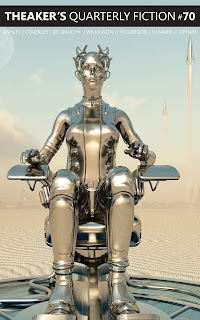
Theaker's Quarterly Fiction #70 is out at last in paperback and ebook!

free epub | free mobi | free pdf | print UK | print USA | Kindle UK | Kindle US

Welcome to Theaker's Quarterly Fiction #70, edited by Stephen Theaker and John Greenwood.

Theaker's Quarterly Fiction #70 is here at long last! It features four short stories: “Some Things Drift Apart” by Allen Ashley, “See How They Run! See How They Run!” by Harris Coverley, “July Job Offer” by Charles Wilkinson and “In the Shadows of the Past” by Alex De-Gruchy. Plus Rafe McGregor and Stephen Theaker review the work of Elaine Graham-Leigh, Shona Kinsella, Joe Dever, Alex Garland, and Scott Frank and Jon Cohen. The cover art is by Steve Upham.

Note: we've held two stories that were originally planned for this issue – “Spending the Government’s 28” by Ross Gresham and “The Ninth Mandala” by Zachary Toombs – over to issue 71. Out soon!


Here are the tremendous contributors to this issue.

Allen Ashley is an award-winning writer and editor based in London, UK. He has recently featured in BFS Horizons and in the anthologies Time We Left edited by Terry Grimwood (The Exaggerated Press) and Terror Tales of the Home Counties edited by Paul Finch (Telos). Allen is a former President of the British Fantasy Society. His most recent book is the poetry collection Echoes from an Expired Earth, now available as an ebook for 99p on Amazon UK: www.amazon.co.uk/Echoes-Expired-Earth-Beats-Ballads-ebook/dp/B086XH41WH/.

Harris Coverley has had short fiction published in Curiosities, Hypnos, The Centropic Oracle and The Periodical, Forlorn, amongst many others, as well as previously in this magazine. He is also a Rhysling-nominated poet, with verse in Spectral Realms, View From Atlantis, Scarlet Leaf Review, Corvus Review, Ariel Chart and elsewhere. He lives in Manchester, England.

Charles Wilkinson’s publications include The Pain Tree and Other Stories (London Magazine Editions, 2000). His stories have appeared in Best Short Stories 1990 (Heinemann), Best English Short Stories 2 (WW Norton, USA), Best British Short Stories 2015 (Salt), Confingo, London Magazine and in genre magazines/ anthologies such as Black Static, The Dark Lane Anthology, Supernatural Tales, Theaker’s Quarterly Fiction, Phantom Drift (USA), Bourbon Penn (USA), Shadows & Tall Trees (Canada), Nightscript (USA) and Best Weird Fiction 2015 (Undertow Books, Canada). His anthologies of strange tales and weird fiction, A Twist in the Eye (2016), Splendid in Ash (2018) and Mills of Silence (2021) appeared from Egaeus Press. A full-length collection of his poetry came out from Eyewear in 2019 and Eibonvale Press are soon to publish his chapbook of weird stories, The January Estate. He lives in Wales. More information can be found at his website: charleswilkinsonauthor.com.

Alex De-Gruchy is a writer whose work has included comic books, videogames, prose fiction, film, radio and other audio, poetry and more. Find out more at www.alexdegruchy.wordpress.com or on Twitter at @AlexDeGruchy.

Rafe McGregor lectures at Edge Hill University. He is the author of two monographs, two novels, six collections of short fiction, and two hundred articles, essays, and reviews. His most recent work of fiction is The Adventures of Roderick Langham, a collection of occult detective stories.

Stephen Theaker’s reviews, interviews and articles have also appeared in Interzone, Black Static, Prism, Dark Horizons and the BFS Journal.

Steve Upham provides the cover art for this issue. He published some smashing books as the proprietor of Screaming Dreams, and some great stories as the editor of the Estronomicon ezine.


As ever, all back issues of Theaker's Quarterly Fiction are available for free download.

Sunday, 5 December 2021

Station Eleven by Emily St. John Mandel (Knopf Doubleday Publishing Group) | Review by Douglas J. Ogurek

Superflu survival story combines low tech with high pressure

It’s hard to believe that in the middle of Station Eleven, a novel that is, on its surface, about people trying to survive decades after a superflu, there are interviews between high-profile job coaches and corporate executive administrative assistants, or between tabloid journalists and movie stars. This oddity comes thanks to author Emily St. John Mandel’s unique (and in this case, effective) structure. 

The story revolves around a live performance of King Lear during which two major things happen: prominent actor Arthur Leander dies and the Georgia flu that will decimate 99% of the world’s population takes hold. The rest of the novel moves back and forth in time, from the events immediately following Leander’s death to the new world that exists decades afterward, and back to the stories of Leander and his acquaintances well before the event. Among the characters, all of whom are connected to Leander, are his wives, fellow actors, business associates, friends, and the adult manifestations of those who were children when he died.

The post-apocalyptic protagonist is Kirsten, a member of the Travelling Symphony that performs orchestral music and Shakespearean plays in a world where people will kill you for the contents of your backpack. The symphony uses a caravan of pickup trucks that run not by gas — that ran out three years after the collapse — but by horses. The front of the caravan bears a slogan: “Survival is insufficient.” And thus St. John Mandel poses a question to the reader: if survival isn’t enough, then what is?

The symphony confronts a cult led by the Prophet, a charismatic and cryptic smooth talker with some questionable behaviours. After they abandon the cult, the performers are concerned that it might have long tentacles … tentacles that come after them. 

Woven into the novel are highlights from Arthur’s life including his ascent from a nobody on a small island in British Columbia to an internationally revered film star and the many complications that come with such fame. 

Miranda, one of Arthur’s wives, is the creator of Station Eleven, a far-future sci-fi comic book, which not only foreshadows the actual novel’s apocalyptic events, but also ends up revealing the long-lasting and unpredictable power of art. With his trademark Pomeranian and red fedora, Dr. Eleven, along with his colleagues, lives on a moon-sized space station (Station Eleven) that resembles a water planet. Miranda sees Dr. Eleven and his strange world as a source of comfort. She is not concerned about publication — it’s more about the love of creation. The obscure comic, gifted to Kirsten by Leander before he dies, will play a pivotal role in her story. 

Another storyline follows Arthur’s longtime friend Clark, a former C-suite coach who lives at an airport after the superflu. There he curates an exhibit of technologies that no longer work. Among the unique cast of characters at the airport are Elizabeth (Leander’s second wife) and her son Tyler. 

Just as much as it is a post-apocalyptic survival story, Station Eleven is a reflection on mankind’s accomplishments and foibles. In one excerpt, St. John Mandel reflects on the things lacking in this new world that characters (and we readers) took for granted in the modern world … things like the internet and airplanes. With or without those things, the reader learns, there are going to be problems and opportunities.—Douglas J. Ogurek****


Monday, 8 November 2021

Pinocchio (2019) | review by Douglas J. Ogurek

No strings attached: sometimes he’s a hero, sometimes he’s a jackass

Poor carpenter Geppetto (Roberto Benigni) carves Pinocchio (Federico Ielapi) from a piece of magical wood. Geppetto proudly proclaims his love for his son. Alas, Pinocchio is much more an adventurer than he is a student, and because of his disobedience, he gets separated from his father and their small Italian village. Thus begins a quest to make it back to Dad.

During his journey, Pinocchio undergoes several challenges and encounters a variety of eccentric characters. Some of the adults, many of which are thinly disguised as animals, have malicious intents, while others want to help the wooden boy. Examples range from a seemingly avuncular old man who transports carriages full of boys to a place where they can play all day to a cautionary cricket and a melancholy tuna.

This Italian version, directed by Matteo Garrone, resurfaces most key elements of the original story. I was taken aback by the brevity of the nose-growing scene. Shouldn’t this classic Pinocchio detail be given more screen time? As it turns out, the original Disney version only had a brief scene as well.

Initially, I was also disturbed by Pinocchio’s lukewarm desire, which isn’t expressed until halfway through the film, to be a boy. But then, this is a boy—how many boys know what they really want? Sure, he misses Geppetto and wants to get back to him, but there are so many opportunities for fun. Like a boy, Pinocchio is easily distracted and flits from one thing to the next. The way to become a real boy (or is it a man?), the film suggests, is to give up selfish aims and instead focus on caring for others. 

In a commendable departure from CGI, this film relies on human actors to play animals. Nevertheless, shysters Fox and Cat, two such characters that get the most screentime, offer stagy performances (e.g., overblown gestures, extreme facial expressions, funny voices) that compete with the annoying exuberance of typical CGI characters. But children like such exuberance, don’t they? Fox and Cat waylay Pinocchio and attempt to steal his coins so they can fulfil their obsession of finding something to “nibble.”

Pinocchio’s absence of strings is another interesting consideration. When he gets involved with a traveling puppet show, his fellow puppets are all controlled by strings. Interestingly, those who control the strings are never shown. Thus, when the puppets are outside, for instance, their strings lead back into the trailer. The protagonist’s missing strings comment on Geppetto’s strength as a father . . . his willingness to sacrifice control and let Pinocchio learn from his mistakes. 

Most enjoyable about this film are the details with which the settings are rendered, from the muted colours of pubs and woodworkers’ shops—it’s as if everything has been coated in a layer of ash and sawdust—to the vibrant fields that Pinocchio traverses. 

This is the kind of movie that makes you want to sit in front of a fireplace in a wooden chair and smoke a pipe or sip a whiskey on a winter’s eve. Do you really want to do that, though?—Douglas J. Ogurek***

Saturday, 2 October 2021

Ghosts of War | review by Douglas J. Ogurek

Soldiers sit in a mansion and wait for bad stuff to happen to them.

For some reason, five American soldiers get tasked with watching over a mansion that the Americans have commandeered from the Germans in Nazi-occupied France. The group that they’re relieving is eager to get out. The five fellows sit around and drink and smoke while the mansion’s nefarious objectives intensify. And there’s a mysterious word that keeps popping up: “Vetrulek.” 

The Ghosts of War players include the following: Butchie (Alan Ritchson), a musclebound brute who likes fighting; Tappert (Kyle Gallner), a southerner who enjoys cutting off body parts and yanking out gold teeth from dead Nazis; Kirk (Theo Rossi), a guy with an itchy foot; Eugene (Skylar Astin), a scholarly type; and Chris (Brenton Thwaites), an unmemorable leader. What they have in common is a lack of development and little to put the viewer in their corner. The most engaging of the quintet is sharpshooter Trappert, whose off-his-rocker comments and contradictory actions give him some zest. Trappert’s cohorts are more than a little perturbed about the game of cat’s cradle he played with Nazi youth.

Ghosts of War, written and directed by Eric Bress, attempts to merge Saving Private Ryan-type soldierly bonding with the typical haunted house fare. Among the clichés are hushed or threatening voices, scraping, creaking, jump scares, cryptic symbols, and of course, creepy dolls and music boxes that start on their own. There’s even a brief scene when Eugene—he’s the one who wears glasses and drinks Earl Grey, so you know he’s the cerebral one—stands before a bookshelf and lectures. 

The revelation of what is happening in the mansion is likely to make jaws drop for some and eyes roll for others. One thing is for certain—the reveal is hard to predict. 

One aspect that sets this film apart from the typical war story is the threat of a secondary enemy. When they do take place, skirmishes get spiked with a supernatural elixir to make them more entertaining. Hence the military horror categorization. A more action-oriented and satisfying contender in this subgenre is Overlord (2018). Nevertheless, Ghosts of War is worth the watch, if merely to experience its twisty resolution.—Douglas J. Ogurek***


Sunday, 12 September 2021

Riot Baby by Tochi Onyebuchi (Tordotcom) | Review by Douglas J. Ogurek

Sci-fi and urban magic realism merge in near-future tale that explores the challenges and potentials of young black adults.

Though Riot Baby suffers from clarity issues because it moves so quickly, this short novel does a fine job commenting on the difficulties that black Americans face. Kevin, the titular character, is born in South Central Los Angeles during the 1992 riots in that region. By the second chapter, Kevin, his sister Ella, and their mother have moved to another dangerous neighborhood in Harlem. 

Ella has magical powers – Kevin calls them her “Thing” – that enable her to levitate (or crush) objects, manipulate temperatures, and fly. She can also see into the future and mentally transport herself and others… to other countries, to a racetrack, or even back in time to her mother giving birth to a stillborn. Their mother worries that Ella will do something bad. Fortunately, when Ella’s powers begin to move toward major destruction, she retreats to a desert to get them under control. 

The most compelling part of the novel involves a young Kevin navigating his Harlem neighborhood while dealing with various threats. Another section details Kevin’s experience as a prisoner at New York’s notorious Rikers Island, where everything is a threat. Here Ella “visits” Kevin and slips into the heads of various people to see what they’re about to do or what is about to happen to them. 

This story’s rapidity, along with the flipping back and forth in time, makes it a little hard to follow. Nevertheless, Riot Baby makes a statement about racial injustice and encourages the empowerment of black individuals. ***Douglas J. Ogurek

Wednesday, 11 August 2021

Full Throttle by Joe Hill (William Morrow) | Review by Douglas J. Ogurek

Hill conjures another masterwork of genre fiction with a literary bent. 

“I’m always ready to see Another Marvelous Thing. Are you?” So says the narrator in “Late Returns,” one of thirteen stories in Full Throttle. That narrator’s comment relates to the magic of books, but it’s also author Joe Hill’s invitation to readers to drop their concerns and come along for a ride . . . and such a memorable ride it is. Are you open to thinking about how different things could be . . . and maybe are? Are you ready to accept that all may not be as it seems? 

Full Throttle is a fitting title for Hill’s fourth collection—the stories grab the reader and refuse to let go as the action barrels forward and the conflicts stack up. I was so captivated by one story, “Fawn,” that I ate half my wife’s bagel without even noticing. 

Though Hill references “full-throttle” action films and books in his intro, these stories are far from shallow—they plunge far beneath the surface with a potent mixture of themes, backstory, and perspectives, while charming the reader with sensory details (a house that smells like “Bengay and neglect,” for example). 

The characters within these tales straddle a wide spectrum. Sometimes, a would-be villain turns out to be a hero. Other times, an ultra-conservative bigmouth—these turn up several times in this collection—surprises the reader with a glimpse of compassion. Some of Hill’s characters undergo dramatic changes. Others seem on the brink of a major shift, but instead revert back to their old ways thanks to Hill’s refusal to conclude every tale on a positive note. 

In the introduction, Hill talks about his literary ascent. How inspiring it must have been to see your parents, Stephen and Tabitha King, pounding away at their typewriters and keyboards day after day. Hill reflects on the books his parents would read to him, bumps in the literary road, his pivotal experiences with makeup artist Tom Savini on the Creepshow set, and his switch from more literary writing to horror. 

The opening story, “Throttle,” cowritten with Stephen King, is a pedal-to-the-metal ride in which a demented trucker goes after a motorcycle gang. It’s a masterful story that offers intense, brutally violent scenes, but also explores tension between characters. 

Don’t start reading “Dark Carousel” if you have something to do—you won’t be able to put it down. The story, which Hill refers to as “a cover” of his father’s work, reminded me of one of the lovely Creepshow 2 (1987) segments called “Old Chief Wood’nhead.” This time, four teens run into a conflict at a carnival and something awful happens as a result. This story exemplifies Hill’s knack for details, especially with the carnival. He writes about the smells of cotton candy, the puke with popcorn floating in it, and the carousel operator’s lips. The “chill factor” of this story is off the charts.  

In “Wolverton Station,” a satirical piece about class and capitalism, an idealistic youth turned American corporate scoundrel opens a coffee business that employs children in foreign countries and decimates mom and pop shops. Saunders is the kind of guy who fires a pregnant woman with a dismissive text. His life changes when an atypical passenger sits right next to him on an otherwise empty first-class train car in Britain. Astonishingly, Saunders isn’t afraid to talk back to this rather intimidating character, who has some negative things to say about Americans who think they can bring their moneymaking franchises into other countries. 

Brothers Joel and Ben Quarrel (interesting surname) and their friend Gail London discover a dead plesiosaur that has washed ashore in “By the Silver Water of Lake Champlain,” a multi-layered story about our inability to control death. A fog surrounds not only the children, but also the reader (as it relates to our understanding of death). Is the creature, essentially a symbol of death, nothing more than a large rock as the characters initially suspect? Or is it an actual dinosaur? The story, which also takes on loneliness and parental abuse, is at once still and sinister.

“Faun,” a fairy tale version of Jurassic Park, follows a group of trophy hunters who get the opportunity to pursue prey unlike anything they’ve encountered, but there is a cost. This one has everything one could possibly want in a story: characters with depth, plot twists, a fantastical setting, and much more. “Fawn” condemns not only people who perpetuate crimes against the environment, but also those who sit back and do nothing about it. 

In “Late Returns,” a man gets a job on a bookmobile, where he encounters some visitors with unresolved issues. He discovers a way to comfort them by letting them borrow books. In the hands of a less capable author, this story would have been a disaster: clichéd, boring, etc. But Hill pulls it off. 

“All I Care About Is You” is a sci-fi story that is in some ways Cinderella-like and in other ways, the opposite. The 16-year-old girl protagonist wants to wear a mask that gives her a different face that will impress her friends—it’s like an expensive pair of blue jeans or sneakers today. Hill explores the figurative masks that people wear and the idea of being content with what you have versus always wanting more. 

Mal (that means “bad”), the female protagonist in “Thumbprint,” has returned from Iraq, where she and her fellow soldiers did some questionable things while interrogating an Iraqi prisoner called the “Professor.” The story comments on trust and how war affects different individuals. 

Paragraphs in “The Devil on the Staircase” look like steps. A little gimmicky, but entertaining nonetheless. After protagonist Calvino commits a horrific crime, he descends an outdoor staircase that purportedly leads to hell. He then meets a boy who gives him a bird that releases a beautiful song every time a lie is told. 

“Twittering from the Circus of the Dead” is told in tweets from a teenage girl whose family stops by a circus after a vacation. During the first half of the story, she’s bored to tears and fed up with her mom, but she does enjoy her jokester brother’s antics. Then they stop at a circus and things change… Hill was wise to use tweets to tell the story, which explores the negative impacts of social media. 

“In the Tall Grass,” also cowritten with Stephen King, might be classified as “eco horror.” It details the travails of an adult brother and sister who enter a field of tall grass in Kansas with hopes of finding a child they hear calling for help. The first third of the story is superb: the siblings discover that within this grass, direction and distances are skewed. Leap up to see above the grass. A church appears on the horizon in one spot. Leap up again and the church appears to have moved. The prospect of returning to their car grows dimmer. At one point, the reader feels a bit disjointed with what’s happening in the story, but perhaps that’s how getting lost in a field of tall grass would feel. 

“Mums” focuses on thirteen-year-old Jack, whose father is a right-wing southern separatist who plans to do something extreme. The story starts strong, but the eventual introduction of supernatural plants speaking in a cryptic fashion is a bit silly. However, I appreciate the point that Hill is trying to make about the nation being divided and the role of the environment in our ascension. 

The collection concludes on a note that is both beautiful and frightening in “You Are Released,” a tense story that merges three-dimensional characters and deep meaning. It focuses on an event as experienced by passengers on a flight. Hill releases evidence of the catastrophe not in one massive explosion, but rather in much more frightening fragments. The reader feels the seriousness of the situation and the terror of the passengers. The narration jumps into the perspectives of a diverse cast of characters that encapsulates all the divisiveness, complexity, and potential of humans. Though the action is restricted to the goings on within a single airplane, the story acknowledges that humans are, for better or worse, stuck together. 

The stories in Full Throttle are so diverse that it’s hard to fathom that they were written by the same author. Most of them achieve the rare distinction of entertaining on the first read, but also tempting the reader to return to them to discover new insights. 

Within this volume, you will find characters who will astound you and piss you off, characters who are heroic and characters who are irredeemably selfish. One story will drag you down, then the next will lift you up. Up and down Hill goes.*****Douglas J. Ogurek

Sunday, 8 August 2021

A Quiet Place Part II | review by Douglas J. Ogurek

Suspense and a reluctant hero speak volumes in a world where the slightest sound means death.  

Returning director John Krasinski plunges us back into the muted existence of the Abbott family in A Quiet Place Part II. The family’s surviving members leave the safety of their home to find potential allies while evading blind aliens with super-sensitive hearing. And make no mistake . . . these invaders are vicious creatures whose killing sprees involve impaling and throwing around humans like rag dolls. 

The challenge that Krasinski faces in this sequel is whether he can give viewers the same strong doses of suspense as the first film, while bringing something new to the table. He achieves the first hurdle with the ever-present anxiety that comes with characters keeping out of the creatures’ earshot, as well as with new obstacles such as oxygen deprivation and human threats. A favourite scene involves strangers with questionable motives—the new, threatening characters must be silent because of the situation.

The second challenge, that of adding something not in part one, is achieved with the reluctant hero. Cillian Murphy’s Emmett, once a fellow community member of the Abbotts, has managed to survive the aliens at great cost. When he comes across Evelyn Abbott (Emily Blunt) and her three children, Emmett does not want to help them—because of what he’s witnessed since the invasion, he has lost hope in humanity. People, he thinks, are all out for themselves. But Regan Abbott (Millicent Simmonds), the teenage girl who proved her mettle in the first film, has other ideas about people. Worth comment is Murphy’s performance as Emmett: he’s not an overblown maniac, but rather a quiet, standoffish guy living a grim existence. 

The majority of A Quiet Place Part II splits into three scenarios: Emmett and Regan traveling toward an island off the coast of New York, Evelyn going to get medicines for an injured family member, and Evelyn’s son Marcus (Noah Jupe) protecting his new-born sibling. Another treat is the opening sequence, during which a major threat looms. 

One of the film’s biggest (and perhaps most overlooked) strengths, like its forerunner, is the extreme juxtaposition between the hearing abilities of Regan and her adversaries. Talk about an underdog.—Douglas J. Ogurek *****

Read Douglas’s review of A Quiet Place.


Wednesday, 28 July 2021

Lone Wolf 27: Vampirium | review by Rafe McGregor

Lone Wolf 27: Vampirium (Collector’s Edition) by Joe Dever

Holmgard Press, hardback, £19.99, July 2020, ISBN 9781916268043


Lone Wolf 27: Vampirium is the seventh (of twelve) gamebooks in the New Order series of the Lone Wolf cycle of thirty-two, all but one of which have already been published although the majority remain out of print (1 to 29 can be played online, at Project Aon). I won’t bore regular readers with details of either the cycle or its publication as they are described at length in my reviews of books 21, 22, 23, 24, 25, 26, 29, 30, and 31, all available on this blog. Vampirium is also Holmgard Press’s eighth publication and maintains the high standard of production values begun with Lone Wolf 29: The Storms of Chai. The New Order series turns away from protagonist Lone Wolf to focus on a new member of the Kai order, Sommerlund’s warrior elite, and combines standalone with campaign adventures. Vampirium begins a campaign that is continued through gamebooks 28 and 29, despite the elapse of nineteen years of real time and seventeen years of game time between the latter two. The adventure begins three months after the conclusion of Lone Wolf 26: The Fall of Blood Mountain and sees Grand Master True Friend (of randomly-generated-name-fame) once again pitted against the agents of the evil deity Naar.

Monday, 5 July 2021

Dredd | review by Rafe McGregor

Dredd, by Pete Travis (Entertainment Film Distributors) 

Zero tolerance for the wretched of the Earth. 

Film form refers to the narrative, pictorial, and technological elements of a cinematic work and one of its functions is to configure the cinematic experience. The cinematic experience of Pete Travis’s Dredd is configured by a combination of cinematography and voice from the moment the film begins to the last few seconds before the end credits, providing three points of reference that structure the cinematic event. Mega City One is an imagined future urban sprawl on the eastern seaboard of the US in which over double the current population of the country is packed into less than two percent of its territory. The representation of urban space was created by applying computer-generated imagery to photography of contemporary Johannesburg, South Africa’s largest metropolitan area, itself plagued by extreme poverty and hyper-violence. The narrative opens with several aerial tracking shots of Mega City One during which Judge Dredd (played by Karl Urban) introduces a post-apocalyptic America, the megalopolis, mega-blocks (vertical slums), and the criminal justice system (in which the functions of police, jury, and judiciary are combined in the figure of the judge). As the camera tracks up the edifice of the Hall of Justice, Dredd concludes: ‘Only one thing fighting for order in the chaos: the men and women of the Hall of Justice…juries, executioners, judges.’ In the fifteenth minute (of ninety-five) there is a scene that will be familiar to police officers the world over, in which patrols depart the Hall of Justice for their tours of duty at the beginning of the shift. The camera focuses on Dredd and Cassandra Anderson (played by Olivia Thirlby), a trainee-judge, as they mount their Lawmaster motorbikes. Dredd informs Anderson of the daunting task ahead: ‘Twelve serious crimes a minute, seventeen thousand per day. We can respond to around six percent.’ The final scene of the film (the last forty-five seconds) returns to the opening, with two aerial shots of the megalopolis. There is a second voiceover from Dredd, which repeats part of the first: ‘Mega City One: eight hundred million people living in the ruin of the old world and the mega-structures of the new one. Only one thing fighting for order in the chaos: judges.’ The combination of reproduced reality with Dredd’s gravelly saw-cutting-through-bone voice configures a cinematic event in which zero tolerance policing is endorsed as a response to violent crime, his authoritative tone supplemented by pictorial and statistical evidence.

Monday, 28 June 2021

Minority Report | review by Rafe McGregor

Steampunk criminology, paradoxical policing.

Minority Report, which was released in 2002, is set in Washington, D.C. in 2054, in the ninth year of PreCrime, a crime prevention programme. The programme originated with genetic experimentation conducted by Dr Iris Hineman (played by Lois Smith) for the purpose of healing the neurotrauma suffered by the children of women addicted to neuroin, a powerful opiate that was becoming popular in the illegal drug market. The intervention was unsuccessful, with most of the children dying, but unintentionally provided three of the survivors with the power of prevision. These ‘precogs’, pre-cognitives, developed the ability to envision murders – and only murders – up to four days in advance of their occurrence. This mutation was exploited by the District of Columbia’s criminal justice authorities, who use the precogs to drive an apparently perfect, albeit unverifiable, predictive policing programme under the directorship of Lamar Burgess (played by Max von Sydow). PreCrime is maintained by sequestering the precogs in a room called the ‘temple’ in police headquarters, where their neural activity is permanently monitored while they are kept in a state of semi-consciousness, semi-immersed in a tank of amniotic liquid. Their visions are projected onto a screen that police detectives use to solve the crime before it occurs and the programme involves both judicial and penal participants, with a judge and forensic expert witnessing the detection and detention by videolink and arrested suspects sent to the Department of Containment, where they are kept in a similar state of semi-consciousness to the precogs for the rest of their lives. PreCrime has been operational for six years and was an immediate success, reducing the murder rate in Washington, D.C. by ninety percent in its first month and one hundred percent ever since. The projected visions of all three of the precogs, Agatha (played by Samantha Morton) and identical twins Arthur and Dashiell (played by Michael and Matthew Dickman respectively), are apparently always complementary and the balance of probability of the available evidence suggests that they have always been accurate. Occasionally, the precogs see the same murder more than once, but these ‘echoes’ are easily identifiable and disregarded by the detectives and PreCrime is widely recognised as a perfect crime prevention programme.

The operational head of PreCrime is Chief John Anderton (played by Tom Cruise) and the narrative opens at a crucial stage of its development: despite opposition from the American Civil Liberties Union, the Attorney General is considering expanding it from a municipal to a national initiative and has sent a Justice Department agent, Danny Witwer (played by Colin Farrell), to subject it to a final scrutiny. The central plot of the film is set in motion when Anderton, who is a neuroin addict, is alerted to a future murder in which he is the perpetrator and the victim a man named Leo Crow (played by Mike Binder), who is unknown to him. The identification of Anderton as a murderer provides an exploration of the relationship between free will and determinism as he attempts to find Crow in order to discover why the murder has been predicted – but in doing so brings himself and Crow into close proximity, enabling the murder. Now that he has been identified as a perpetrator, Anderton is anxious to find out whether there have ever been any differences in the predictions of the three precogs and discovers that there have been times when Agatha has made predictions that differed from those of the twins. These are the ‘minority reports’ of the title and the film is based on Philip K. Dick’s 1956 short story, ‘The Minority Report’. While Dick is the most obvious inspiration, the ‘sprawl’ and the repeated use of the prefix neuro are both allusions to William Gibson’s Neuromancer (1984), the first novel in his Sprawl Trilogy. In Gibson’s dystopian novel, the Sprawl is an extended urban area on the eastern seaboard of the US, the Boston-Atlanta Metropolitan Axis. In Minority Report, the sprawl is a neglected, crime-ridden part of Washington, D.C. Spielberg’s acknowledgement of the influence of Gibson is a reminder of another of the latter’s works, The Difference Engine (1990), his collaboration with Bruce Sterling.

The novel is the canonical work of the steampunk genre, which Patrick Jagoda characterises as ‘alternative histories that frequently explore the rise of new technologies in Victorian England and throughout its global empire’. Like steampunk, Minority Report combines the old (Victorian setting and film noir style respectively) with the new (advanced technology in both) and this combination of the retrospective and the prospective is repeated in the central concept of the film, the PreCrime Programme. The desire to be able to predict all crime (or all of a particular type of crime) with perfect accuracy harks back to the positivist imperative of the nineteenth and early twentieth centuries, in which sociological, biological, and psychological variations of determinism aspired to be able to forecast human behaviour with mathematical certainty. The London of The Difference Engine features a ‘Central Statistics Bureau’ that is home to departments of ‘Quantitative Criminology’, ‘Deterrence Research’, and ‘Criminal Anthropometry’, all of which are aimed at the making of ‘utterly objective, entirely statistical investigations’ of social reality. The idea is that if crime can be predicted with accuracy, it can be prevented with certainty, producing a crime-free utopia. What elevates Minority Report above its achievement as a gripping and clever thriller is the logical paradox it identifies at the heart of all crime prevention programmes: the moment one combines prediction with policing, the prediction is falsified. The previsions would only be accurate if the murders were allowed to take place – but the whole point of employing the previsions in PreCrime is to alter the future they predict. The real-life paradox to which the fictional film alludes involves a second combination, between pre-emption and prosecution. Pre-inchoate offences, which have become increasingly popular since the beginning of the War on Terror, are concerned with pre-empting harmful conduct before the opportunity for its commission arises. But if an offence is not even in its initial stages, then the only means by which it can be called an offence is prediction. The paradox, which is legal rather than logical, is how anyone can justify prosecuting a suspect for such an offence. We can, it seems, have pre-emption or prosecution, but not both. What I find particularly interesting about Minority Report is that it was filmed in the spring of 2001, several months before the September 11 attacks that have produced so many changes to so many laws in so many countries ever since. *****

Monday, 26 April 2021

TQF69: UNSPLATTERPUNK! 4 is now out in paperback and ebook!

free epub | free mobi | free pdf | print UK | print USA | Kindle UK | Kindle US

Welcome to UNSPLATTERPUNK! 4, edited by Douglas J. Ogurek. Six stories unite the gruesome contents of the splatterpunk subgenre with the millennia-old notion that art should offer moral instruction. In the tales that follow, villains use advantages, whether a silver tongue or a silver spoon, to subject others to humiliation and violence. Things get shoved into or pushed out of tight places. Flesh tears. Eyeballs burst. And of course, people get eaten by familiar and not-so-familiar species. However, these stories also offer moral nuggets that can’t be found in splatterpunk: a call to share our feelings with those we love, a declaration about the importance of tolerance and unity, a critique on capitalism in America, an appeal to use our skills for good, and a warning about imposing our values on others. This instalment concludes with what could be the most repulsive entry in the UNSPLATTERPUNK! canon: Rick Saldana’s “Boot Camp”, a mind-and-other-body-part-expanding examination of economic disparity, youthful indiscretion, and the ability to transcend life’s most trying moments. Prepare yourself for the next phase of unsplatterpunk – you’re about to learn some painful lessons.


Here are the tremendous contributors to this issue.

Chisto Healy has been writing since childhood, but he only started following his dreams and writing full time in 2020. On top of the award-nominated, self-published novels from his earlier days, he now has more than 100 published stories. You can find out more at his blog chistohealy.blogspot.com or follow him on Amazon, where his new stuff is constantly coming out. He lives in North Carolina with his fiancé and her mom, his daughter Ella who has inspired his stories, his daughter Julia who has been published alongside him, and his son Boe who thinks the world is his drum..

Born into a large Italian family in the Arts District of Dallas, Texas, Edward Villanova is the product of culture and chaos. He began writing at the age of four, and credits reading Harlan Ellison’s I Have No Mouth, and I Must Scream at the age of six as the definitive moment that he fell in love with horror. Edward hosts the comedy horror podcast Eddie V’s Horror Show, where he discusses terrifying happenings, scary movies, and the art of writing, all with a comedic bent. His published works include political nonfiction under another name, as well as fiction in The Scarlet Leaf Review and via Kindle Direct Publishing.

Ben Fitts is the author of more than thirty published short stories. His debut collection My Birth and Other Regrets was released by the indie press NihilismRevised in 2019. He lives in Brooklyn, New York, where he writes weird stories, plays guitar in the indie rock band War Honey, and puts too much hot sauce on everything.

Tim J. Finn was born in Boston and still calls the area home sweet home. He penned his first story, an origin tale for Aurora’s Forgotten Prisoner of Castle Mare kit, while enrolled in Catholic school. The good nuns no doubt felt his literary tastes confirmed their convictions regarding the sinister nature of a left-handed person. Tim is a member of New England Horror Writers and the Horror Society and holds a B.A. in English from Grinnell College. His work has been published in numerous anthologies and magazines. Please visit his website www.authortimjfinn.net.

Eric Raglin is a speculative fiction writer, podcaster, and horror educator from Nebraska. He frequently writes about queer issues, the terrors of capitalism, and body horror. His work has been published in Novel Noctule, Fever Dream and Shiver. Find him at www.ericraglin.com and www.twitter.com/ericraglin1992.

Rick Saldana is an award-winning pig breeder from Wales. He also writes fiction..

Rafe McGregor lectures at Edge Hill University. He is the author of two monographs, two novels, six collections of short fiction, and two hundred articles, essays, and reviews. His most recent work of fiction is The Adventures of Roderick Langham, a collection of occult detective stories.

Douglas J. Ogurek is the pseudonym for a writer living somewhere on Earth. Though banned on Mars, his fiction appears in more than fifty Earth publications. Douglas’s website can be found at www.douglasjogurek.weebly.com and his Twitter account is at www.twitter.com/unsplatter.

Stephen Theaker’s reviews, interviews and articles have also appeared in Interzone, Black Static, Prism, Dark Horizons and the BFS Journal.


As ever, all back issues of Theaker's Quarterly Fiction are available for free download.

Monday, 1 March 2021

Oedipus, Carthago, Sweet Tooth and other reviews in brief


Brief reviews of the books I finished reading (or listening to) in February. Creators, publishers, etc as per Goodreads; apologies to anyone left out. (Apologies as well to everyone waiting for TQF69! Almost there!)

Hedra, Jesse Lonergan (Image Comics): Short, silent graphic novel about a spacewoman who sets off from an Earth devastated by nuclear war to find plant life that can survive in our soil. Interesting use of panels throughout, for example some that twist around the page to convey the feeling of crawling through caves. ***

The Victim, P.D. James (Faber & Faber): A former assistant librarian thinks back to the year that followed his divorce, and all the effort he put into preparing what he thought would be the perfect murder. It's very good. I was surprised by how unconcerned he was about DNA evidence, but then realised it's from 1973. ****

I Am Legion, Vol. 1: The Dancing Faun, John Cassaday, Fabien Nury, Laura Martin (Humanoids Inc): Two supernatural body-swapping blood creatures, one in London and one in Nazi-occupied Romania, are up to no good. One of their abandoned bodies sparks a murder investigation. Looks great throughout, but it's very much a chapter of a story rather than a complete story in itself. ***

Carthago, Vol. 2: The Challenger Abyss, Christophe Bec, Eric Henninot, Milan Jovanovic (Humanoids): A scientist's daughter is kidnapped by a reclusive billionaire, to force her into joining a megalodon hunt. A big summer blockbuster of a comic that already had a lot going on before throwing a giant yeti, a secret undersea base and a dinosaur attacking a U-boat into the mix. The animals look spectacular throughout. ***

The Raven King, Liz Tuckwell (Demain): DI Lis Liszt of the Supernatural Crimes Squad is assigned a sneery DC while they investigate the disappearance of the ravens from the Tower of London. Nice little story. The denouement perhaps overestimates the effect of throwing one's female body at a hulking thug during combat. ***

Sweet Tooth: Deluxe Edition, Book One, Jeff Lemire, José Villarrubia, Michael Sheen, Carlos M. Mangual (Vertigo): After Earth is devastated by plague, some of the survivors start to have children who appear to be human-animal hybrids. Gus lives in the woods with his father, but gets forced out into a world that's not kind to people like him. A classically Vertigo mix of fantasy and violence. ****

The Oedipus Plays: An Audible Original Drama, Sophocles (Audible Studios): This was one of my favourite ever Audible books. The first two plays, despite their tragedies, often had me chuckling thanks to the dialogue sometimes sounding, in the mouths of modern actors, like an Absolutely or Armstrong and Miller sketch. For example: "I will go, but you know there are conditions." / "Tell me. Once I hear them I'll know what they are." At times the arguments people had sounded just like online arguments, with all the same tactics and complaints: people haven't changed all that much! The drama still packed a punch. Then the third play knocked my socks off. Hayley Atwell was thrillingly virtuous as uncompromising Antigone, doing what she thinks right despite the consequences, and Michael Maloney was equally excellent as the king whose desire for order and obedience leads to his own ruin. The scene where his son tries to persuade him to clemency was especially stunning, and so full of wisdom. There's a reason new adaptations of these plays are still being made, twenty-four centuries after they were written. *****

Sweet Tooth: Deluxe Edition, Book Two, Jeff Lemire, José Villarrubia, Carlos M. Mangual (Vertigo): A man of violence tries to look after a gentle little deer-boy, whose very existence could be to blame for humanity's doom, or could be its salvation. It's enjoyable and looks great, but on the whole it's quite familiar territory. The symbolic covers for each issue are very good. ***

Carthago Vol. 3: The Monster of Djibouti, Christophe Bec, Eric Henninot, Milan Jovanovic (Humanoids): Dr Melville and two colleagues take individual submersibles down into the ocean off Djibouti to look for a giant shark, with predictably unfortunate consequences. Other shenanigans are interspersed among awesome drawings of giant beasts and wonderfully detailed dinner spreads. ***

Can You Just Die, My Darling? Vol. 1, Majuro Kaname (Kodansha Comics): A boy gets infected with an illness that makes him want to murder the girl he loves, Hanazono. It also gives him super-strength. He resists, but everyone else in school loves her too and the infection is spreading. On the whole, rather unpleasant, but Hanazono was quite funny. ***

The Devil's Own Work, Alan Judd, Matt Godfrey (Valancourt Books): After a decent first book, a writer is made much more famous by his scathing review of a big name author's latest tome, and is invited to interview him. Only one will leave the room alive! An interesting story of supernatural literary ambition, read very well by Matt Godfrey. ****

Batman: The Dark Knight – Master Race, Frank Miller, Brian Azzarello, Andy Kubert, Klaus Janson, Eduardo Risso, John Romita Jr. (DC Comics): Surprised by how much I enjoyed this, after how much I didn't enjoy Holy Terror. Plus, part of The Dark Knight Return's appeal was it being the last Batman story, and sequels make it just another Batman story. But this was great fun. I loved Andy Kubert's art, and how epic and legendary it all felt. ****

The Funeral Birds, Paula R.C. Readman (Demain Publishing ): A can-do wife joins her detective husband on the case of a murdered woman. Needed a bit more editing (e.g. "It looks to be a grave. An old very one."), but I was amused by the husband/wife team and the way the husband's hunches came via a ghost granny making him want to poop. ***

The History of Sketch Comedy, Keegan-Michael Key and Elle Key (Audible Original): An enjoyable audiobook about the history of sketch comedy, from the ancient Greeks through to one-season wonders on Netflix. Co-writer and narrator Keegan Michael-Key also talks about his own influences and career, and acts out favourite sketches like Fork Handles with infectious enthusiasm. Nice! If there's a criticism, it's that it makes US comedy sound rather rule-bound and regimented, but maybe that's because it is? The "You can't do that!" refrain in each chapter sounds a bit odd to listeners used to sketch shows where people regularly do all that and more. I was also struck by how few US sketch shows there seemed to be, whereas the episode about the UK was packed solid even without mentioning Not the Nine O'Clock News, Harry Enfield, French & Saunders, The Fast Show, Absolutely, Big Train or The League of Gentlemen. ****

The Banks, Roxane Gay and Ming Doyle (TKO Studios): Three generations of women team up in an attempt to rob a creep. There's potential in the idea but the book feels far too rushed, with duff dialogue, plot handwaving and even unfinished art in a few places. The robbers keep saying how good they are, but seem like complete blunderers. **

Doctor Who and the Zarbi, Bill Strutton, read by William Russell (BBC Audio): The first Doctor and chums on a world of giant insects! Oddly fond of this since it's long been the audiobook I put on when I'm poorly and need to sleep. It's perfect for such times because William Russell's reading is warm and grandfatherly, and the story is very, very dull. ***

The Killer Vol. 1: Long Fire, Matz and Luc Jacamon (Archaia): A ruthless hitman thinks about his career while waiting for a target to show up, then scarpers to Venezuela when things go wrong. Apparently I read a different edition of this already in 2011, but I didn't remember much after the first issue. His worsening frame of mind is conveyed in interesting ways. ***

Robert Silverberg's Colonies: Return to Belzagor, Vol. 2, Philippe Thirault and Laura Zuccheri (Humanoids): Second and final part of an adaptation of Downward to the Earth follows a bunch of humans on their journey to see a mysterious ceremony of renewal. A good story, but the book's biggest strength is the art of Laura Zuccheri, who really makes it feel like we are on an alien planet. ***

The Metabaron Vol. 2: Khonrad, The Anti-Baron, Alejandro Jodorowsky, Jerry Frissen, Valentin Sécher (Humanoids): The Techno-Admiral's flunky Tetanus devises a plan to destroy both his boss and the Metabaron by cloning an Anti-Baron, but it all goes horribly wrong, especially for the clone's mothers. Typical Jodo-nonsense from the Incal-verse: beautifully drawn and full of casual misogyny. ***

A Quiet Apocalypse, Dave Jeffery (Demain Publishing): In an England where a virus killed almost everyone and deafened most of the survivors, a former teacher kept as a slave for his ability to hear tries to make his way to freedom. Appropriately bleak, but malapropisms, mistakes and overexuberant prose work against the post-apocalyptic tone. **

Carthago Vol. 4: The Koube Monoliths, Christophe Bec, Milan Jovanovic, Eric Henninot (Humanoids): The megalodons become public knowledge after a terrible tsunami leaves one aground in Malaysia. Spectacular art as ever, with beautifully drawn animals and awe-inspiring undersea locations, but it's book four now and the ongoing story has barely moved forward since book one. ***

Mr Salary, Sally Rooney (Faber & Faber): A 24-year-old woman returns from Boston to Dublin to visit her dying father, and stays with an older relative by marriage who lent her a room during her penniless university days. About as steamy as a book can get without being explicit. ****

Dante and the Lobster, Samuel Beckett (Faber & Faber): Belacqua goes out to get some stinky cheese but it isn't stinky enough. He collects a lobster for his Italian tutor, and gets upset when he realises it's still alive and she's going to cook it. The book includes 14 blank pages at the end for anyone minded to write a continuation. ****

Free Speech and Why It Matters, Andrew Doyle (Constable): A short (very short: the main text ends at 55% of the ebook) run-through of arguments in favour of free speech, arguing that protecting the free speech of our political enemies is a key part of protecting our own free speech. Not funny like his Titania McGrath books, but it makes its point. ***

Buck Danny Vol. 1: Night of the Serpent, Francis Bergèse (Cinebook): While flying over the Korean DMZ an American is dazzled and left reliant on the autopilot, which stubbornly refuses to go anywhere but north. Buck Danny (in his 49th Belgian tome, but first from Cinebook) is involved in the rescue mission. A good, detailed, Bigglesish adventure. Had to re-read the bits that take place in darkness to properly understand what was going on. ***

Sergeant Bigglesworth, C.I.D., Captain W.E. Johns (Hodder & Stoughton): After World War II ends, Biggles and his chums get a job investigating airborne criminals. Their first assignment is to stop a gang of ruthless thieves led by a Nazi and an American mobster. It's the early Sopwith Camel stories that I love, but this later book (the 32nd) had its moments. Biggles is surprisingly obnoxious at times, but made me chuckle with his occasional ejaculations. (Maybe I shouldn’t have drawn attention to this ebook: it’s now been removed from the Kindle store.) ***

A Good Man is Hard to Find, Flannery O'Connor (Faber & Faber): A racist grandma gets her son and his family into serious trouble by sneaking a cat into their car and asking to see a plantation on which she was wooed in her youth. It's very good, but, like Truman Capote's In Cold Blood, I rather regret reading it, because now it's in my head forever. ****