Showing posts with label Jacob Edwards. Show all posts

Friday, 19 January 2024

Hounds of the Underworld by Dan Rabarts and Lee Murray (Raw Dog Screaming Press) | review by Jacob Edwards

This review originally appeared in TQF64 (March 2019).

New Zealand’s answer to Richard Morgan.

I don’t read as much as I’d like to – life spills over; time seeps away – but there are names from my editing days at Andromeda Spaceways that I still look out for. Dan Rabarts is one of them. I particularly like the way Dan builds his stories, grounding them in both character and setting and then pursuing an idea of real substance. When I heard he’d written a novel – co-authored with Lee Murray – I put it at the top of my short but optimistic “to read” list.

Monday, 18 January 2021

Star Wars: Dark Disciple, by Christie Golden (Lucas Books/Penguin Random House Audio)

Somebody, Please Kill Me.

(Note: spoilers abound.)

Dark Disciple is a suitably epic tale set amidst the Clone Wars (and based, apparently, on unmade scripts for the animated series). It lays the thematic groundwork for Anakin Skywalker’s fall to the Dark Side. It eschews multiple storylines and tedious politics and concentrates instead on space opera Jedi action. Golden does so much right.

Wednesday, 3 June 2020

Terminator: Dark Fate | review by Jacob Edwards

The future’s so grim, I don’t even wear shades.

I don’t write many reviews nowadays. I don’t see many films. I’m time poor and fully committed to sparing the world my verbiage from on high.

But then another Terminator movie comes along and – well, here I am, contemplating the inevitability of it all while staring at a cinema ticket that reads:

__Cinema 1__

__Terminator: Dark Fat__

Tuesday, 31 December 2019

Theaker's Quarterly Fiction #65: UNSPLATTERPUNK! 3: now out in paperback and ebook!

free epub | free mobi | free pdf | print UK | print USA | Kindle UK | Kindle US

GUEST-EDITED BY DOUGLAS J. OGUREK

Vicious parasites, punctured flesh, eyeball trauma, severed limbs, theatrical licking. The TQF UNSPLATTERPUNK! series returns with its third instalment. Six subversive stories, including an all-new tale by unsplatterpunk luminary Drew Tapley, aim to keep the reader entertained and aghast, while delivering a positive message.

A soon-to-be father focuses on helping others amid a Martian base massacre that shows the repercussions of human intrusion. Outraged women unite to stop a high-ranking male oppressor, and in the process, unravel the key to combating male chauvinism and its disastrous effects. A woman, certain of the upstanding life she’s led, learns a lesson that will seal her postmortem fate. Support group bloodshed leads to a scientific breakthrough. Three brothers on an Irish farm dismantle a brutal patriarchy… and chop off body parts. Back-of-theatre make-out sessions plunge to new slimy depths in an exploration of the pressure teens feel to become sexual legends.

So put on your coveralls and jump into the carnage and debauchery… You’re going to get filthy, but you’ll also emerge with a sense of hope.

Also includes reviews of books by Aliette de Bodard, John Llewellyn Probert, Laurie Penny, Pixie Britton and William F. Temple, and of the films Aquaman, Crawl, Every Day, Glass, It Chapter Two, Mary Poppins Returns, Ready or Not, Under the Skin and Us, and of the television series Carnival Row.


Here are the gore-unsplattered contributors to this issue:

Chris Di Placito is a writer living in Fife, Scotland. His work has appeared in magazines such as Litro, BULL, Porridge, Ink In Thirds, STORGY and Structo.

Douglas J. Ogurek is the pseudonym for a writer living somewhere on Earth. Though banned on Mars, his fiction appears in over fifty Earth publications. Douglas’s website can be found at www.douglasjogurek.weebly.com and his Twitter account is at www.twitter.com/unsplatter.

Drew Tapley is a British copywriter, journalist and filmmaker based in Toronto.

Garvan Giltinan is a recovering Irishman with a fascination with the bizarre/grotesque/puerile. His work has appeared in the anthologies New England: Weird, Triggered, and Fatal Fetish. Forthcoming publications include the novel Backdoor Carnivore (JEA Press) and the short story “Titty Kitties” (Thicke and Vaney Books). Giltinan has an MFA in Creative Writing from Pine Manor College, and really weirds out his wife with the subject matter of his stories.

Jacob Edwards also writes 42-word reviews for Derelict Space Sheep. His website is at www.jacobedwards.id.au, his Facebook page at www.facebook.com/JacobEdwardsWriter, and his Twitter account is at www.twitter.com/ToastyVogon.

Joanna Koch writes literary horror and surrealist trash. Author of the novella The Couvade and other short fiction, Joanna has been published in journals and anthologies such as SYNTH #1: An Anthology of Dark SF, Honey & Sulphur and In Darkness, Delight: Masters of Midnight. Joanna is a Contemplative Psychotherapy graduate of Naropa University and lives near Detroit. Follow their monstrous musings at horrorsong.blog.

Rafe McGregor lectures at Edge Hill University. He is the author of two monographs, two novels, six collections of short fiction, and two hundred articles, essays, and reviews. His most recent work of fiction is The Adventures of Roderick Langham, a collection of occult detective stories.

Stephen Theaker is the co-editor of TQF and shares his home with three slightly smaller Theakers, one of whom provided the art for this issue's cover. His reviews, interviews and articles have also appeared in Interzone, Black Static, Prism, BFS Horizons and the BFS Journal.

Manchester, UK-based Tom Over is a writer of dark, speculative strangeness. He grew up loving all things horror and has been suckling on the gnarled teat of weird fiction ever since he was knee high to a Mugwump. He generally divides his time between watching cult movies with his girlfriend and working on his first collection. To date, his work has appeared in CLASH Media, Aphotic Realm, Crystal Lake Publishing and Horror Sleaze Trash amongst others. His first collection is due for release in early 2020 from NihilismRevised.

Zeke Jarvis is a professor of English at Eureka College. His work has appeared in Moon City ReviewPosit and KNOCK, among other places. His books include So Anyway…In A Family WayLifelong Learning and the forthcoming The Three of Them.


As ever, all back issues of Theaker’s Quarterly Fiction are available for free download.

Tuesday, 14 August 2018

Pawn: A Chronicle of the Sibyl’s War, by Timothy Zahn (Tor) | review by Jacob Edwards

A chronicle of discontent.

This is not so much a review as a lament. Timothy Zahn used to be a favourite author of mine. I own many of his books. But in recent years I find myself borrowing, not buying (and even then I do so more from inertia than with the thrill of expectation). Perhaps the fault is mine, and my tastes have moved on. Or maybe Zahn has grown too comfortable in his niche.

Wednesday, 31 January 2018

Theaker's Quarterly Fiction #61: now out!

free epub | free mobi | free pdf | print UK | print USA | Kindle UK | Kindle US

Issue sixty-one of Theaker’s Quarterly Fiction is out now! It contains two stories from old friends – Allen Ashley (“Bound for Glory”) and Douglas Thompson (“Yttrium: Part 2”) – plus four stories from first-time contributors – S.J. Hosking (“The Guidance Counsellor”), A. Katherine Black (“Tether”), Tim Major (“To Ashes, Dust”) and Libby Heily (“Regression”) – plus “Frakking Toasters”, a non-fiction article on the language of Battlestar Galactica from Jessy Randall.

Then there are nine reviews from the usual team of Douglas J. Ogurek, Rafe McGregor, Jacob Edwards and Stephen Theaker: the BBC Radio John Wyndham Collection, Pawn by Timothy Zahn, Annabelle: Creation, Blade Runner 2049, Geostorm, It, Justice League, Star Wars: The Last Jedi and Thor: Ragnarok. The wraparound cover artwork is by the marvellous Howard Watts, completing a run of thirty-one consecutive covers!

Sorry it’s so much later than planned. But we always get there in the end! We're ten issues ahead of my heroes at McSweeney's now, you know, and we gave them a ten-issue head start…


Here are the splendid and soulful contributors to this issue:

A. Katherine Black is an audiologist on some days and a writer on others. Her fiction has appeared in Farther Stars Than These, Seven by Twenty, Abstract Jam and others, and is forthcoming in Flash Fiction Magazine. She lives in Maryland with her family, their cats and her coffee machine. Website: www.flywithpigs.com.

Allen Ashley works as a creative writing tutor with six groups running across north London, including the advanced science fiction and fantasy group Clockhouse London Writers. He is the judge for the annual British Fantasy Society Short Story Competition and is currently working on an editing project on behalf of the BFS.

Douglas J. Ogurek’s work has appeared in the BFS Journal, The Literary Review, Morpheus Tales, Gone Lawn, and several anthologies. Douglas’s website can be found at www.douglasjogurek.weebly.com and his Twitter account is at www.twitter.com/unsplatter
.
Douglas Thompson won the Herald/Grolsch Question of Style Award in 1989, second prize in the Neil Gunn Writing Competition in 2007, and the Faith/Unbelief Poetry Prize in 2016. His short stories and poems have appeared in a wide range of magazines and anthologies, including Ambit, New Writing Scotland and Albedo One. His first book, Ultrameta, published by Eibonvale Press in August 2009, was followed by eight subsequent novels and short story collections: Sylvow (Eibonvale Press, 2010), Apoidea (The Exaggerated Press, 2011), Mechagnosis (Dog Horn Publishing, 2012), Entanglement (Elsewhen Press, 2012), The Rhymer (Elsewhen Press, 2014), The Brahan Seer (Acair Books, 2014), Volwys (Dog Horn Publishing, 2014), and The Sleep Corporation (The Exaggerated Press, 2015). A new combined collection of short stories and poems The Fallen West will be published by Snuggly Books in early 2018. His first poetry collection Eternity’s Windfall will be published by Red Squirrel in early 2018. A retrospective collection of his earlier poetry, Soured Utopias, will be published by Dog Horn in late 2018. “Yttrium: Part 2” is taken from his novel Barking Circus, forthcoming in 2018 from Eibonvale. “Yttrium: Part 1” appeared in TQF60.

Jacob Edwards also writes 42-word reviews for Derelict Space Sheep. His website is at www.jacobedwards.id.au, his Facebook page at www.facebook.com/JacobEdwardsWriter, and his Twitter account is at www.twitter.com/ToastyVogon.

Jessy Randall’s stories, poems, and other things have appeared in Asimov’s, Lady Churchill’s Rosebud Wristlet, McSweeney’s and Theaker’s (most recently in April 2017). She is a librarian at Colorado College and her website is bit.ly/JessyRandall. “Frakking Toasters” was originally written for the wonderful and now-defunct Verbatim: The Language Quarterly.

Libby Heily’s short stories have been published in The Write Room, Mixer Publishing, Bookends Review, The Dirty Pool, Kaaterskill Basin Literary Journal and Twisted Sister Literary Magazine. Her plays have received multiple staged readings around the country and have been produced at Longwood University, Davis and Elkins College, Sonorous Road Theater and by the Cary Playwrights Forum. Her Young Adult novel, Welcome to Sortilege Falls, was published in 2016 by Fire and Ice YA Publishing. The sequel, Wrong Side of the Rift, was published in November 2017.

Rafe McGregor is the author of The Value of Literature, The Architect of Murder, five collections of short fiction, and over one hundred articles and essays. He lectures at the University of York and can be found online at www.twitter.com/rafemcgregor.

S.J. Hosking enjoys a wide variety of literary genres, and historical fiction, horror, fantasy, science fiction, and gothic are amongst his favourites. His literary influences include, but are not limited to, Neil Gaiman, Terry Pratchett, Robert Harris, C.J. Sansom, and Stephen King. S.J. has had one story published so far, “The Princess and the Tower”, in Aphotic Realm magazine (Apparitions, June/July 2017). Aside from short stories, S.J. also writes poetry and flash fiction, and has had a sestina published online. He is currently working on his first novel. When not writing, S.J. enjoys running, walking, swimming and tennis.

Stephen Theaker is the co-editor of Theaker’s Quarterly Fiction. His reviews, interviews and articles have appeared in Interzone, Black Static, Prism and the BFS Journal.

Tim Major is a freelance editor and co-editor of the British Fantasy Society’s fiction journal, BFS Horizons. His first novel, You Don’t Belong Here, was published by Snowbooks. He has also released two novellas: Blighters (Abaddon) and Carus & Mitch (Omnium Gatherum). In 2018 ChiZine will publish his first YA novel, Luna Press will publish his first short story collection and Electric Dreamhouse Press will publish his non-fiction book about the silent crime film, Les Vampires. Tim’s short stories have appeared in Interzone, Not One of Us and numerous anthologies. Find out more at www.cosycatastrophes.wordpress.com.


As ever, all back issues of Theaker’s Quarterly Fiction are available for free download.

Friday, 29 September 2017

Doctor Who: The Power of the Daleks by David Whitaker (BBC) | review by Jacob Edwards

Seeing is believing – the BBC is your ser-vant.

Although most Doctor Who fans have a favourite Doctor, for many the choice is as much about era as actor. Style of story, and the broadcast years during which the viewer was of formative age, must go a long way towards shaping this preference.

Monday, 25 September 2017

Assassin’s Creed, by Michael Lesslie, Adam Cooper and Bill Collage (Ubisoft et al.) | review by Jacob Edwards

if you like eagles* flying

if you like lots of fighting

if you like people liable to jump from

the tops of high places

their options like eyelids, unbatted

surviving, unflappable, by means of –

[cut away]

why, i’d say this just might be for you


if you like falcons* flying

and jeremy irons

if you value high orders of god corporate

cluelessness, science divine

in its improbability

plots lines that spew from computer screens

proving the existence of game theory

really, this could be for you


if you like your hawks* flying

if you like your films stylish

if you like your macguffins quite rounded

your heroes brought low

but still bearded, gruff, cut from a mould

if you like all the conflicts to stay unresolved

’til the sequel that’s stealing the plot

well, what ho! this’ll do


if turkeys* are flying, if you stand to decry

but you find yourself writing reviews

with a semblance of rhyme

in the hope your denial won’t show

and that no one will find out you didn’t despise it

console yourself knowing the trailer with matt damon

blank-faced and fighting off dragons in china

probably gave you perspective (false positive)

rose-tinting all you’d expect to find dire


* despite prolonged opportunity, this viewer failed properly to distinguish

Monday, 28 August 2017

Resurrecting Sunshine, by Lisa A. Koosis (Albert Whitman) | review by Jacob Edwards

As human as it gets.

The rest of the world knew her as Sunshine but to Adam she was Marybeth, the love of his troubled adolescence. Behind the alter ego, beyond the music and the fame, Marybeth meant everything to Adam; and when Sunshine died she took Marybeth with her. Adam’s life fell apart.

But what if he could bring her back? What if his memories could help resurrect Sunshine in a clone body? He would give anything, wouldn’t he?

But will it really be Marybeth? Will having her back take the pain away?

The more Adam commits to the procedure, the more he starts to wonder if maybe Marybeth’s death came a long time before Sunshine’s…

I first happened upon Lisa A. Koosis when editing for Andromeda Spaceways. Her story “Soul Blossom” was sad and beautiful. As soon as I read it I knew hers was a name to look out for.

Resurrecting Sunshine returns to the same themes as “Soul Blossom” – loss; grief; hope beyond death – but gives them a book-length treatment, aimed at teens but no less profound in the telling. As an adult reader I found myself intrigued, drawn in and then taken by the story’s flow. (As a reviewer I’d usually try for some kind of simile at this point, but it feels wrong; Koosis’s writing calls out to stand by itself.) The novel is perfectly paced. I read it in three sittings, each longer than the last yet seeming to go faster. There was a sense of inevitability to the narrative, but not predictability. When the ending came, it brought closure.

In her acknowledgments Koosis describes Resurrecting Sunshine as “the book that would not die”. This suggests also a book that didn’t want to be born; a story that came but grudgingly into the world; and yet, whatever difficulties it posed the author, the end result is seamless. In fact, it is Koosis’s obvious investment in her work that makes it so compelling. Underlying the spec-fic “now” tale is a heartfelt backstory whose gradual emergence brings a depth of emotion so lacking in most teen novels. All the characters feel genuine. They’re not just there to tell a story; they’re living through one.

Resurrecting Sunshine is written in the present tense from a first-person male perspective. Koosis handles this well, as does she that fine balancing act between keeping the reader guessing and allowing the book to retain its integrity. Resurrecting Sunshine is a profound, beguiling debut that transcends genre to resonate with yearnings deep within. Buy it for yourself and then buy a copy for someone you love. Because this is as human as it gets…

And wouldn’t you do anything?

Friday, 6 January 2017

Ghostbusters: Answer the Call | review by Jacob Edwards

There’s dĂ©jĂ  vu in the neighbourhood.

Ivan Reitman, speaking of the development of the original Ghostbusters film,[1] recalls Dan Aykroyd’s first treatment as featuring many groups of futuristic ghostbusters and about fifty large-scale monsters (of which the marshmallow man was just one), with an estimated production cost of (only half-jokingly) $300 million. This is not the movie that ended up being made in 1984; nor, sadly, is it the film that rebooted in 2016.


Saturday, 17 December 2016

Theaker's Quarterly Fiction #57: now out, in print and ebook!

free pdf | free epub | free mobi | print UK | print US | Kindle UK | Kindle US

Issue fifty-seven of Theaker’s Quarterly Fiction is now out!

It is one hundred and sixty-eight pages long, and features five tales of fantasy, horror and science fiction: “The Elder Secret’s Lair” by Rafe McGregor, “Nold” by Stephen Theaker, “On Loan” by Howard Watts, “The Battle Word” by Antonella Coriander, and “With Echoing Feet He Threaded” by Walt Brunston. The spectacular wraparound cover is by Howard Watts, and the editorial includes exciting news about the magazine’s plans for 2017. The issue also includes forty pages of reviews, and some sneaky interior art from John Greenwood.

In the Quarterly Review, Stephen Theaker, Douglas J. Ogurek, Jacob Edwards and Rafe McGregor consider audios written by Colin Brake, Jonathan Morris, Justin Richards and Marc Platt, books by Cate Gardner, Erika L. Satifka, Harun Siljak, Joe Dever and Karl Edward Wagner, and comics from Joshua Williamson and Fernando Dagnino, G. Willow Wilson and Adrian Alphona, and Erik Larsen, plus the films Don’t Breathe, Ghostbusters: Answer the Call, Ouija: Origin of Evil and Suicide Squad, and the television programmes Preacher season one and The X-Files season ten.


Here are the kindly contributors to this issue:

Antonella Coriander is not so sure about this. “The Battle Word” is the eighth episode of her ongoing Oulippean serial, Les aventures fantastiques de Beatrice et Veronique.

Douglas J. Ogurek’s work has appeared in the BFS Journal, The Literary Review, Morpheus Tales, Gone Lawn, and several anthologies. He lives in a Chicago suburb with the woman whose husband he is and their pit bull Phlegmpus Bilesnot. Douglas’s website can be found at: http://www.douglasjogurek.weebly.com.

Howard Watts is a writer, artist and composer living in Seaford who provides both a story and the amazing wraparound cover art for this issue. His artwork can be seen in its native resolution on his deviantart page: http://hswatts.deviantart.com. His novel The Master of Clouds is now available on Kindle.

Jacob Edwards also writes 42-word reviews for Derelict Space Sheep. This writer, poet and recovering lexiphanicist’s website is at http://www.jacobedwards.id.au. He has a Facebook page at http://www.facebook.com/JacobEdwardsWriter, where he posts poems and the occasional oddity, and he can be found on Twitter too: https://twitter.com/ToastyVogon.

Rafe McGregor is the author of The Value of Literature, The Architect of Murder, five collections of short fiction, and over one hundred magazine articles, journal papers, and review essays. He lectures at the University of York and can be found online at https://twitter.com/rafemcgregor.

Stephen Theaker’s reviews, interviews and articles have appeared in Interzone, Black Static, Prism and the BFS Journal, as well as clogging up our pages. He shares his home with three slightly smaller Theakers, no longer runs the British Fantasy Awards, and works in legal and medical publishing.

Walt Brunston’s adaptation of the classic television story, Space University Trent: Hyperparasite, is now available on Kindle.


As ever, all back issues of Theaker’s Quarterly Fiction are available for free download.

Wednesday, 5 October 2016

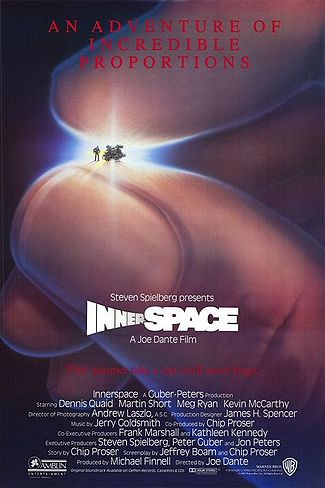
Innerspace, by Jeffrey Boam and Chip Proser (Warner Bros. et al.) | review by Jacob Edwards

Dir. Joe Dante. 1 July 1987 (Amblin Entertainment). Genre: SF Comedy. Ratings: 81% (Rotten Tomatoes) 6.7 (IMDB).

Obstreperous test pilot Tuck Pendleton (Dennis Quaid) volunteers for a miniaturisation experiment that should see him and his ship injected into the bloodstream of a laboratory rabbit. Instead, thanks to some industrial espionage gone badly wrong, he finds himself inside hypochondriac no-hoper Jack Putter (Martin Short). Aided by Pendleton’s ex-girlfriend, journalist Lydia Maxwell (Meg Ryan), and guided from within by Pendleton himself, Putter must overcome his inhibitions, thwart the villains and recover the microchip necessary to extract the ship before Pendleton’s oxygen runs out.

Friday, 8 July 2016

Life, the Universe and Everything, by Douglas Adams (MacMillan Audio) | review by Jacob Edwards

Laughter beyond fits.

Life, the Universe and Everything is a remarkable book, and not just for the cosmic pull-tab placed so aptly on its front cover. Like its predecessors it is an existential satire with vast and brilliant ideas. Like its predecessors it projects human foibles onto the whole of creation, thence to bounce back in a fatalistic and absurdly funny manner. And like its predecessors it indulges in a digressive, facetious and distinctly Adamsey disregard for the sanctity of traditional prose narrative. Unlike its predecessors it isn’t really a Hitchhiker’s novel.

Monday, 4 July 2016

Theaker's Quarterly Fiction #55: now out, in print and ebook!

free pdf | free epub | free mobi | print UK | print US | Kindle UK | Kindle US | review

Issue fifty-five of Theaker’s Quarterly Fiction is now out!

It is guest edited by the zine’s long-time cover artist, Howard Watts, and includes stories inspired by his art, including competition winner “The Departure” by Mark Lewis, “Our Sad Triangle” by Len Saculla, and “The Stone Gods of Superspace” by Howard Phillips (a TQF crossover special featuring many friends from past issues), plus the more tangentially related “This Alien I” by Antonella Coriander and “The Little Shop That Sold My Heart”, and an entire weird novella from Anthony Thomson, “My Place”. Then a sixty-page review section features the work of Stephen Theaker, Douglas J. Ogurek, Jacob Edwards, Howard Watts and Rafe McGregor. The cover art is by Howard Watts.

We look at the work of Alcatena, Andy Diggle, Brian K. Vaughan, Cherie Priest, David Tallerman, Douglas Adams, Frazer Irving, Geoff Johns, Grant Morrison, Guy Adams, Henry Flint, Jimmy Broxton, Joe Dever, John Wagner, Peter Tomasi, Phil Hester, Pia Guerra, Steve Yeowell and Tony Harris. Plus there are reviews of 10 Cloverfield Lane, Ash vs Evil Dead, Deadpool, Fallout 4, Fear the Walking Dead: Season 1, Gods of Egypt, Jessica Jones: Season 1, Sherlock: The Abominable Bride, The Boy and The Witch.

The spectacular wraparound cover art is, as ever, by the marvellous Howard Watts.


Here are the kindly contributors to this issue:

Anthony Thomson has an idea he lives in Brighton, but can never be sure. His short story “Burning Up” was published by ABeSea magazine. He’s influenced by the paintings of Leonora Carrington and Remedios Varos, and he mines the soundscapes of sixties music for psychedelic nuggets.

Antonella Coriander has never been happier. “This Alien I”, which appears in this issue, is the sixth episode of her ongoing Oulippean serial, Les aventures fantastiques de Beatrice et Veronique.

Len Saculla had a story entitled “Zom-Boyz Have All the Luck” in Theaker’s Quarterly Fiction #52. He has also had work published in the BFS Journal, Wordland, Unspoken Water and anthologies from Kind of a Hurricane Press in America. In 2015, he was nominated for a Pushcart Prize.

Mark Lewis has recently had work published in The Four Seasons anthology from Kind of a Hurricane Press, and in collaboration with fellow Clockhouse London Writers in The Masks anthology by Black Shuck Press. He has also had fiction and poetry widely published in the independent press, including the British Fantasy Society Journal, Escape Velocity, Scheherazade, Estronomicon, The Nail, and others. He has also written and performed in pantomimes. More of Mark’s writing can be found at: http://syntheticscribe.wordpress.com.

Douglas J. Ogurek’s work has appeared in the BFS Journal, The Literary Review, Morpheus Tales, Gone Lawn, and several anthologies. He lives in a Chicago suburb with the woman whose husband he is and their pit bull Phlegmpus Bilesnot. Douglas’s website can be found at: http://www.douglasjogurek.weebly.com.

Howard Phillips typed up the novella that appears in this issue, “The Stone Gods of Superspace”, after finding a draft version in his moleksine notebook. He does not remember writing it, and is not sure whether those events really happened or not.

Howard Watts is a writer, artist and composer living in Seaford who also provides the wraparound cover art for this issue. His artwork can be seen in its native resolution on his deviantart page: http://hswatts.deviantart.com. His novel The Master of Clouds is now available on Kindle.

Jacob Edwards also writes 42-word reviews for Derelict Space Sheep. This writer, poet and recovering lexiphanicist’s website is at www.jacobedwards.id.au. He has a Facebook page at www.facebook.
com/JacobEdwardsWriter, where he posts poems and the occasional oddity, and he can now be found on Twitter too: https://twitter.com/ToastyVogon.

Rafe McGregor has published over one hundred and twenty short stories, novellas, magazine articles, journal papers, and review essays. His work includes crime fiction, weird tales, military history, literary criticism, and academic philosophy.

Stephen Theaker’s reviews have appeared in Interzone, Black Static, Prism and the BFS Journal, as well as clogging up our pages. He shares his home with three slightly smaller Theakers, runs the British Fantasy Awards, and works in legal and medical publishing.


As ever, all back issues of Theaker’s Quarterly Fiction are available for free download.

Friday, 25 March 2016

Star Wars: The Force Awakens, by Lawrence Kasdan and chums | review by Jacob Edwards [spoilers]

Déjàvooine Sunrise.

Star Wars Episode VII: The Force Awakens (if we may be allowed a scrolling preamble) has been released with considerable fanfare and after much anticipation. Like the birth of Prince George, Duke of Cambridge, its arrival brings together a nation of fans united in pride, patriotism, hope and nostalgia (and, be warned, young George, with a bevy of concealed weapons held at the ready). At last! A renewal of the franchise that blew up the box office in 1977 and grew quickly to become – for some people quite literally – a cinematic religion. But those who queue for midnight screenings do so with some trepidation. Given the false dawn of the prequelogy (Episodes I–III), will this merely be more of the tepid same? How will the new film tie in with the Expanded Star Wars Universe? Will the original characters return and stay true to memory three decades on? Will director J.J. Abrams bring with him an unconscionable crosspollination from the Star Trek franchise? In short, will Star Wars survive its metamorphosis to the post-Lucas era? The story continues…

Friday, 18 March 2016

Stoker’s Manuscript, by Royce Prouty (G.P. Putnam’s Sons) | review by Jacob Edwards

Neither fading nor impaling into insignificance.

There are numerous ways to kill a vampire; somewhat fewer to keep him dead. Many a blood-curdling tale has been told. But the modern brow frowns upon capital punishment, so nowadays we prefer neutering (in the sense of making something ineffective). We strap vampires to the operating table and infuse them with a ghastly blend of garlic sauce and teenage hormones. We turn them into that which they most despise.

Friday, 11 March 2016

The Shepherd’s Crown, by Terry Pratchett (Harper) | review by Jacob Edwards

A Wickerword basket.

Terry Pratchett – author and humorist; a writer of such immense popularity, his books for many years topped Britain’s most-stolen tally; the man who armed Death with laconic wit and a scythe and made him a recurring character – is dead. This of course was inevitable. THERE CAN BE NO EXCEPTIONS. But for all that Pratchett’s passing will leave a vacuum to be filled in the New York Times bestseller lists and the reading lives of millions of devoted followers, let us not mourn overmuch; rather, we should cherish the years he gave us and scrump one last time from the verdant pages of a new Discworld novel: a gentle, bittersweet celebration.

Friday, 4 March 2016

Savages, by K.J. Parker (Subterranean Press) | review by Jacob Edwards

“The end of the world began with a goat…”

Savages, for want of better terminology, is a down-to-earth epic historical fantasy wherein a once-mighty empire hangs in the balance, its waning existence threatened by not-so-proverbial (in fact, ever-so-practical) barbarians at the gate. K.J. Parker threads together several storylines in exploring this scenario, primary of which are those of Raffen, a chieftain whose loss of identity affords him freedom to turn his hand to any craft; Calojan, an imperial general with a self-fulfilling reputation for invincibility; and Aimeric, a pacifist turned arms-maker and politician, upon whose wiles may rest not only the future of the city but also a watertight case for prosecution by cosmic irony. Parker avoids playing favourites, and so each player holds the reader’s sympathies in conjunction with the spotlight, this perspective switching subtly whenever one is placed in opposition to another. Such protagonistic ambiguity – a load-bearing device that feeds credence back into the narrative mechanism – is a feature of Parker’s novels, and allows the possible storylines to unfold without prejudice. Whatever happens will happen.

Friday, 26 February 2016

Theaker's Quarterly Fiction #54: now out!

free pdf | free epub | free mobi | print UK | print US | Kindle UK | Kindle US | review | review

Theaker’s Quarterly Fiction #54 is here. It features a new short story by Charles Wilkinson, “Septs”, and an entire novella – complete in this issue! – by Patrick Whittaker, former winner of the BFS Short Story Competition. “The Policeman and the Silence” concerns a murder investigation in the weird town of Kaza-Blanka. I think you’ll love both stories. The issue also includes a tremendously exciting editorial where I (a) apologise for this issue being late, (b) talk about a publisher who doesn’t pay their reviewers slamming people who don’t pay other types of writer, and (c) look back at my reading in 2015. The issue also includes thirty-one reviews, by Douglas J. Ogurek, Jacob Edwards and me.

We look at the work of Charles Chilton, Felicia Day, Warren Ellis, Johann Peter Hebel, K.J. Parker, Terry Pratchett, H.G. Wells, Royce Prouty, Malcolm C. Lyons, Pu Songling, Sam Dyer, Leo, Garth Ennis and John McCrea, Brian Clevinger and Scott Wegener, CLAMP, Robbie Morrison and Brian Williamson, Keith Giffen and Robert Loren Fleming, Alexandro Jodorowsky and Zoran Janjetov, and Brian K. Vaughan and Pia Guerra. Plus there are reviews of Ant-Man, Goosebumps, The Green Inferno, The Hunger Games: Mockingjay, Part 2, Krampus, Star Wars: The Force Awakens (twice), The Visit, Trials Fusion Awesome Max Edition, Arrow Season 2, Doctor Who Season 9, and The Flash Season 1.

The amazing wraparound cover art is, as ever, by the marvellous Howard Watts.


Here are the kindly contributors to this issue:

Charles Wilkinson’s books have included The Pain Tree and Other Stories (London Magazine Editions) and Ag & Au, a pamphlet of his poems. His stories have appeared in Best Short Stories 1990 (Heinemann), Best English Short Stories 2 (W.W. Norton), Unthology (Unthank Books), Best British Short Stories 2015 (Salt), London Magazine, Under the Radar, Prole, Able Muse Review, Ninth Letter, The Sea in Birmingham and in genre magazines/anthologies such as Supernatural Tales, Horror Without Victims (Megazanthus Press), Rustblind and Silverbright (Eibonvale Press), Phantom Drift (USA), Bourbon Penn (USA), Shadows & Tall Trees, Prole, Nightscript and Best Weird Fiction 2015 (Undertow Books). He lives in Powys, Wales, where he is heavily outnumbered by members of the ovine community. A Twist in the Eye, his collection of strange tales and weird fiction, is forthcoming from Egaeus Press. Several of the stories first appeared in Theaker’s Quarterly Fiction.

Douglas J. Ogurek’s work has appeared in the BFS Journal, The Literary Review, Morpheus Tales, Gone Lawn, and several anthologies. He lives in a Chicago suburb with the woman whose husband he is and their pit bull Phlegmpus Bilesnot. Douglas’s website can be found at: http://www.douglasjogurek.weebly.com.

Howard Watts is a writer, artist and composer living in Seaford who also provides the wraparound cover art for this issue. His artwork can be seen in its native resolution on his deviantart page: http://hswatts.deviantart.com. His novel The Master of Clouds is now available on Kindle.

Jacob Edwards also writes 42-word reviews for Derelict Space Sheep. This writer, poet and recovering lexiphanicist’s website is at http://www.jacobedwards.id.au. He has a Facebook page at http://www.facebook.com/JacobEdwardsWriter, where he posts poems and the occasional oddity.

Patrick Whittaker has made the occasional foray into short film making and has two feature film scripts in pre-production. Two of his shorts – The Raven and Raspberry Ripple – have won awards. He has an honours degree in Media Production. In 2009, he won the British Fantasy Society Short Story Competition with “Dead Astronauts”, a tale of odd goings-on in English suburbia. His dystopian novel, Sybernika, is published by Philistine Press: http://www.philistinepress.com.

Stephen Theaker’s reviews have appeared in Interzone, Black Static, Prism and the BFS Journal, as well as clogging up our pages. He shares his home with three slightly smaller Theakers, runs the British Fantasy Awards, and works in legal, medical and political publishing.


As ever, all back issues of Theaker’s Quarterly Fiction are available for free download.

Monday, 25 January 2016

Terminator Genisys, by Laeta Kalogridis and Patrick Lussier (Paramount) | review

Tirmynator Genisys: the best misspelling since slyced bred.

Yes, let’s start with the obvious gripe: Genisys. Originally the film was titled Genesis, then someone made the executive decision (absolute power corrupting absolutely) to change/distort/pervert it, presumably working under the delusion that misspelling something makes it stand out in a good way. One wonders how the original Terminator would have fared had Sarah Connor been misspelled in Skynet’s records. The T-1000 would have opened up the phone directory and had a meltdown. Where is S’air-a Conher? Target cannot be acquired. And why? (We bang our heads against the nearest busborne billboard.) Why subscribe to this wanton degradation of language? The only explanation that doesn’t leave the producers hanging their heads in shame is that the alphabetic disparity between Genesis and Genisys is intended to mirror the narrative disparity between the events of the first Terminator movie and their retrofitting in this latest offering. In which case, well played… but a propensity for randomising still seems the more likely cause! Watch out for Terminator 6, where Skynet, unable to destroy humanity by conventional means, sends a T-3000 back to 12 May 1754 to kill Samuel Johnson. Without his dictionary to unite them, the Resistance of the future is torn apart by wilful misspellings.