Showing posts with label PS Publishing. Show all posts

Friday, 11 October 2024

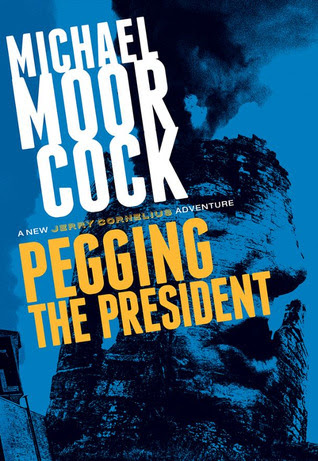
Pegging the President by Michael Moorcock (PS Publishing) | review by Stephen Theaker

This review originally appeared in TQF64 (March 2019).

Like other Jerry Cornelius stories, this brand new novella is a collage of in-jokes, allusions and references, and I doubt I caught more than one in ten of them. Your taste for that kind of thing will have a big effect on how much you enjoy the book. When I first read the Cornelius books, I found all of that funny because it seemed so random, cool and quirky. And even though I’m more used to the techniques being used, I still appreciate it. But I’m not going to pretend that I had a particularly good idea of what was going on in the story. What I did gather was that Jerry Cornelius, his friends, his family and his enemies, seemed to be slipping around in time, through different future and alternate history wars. All the favourites from the books show up: his sister Catherine Cornelius, Una Persson, Miss Brunner, Colonel Pyat, Shakey Mo, Jerry’s mum and dad, Cuban heels, Derry & Tom’s Famous Roof Garden. Even the famous needle gun makes an appearance. Jerry is still young, even though fifty years have (perhaps) passed, and he is able to do things like materialising in the seat of a car that someone else is driving. “The difference between fact and fiction”, Jerry comes to understand at one point, “[was] irretrievably blurred.” Each chapter begins with an extract: there are news items about the war in Syria, for example, and an extensive amount of It Can’t Happen Here by Sinclair Lewis, which has obvious relevance to present-day events in the USA: a capricious president who longs for the absolute power of a dictator, and a significant portion of the population also wishes he had it. It does break up the story a lot, though, and it feels as if you spend more time on the extracts than the adventure. It doesn’t help that a few of the extracts appear more than once, although that does reinforce the message. We thought we had set the ball rolling, thinks Jerry, but “all we’d done is start the pendulum”. Fans are likely to enjoy it very much, and I think it makes a pretty good entry point for those new to Jerry Cornelius – it’s no easier than the others, but it does give you a good idea of what they are like. Stephen Theaker ****

Monday, 18 September 2023

Anchor’s Heart, by Cavan Scott (Absinthe Books) | review by Stephen Theaker

Cavan Scott is a well-regarded and astonishingly productive writer of media tie-ins. A search for his name on Goodreads or Amazon brings up a panoply of books, comics and audioplay spin-offs for Doctor Who, Star Wars, Pacific Rim, Judge Dredd, War
hammer, Transformers, Assassin’s Creed, Sherlock Holmes and the Teen Titans. He was even credited, in the most recent issue of Empire magazine I read, for inspiring an upcoming Star Wars television series. This novella, however, is set in a universe of his own creation, and it’s rather a glum place.

Mark Poole is a paramedic who after seven years on the job took a call that left him seriously traumatised. He wasn’t responsible for the death, but that only seems to have made it worse. If he had messed up, he could learn to do better next time, but the inevitability of such moments, of turning up to find dead bodies, of how often it happened during the pandemic, was too much for him. And now four months later he’s staying home, helping Beryl from the downstairs apartment with her gardening. He starts to hear music no one else can hear, has visions of disturbingly erotic artwork, and becomes convinced that someone in the house next door needs his help.

I didn’t enjoy this book as much as I had hoped, given the excellent track record of PS Publishing when it comes to novellas. (Absinthe Books is a boutique PS Publishing imprint run by Marie O’Regan, who also provides a brief introduction to the book.) It isn’t terrible, but for me it didn’t rise above being a three-star book, a readable enough slice of horror that never really takes off. Part of the problem is that it’s told in the first person present tense, and Mark isn’t a very interesting narrator. His phrasing is quite humdrum (“The most I know about him is that his car is an absolute beauty”) and when describing sexual stuff his language can be off-puttingly pornified. He frequently uses short one-sentence paragraphs for dramatic effect and they tend to fall flat.

Another problem for me was that although Mark is obviously not in his right mind during the events of the story, his actions often beggar belief. As a health worker, he would have been on as many safeguarding courses as any of us. Despite the supernatural elements, he should have known perfectly well how best to go about raising the alarm over what he believes to be a mistreated child. The lack of consequences for his actions also bothered me. For example, at one point he persuades his sister, a GP, to access a patient’s medical records, with serious consequences for the patient, but none for Mark or his sister.

But the book does have its strengths. It’s very good at conveying Mark’s mounting frustration, and the reader can only share his distress as things get worse for him rather than better. It realistically portrays the way his relationships (with Beryl, Jason in the apartment upstairs, and his sister) crumble under the pressure of his obsession with the house next door. The short, intense chapters encourage the reader to share his sense of panic, since there’s never enough time in them for anything to be fixed. And the book’s revelations end up being not quite what one expects. Dedicated horror fans may find that it provides a satisfying enough portion of what they want from a book. Stephen Theaker ***


This review originally appeared on the previous version of the British Fantasy Society's website, and then in Theaker's Quarterly Fiction #72. The book is available in signed and unsigned editions from PS Publishing.

Saturday, 15 September 2018

Waking in Winter, by Deborah Biancotti (PS Publishing) | review by Stephen Theaker

In this science fantasy novella, reminiscent in good ways of Whiteout or The Thing, Muir is working on an alien planet, part of a group of glacionauts working from the Base Station. She’s a couple of days away from going home, though she isn’t keen because her mother’s funeral awaits. On what would have been one of her last trips in her twin-seater flying Otter she sees something under the ice: a gigantic woman, a mermaid with a six-metre-wide tail and miles of hair. She assumes it’s been carved into the ice, but when other team members look at it they each see something different, something rooted in their own cultural heritage. No one wants to talk about it, and Muir doesn’t think it’s a good thing. When a colleague says he sees a lotus flower, “Muir felt something slip inside her. The beginning of an avalanche.” The book never lets us forget how cold it is there, so the reader understands very quickly how dangerous the situation could become. There are only two days until winter sets in, and it’s going to get dark, but her colleagues are keen to dig up what they can. As you might imagine, that’s a mistake. I enjoyed this a lot: it was frightening, and awe-inspiring, and very good at showing how co-workers who spend too much time together can wind each other up. Available here.  ****

Monday, 4 September 2017

A Wizard’s Henchman by Matthew Hughes (PS Publishing) | review by Stephen Theaker

For those readers who have had the immense pleasure of reading several of this author’s Archonate books, A Wizard’s Henchman is simply unmissable. Over many short stories, novellas and novels we have been shown a universe on the point of collapse, rapidly approaching the point at which reality will flip, from being based like ours (one hopes) on scientific principles to being ruled instead by magic, or, to be more precise, by the will. Some books have shown magic bleeding through, and others have even taken us into the future for a brief glimpse of what is to come, but this is where it actually happens! It is very abrupt. Flying cars fall out of the sky. Buildings collapse. People starve. But not our protagonist. Knowing a little bit about what is going to happen, he gloms on to a promising candidate for wizardship and keeps him safe while he prepares and later learns to use his new powers. Less pleasant magic users are also making their play, and the denizens of other dimensional planes are also ready to take advantage of the new status quo. The book offers a comfortingly familiar mix of science fiction, fantasy and mystery, while never being reluctant to offer a shocking image or idea when appropriate. It gives us a protagonist for whom self-preservation is at first a priority, but who grows in stature into a true hero, in large part thanks to his determination to adapt and learn. A brilliant book, probably my favourite new book of 2016. *****

Monday, 7 August 2017

Letters to Arkham: The Letters of Ramsey Campbell and August Derleth, 1961–1971, edited by S.T. Joshi (PS Publishing) | review by Stephen Theaker

This book collects the correspondence (or so much of it as remains) from the 1960s between the prolific writer and editor August Derleth and the young Ramsey Campbell. The latter would go on to be a titan of the horror world, and the former already was, his publishing of H.P. Lovecraft’s work in hardback having done a great deal to cement that writer’s reputation. The letters are often fascinating. Campbell, fifteen at first, is importunate, full of questions – reminding us that this was a time when you couldn’t simply look things up on the internet – a virgin, somewhat testy and defensive. August Derleth, much older, is sexually omnivorous, patronising, encouraging, and exceedingly free with his opinions. One thing I had noted reading Derleth’s pastoral Sac Prairie Journal immediately before this is that August Derleth’s romantic life is completely absent from its pages, and these letters make it obvious why: he was having it off with whoever he could! Given that the letters are remarkably revealing, it’s a credit to Ramsey Campbell and to the literary estate of August Derleth that their publication was allowed. That the book would be edited by Lovecraft scholar S.T. Joshi must have helped in that regard, and he provides very useful footnotes to the letters, supplying information about everything from incorrect film titles (there is a great deal of film chat) to whether planned titles from both writers were ever published, and if so in what form and under what titles. One of their favourite topics of conversation is films, and reading the book now, when so much of cinema’s rich history is available for a few pounds and a couple of clicks, it’s almost shaming to see the lengths to which the two of them go to watch really good films, travelling for hours to get to a particular cinema on the one night that film would be shown. Since reading the book I’ve certainly been making more of an effort to watch better quality films. It’s essential reading for fans of either writer, and very interesting reading for everyone else. ****

Wednesday, 16 November 2016

The Last Weekend, by Nick Mamatas (PS Publishing) | review by Stephen Theaker

Even before the collapse, Vasilis Kostopolos was not a nice guy, and not a happy guy either. A self-loathing alcoholic who follows an ex-girlfriend to Boston, who follows random women on the subway while abusing them in his mind, who doesn’t mind if the money he spends on drink helps fund the IRA, he ends up in San Francisco, a surprisingly good place to be when the dead start to rise. There are no cemeteries there, and the zombies struggle with the big hills. He’s a writer, and he can prove that with the print-out of his one published story that he keeps in his pocket at all times, but he takes a job as a driller. When the dying seem likely to turn, he gets a call. If he’s lucky, he gets there once they’re dead but before they’ve revived, but he’s rarely lucky. Turns out he’s pretty good at the job, or at least he doesn’t quit or get eaten. He’s a guy who spent his “adult life trying to avoid adult life, living a simplified version of it without dreams of a family”. Before the collapse he would consider killing himself “a dozen times a day, maybe more”. So when everything falls apart for everyone else (at least in the USA; nowhere else seems to be affected) he copes pretty well, his life hasn’t got much worse. (Also a theme of the later show Fear the Walking Dead, where a junkie adapts better to the apocalypse than the rest of his family.) He even starts to meet women: Alexa, who shoots a boy who jumps out at them, pretending to be a zombie; Thunder, a friend of the dead boy who shamelessly steals Vasilis’s stuff; Jaffe, a civil servant who kept on serving after the collapse. Thunder and Alexa share a desire to get to the bottom of things, to uncover the mysteries of the apocalypse, to find out what the government (such as it is) is hiding, and Vassily gets mixed up in their plans despite himself. This is a terrific book, the kind of thing you might expect if McSweeney’s had a horror imprint, intelligent, provoking, self-aware, and full of interesting ideas. You wouldn’t ever want to be this guy, as a writer, or as a human being, but you can understand why he survives, and why it takes the breakdown of human society for him to write his great American novel. ****

Friday, 10 July 2015

Book notes #8

Notes and ratings from TQF50 and TQF51 for books I didn’t review for TQF. Credits from Goodreads; apologies to anyone miscredited or missing.

Magnus Robot Fighter Archive, Vol. 2 (Dark Horse Comics), by Russ Manning and Philip Simon. Collection of old comics about a guy with super-strength who battles robots who go bad, and when necessary the people who control them. Notable for Russ Manning’s art and the way the bad robots shout “Squeee!” when he knocks off their heads. ***

Nemo: The Roses of Berlin (Top Shelf Productions), by Alan Moore and Kevin O’Neill. These short Nemo books in the world of the League of Extraordinary Gentlemen are instant purchases for me. This one brings in characters from Metropolis and The Great Dictator. ****

Of Whimsies & Noubles (PS Publishing), by Matthew Hughes. Another fabulous Luff Imbry novella. In this one he is apprehended and sent to a prison world. ****

Planet of the Apes, Vol. 1: The Long War (BOOM! Studios), by Daryl Gregory. Set in the continuity (if you can call it that) of the original film series, this was okay but not much fun. ***

Rat Queens, Vol. 1: Sass & Sorcery (Image Comics), by Kurtis J. Wiebe and Roc Upchurch. Funny comic about a group of adventurers whose world is modelled after our world’s roleplaying games. ****

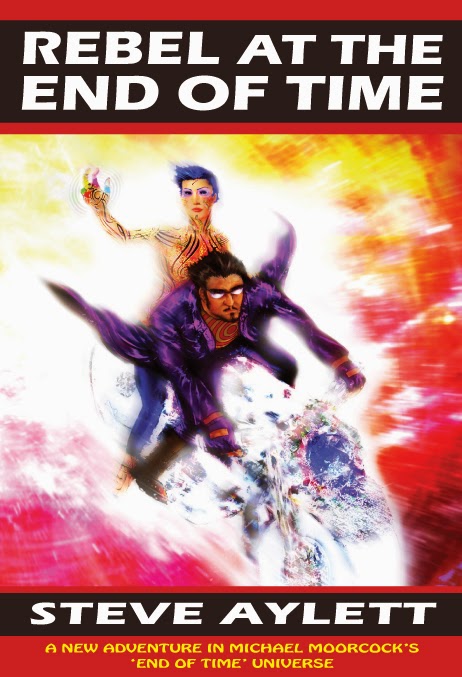
Rebel at the End of Time (PS Publishing), by Steve Aylett and Michael Moorcock. A short novel which throws Leo Del Toro, a 21st century Che Guevera, into the bewildering world of Michael Moorcock’s brilliant Dancers at the End of Time trilogy, where he must battle his despair among people for whom action is meaningless, novelty everything. The difficulty of reading the story comes from the misunderstandings of the people of the future, which leads to surprises in every sentence. Aylett’s story is a great addition to the End of Time, in that it shows us (or speculates on) how a different type of protagonist would handle it. The great man himself Michael Moorcock contributes a twenty-page story to the book, “Sumptuous Dress”, which comes close to causing a meltdown in the space-time continuum by crossing the end of time with the equally confusing Second Ether, producing more bafflement than most readers will be able to bear in a single story ****

Secret Lives (Cheeky Frawg Books), by Jeff VanderMeer. A series of stories written for and about the people who bought the special edition of one of the author’s other books. Not at all as throwaway as their provenance might lead you to expect; some stories are downright excellent. ***

Showcase Presents: Superman Family, Vol. 3 (DC Comics) by Otto Binder, Robert Bernstein, Curt Swan, Stan Kaye, Ray Burnley, Kurt Schaffenberger, Wayne Boring, Dick Sprang, John Forte, Creig Flessel and Al Plastino. I could barely read a page of this without thinking, what the hell, Superman? The description of Descartes’ evil demon fits him perfectly: “as clever and deceitful as he is powerful, who has directed his entire effort to misleading [Lois and Jimmy]”. Here are just a few examples. In “Lois Lane’s Super-Perfume” he proposes marriage to Lois – and then takes it back. It was a ruse to trap some swindlers! In “Three Nights at the Fortress of Solitude” he uses a robot to spank her so hard she can’t sit down the next day! And in “The Cry-Baby of Metropolis” he lets her go through the terror of reverting to a baby while pretending he doesn’t know she’s the baby, to teach her a lesson about inquisitiveness! Sometimes he’s astonishingly reckless: in “The Shocking Secret of Lois Lane” he throws two drill-saws at her head to remove a box she’s using as a mask! It’s so sexist: in “Lois Lane’s Signal Watch” Superman gives her an emergency watch just like Jimmy Olsen’s. She summons the Man of Steel to unstick the zipper on her purse… ***

Sin City, Vol. 3: The Big Fat Kill (Dark Horse Comics), by Frank Miller. The last book I read by Frank Miller was so bad that I’d almost forgotten how good he can be. ****

Sin City, Vol. 6: Booze, Broads & Bullets (Dark Horse Comics), by Frank Miller. Short stories collected from various Sin City one-shots. ***

Smiler’s Fair (Hodder & Stoughton), by Rebecca Levene. Slightly disappointing and unimaginative fantasy. Reviewed for Interzone #254. ***

Star Trek: New Visions (IDW Publishing), by John Byrne. Photo-stories based on the original TV series. Not as much fun as expected. Lots of recapping. **

Friday, 26 June 2015

Book notes #6

Notes and ratings from TQF50 and TQF51 for books I didn’t review. Credits from Goodreads; apologies to anyone miscredited or missing.

Fear Itself (Marvel), by Matt Fraction and Stuart Immonen. An underwhelming crossover story. Odin has given up on Earth, but Thor and the Avengers think there is still hope. ***

G.I. Joe: Classics, Vol. 4 (IDW Publishing), by Larry Hama, Rod Whigham, Frank Springer, Mark Bright, Bob Camp and Rod Wigham. Collection of Marvel’s attempt to create decent comics based on the daft soldier toys. ***

God Rest Ye Merry, Gentlepig (Beale-Williams Enterprise) by Tad Williams. A novella about an angel advocate trying to help out a werewolf client. ***

God’s War (Del Rey), by Kameron Hurley. Grimdark science fiction about an unlikeable mercenary and her gang. Nyx used to be a Bel Dame, sent by the government to take the heads of boys running away from the war, but now she’s freelance. Her world is one of strong religion and what seems to us like magic, where insect life is the basis for technology and wombs can be dropped off at organ banks to avoid putting them in any danger. It’s a bit of a grind, full of torture, misery, and characters who hate each other, but it was good. Reminded me of things like John Carpenter’s Escape from New York and Roger Zelazny’s Damnation Alley. A bit like 2000AD if it were written by John Brunner instead of Pat Mills & co. ***

Gorel and the Pot-Bellied God (PS Publishing), by Lavie Tidhar. Not, as a previous issue of this magazine had it, Gorel and the Pot-Bellied Pig! This is, as its subtitle tells us, a guns and sorcery novella. Gorel was “cast out of Goliris”, “exiled to the harsh lands of Lower Kidron”, where he makes his way as a hired hand, riding an insectoid Graal, hoping always to return home to avenge his family and punish his betrayers. In this story he encounters the froggish falang and the god they worship. This novella dates back to 2011, and ever since this review has glared balefully at me, even while I’ve reviewed several of the author’s other books. That was just because I read it quickly in amongst a bunch of other books, not because I didn’t enjoy it enough to write a review. Far from it: I thought this was terrific, and began a run of Tidhar’s books that have made him one of my favourite authors. It’s an extremely interesting book, reminding me of Elric in the way it attacks the conventions of the genre. You read it assuming that Gorel is a Conan-type hero, but as he does bad things it’s almost as if the author is saying, this is your hero? He’s a drug addict, injecting himself with gods’ dust, and he’s still your hero? What about when he does this? Or this?! How bad can a badass hero get before the reader stops admiring them? ****

Guardians of the Galaxy, Vol. 1: Cosmic Avengers (Marvel) by Brian Michael Bendis, Steve McNiven, Sara Pichelli, Michael Avon Oeming and many others. This shows up as a 350pp book on Comixology, so I was expecting an epic in the style of DC’s three-issue crossover Invasion. Sadly not; most of it is a series of single panel guided view strips; the real story is only ninety pages or so. Lacks the verve of the Abnett and Lanning series, but the art is nice. ***

Guardians of the Galaxy, Vol. 1: Legacy (Marvel), by Dan Abnett, Andy Lanning, Paul Pelletier. Inspiration for the film, with a similar spark. Here the new Guardians assemble in the aftermath of a galactic crisis. ***

Friday, 29 May 2015

Book notes #2

Notes and ratings from TQF50 and TQF51 for books I didn’t review for TQF. Credits from Goodreads; apologies to anyone miscredited or missing.

Axe Cop, Vol 2: Bad Guy Earth (Dark Horse Comics), by Malachai Nicolle and Ethan Nicolle. Nothing could ever be quite as hilarious as Axe Cop, Vol. 1, which made me laugh so much the sides of my eyes were sore for days from wiping away the tears, and this isn’t, but it comes pretty close. Axe Cop and friends have to battle two psychic bad guys who want to turn everyone on Earth into bad guys. Written by a little kid and drawn by his grown-up brother, this does a great job of harnessing the imaginative fireworks that go off whenever children start to rattle off stories. ****

Baltimore, Vol. 2: The Curse Bells (Dark Horse Books) by Mike Mignola, Christopher Golden and Ben Stenbeck. A story in five chapters, which begins with a betrayal in Lucerne. Baltimore searches for the vampire Haigus, who he first encountered on the bloodstained fields of World War One. ***

Baltimore, Vol. 3: A Passing Stranger (Dark Horse Books) by Mike Mignola, Christopher Golden and Ben Stenbeck. Lord Baltimore fights his way through five short stories, hunting for his hated enemy. ***

Batman: The Black Mirror (DC Comics), by Scott Snyder, Jock, Francesco Francavilla. Good story about Batman (Dick Grayson, who I think might be my favourite Batman) fighting a weird secret society. ***

Be a Sex-Writing Strumpet (self-published) by Stacia Kane. Reading this didn’t half make me blush. It compiles a series of blog posts on the subject of writing sex scenes, principally for erotic novels. I don’t often include that stuff in my writing, but I’d read some sensible blog posts on responding to reviews by the author and wanted to buy something of hers. And it was useful to me: much of what she says can be applied to other kinds of action. It’s good, though some readers may feel it could have used a rewrite to make it more bookish and less bloggy. ***

Billy’s Book (PS Publishing) by Terry Bisson. A short PS Publishing collection of deliberately fragmentary and repetitive stories about a boy who has odd stuff turn up at his house, like giant ants and wizards and unicorns. They’re okay, but it was a bit of a surprise at the end to see what starry venues they had originally appeared in. ***

Black and Brown Planets: The Politics of Race in Science Fiction (University Press of Mississippi), by Isiah Lavender III (ed.). Interesting book of essays. Two about one episode of Star Trek: Deep Space 9 are maybe a bit much, and given the title it seems odd that it doesn’t cover India, the country that might well come to lead the space race (the “Brown” section is more about South America), but I learnt a lot from it. Like any book of literary criticism, it can be dull, but that’s outweighed by the issues, authors and stories it works so carefully to bring to our attention. A few essays make great claims without much evidence, but all provide much to think about; it opens up the conversation, rather than having the last word. Walter Mosley is quoted inside as saying: “The power of science fiction is that it can tear down the walls and windows, the artifice and laws by changing the logic, empowering the disenfranchised or simply by asking, What if?” Black and Brown Planets shows how writers and critics are doing just that. Reviewed in full for Interzone #255. ****

Black Science, Vol. 1: How to Fall Forever (Image Comics), by Rick Remender, Matteo Scalera, Dean White. Begins with a pair of scientists dashing through a bizarre alien world, desperate to get back to the children who will die if they don’t get back in time. As the story goes on, it begins to feel a bit like Sliders or Primeval, one of those shows where characters pitch up in a place and have to get out again. It’s better than either of those so far, let’s hope that continues. The art is spectacular. ***

Monday, 16 March 2015

Black Gods Kiss by Lavie Tidhar | review by Stephen Theaker

If I were a judge and this were a court and the case were that of Black Gods Kiss by Lavie Tidhar (PS Publishing, 184pp), I would have to recuse myself, because by this point I am such a fan of this writer’s work that my impartiality would be in serious doubt. Cloud Permutations, Martian Sands, The Violent Century: each has been remarkable in its very own way. If I were writing a list of my favourite books of the last few years they would all show up on it.

Monday, 10 November 2014

The Wurms of Blearmouth by Steven Erikson / review by Stephen Theaker

Lord Fangatooth Claw the Render, insane lord sorceror of West Elingarth’s Forgotten Holding, celebrates dominion over Spendrugle village with daily tortures of his brother, his rule upheld by three iron golems with buckets for heads, at least one of whom took him five months to create. By his law, being a stranger is punishable by death, which suits the villagers since it leaves no survivors of the shipwrecks from which they draw their pocket money. But the new folks brought in by the tide are the kind that take a fair bit of killing. Most dangerous are the first to arrive: Bauchelain and Korbal Broach, necromancers, one sharp and expansive, the other taciturn and brutal, both ready to kill at the twitch of an eye.

Monday, 25 November 2013

The Last Revelation of Gla’aki by Ramsey Campbell, reviewed by Stephen Theaker

Leonard Fairman is an archivist at Brichester University, whose unwise curiosity regarding a series of occult volumes leads to his involvement in the events described by Ramsey Campbell in The Last Revelation of Gla’aki (PS Publishing, hb, 137pp; pdf ARC supplied by publisher). He is invited by Frank Lunt to Gulshaw, a run-down seaside town, to collect the series, which includes such titles as Of Humanity as Chrysalis, Of the World as Lair, On the Purposes of Night, and Of the Uses of the Dead. But Lunt has just one volume, and directs Fairman to the possessor of the next, and so it goes. Reading each of the books brings on strange thoughts and visions, and Fairman becomes desperate to leave this strange, damp, sticky little town. But everyone seems awfully pleased to have him there, and as they say: “there is so much more to see”. Or is it that there’s so much more to sea?

Monday, 3 June 2013

Martian Sands by Lavie Tidhar, reviewed by Stephen Theaker

In Martian Sands by Lavie Tidhar (PS Publishing, hb, 224pp), Mars has been settled. The New Israelis are governed by a succession of simulacra, Jewish leaders of the past recreated to act as figurehead prime ministers, but their new Golda Meir isn’t sticking to her programming. “Something is fundamentally flawed with reality,” she tells Miriam Elezra, the woman who commissioned her. There are rumours of time travel experiments, rumours the reader knows to be true having already seen Bill Glimmung in the Oval Office on December 7, 1941, the day before the first death camp opens, offering weapons to Franklin Delano Roosevelt in return for preventing the Holocaust. And yet on Mars we see that Bill Glimmung is a character from the film Martian Sands, “Elvis Mandela’s second masterpiece”. Carl Stone, who built the Golda, has four arms, two extras grafted on to reflect his status as “a Martian warrior, reincarnated in an alien world”. His Revolutionary Brotherhood of Martian Warriors share Barsoomian dreams, visions supposedly sent by their emperor. The most mysterious beings on Mars are the Others, artificial intelligences sometimes ferried by compliant humans, sometimes controlling host bodies. All roads lead to a remote kibbutz in the FDR mountains, the same kibbutz to which Josh has just made the kind of manure sale that could do wonders for his career.

Friday, 11 January 2013

The Yellow Cabochon, by Matthew Hughes – reviewed by Stephen Theaker

The Yellow Cabochon (PS Publishing, hb, 93pp) is a novella in the far-future Archonate setting frequented by one of my favourite writers of the moment, Matthew Hughes (see issue TQF39 for an interview and reviews of three excellent novels). It follows on from the marvellous Quartet & Triptych (reviewed in TQF34), being a new adventure in the life of Luff Imbry, the master thief with the extra large waist – “the fat man”, as the narrator very frequently (and slightly upsettingly, for those of us on the wrong side of the scales!) chooses to call him.

Wednesday, 5 December 2012

Interzone #243 (ft. Theaker) – out on Kindle

The latest issue of Interzone is now out on Kindle. It features fiction by Jon Wallace, Jason Sanford, Priya Sharma, Chen Qiufan and Caroline M. Yachim, colour illustrations by Richard Wagner, Warwick Fraser-Coombe, and Martin Hanford, an interview with Adam Roberts, and much more.

But of course the very, very best reason to buy it is that it also features a review by me, of The Wurms of Blearmouth, Steven Erikson's latest Bauchelain and Korbal Broach novella.

Links:

Interzone #243 on Kindle UK
Interzone #243 on Kindle US
Print subscriptions to Interzone (and other TTA magazines)
The Wurms of Blearmouth on PS Publishing's website

Friday, 7 September 2012

A Woman of Mars by Helen Patrice – reviewed by Stephen Theaker

A Woman of Mars, by Helen Patrice (hb, 48pp, available here) is the sixth collection of poetry from PS Publishing’s Stanza imprint, telling the story of a fifteen year-old girl who falls for a handsome twenty-six year-old astronaut—“Only from within his eyes, / did I see clear / for the first time, / a future of steel and stars” (“The Stirring”)—and travels to Mars in the spaceship he pilots to join the founding of a colony. Hence the subtitle: the poems of an early homesteader. The story it tells, of dust storms, disasters and terraforming, isn’t particularly novel, but its point of view is, as shown by the title: she’s a woman of Mars, not a princess, warlord or god; it’s the story of what a normal life might be like, lived on Mars, coping with life and with death, and the subtitle suggests that these are not just poems about her, they are to be taken as poems by her. Not every poem is in the first person—“Buried”, for example, imagines a series of messages sent out to Station five during a sandstorm (“Mining station five, / the storm is abating. / What is your status?”)—but most are, and we see both old and new Mars through the prism of her life and relationships.

Friday, 2 September 2011

Ventriloquism by Catherynne M. Valente, reviewed by Stephen Theaker

Envying your children doesn’t look good on a parent. My daughter has given five-star ratings to 37 books so far this year, while I've only done it once, with The Art of McSweeney's. I’ve slightly begrudged her the thrill of finding something new and wonderful in almost every single book she reads. At one point I began to wonder, was I losing the ability to be impressed to that extent by a book? Thank goodness for Ventriloquism, which makes it clear that if I want to be impressed, I’ve been reading the wrong books! All thirty-two of the stories in this collection surprised and challenged me with language, allusion and form, and gave me the unmistakable pleasure that comes from reading something I had never read before.

Monday, 29 August 2011

Stonewielder, Volume I, by Ian Cameron Esslemont - reviewed by Stephen Theaker

I read quite a lot of heroic fantasy as a youngster: Tolkien, Eddings, Brooks, Conan (mostly spin-offs rather than the Howard originals, I’m afraid), Donaldson, Leiber and lots and lots of Moorcock. I kind of fell away from it as the books got longer and longer, and I went through a long period of reading barely anything but comics and Doctor Who novels. But in recent years I’ve started to enjoy my fantasy a lot more, reading and getting quite excited about books by Joe Abercrombie, William King and Steven Erikson - and Game of Thrones is my favourite new television programme of the year.

Monday, 2 May 2011

The Heavenly Fox, by Richard Parks – reviewed

A fox who lives to the age of fifty can transform at will into a human woman; one who lives to a thousand becomes immortal – so says The Den and Burrow Guide to Immortality, and upon reaching that venerable age, by fair means and fowl (one assumes), Springshadow finds the legend to be true. A little regretful about the human males whose yang energy she has drained to get there, and a little annoyed by all the new tails she has sprouted, she takes her cloud up to heaven to see what's happening. The answer being not much, Springshadow must find a use to which she can put her hard-won eternity.

Although it feels like little more than a taster for a full-length novel, The Heavenly Fox performs that duty well, introducing an intriguing world of demons, immortals and deities about whom most readers will be keen to learn more. One touchstone here would of course be the ancient chinese myths and legends – one would be disappointed not to meet a monkey god at some point if this becomes a series – while another would be Piers Anthony at his best. The tone, style and plot revived long-faded memories of the Incarnations of Immortality series. That series ran for quite a while; I can see this one doing the same.

The Heavenly Fox, by Richard Parks. PS Publishing, hb, 78pp. Available from Amazon UK and the PS Publishing website.