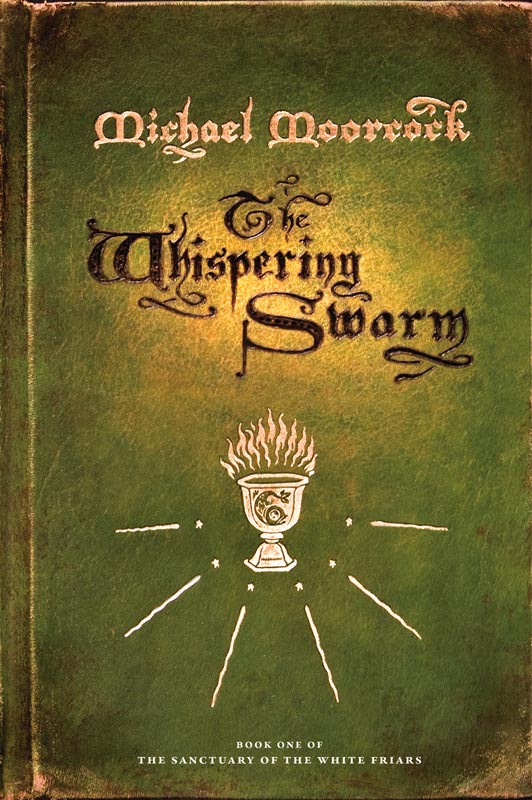
This book (Tor Books ebook, 7569ll) tells the story of Michael Moorcock, a hard-working writer of fantasy, science fiction and literary fiction plagued by the noise of a mysterious swarm. As a teenager, already at work in publishing, Moorcock meets Friar Isidore, who takes him to Alsacia, a magical Sanctuary with connections to all time and space by way of the moonbeam roads. There he meets people like Dick Turpin, Jim Bowie and Buffalo Bill.
At first he thinks them all actors on a film set, and later he comes to think the whole experience must have been a dream, but then comes the whispering, beginning shortly after the birth of his children, at which point it is but the “faintest of distant murmurings”, growing into “a torrent of unfamiliar, whispering voices”, and later becoming so unbearable that he can “barely ignore it for seconds at a time”.
That noise abates only in Alsacia, so he decides to stay there. He eventually becomes friends with the four musketeers and Prince Rupert of the Rhine, and thence involved in the war between the Roundheads and the Cavaliers. Drawn into a desperate plot to save King Charles from Oliver Cromwell and the scaffold, Moorcock must balance principle, friendship and his own responsibilities, choosing to help his new comrades though they must surely fail.
His story is told in the first person, and the reader may find themselves wondering how much credit these adventures are owed. The whispering begins when he has been “worrying what was best for the baby, where we should move and so on”, and much of his time in Alsacia is spent romantically with Moll Midnight, the inspiration for his most popular historical fantasies, while his wife and children believe him to be recuperating at a retreat.
Moorcock married young, to Helena, and they had children when young, and though his love for those children isn’t in question it doesn’t feel like he was ready to have them, and the character’s justifications for his absences fall flat throughout. At times it feels like the whole thing is a tall tale told to his children to explain away the times when he abandoned them, a fanciful excuse for a mundane affair.
He takes them to the cinema and the roof garden of Derry and Toms, but isn’t always there for everyday life. He comes across pretty badly. He takes lots of drugs (“where the coke and the speed met the mary jane and the wine my poor, puny little ego decided that promises were negotiable”), decries “unhappy women who eroticised inequality”, and at times becomes “briefly, a roaring monster with my friends or Helena”.
It is easier to cheer on his successes in publishing, from Tarzan Adventures and Sexton Blake Library to New Worlds, Elric, Jerry Cornelius and American success, “going instantly from work-for-hire hack to literary novelist”. He explains the two strands of his writing career thus: the fantasies are paperbacks and take three days to write, while the literary books appear in hardcover, are reviewed by the mainstream press, and take ten days to write.
His encounters with writers, editors and publishers make the book unmissable for publishing geeks and fans of the new wave, whatever its merits as a novel. He has a “desultory correspondence” with William Burroughs, trusts Barrington J. Bayley with the secret of Alsacia, and goes to the pub with Harry Harrison, Ted Carnell and John Wyndham. He helps “barmy, brilliant, treacherous old Phil” K. Dick get a publishing deal with Jonathan Cape.
E.C. Tubb tries to get off with Moorcock’s mum at a party. John Brunner gets it in the neck – “I tried to tell him he irritated people” – but gets credit for writing “with tremendous brio”. Other names are somewhat familiar, like Jack Allard, Jack Slade and Rex Fisch, though it’s worth remembering that the book tells us: “All of the characters ... are either products of the author’s imagination or are used fictitiously.”
The narrative is straightforward and linear, so it’s not a difficult book, but it is peculiar. Like The Coming of the Terraphiles it may divide its readership. The autobiographical elements will fascinate fans, but if the book weren’t stretched out to fit those facts it might have felt a bit tighter and less repetitive. Bored readers should skip to chapter forty-one before giving up.
That’s when the book springs to life, with the mission to save King Charles. Moorcock, Rupert and the musketeers sneak into Whitehall with an unwitting impersonator, then try to escape down the frozen Thames at night while hunted by Cromwell’s men. Like his fictional equivalent, our Moorcock has few equals when writing adventure tales, and the last forty thousand words here comprise one of his best. ****
This review originally appeared in Interzone #258.
Showing posts with label Tor. Show all posts
Sunday, 2 December 2018
Tuesday, 14 August 2018
Pawn: A Chronicle of the Sibyl’s War, by Timothy Zahn (Tor) | review by Jacob Edwards
A chronicle of discontent.
This is not so much a review as a lament. Timothy Zahn used to be a favourite author of mine. I own many of his books. But in recent years I find myself borrowing, not buying (and even then I do so more from inertia than with the thrill of expectation). Perhaps the fault is mine, and my tastes have moved on. Or maybe Zahn has grown too comfortable in his niche.
Or could this be an opportunity to blame the publishing industry…? Actually, yes. Let’s do that.
Pawn touts itself as “a chronicle of the Sibyl’s War”; but in the modern SF parlance this doesn’t mean a complete chronicle. It means the first instalment of innumerably many in a story that once would have been told in a single book.
And with this I take issue.
Zahn in fact remains as imaginative as ever. His writing still bubbles along. But Pawn, just like so many films nowadays, isn’t really an experience in its own right. It is merely, solely, a prequel to whatever comes next. Zahn has envisaged an intriguing scenario but we learn about it only by way of breadcrumbs dropped along the path, and even then not very much. The novel in fact ends right where it should be beginning, and instead of the “A” plot (left scattered for future consumption) we are given a “B” plot that holds very little interest. Essentially, the entire book is clickbait.
On the first page of Pawn we meet Nicole, a somewhat abused low-ranking member of a Philadelphian street gang. By the end of the first chapter she has been abducted to an alien spaceship, and by the end of the book her gangland personality has more or less washed away, readying her for the SF chronicle to come.
To quote from the dust jacket: “Nicole soon discovers that many different factions are vying for control of the Fyrantha, and she and her friends are merely pawns in a game beyond their control. But she is tired of being used, and now Nicole is going to fight.”
Well, no. That is not what’s going to happen in Pawn. That’s what Nicole discovers by the end of it (sorry, the book’s own blurb is a spoiler) and what we might expect from the rest of the series. Looking back at Zahn’s Quadrail books, the template is clear: he has a single novel in mind and he’s going to spin it out across as many publications as his contract stipulates.
If Pawn’s “B” plot is anything to go by, there’ll be a lot of filler along the way.
Well, I’ve had enough. I’m not going to read any more. If the completed “Chronicle of the Sibyl’s War” is ever edited down into one book then I’ll take it up with glee. (The overarching idea really does appeal.) But until then, I’m out.
To push the obvious analogy: no longer will I allow myself to be a pawn of the publishing world.
This is not so much a review as a lament. Timothy Zahn used to be a favourite author of mine. I own many of his books. But in recent years I find myself borrowing, not buying (and even then I do so more from inertia than with the thrill of expectation). Perhaps the fault is mine, and my tastes have moved on. Or maybe Zahn has grown too comfortable in his niche.
Or could this be an opportunity to blame the publishing industry…? Actually, yes. Let’s do that.
Pawn touts itself as “a chronicle of the Sibyl’s War”; but in the modern SF parlance this doesn’t mean a complete chronicle. It means the first instalment of innumerably many in a story that once would have been told in a single book.
And with this I take issue.
Zahn in fact remains as imaginative as ever. His writing still bubbles along. But Pawn, just like so many films nowadays, isn’t really an experience in its own right. It is merely, solely, a prequel to whatever comes next. Zahn has envisaged an intriguing scenario but we learn about it only by way of breadcrumbs dropped along the path, and even then not very much. The novel in fact ends right where it should be beginning, and instead of the “A” plot (left scattered for future consumption) we are given a “B” plot that holds very little interest. Essentially, the entire book is clickbait.
On the first page of Pawn we meet Nicole, a somewhat abused low-ranking member of a Philadelphian street gang. By the end of the first chapter she has been abducted to an alien spaceship, and by the end of the book her gangland personality has more or less washed away, readying her for the SF chronicle to come.
To quote from the dust jacket: “Nicole soon discovers that many different factions are vying for control of the Fyrantha, and she and her friends are merely pawns in a game beyond their control. But she is tired of being used, and now Nicole is going to fight.”
Well, no. That is not what’s going to happen in Pawn. That’s what Nicole discovers by the end of it (sorry, the book’s own blurb is a spoiler) and what we might expect from the rest of the series. Looking back at Zahn’s Quadrail books, the template is clear: he has a single novel in mind and he’s going to spin it out across as many publications as his contract stipulates.
If Pawn’s “B” plot is anything to go by, there’ll be a lot of filler along the way.
Well, I’ve had enough. I’m not going to read any more. If the completed “Chronicle of the Sibyl’s War” is ever edited down into one book then I’ll take it up with glee. (The overarching idea really does appeal.) But until then, I’m out.
To push the obvious analogy: no longer will I allow myself to be a pawn of the publishing world.
Monday, 2 November 2015
Child of a Hidden Sea (Tor) by A.M. Dellamonica | review
Sophie Hansa wants to know why her birth parents put her up for adoption as a baby, twenty-four years ago. She wants to establish a relationship with them. She has a lovely home life, and she adores her adoptive parents and her super smart brother Bram, and maybe it wouldn’t seem so urgent right now if she wasn’t trying to avoid defending her PhD thesis, but she’s got her heart set on it and that’s going to get her, and everyone else, into a lot of trouble.
Stormwrack as a watery planet, even in comparison to our own. The common language is Fleetspeak, spoken by the seagoing folk of two hundred and fifty island nations who gather together in the great Fleet. Things have been quite peaceful for the last century, thanks in part to Temperance, a ship so powerfully magical that its captain can sink any other ship simply by saying its name. You can see how that might bother people with plans of world domination.
These worlds collide after Sophie traces her birth mother Beatrice Vanko to San Francisco. The reunion goes badly. Beatrice wants nothing to do with her and is horrified by the mention of her father. Sophie doesn’t give up. Maybe her spider-sense is tingling, maybe she’s just avoiding that viva, but she stakes out her mother’s house for three days, sleeping in her car, and she’s there when her Aunt Gale gets stabbed by two men.
Leaping to assist, Sophie is dragged in a whirlwind to Stormwrack. That’s where her mum was born, as she’ll soon find out, but her first priority is keeping her aunt alive while swimming a mile to the nearest fishing grounds. And her second priority is to start studying the animals in this odd new world. Giant moths migrating over the ocean and seagoing bats (one of which sits on her head while chomping on a moth) are just the beginning of the treasures Stormwrack offers the curious biologist.
Through accident and inheritance Sophie has to investigate the attack on her aunt, who was a Fleet Courier. Well, she doesn’t have to, exactly. In fact, everyone would rather prefer it if she returned to Erstwhile (as they call our planet/time/dimension) and leave her half-sister to claim the mantle of Fleet Courier and get on with the investigation. Yes, she has a sister, and she has as little time for Sophie as their mother. Sophie sympathises, but staying home would mean giving up the chance to see Stormwrack.
Sophie is a likeable character on whom to hang a novel. She’s endlessly curious, physically brave, capable and clever. She can climb mountain cliffs, scuba dive, and work her way through a legal argument. She's the polar opposite of all those fantasy whiners who ever found their way to a magical land and didn’t stop moaning till they got back to their mundane lives. She embraces the opportunity, can’t wait to see what’s out there, and she’s always thinking.
When she does get sent home to San Francisco, she tells Bram all about it. He’s not totally convinced by her blurry photo of a sailboat, but she doesn’t get into a huff about it - she understands that it’s just a matter of evidence. So she prepares to return. She maxes out her credit cards to buy a video camera, a top of the range phone, a solar-powered charger, and diving equipment. Later on, she finds a way to smuggle her phone back to Earth - to sync her data!
You can’t blame her for wanting to take lots of photos, because Stormwrack is a cool place to visit, even if she does have to deal with some nasty villains. They are using weapons from Erstwhile, which gives her a slight edge - unlike her new friends, she knows grenades are dangerous. But the bad guys are also using magic, and she has a lot to learn about that. Names are the thing when it comes to magic in Stormwrack, and like many a middle school child she has made the mistake of revealing her middle name.
Of course the attack on Aunt Gale was part of a deeper plot, and as Sophia dives to the bottom of that she kicks up trouble for her own family. There’s a reason she was given up for adoption, and it wasn’t that mum and dad couldn’t afford to keep her. But despite the marital problems, the monsters and the mayhem, this is on the whole a jolly book about a rootworthy protagonist, with a good-looking supporting cast and a balmy setting that give it a holiday feel. Just the thing for reading during a rainy British summer! Stephen Theaker
After a bit of editing, this review appeared in Interzone #253, back in 2014.
Stormwrack as a watery planet, even in comparison to our own. The common language is Fleetspeak, spoken by the seagoing folk of two hundred and fifty island nations who gather together in the great Fleet. Things have been quite peaceful for the last century, thanks in part to Temperance, a ship so powerfully magical that its captain can sink any other ship simply by saying its name. You can see how that might bother people with plans of world domination.
These worlds collide after Sophie traces her birth mother Beatrice Vanko to San Francisco. The reunion goes badly. Beatrice wants nothing to do with her and is horrified by the mention of her father. Sophie doesn’t give up. Maybe her spider-sense is tingling, maybe she’s just avoiding that viva, but she stakes out her mother’s house for three days, sleeping in her car, and she’s there when her Aunt Gale gets stabbed by two men.
Leaping to assist, Sophie is dragged in a whirlwind to Stormwrack. That’s where her mum was born, as she’ll soon find out, but her first priority is keeping her aunt alive while swimming a mile to the nearest fishing grounds. And her second priority is to start studying the animals in this odd new world. Giant moths migrating over the ocean and seagoing bats (one of which sits on her head while chomping on a moth) are just the beginning of the treasures Stormwrack offers the curious biologist.
Through accident and inheritance Sophie has to investigate the attack on her aunt, who was a Fleet Courier. Well, she doesn’t have to, exactly. In fact, everyone would rather prefer it if she returned to Erstwhile (as they call our planet/time/dimension) and leave her half-sister to claim the mantle of Fleet Courier and get on with the investigation. Yes, she has a sister, and she has as little time for Sophie as their mother. Sophie sympathises, but staying home would mean giving up the chance to see Stormwrack.
Sophie is a likeable character on whom to hang a novel. She’s endlessly curious, physically brave, capable and clever. She can climb mountain cliffs, scuba dive, and work her way through a legal argument. She's the polar opposite of all those fantasy whiners who ever found their way to a magical land and didn’t stop moaning till they got back to their mundane lives. She embraces the opportunity, can’t wait to see what’s out there, and she’s always thinking.
When she does get sent home to San Francisco, she tells Bram all about it. He’s not totally convinced by her blurry photo of a sailboat, but she doesn’t get into a huff about it - she understands that it’s just a matter of evidence. So she prepares to return. She maxes out her credit cards to buy a video camera, a top of the range phone, a solar-powered charger, and diving equipment. Later on, she finds a way to smuggle her phone back to Earth - to sync her data!
You can’t blame her for wanting to take lots of photos, because Stormwrack is a cool place to visit, even if she does have to deal with some nasty villains. They are using weapons from Erstwhile, which gives her a slight edge - unlike her new friends, she knows grenades are dangerous. But the bad guys are also using magic, and she has a lot to learn about that. Names are the thing when it comes to magic in Stormwrack, and like many a middle school child she has made the mistake of revealing her middle name.
Of course the attack on Aunt Gale was part of a deeper plot, and as Sophia dives to the bottom of that she kicks up trouble for her own family. There’s a reason she was given up for adoption, and it wasn’t that mum and dad couldn’t afford to keep her. But despite the marital problems, the monsters and the mayhem, this is on the whole a jolly book about a rootworthy protagonist, with a good-looking supporting cast and a balmy setting that give it a holiday feel. Just the thing for reading during a rainy British summer! Stephen Theaker
After a bit of editing, this review appeared in Interzone #253, back in 2014.
Friday, 7 August 2015
Book notes #12
Notes and ratings from TQF50 and TQF51 for books I didn’t review for TQF. Credits from Goodreads; apologies to anyone miscredited or missing.
Transit (Image Comics) by Ted McKeever. Street punks, down-and-outs, religious and political fatcats, and assassins. Spud is in a subway station when a murder happens. Quite challenging. Archetypically eighties in style and subject matter. ***
Umbrella Academy, Vol.1: The Apocalypse Suite (Dark Horse Books) by Gerard Way and Gabriel Ba. A bunch of former child heroes reunite as jaded adults. I would not have expected a comic by the singer in a rock band (even one who invited Grant Morrison into his videos) to be as good as this. Reminiscent of Doom Patrol with friendlier art. ****
Usagi Yojimbo, Vol. 13: Grey Shadows (Dark Horse Books) by Stan Sakai. The rabbit ronin travels to collect the bounty for Hosoku the Bandit on behalf of a friend, and while waiting for the money helps Inspector Ishida to investigate murders and corruption in a series of connected short stories. Great stories, and the artwork is clear, detailed and full of character. ****
Valérian et Laureline l’Intégrale, Vol. 2 (Dargaud) by Pierre Christin and Jean-Claude Mézières. Volume two of the complete Valérian and Laureline, which collects Le Pays sans Étoile, Bienvenue sur Alflolol and Les Oiseaux du Maitre. They’re a pair of space agents who get embroiled in a different adventure on each planet. Can’t pretend I understood every word, but that didn’t stop me enjoying them. I like how Laureline does exactly what she wants, however irksome that may be for Valérian. ****
Werewolves of Montpellier (Fantagraphics), by Jason. A thief who dresses as a werewolf on the job attracts the attention of the real thing. ****
Willful Child (Tor Books), by Steven Erikson. Star Trek in the style of Archer. Reviewed for Interzone #256. ***
Winter Well: Speculative Novellas About Older Women (Crossed Genres), by Kay T. Holt (ed.). A decent book collecting four novellas, including “Copper” by Minerva Zimmerman, “The Other World” by Anna Caro, and “To the Edges” by M. Fenn, which begins with an older woman being fired from her job on the day of a terrorist atrocity. “The Second Wife” by Marissa James was for me the best story here. It’s a fantasy or science fantasy story about a second wife whose husband is killed by a conqueror who marries her for her magic. Before he can really set her to work, visitors come from the south, one of whom burns brightly in her mystical visions. Reminiscent in some ways of the Darkover series, but much better. The story has a mature approach to transgender issues. ***
X-Men: The Complete Age of Apocalypse Epic, Book 1 (Marvel), by Scott Lobdell, John Francis Moore, Howard Mackie, Brian K. Vaughan, Ralph Macchio, Terry Kavanagh and Judd Winick. A barely readable muddle set in an alternative X-Men universe. **
Yuki vs Panda, Vol. 1: Revenge. Lust. Karaoke (Duskleaf Media), by Graham Misiurak, Nick Dunec and A.L. Jones. Short and not very good graphic novel about a girl whose nemesis is a panda. **
Transit (Image Comics) by Ted McKeever. Street punks, down-and-outs, religious and political fatcats, and assassins. Spud is in a subway station when a murder happens. Quite challenging. Archetypically eighties in style and subject matter. ***
Umbrella Academy, Vol.1: The Apocalypse Suite (Dark Horse Books) by Gerard Way and Gabriel Ba. A bunch of former child heroes reunite as jaded adults. I would not have expected a comic by the singer in a rock band (even one who invited Grant Morrison into his videos) to be as good as this. Reminiscent of Doom Patrol with friendlier art. ****
Usagi Yojimbo, Vol. 13: Grey Shadows (Dark Horse Books) by Stan Sakai. The rabbit ronin travels to collect the bounty for Hosoku the Bandit on behalf of a friend, and while waiting for the money helps Inspector Ishida to investigate murders and corruption in a series of connected short stories. Great stories, and the artwork is clear, detailed and full of character. ****
Valérian et Laureline l’Intégrale, Vol. 2 (Dargaud) by Pierre Christin and Jean-Claude Mézières. Volume two of the complete Valérian and Laureline, which collects Le Pays sans Étoile, Bienvenue sur Alflolol and Les Oiseaux du Maitre. They’re a pair of space agents who get embroiled in a different adventure on each planet. Can’t pretend I understood every word, but that didn’t stop me enjoying them. I like how Laureline does exactly what she wants, however irksome that may be for Valérian. ****
Werewolves of Montpellier (Fantagraphics), by Jason. A thief who dresses as a werewolf on the job attracts the attention of the real thing. ****
Willful Child (Tor Books), by Steven Erikson. Star Trek in the style of Archer. Reviewed for Interzone #256. ***
Winter Well: Speculative Novellas About Older Women (Crossed Genres), by Kay T. Holt (ed.). A decent book collecting four novellas, including “Copper” by Minerva Zimmerman, “The Other World” by Anna Caro, and “To the Edges” by M. Fenn, which begins with an older woman being fired from her job on the day of a terrorist atrocity. “The Second Wife” by Marissa James was for me the best story here. It’s a fantasy or science fantasy story about a second wife whose husband is killed by a conqueror who marries her for her magic. Before he can really set her to work, visitors come from the south, one of whom burns brightly in her mystical visions. Reminiscent in some ways of the Darkover series, but much better. The story has a mature approach to transgender issues. ***
X-Men: The Complete Age of Apocalypse Epic, Book 1 (Marvel), by Scott Lobdell, John Francis Moore, Howard Mackie, Brian K. Vaughan, Ralph Macchio, Terry Kavanagh and Judd Winick. A barely readable muddle set in an alternative X-Men universe. **
Yuki vs Panda, Vol. 1: Revenge. Lust. Karaoke (Duskleaf Media), by Graham Misiurak, Nick Dunec and A.L. Jones. Short and not very good graphic novel about a girl whose nemesis is a panda. **
Monday, 2 June 2014
The Goblin Emperor by Katherine Addison, reviewed by Stephen Theaker
In The Goblin Emperor (Tor, ebook, 6853ll) Katherine Addison (a name which is, as the dedication hints, a pseudonym) introduces us to Maia, an angry young man exiled to the middle of nowhere with a violent, oppressive guardian: his cousin Setheris. He wakes to the news that his father and older brothers have perished in an airship disaster, the Wisdom of Choharo having crashed with no survivors on the way back from a wedding.
His deadbeat dad was Varenechibel the Fourth, 208th emperor of the Elflands. His mother, Chenelo Drazharan, was a goblin, married off to the emperor for political reasons. Maia was the accident of the marriage’s single act of consummation. In looks, he takes after his mother, which would draw the distrust of the elves even if they weren’t faced with him becoming their new emperor.
Anyone who has read Claudius the God will have an idea of what to expect next. A clever, despised protagonist, dropped into a nest of vipers, learning the ropes and coming good despite the obstacles in his way. However, this book is rather more optimistic (and isn’t bound by history), and Maia – or Edrehasivar VII, as he styles himself upon becoming the 209th emperor – is lucky: in his world paying it forward pays off.
The goodwill he earns through kind words and deeds saves his life more than once - in the very first chapter he earns an essential ally through kindness to the messenger bringing word of his father’s death. This is a book that moseys along in an amiable and pleasant way, with good rewarded and evil punished, and good people facing the challenge of how to stay good when dealing with bad people.
You have to root for Maia as he sorts out the mess left by his father’s death, tries to reckon with his feelings about his father, and investigates whether that death was an accident or not. On top of that he must deal with plots and attempted coups, win the grudging respect of gruff bodyguards and a snooty court, negotiate with foreign powers, select a wife (and learn how to speak to her), and decide whether to build a fancy clockwork bridge.
Though there is plenty going on, it’s quite a static book, Maia’s new position at the heart of empire not permitting much travel. The plot progresses, on the whole, through a series of meetings and conversations. An early look at the appendices is helpful here: extracts from a handbook for travellers in the Elflands, they explain a lot about the subtle use of names and forms of address in the book.
Readers shouldn’t be put off by the dialogue in the early pages - “Merciful goddesses, boy, canst do nothing for thyself?” cries Setheris - because it doesn’t set the tone for the rest of the book. This is a good, enjoyable book, cleanly written, and though it felt quite gentle in comparison to the likes of Game of Thrones and is probably aimed at younger readers than me, it’s nice for once to see a good person’s miserable life get better rather than worse.
His deadbeat dad was Varenechibel the Fourth, 208th emperor of the Elflands. His mother, Chenelo Drazharan, was a goblin, married off to the emperor for political reasons. Maia was the accident of the marriage’s single act of consummation. In looks, he takes after his mother, which would draw the distrust of the elves even if they weren’t faced with him becoming their new emperor.
Anyone who has read Claudius the God will have an idea of what to expect next. A clever, despised protagonist, dropped into a nest of vipers, learning the ropes and coming good despite the obstacles in his way. However, this book is rather more optimistic (and isn’t bound by history), and Maia – or Edrehasivar VII, as he styles himself upon becoming the 209th emperor – is lucky: in his world paying it forward pays off.
The goodwill he earns through kind words and deeds saves his life more than once - in the very first chapter he earns an essential ally through kindness to the messenger bringing word of his father’s death. This is a book that moseys along in an amiable and pleasant way, with good rewarded and evil punished, and good people facing the challenge of how to stay good when dealing with bad people.
You have to root for Maia as he sorts out the mess left by his father’s death, tries to reckon with his feelings about his father, and investigates whether that death was an accident or not. On top of that he must deal with plots and attempted coups, win the grudging respect of gruff bodyguards and a snooty court, negotiate with foreign powers, select a wife (and learn how to speak to her), and decide whether to build a fancy clockwork bridge.
Though there is plenty going on, it’s quite a static book, Maia’s new position at the heart of empire not permitting much travel. The plot progresses, on the whole, through a series of meetings and conversations. An early look at the appendices is helpful here: extracts from a handbook for travellers in the Elflands, they explain a lot about the subtle use of names and forms of address in the book.
Readers shouldn’t be put off by the dialogue in the early pages - “Merciful goddesses, boy, canst do nothing for thyself?” cries Setheris - because it doesn’t set the tone for the rest of the book. This is a good, enjoyable book, cleanly written, and though it felt quite gentle in comparison to the likes of Game of Thrones and is probably aimed at younger readers than me, it’s nice for once to see a good person’s miserable life get better rather than worse.
Subscribe to:
Posts (Atom)