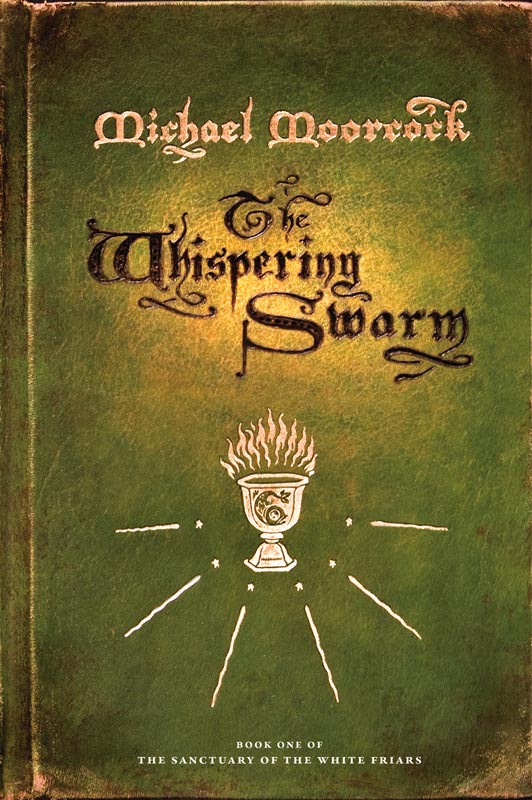
This book (Tor Books ebook, 7569ll) tells the story of Michael Moorcock, a hard-working writer of fantasy, science fiction and literary fiction plagued by the noise of a mysterious swarm. As a teenager, already at work in publishing, Moorcock meets Friar Isidore, who takes him to Alsacia, a magical Sanctuary with connections to all time and space by way of the moonbeam roads. There he meets people like Dick Turpin, Jim Bowie and Buffalo Bill.
At first he thinks them all actors on a film set, and later he comes to think the whole experience must have been a dream, but then comes the whispering, beginning shortly after the birth of his children, at which point it is but the “faintest of distant murmurings”, growing into “a torrent of unfamiliar, whispering voices”, and later becoming so unbearable that he can “barely ignore it for seconds at a time”.
That noise abates only in Alsacia, so he decides to stay there. He eventually becomes friends with the four musketeers and Prince Rupert of the Rhine, and thence involved in the war between the Roundheads and the Cavaliers. Drawn into a desperate plot to save King Charles from Oliver Cromwell and the scaffold, Moorcock must balance principle, friendship and his own responsibilities, choosing to help his new comrades though they must surely fail.
His story is told in the first person, and the reader may find themselves wondering how much credit these adventures are owed. The whispering begins when he has been “worrying what was best for the baby, where we should move and so on”, and much of his time in Alsacia is spent romantically with Moll Midnight, the inspiration for his most popular historical fantasies, while his wife and children believe him to be recuperating at a retreat.
Moorcock married young, to Helena, and they had children when young, and though his love for those children isn’t in question it doesn’t feel like he was ready to have them, and the character’s justifications for his absences fall flat throughout. At times it feels like the whole thing is a tall tale told to his children to explain away the times when he abandoned them, a fanciful excuse for a mundane affair.
He takes them to the cinema and the roof garden of Derry and Toms, but isn’t always there for everyday life. He comes across pretty badly. He takes lots of drugs (“where the coke and the speed met the mary jane and the wine my poor, puny little ego decided that promises were negotiable”), decries “unhappy women who eroticised inequality”, and at times becomes “briefly, a roaring monster with my friends or Helena”.
It is easier to cheer on his successes in publishing, from Tarzan Adventures and Sexton Blake Library to New Worlds, Elric, Jerry Cornelius and American success, “going instantly from work-for-hire hack to literary novelist”. He explains the two strands of his writing career thus: the fantasies are paperbacks and take three days to write, while the literary books appear in hardcover, are reviewed by the mainstream press, and take ten days to write.
His encounters with writers, editors and publishers make the book unmissable for publishing geeks and fans of the new wave, whatever its merits as a novel. He has a “desultory correspondence” with William Burroughs, trusts Barrington J. Bayley with the secret of Alsacia, and goes to the pub with Harry Harrison, Ted Carnell and John Wyndham. He helps “barmy, brilliant, treacherous old Phil” K. Dick get a publishing deal with Jonathan Cape.
E.C. Tubb tries to get off with Moorcock’s mum at a party. John Brunner gets it in the neck – “I tried to tell him he irritated people” – but gets credit for writing “with tremendous brio”. Other names are somewhat familiar, like Jack Allard, Jack Slade and Rex Fisch, though it’s worth remembering that the book tells us: “All of the characters ... are either products of the author’s imagination or are used fictitiously.”
The narrative is straightforward and linear, so it’s not a difficult book, but it is peculiar. Like The Coming of the Terraphiles it may divide its readership. The autobiographical elements will fascinate fans, but if the book weren’t stretched out to fit those facts it might have felt a bit tighter and less repetitive. Bored readers should skip to chapter forty-one before giving up.
That’s when the book springs to life, with the mission to save King Charles. Moorcock, Rupert and the musketeers sneak into Whitehall with an unwitting impersonator, then try to escape down the frozen Thames at night while hunted by Cromwell’s men. Like his fictional equivalent, our Moorcock has few equals when writing adventure tales, and the last forty thousand words here comprise one of his best. ****
This review originally appeared in Interzone #258.
Showing posts with label Philip K. Dick. Show all posts
Sunday, 2 December 2018
Monday, 3 July 2017
The Man in the High Castle, Season 2, by Frank Spotnitz and friends (Amazon Video) | review by Rafe McGregor
Philip K. Dick’s The Man in the High Castle (1962) is one of the most disappointing books I’ve ever read and it’s no spoiler to say that the novel simply doesn’t end. It’s not even as if Dick deliberately withheld closure to fascinate or frustrate his readers, but more a case of found himself in a narrative corner from which he saw no escape, stopped writing, and moved on to the next project. He could have used a disappointing device like that employed by Sarban (the nom de plume of John William Wall) in his similarly dystopian The Sound of His Horn (1952) or declined to publish, but left what I suppose is a rare artefact in itself, an unfinished novel published during an author’s lifetime. What is even more baffling is that it won the Hugo Award for Best Novel in 1962. The work is of course rich in Dick’s trademark complexity, weaving several subplots together and combining literary themes with genre conventions, transporting the reader to a strange and very unpleasant world where the Axis powers were victorious in the Second World War. It was perhaps the careful crafting of this alternative twentieth century that won Dick the award, although that world is not represented with quite as much verisimilitude as the subsequent efforts of Len Deighton in SS-GB (1978) and Robert Harris in Fatherland (1992). I mention the novel in such detail for two reasons: first, as a spoiler alert (alert: Dick spoiled the novel by not finishing it), and second, because the suggestion that there are two different realities in season 1 (that of the story world and the real world revealed in the films of the real world that appear in the story world) was cause for concern that season 2 would follow Dick in failing to explain the very question it had raised.
Season 1 managed to capture many of the finer points of the novel and Dick’s writing more generally, including his use of multiple and often apparently unrelated subplots. Viewers were introduced to a host of characters without knowing which of them the overarching plot would coalesce around or who would live or die, all of which added to the suspense. The narrative appeared to focus on the two characters used to advertise the series, Obergruppenführer (SS-General) John Smith (Rufus Sewell), based in New York in the Greater German Reich, and Juliana Crane (Alexa Davalos), a young woman who has remained remarkably free from prejudice in the San Francisco of the Japanese Pacific States. The two are linked by a third, Joe Blake (Luke Kleintank), a young American who is employed as an SS agent by Smith and meets Juliana on a mission in the Neutral Zone between the two empires. The main problem with season 1 was that Sewell stole the show. (I must interject here to berate the BBC for cancelling Zen, which featured Sewell in the title role, in 2011 and reducing the best British crime series to date to a meagre three episodes.) Granted, Smith is head of SS-US, has previously participated in genocide, and keeps his fellow citizens under the jackboot, but he is also fiercely loyal (to his family and the Führer), very shrewd (in outwitting the various Nazis jockeying for power as Hitler’s health declines), and pretty much un-killable (whether the assassins be fellow-Nazis or enemies of the Reich). In contrast, the heroes, including Juliana, are continually wavering between joining the Resistance and accepting their status as a colonised people and when the Resistance in either the (Japanese) West or (German) East does take action it is either pointless, useless, or both. What is perhaps most disappointing is the heroes’ general selfishness and lack of interest in sacrificing their personal safety for a greater cause – unlike Smith, who has devoted his life to service, albeit it to a completely reprehensible cause.
Producer and writer Frank Spotnitz wisely decided to change the book that was written by Hawthorne Abendsen (the man in the high castle), The Grasshopper Lies Heavy, in Dick’s novel to a series of film reels. This adaptation both enhances the film and reveals a further weakness in Dick’s story. The Grasshopper Lies Heavy, the book within the novel, is a representation of a world where the Allies won the Second World War (i.e. the real world) and naturally banned by the authorities. But the fascination with the novel is never quite explained nor is there any need to explain how the author came up with the ideas – that is, after all, exactly what authors do, make things up. In contrast, the existence of documentary film reels seems to show an actual alternative reality, particularly in an era where special effects were extremely limited in scope. The films immediately suggest a science fiction element in addition to the alternative history and the presence of Blake and others therein at the end of season 1 creates a compelling mystery that is largely absent in the novel. At the beginning of season 2 it is revealed that these films do not depict what has happened, but possible futures – events that have not happened yet, but might, and Abendsen is cataloguing them year by year in order to attempt to change the future of the story world.
The main plot of season 2 revolves around geo-political events, specifically the escalation of the jockeying for power within the Greater German Reich as Hitler’s health takes its final turn for the worse and the rush for the Greater Japanese Empire to build a nuclear bomb in order to maintain the Cold War peace. The events in the two empires are exacerbated by the presence of jingoistic elements on both sides: Germans who are attempting to pre-empt a war with Japan before she is capable of nuclear retaliation and Japanese who want to build a bomb as a precursor to declaring war on Germany. In the midst of these momentous world events, the various subplots in season 2 focus on five main characters, the three from season 1 and: Frank Frink (Luke Evans), Juliana’s boyfriend and newcomer to the Resistance, and Nobusuke Tagomi (Cary-Hiroyuki Tagawa), the Trade Minister of the Pacific States. This narrower focus sees all five characters, including the heroes, pursuing clear goals as Juliana and Frink commit fully to the Resistance, Joe commits to the Nazis, and Tagomi finds himself capable of moving between the story world and the real world. The tension and action are heightened for all five and the revelation of the relevance of their own stories to the apparently inevitable Third World War makes for exciting viewing. In a reversal of the way in which I was amazed at Dick’s novel winning a prize, I am amazed to see negative reviews of this series, which – if watched as intended, as the sequel to season 1 – is really outstanding in terms of plot, acting, cinematic production… it really is difficult to find a flaw. Perhaps the most satisfying aspect of the series is the way that season 2 ends. The films and, more importantly, the two realities between which Tagomi can move, are explained in full. There is a resolution with respect to both Smith and Juliana’s plots and the geo-political situation reaches a milestone rather than a climax. The contrast with Dick’s original is stark: where the novel terminated without concluding, season 2 has been perfectly-judged, such that the narrative concludes in a satisfying manner as-is, but could continue in future seasons. Where Dick’s novel failed to provide any closure, Spotnitz’s closure is unusual – if not unique – in working equally well as both an interim and final conclusion.
Season 1 managed to capture many of the finer points of the novel and Dick’s writing more generally, including his use of multiple and often apparently unrelated subplots. Viewers were introduced to a host of characters without knowing which of them the overarching plot would coalesce around or who would live or die, all of which added to the suspense. The narrative appeared to focus on the two characters used to advertise the series, Obergruppenführer (SS-General) John Smith (Rufus Sewell), based in New York in the Greater German Reich, and Juliana Crane (Alexa Davalos), a young woman who has remained remarkably free from prejudice in the San Francisco of the Japanese Pacific States. The two are linked by a third, Joe Blake (Luke Kleintank), a young American who is employed as an SS agent by Smith and meets Juliana on a mission in the Neutral Zone between the two empires. The main problem with season 1 was that Sewell stole the show. (I must interject here to berate the BBC for cancelling Zen, which featured Sewell in the title role, in 2011 and reducing the best British crime series to date to a meagre three episodes.) Granted, Smith is head of SS-US, has previously participated in genocide, and keeps his fellow citizens under the jackboot, but he is also fiercely loyal (to his family and the Führer), very shrewd (in outwitting the various Nazis jockeying for power as Hitler’s health declines), and pretty much un-killable (whether the assassins be fellow-Nazis or enemies of the Reich). In contrast, the heroes, including Juliana, are continually wavering between joining the Resistance and accepting their status as a colonised people and when the Resistance in either the (Japanese) West or (German) East does take action it is either pointless, useless, or both. What is perhaps most disappointing is the heroes’ general selfishness and lack of interest in sacrificing their personal safety for a greater cause – unlike Smith, who has devoted his life to service, albeit it to a completely reprehensible cause.
Producer and writer Frank Spotnitz wisely decided to change the book that was written by Hawthorne Abendsen (the man in the high castle), The Grasshopper Lies Heavy, in Dick’s novel to a series of film reels. This adaptation both enhances the film and reveals a further weakness in Dick’s story. The Grasshopper Lies Heavy, the book within the novel, is a representation of a world where the Allies won the Second World War (i.e. the real world) and naturally banned by the authorities. But the fascination with the novel is never quite explained nor is there any need to explain how the author came up with the ideas – that is, after all, exactly what authors do, make things up. In contrast, the existence of documentary film reels seems to show an actual alternative reality, particularly in an era where special effects were extremely limited in scope. The films immediately suggest a science fiction element in addition to the alternative history and the presence of Blake and others therein at the end of season 1 creates a compelling mystery that is largely absent in the novel. At the beginning of season 2 it is revealed that these films do not depict what has happened, but possible futures – events that have not happened yet, but might, and Abendsen is cataloguing them year by year in order to attempt to change the future of the story world.
The main plot of season 2 revolves around geo-political events, specifically the escalation of the jockeying for power within the Greater German Reich as Hitler’s health takes its final turn for the worse and the rush for the Greater Japanese Empire to build a nuclear bomb in order to maintain the Cold War peace. The events in the two empires are exacerbated by the presence of jingoistic elements on both sides: Germans who are attempting to pre-empt a war with Japan before she is capable of nuclear retaliation and Japanese who want to build a bomb as a precursor to declaring war on Germany. In the midst of these momentous world events, the various subplots in season 2 focus on five main characters, the three from season 1 and: Frank Frink (Luke Evans), Juliana’s boyfriend and newcomer to the Resistance, and Nobusuke Tagomi (Cary-Hiroyuki Tagawa), the Trade Minister of the Pacific States. This narrower focus sees all five characters, including the heroes, pursuing clear goals as Juliana and Frink commit fully to the Resistance, Joe commits to the Nazis, and Tagomi finds himself capable of moving between the story world and the real world. The tension and action are heightened for all five and the revelation of the relevance of their own stories to the apparently inevitable Third World War makes for exciting viewing. In a reversal of the way in which I was amazed at Dick’s novel winning a prize, I am amazed to see negative reviews of this series, which – if watched as intended, as the sequel to season 1 – is really outstanding in terms of plot, acting, cinematic production… it really is difficult to find a flaw. Perhaps the most satisfying aspect of the series is the way that season 2 ends. The films and, more importantly, the two realities between which Tagomi can move, are explained in full. There is a resolution with respect to both Smith and Juliana’s plots and the geo-political situation reaches a milestone rather than a climax. The contrast with Dick’s original is stark: where the novel terminated without concluding, season 2 has been perfectly-judged, such that the narrative concludes in a satisfying manner as-is, but could continue in future seasons. Where Dick’s novel failed to provide any closure, Spotnitz’s closure is unusual – if not unique – in working equally well as both an interim and final conclusion.
Subscribe to:
Posts (Atom)