Showing posts with label John Brunner. Show all posts

Sunday, 2 December 2018

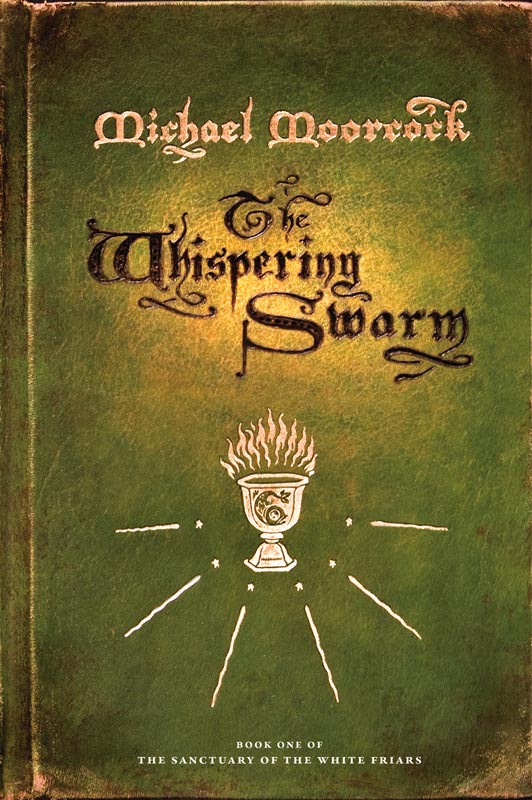
The Whispering Swarm by Michael Moorcock | review by Stephen Theaker

This book (Tor Books ebook, 7569ll) tells the story of Michael Moorcock, a hard-working writer of fantasy, science fiction and literary fiction plagued by the noise of a mysterious swarm. As a teenager, already at work in publishing, Moorcock meets Friar Isidore, who takes him to Alsacia, a magical Sanctuary with connections to all time and space by way of the moonbeam roads. There he meets people like Dick Turpin, Jim Bowie and Buffalo Bill.

At first he thinks them all actors on a film set, and later he comes to think the whole experience must have been a dream, but then comes the whispering, beginning shortly after the birth of his children, at which point it is but the “faintest of distant murmurings”, growing into “a torrent of unfamiliar, whispering voices”, and later becoming so unbearable that he can “barely ignore it for seconds at a time”.

That noise abates only in Alsacia, so he decides to stay there. He eventually becomes friends with the four musketeers and Prince Rupert of the Rhine, and thence involved in the war between the Roundheads and the Cavaliers. Drawn into a desperate plot to save King Charles from Oliver Cromwell and the scaffold, Moorcock must balance principle, friendship and his own responsibilities, choosing to help his new comrades though they must surely fail.

His story is told in the first person, and the reader may find themselves wondering how much credit these adventures are owed. The whispering begins when he has been “worrying what was best for the baby, where we should move and so on”, and much of his time in Alsacia is spent romantically with Moll Midnight, the inspiration for his most popular historical fantasies, while his wife and children believe him to be recuperating at a retreat.

Moorcock married young, to Helena, and they had children when young, and though his love for those children isn’t in question it doesn’t feel like he was ready to have them, and the character’s justifications for his absences fall flat throughout. At times it feels like the whole thing is a tall tale told to his children to explain away the times when he abandoned them, a fanciful excuse for a mundane affair.

He takes them to the cinema and the roof garden of Derry and Toms, but isn’t always there for everyday life. He comes across pretty badly. He takes lots of drugs (“where the coke and the speed met the mary jane and the wine my poor, puny little ego decided that promises were negotiable”), decries “unhappy women who eroticised inequality”, and at times becomes “briefly, a roaring monster with my friends or Helena”.

It is easier to cheer on his successes in publishing, from Tarzan Adventures and Sexton Blake Library to New Worlds, Elric, Jerry Cornelius and American success, “going instantly from work-for-hire hack to literary novelist”. He explains the two strands of his writing career thus: the fantasies are paperbacks and take three days to write, while the literary books appear in hardcover, are reviewed by the mainstream press, and take ten days to write.

His encounters with writers, editors and publishers make the book unmissable for publishing geeks and fans of the new wave, whatever its merits as a novel. He has a “desultory correspondence” with William Burroughs, trusts Barrington J. Bayley with the secret of Alsacia, and goes to the pub with Harry Harrison, Ted Carnell and John Wyndham. He helps “barmy, brilliant, treacherous old Phil” K. Dick get a publishing deal with Jonathan Cape.

E.C. Tubb tries to get off with Moorcock’s mum at a party. John Brunner gets it in the neck – “I tried to tell him he irritated people” – but gets credit for writing “with tremendous brio”. Other names are somewhat familiar, like Jack Allard, Jack Slade and Rex Fisch, though it’s worth remembering that the book tells us: “All of the characters ... are either products of the author’s imagination or are used fictitiously.”

The narrative is straightforward and linear, so it’s not a difficult book, but it is peculiar. Like The Coming of the Terraphiles it may divide its readership. The autobiographical elements will fascinate fans, but if the book weren’t stretched out to fit those facts it might have felt a bit tighter and less repetitive. Bored readers should skip to chapter forty-one before giving up.

That’s when the book springs to life, with the mission to save King Charles. Moorcock, Rupert and the musketeers sneak into Whitehall with an unwitting impersonator, then try to escape down the frozen Thames at night while hunted by Cromwell’s men. Like his fictional equivalent, our Moorcock has few equals when writing adventure tales, and the last forty thousand words here comprise one of his best. ****

This review originally appeared in Interzone #258.

Monday, 24 November 2014

John Brunner by Jad Smith / review by Stephen Theaker

Sarah Pinborough once said that “anyone who thinks any writer, bestseller or on the breadline, writes for the money, is a fool”, but it would be equally foolish to think money has no effect on what they write – and especially on what we get to see of their work. This book on John Brunner (University of Illinois Press, hb, 196pp), who gave up scholarships and well-paying jobs to concentrate on writing, but frequently focused his efforts on fulfilling the particular needs of the market, illustrates both sides of the coin. Smith draws a picture of him as a writer often stranded in “interzones” (a word used here so frequently that a review in these pages was surely inevitable): too pessimistic and unpredictable for American readers, too market-orientated for the new wave; a devoted fan (after leaving the RAF he hoped to “spend a year at home writing ... and fanning”), but apparently unpopular on the convention scene.

Though coming from a university press – it forms part of the Modern Masters of Science Fiction series from the University of Illinois – this book isn’t steeped in literary criticism or swamped in jargon; general readers interested in the subject will find it perfectly accessible. Where it is polemical, it’s in support of the author’s ideas rather than his politics, in particular his thesis that Brunner’s whole oeuvre is worth studying, not just the books that won awards; he wants to situate “his better-known works within the larger arc of his career”. He shows how Brunner’s writing career did not progress neatly from Ace entertainments to hardback Hugo-winning literature. Rather, the two types of book intertwined throughout his career, as he rushed some books out to fund the concentrated spells of attention that more ambitious works required.

That Stand on Zanzibar was released to a hostile reception, and treated as a commercial, American appropriation of the New Wave, may be a surprise to readers accustomed to regarding it as a well-established part of the science fiction canon. A review of Telepathist in Vector described it as the kind of affected intellectualism “one might expect from an author who sports a goatee and a wine-coloured corduroy jacket”. Although the book is very much on Brunner’s side in such matters – Moorcock, Aldiss and Platt are portrayed as nothing short of schoolyard bullies – it does acknowledge his moodiness and, for example, Zanzibar’s immense debt to Dos Passos. Asides such as that describing “John and Marjorie’s relationship as sexually open and emotionally tumultuous” suggest a biography proper would be worthwhile.

Given that this is a book which, very usefully, draws on several hard-to-find primary sources – fanzines, letters and convention speeches, for example – it’s disappointing that it is so parsimonious with its quotations, rarely providing more than a line or two of Brunner himself. While that contributes to its readability, it does mean the reader is left to accept the author’s paraphrases and interpretations of Brunner’s words, rather than being able to come to their own conclusions. A short interview is included, from 1975, but that gives us only a snapshot of a particular period of his writing, a single mood. An extensive bibliography takes up the book’s last quarter, so at least signposts to the original texts are there for those who want to investigate further.

The book doesn’t provide a radical new way of looking at Brunner’s work – the overall effect is of a well-crafted and lengthy encyclopaedia entry written by someone with a slight bias towards to the subject – but it argues well for the continuing interest and relevance of his work. Hard to argue with that when Smith’s summary of The Sheep Look Up sounds like a week’s worth of headlines from The Independent: “Fish stocks are depleted. Natural bee populations have collapsed ... Human bodies fester with once-controlled but now drug-resistant diseases.” Smith is also right to highlight the strangeness of such a book coming from the same writer as, say, The Super Barbarians and its goofy portrayal of human exceptionalism.

Readers unfamiliar with Brunner’s novels would find this a perfect introduction to them (except in so far as it gives away the plots, but that’s only to be expected in a critical study). Even those who have read the award winners may find their interest piqued by discussion of fringe titles: The Atlantic Abomination sounds much better than the title would suggest. Smith mentions in places that certain works were never reprinted, and it’s a sad fact that Brunner was almost entirely out of print at the time of his death, but one pleasure of reading this book is knowing almost all of it is now available (albeit, in some cases, marred by appalling typos) via the SF Gateway. This book left me keen to read more Brunner, and also to read further titles in the Modern Masters range.

After a bit of editing, this review appeared in Interzone #245, back in 2013.

Monday, 3 December 2012

The Super Barbarians, by John Brunner – reviewed by Stephen Theaker

The first paragraph of The Super Barbarians by John Brunner (SF Gateway, ebook, 2655ll) sets the scene; it’s fifty years since our first interstellar war was lost, twenty-five since the Great Grip was loosened, ten since humans were accorded rights on Qallavarra, home planet of our conquerors. The Vorrish have an elaborate social structure and a convoluted language to match, but despite their military superiority they seem lacking in certain areas: their cars are imported from Earth, there are members of their nobility who cannot read or write, and superstition runs rampant. All are things that Gareth Shaw, a lowly human in the Household of Pwill, begins to realise he can turn to his advantage—and that of all humans.

Though The Super Barbarians is far from being one of Brunner’s masterworks, I would have enjoyed it very much had this particular edition not been such a mess. It’s interesting in that it’s a tale of the indomitable human spirit, of aliens who just can’t—at least in the long run—cope with our wiles, determination, hard work and technical know-how; not at all what you would expect from the author of dour, pessimistic novels like Stand on Zanzibar and The Sheep Look Up. One suspects it was written very specifically to appeal to Ace, its original American publisher. There’s no doubt that the storyline panders to our vanity as a species, but it makes for a fun, pleasant and hopeful book.

Unfortunately, this Gollancz/SF Gateway edition of the book was, like the previously reviewed Dumarest 4: Kalin from the same publisher, utterly dreadful, clearly having been scanned in and never checked, with ridiculous mistakes from start to finish. Typical errors included: “On the Vorrish side it was tempered with a land of puzzlement”, “This was another point they bore in mind when dunking of us”, “Where is he JIOW?” and an order “not to supply any more of this poison to my 8011” (meaning son). It’s clear that Gollancz only got all those thousands of books out so quickly by cutting all the corners. And it’s not as if the books are particularly cheap. I won’t buy any more SF Gateway books without checking the Kindle previews; wish I hadn’t pre-ordered so many before they were released.