Monday, 28 June 2021

Minority Report | review by Rafe McGregor

Steampunk criminology, paradoxical policing.

Minority Report, which was released in 2002, is set in Washington, D.C. in 2054, in the ninth year of PreCrime, a crime prevention programme. The programme originated with genetic experimentation conducted by Dr Iris Hineman (played by Lois Smith) for the purpose of healing the neurotrauma suffered by the children of women addicted to neuroin, a powerful opiate that was becoming popular in the illegal drug market. The intervention was unsuccessful, with most of the children dying, but unintentionally provided three of the survivors with the power of prevision. These ‘precogs’, pre-cognitives, developed the ability to envision murders – and only murders – up to four days in advance of their occurrence. This mutation was exploited by the District of Columbia’s criminal justice authorities, who use the precogs to drive an apparently perfect, albeit unverifiable, predictive policing programme under the directorship of Lamar Burgess (played by Max von Sydow). PreCrime is maintained by sequestering the precogs in a room called the ‘temple’ in police headquarters, where their neural activity is permanently monitored while they are kept in a state of semi-consciousness, semi-immersed in a tank of amniotic liquid. Their visions are projected onto a screen that police detectives use to solve the crime before it occurs and the programme involves both judicial and penal participants, with a judge and forensic expert witnessing the detection and detention by videolink and arrested suspects sent to the Department of Containment, where they are kept in a similar state of semi-consciousness to the precogs for the rest of their lives. PreCrime has been operational for six years and was an immediate success, reducing the murder rate in Washington, D.C. by ninety percent in its first month and one hundred percent ever since. The projected visions of all three of the precogs, Agatha (played by Samantha Morton) and identical twins Arthur and Dashiell (played by Michael and Matthew Dickman respectively), are apparently always complementary and the balance of probability of the available evidence suggests that they have always been accurate. Occasionally, the precogs see the same murder more than once, but these ‘echoes’ are easily identifiable and disregarded by the detectives and PreCrime is widely recognised as a perfect crime prevention programme.

The operational head of PreCrime is Chief John Anderton (played by Tom Cruise) and the narrative opens at a crucial stage of its development: despite opposition from the American Civil Liberties Union, the Attorney General is considering expanding it from a municipal to a national initiative and has sent a Justice Department agent, Danny Witwer (played by Colin Farrell), to subject it to a final scrutiny. The central plot of the film is set in motion when Anderton, who is a neuroin addict, is alerted to a future murder in which he is the perpetrator and the victim a man named Leo Crow (played by Mike Binder), who is unknown to him. The identification of Anderton as a murderer provides an exploration of the relationship between free will and determinism as he attempts to find Crow in order to discover why the murder has been predicted – but in doing so brings himself and Crow into close proximity, enabling the murder. Now that he has been identified as a perpetrator, Anderton is anxious to find out whether there have ever been any differences in the predictions of the three precogs and discovers that there have been times when Agatha has made predictions that differed from those of the twins. These are the ‘minority reports’ of the title and the film is based on Philip K. Dick’s 1956 short story, ‘The Minority Report’. While Dick is the most obvious inspiration, the ‘sprawl’ and the repeated use of the prefix neuro are both allusions to William Gibson’s Neuromancer (1984), the first novel in his Sprawl Trilogy. In Gibson’s dystopian novel, the Sprawl is an extended urban area on the eastern seaboard of the US, the Boston-Atlanta Metropolitan Axis. In Minority Report, the sprawl is a neglected, crime-ridden part of Washington, D.C. Spielberg’s acknowledgement of the influence of Gibson is a reminder of another of the latter’s works, The Difference Engine (1990), his collaboration with Bruce Sterling.

The novel is the canonical work of the steampunk genre, which Patrick Jagoda characterises as ‘alternative histories that frequently explore the rise of new technologies in Victorian England and throughout its global empire’. Like steampunk, Minority Report combines the old (Victorian setting and film noir style respectively) with the new (advanced technology in both) and this combination of the retrospective and the prospective is repeated in the central concept of the film, the PreCrime Programme. The desire to be able to predict all crime (or all of a particular type of crime) with perfect accuracy harks back to the positivist imperative of the nineteenth and early twentieth centuries, in which sociological, biological, and psychological variations of determinism aspired to be able to forecast human behaviour with mathematical certainty. The London of The Difference Engine features a ‘Central Statistics Bureau’ that is home to departments of ‘Quantitative Criminology’, ‘Deterrence Research’, and ‘Criminal Anthropometry’, all of which are aimed at the making of ‘utterly objective, entirely statistical investigations’ of social reality. The idea is that if crime can be predicted with accuracy, it can be prevented with certainty, producing a crime-free utopia. What elevates Minority Report above its achievement as a gripping and clever thriller is the logical paradox it identifies at the heart of all crime prevention programmes: the moment one combines prediction with policing, the prediction is falsified. The previsions would only be accurate if the murders were allowed to take place – but the whole point of employing the previsions in PreCrime is to alter the future they predict. The real-life paradox to which the fictional film alludes involves a second combination, between pre-emption and prosecution. Pre-inchoate offences, which have become increasingly popular since the beginning of the War on Terror, are concerned with pre-empting harmful conduct before the opportunity for its commission arises. But if an offence is not even in its initial stages, then the only means by which it can be called an offence is prediction. The paradox, which is legal rather than logical, is how anyone can justify prosecuting a suspect for such an offence. We can, it seems, have pre-emption or prosecution, but not both. What I find particularly interesting about Minority Report is that it was filmed in the spring of 2001, several months before the September 11 attacks that have produced so many changes to so many laws in so many countries ever since. *****

Monday, 26 April 2021

TQF69: UNSPLATTERPUNK! 4 is now out in paperback and ebook!

free epub | free mobi | free pdf | print UK | print USA | Kindle UK | Kindle US

Welcome to UNSPLATTERPUNK! 4, edited by Douglas J. Ogurek. Six stories unite the gruesome contents of the splatterpunk subgenre with the millennia-old notion that art should offer moral instruction. In the tales that follow, villains use advantages, whether a silver tongue or a silver spoon, to subject others to humiliation and violence. Things get shoved into or pushed out of tight places. Flesh tears. Eyeballs burst. And of course, people get eaten by familiar and not-so-familiar species. However, these stories also offer moral nuggets that can’t be found in splatterpunk: a call to share our feelings with those we love, a declaration about the importance of tolerance and unity, a critique on capitalism in America, an appeal to use our skills for good, and a warning about imposing our values on others. This instalment concludes with what could be the most repulsive entry in the UNSPLATTERPUNK! canon: Rick Saldana’s “Boot Camp”, a mind-and-other-body-part-expanding examination of economic disparity, youthful indiscretion, and the ability to transcend life’s most trying moments. Prepare yourself for the next phase of unsplatterpunk – you’re about to learn some painful lessons.


Here are the tremendous contributors to this issue.

Chisto Healy has been writing since childhood, but he only started following his dreams and writing full time in 2020. On top of the award-nominated, self-published novels from his earlier days, he now has more than 100 published stories. You can find out more at his blog chistohealy.blogspot.com or follow him on Amazon, where his new stuff is constantly coming out. He lives in North Carolina with his fiancé and her mom, his daughter Ella who has inspired his stories, his daughter Julia who has been published alongside him, and his son Boe who thinks the world is his drum..

Born into a large Italian family in the Arts District of Dallas, Texas, Edward Villanova is the product of culture and chaos. He began writing at the age of four, and credits reading Harlan Ellison’s I Have No Mouth, and I Must Scream at the age of six as the definitive moment that he fell in love with horror. Edward hosts the comedy horror podcast Eddie V’s Horror Show, where he discusses terrifying happenings, scary movies, and the art of writing, all with a comedic bent. His published works include political nonfiction under another name, as well as fiction in The Scarlet Leaf Review and via Kindle Direct Publishing.

Ben Fitts is the author of more than thirty published short stories. His debut collection My Birth and Other Regrets was released by the indie press NihilismRevised in 2019. He lives in Brooklyn, New York, where he writes weird stories, plays guitar in the indie rock band War Honey, and puts too much hot sauce on everything.

Tim J. Finn was born in Boston and still calls the area home sweet home. He penned his first story, an origin tale for Aurora’s Forgotten Prisoner of Castle Mare kit, while enrolled in Catholic school. The good nuns no doubt felt his literary tastes confirmed their convictions regarding the sinister nature of a left-handed person. Tim is a member of New England Horror Writers and the Horror Society and holds a B.A. in English from Grinnell College. His work has been published in numerous anthologies and magazines. Please visit his website www.authortimjfinn.net.

Eric Raglin is a speculative fiction writer, podcaster, and horror educator from Nebraska. He frequently writes about queer issues, the terrors of capitalism, and body horror. His work has been published in Novel Noctule, Fever Dream and Shiver. Find him at www.ericraglin.com and www.twitter.com/ericraglin1992.

Rick Saldana is an award-winning pig breeder from Wales. He also writes fiction..

Rafe McGregor lectures at Edge Hill University. He is the author of two monographs, two novels, six collections of short fiction, and two hundred articles, essays, and reviews. His most recent work of fiction is The Adventures of Roderick Langham, a collection of occult detective stories.

Douglas J. Ogurek is the pseudonym for a writer living somewhere on Earth. Though banned on Mars, his fiction appears in more than fifty Earth publications. Douglas’s website can be found at www.douglasjogurek.weebly.com and his Twitter account is at www.twitter.com/unsplatter.

Stephen Theaker’s reviews, interviews and articles have also appeared in Interzone, Black Static, Prism, Dark Horizons and the BFS Journal.


As ever, all back issues of Theaker's Quarterly Fiction are available for free download.

Monday, 1 March 2021

Oedipus, Carthago, Sweet Tooth and other reviews in brief


Brief reviews of the books I finished reading (or listening to) in February. Creators, publishers, etc as per Goodreads; apologies to anyone left out. (Apologies as well to everyone waiting for TQF69! Almost there!)

Hedra, Jesse Lonergan (Image Comics): Short, silent graphic novel about a spacewoman who sets off from an Earth devastated by nuclear war to find plant life that can survive in our soil. Interesting use of panels throughout, for example some that twist around the page to convey the feeling of crawling through caves. ***

The Victim, P.D. James (Faber & Faber): A former assistant librarian thinks back to the year that followed his divorce, and all the effort he put into preparing what he thought would be the perfect murder. It's very good. I was surprised by how unconcerned he was about DNA evidence, but then realised it's from 1973. ****

I Am Legion, Vol. 1: The Dancing Faun, John Cassaday, Fabien Nury, Laura Martin (Humanoids Inc): Two supernatural body-swapping blood creatures, one in London and one in Nazi-occupied Romania, are up to no good. One of their abandoned bodies sparks a murder investigation. Looks great throughout, but it's very much a chapter of a story rather than a complete story in itself. ***

Carthago, Vol. 2: The Challenger Abyss, Christophe Bec, Eric Henninot, Milan Jovanovic (Humanoids): A scientist's daughter is kidnapped by a reclusive billionaire, to force her into joining a megalodon hunt. A big summer blockbuster of a comic that already had a lot going on before throwing a giant yeti, a secret undersea base and a dinosaur attacking a U-boat into the mix. The animals look spectacular throughout. ***

The Raven King, Liz Tuckwell (Demain): DI Lis Liszt of the Supernatural Crimes Squad is assigned a sneery DC while they investigate the disappearance of the ravens from the Tower of London. Nice little story. The denouement perhaps overestimates the effect of throwing one's female body at a hulking thug during combat. ***

Sweet Tooth: Deluxe Edition, Book One, Jeff Lemire, José Villarrubia, Michael Sheen, Carlos M. Mangual (Vertigo): After Earth is devastated by plague, some of the survivors start to have children who appear to be human-animal hybrids. Gus lives in the woods with his father, but gets forced out into a world that's not kind to people like him. A classically Vertigo mix of fantasy and violence. ****

The Oedipus Plays: An Audible Original Drama, Sophocles (Audible Studios): This was one of my favourite ever Audible books. The first two plays, despite their tragedies, often had me chuckling thanks to the dialogue sometimes sounding, in the mouths of modern actors, like an Absolutely or Armstrong and Miller sketch. For example: "I will go, but you know there are conditions." / "Tell me. Once I hear them I'll know what they are." At times the arguments people had sounded just like online arguments, with all the same tactics and complaints: people haven't changed all that much! The drama still packed a punch. Then the third play knocked my socks off. Hayley Atwell was thrillingly virtuous as uncompromising Antigone, doing what she thinks right despite the consequences, and Michael Maloney was equally excellent as the king whose desire for order and obedience leads to his own ruin. The scene where his son tries to persuade him to clemency was especially stunning, and so full of wisdom. There's a reason new adaptations of these plays are still being made, twenty-four centuries after they were written. *****

Sweet Tooth: Deluxe Edition, Book Two, Jeff Lemire, José Villarrubia, Carlos M. Mangual (Vertigo): A man of violence tries to look after a gentle little deer-boy, whose very existence could be to blame for humanity's doom, or could be its salvation. It's enjoyable and looks great, but on the whole it's quite familiar territory. The symbolic covers for each issue are very good. ***

Carthago Vol. 3: The Monster of Djibouti, Christophe Bec, Eric Henninot, Milan Jovanovic (Humanoids): Dr Melville and two colleagues take individual submersibles down into the ocean off Djibouti to look for a giant shark, with predictably unfortunate consequences. Other shenanigans are interspersed among awesome drawings of giant beasts and wonderfully detailed dinner spreads. ***

Can You Just Die, My Darling? Vol. 1, Majuro Kaname (Kodansha Comics): A boy gets infected with an illness that makes him want to murder the girl he loves, Hanazono. It also gives him super-strength. He resists, but everyone else in school loves her too and the infection is spreading. On the whole, rather unpleasant, but Hanazono was quite funny. ***

The Devil's Own Work, Alan Judd, Matt Godfrey (Valancourt Books): After a decent first book, a writer is made much more famous by his scathing review of a big name author's latest tome, and is invited to interview him. Only one will leave the room alive! An interesting story of supernatural literary ambition, read very well by Matt Godfrey. ****

Batman: The Dark Knight – Master Race, Frank Miller, Brian Azzarello, Andy Kubert, Klaus Janson, Eduardo Risso, John Romita Jr. (DC Comics): Surprised by how much I enjoyed this, after how much I didn't enjoy Holy Terror. Plus, part of The Dark Knight Return's appeal was it being the last Batman story, and sequels make it just another Batman story. But this was great fun. I loved Andy Kubert's art, and how epic and legendary it all felt. ****

The Funeral Birds, Paula R.C. Readman (Demain Publishing ): A can-do wife joins her detective husband on the case of a murdered woman. Needed a bit more editing (e.g. "It looks to be a grave. An old very one."), but I was amused by the husband/wife team and the way the husband's hunches came via a ghost granny making him want to poop. ***

The History of Sketch Comedy, Keegan-Michael Key and Elle Key (Audible Original): An enjoyable audiobook about the history of sketch comedy, from the ancient Greeks through to one-season wonders on Netflix. Co-writer and narrator Keegan Michael-Key also talks about his own influences and career, and acts out favourite sketches like Fork Handles with infectious enthusiasm. Nice! If there's a criticism, it's that it makes US comedy sound rather rule-bound and regimented, but maybe that's because it is? The "You can't do that!" refrain in each chapter sounds a bit odd to listeners used to sketch shows where people regularly do all that and more. I was also struck by how few US sketch shows there seemed to be, whereas the episode about the UK was packed solid even without mentioning Not the Nine O'Clock News, Harry Enfield, French & Saunders, The Fast Show, Absolutely, Big Train or The League of Gentlemen. ****

The Banks, Roxane Gay and Ming Doyle (TKO Studios): Three generations of women team up in an attempt to rob a creep. There's potential in the idea but the book feels far too rushed, with duff dialogue, plot handwaving and even unfinished art in a few places. The robbers keep saying how good they are, but seem like complete blunderers. **

Doctor Who and the Zarbi, Bill Strutton, read by William Russell (BBC Audio): The first Doctor and chums on a world of giant insects! Oddly fond of this since it's long been the audiobook I put on when I'm poorly and need to sleep. It's perfect for such times because William Russell's reading is warm and grandfatherly, and the story is very, very dull. ***

The Killer Vol. 1: Long Fire, Matz and Luc Jacamon (Archaia): A ruthless hitman thinks about his career while waiting for a target to show up, then scarpers to Venezuela when things go wrong. Apparently I read a different edition of this already in 2011, but I didn't remember much after the first issue. His worsening frame of mind is conveyed in interesting ways. ***

Robert Silverberg's Colonies: Return to Belzagor, Vol. 2, Philippe Thirault and Laura Zuccheri (Humanoids): Second and final part of an adaptation of Downward to the Earth follows a bunch of humans on their journey to see a mysterious ceremony of renewal. A good story, but the book's biggest strength is the art of Laura Zuccheri, who really makes it feel like we are on an alien planet. ***

The Metabaron Vol. 2: Khonrad, The Anti-Baron, Alejandro Jodorowsky, Jerry Frissen, Valentin Sécher (Humanoids): The Techno-Admiral's flunky Tetanus devises a plan to destroy both his boss and the Metabaron by cloning an Anti-Baron, but it all goes horribly wrong, especially for the clone's mothers. Typical Jodo-nonsense from the Incal-verse: beautifully drawn and full of casual misogyny. ***

A Quiet Apocalypse, Dave Jeffery (Demain Publishing): In an England where a virus killed almost everyone and deafened most of the survivors, a former teacher kept as a slave for his ability to hear tries to make his way to freedom. Appropriately bleak, but malapropisms, mistakes and overexuberant prose work against the post-apocalyptic tone. **

Carthago Vol. 4: The Koube Monoliths, Christophe Bec, Milan Jovanovic, Eric Henninot (Humanoids): The megalodons become public knowledge after a terrible tsunami leaves one aground in Malaysia. Spectacular art as ever, with beautifully drawn animals and awe-inspiring undersea locations, but it's book four now and the ongoing story has barely moved forward since book one. ***

Mr Salary, Sally Rooney (Faber & Faber): A 24-year-old woman returns from Boston to Dublin to visit her dying father, and stays with an older relative by marriage who lent her a room during her penniless university days. About as steamy as a book can get without being explicit. ****

Dante and the Lobster, Samuel Beckett (Faber & Faber): Belacqua goes out to get some stinky cheese but it isn't stinky enough. He collects a lobster for his Italian tutor, and gets upset when he realises it's still alive and she's going to cook it. The book includes 14 blank pages at the end for anyone minded to write a continuation. ****

Free Speech and Why It Matters, Andrew Doyle (Constable): A short (very short: the main text ends at 55% of the ebook) run-through of arguments in favour of free speech, arguing that protecting the free speech of our political enemies is a key part of protecting our own free speech. Not funny like his Titania McGrath books, but it makes its point. ***

Buck Danny Vol. 1: Night of the Serpent, Francis Bergèse (Cinebook): While flying over the Korean DMZ an American is dazzled and left reliant on the autopilot, which stubbornly refuses to go anywhere but north. Buck Danny (in his 49th Belgian tome, but first from Cinebook) is involved in the rescue mission. A good, detailed, Bigglesish adventure. Had to re-read the bits that take place in darkness to properly understand what was going on. ***

Sergeant Bigglesworth, C.I.D., Captain W.E. Johns (Hodder & Stoughton): After World War II ends, Biggles and his chums get a job investigating airborne criminals. Their first assignment is to stop a gang of ruthless thieves led by a Nazi and an American mobster. It's the early Sopwith Camel stories that I love, but this later book (the 32nd) had its moments. Biggles is surprisingly obnoxious at times, but made me chuckle with his occasional ejaculations. (Maybe I shouldn’t have drawn attention to this ebook: it’s now been removed from the Kindle store.) ***

A Good Man is Hard to Find, Flannery O'Connor (Faber & Faber): A racist grandma gets her son and his family into serious trouble by sneaking a cat into their car and asking to see a plantation on which she was wooed in her youth. It's very good, but, like Truman Capote's In Cold Blood, I rather regret reading it, because now it's in my head forever. ****

Monday, 15 February 2021

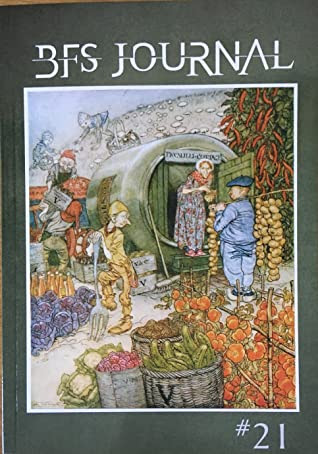
BFS Journal #21, by Sean Wilcock and Sarah Deeming (eds) (The British Fantasy Society) | review by Stephen Theaker

At the time of writing (July 2020), it’s been four years since the release of a new issue of the BFS Journal was last mentioned on the British Fantasy Society’s website, and almost four years since the society last announced a new issue on Twitter, but new issues are still being regularly released.

The last issue I reviewed was BFS Journal #18, edited by Allen Stroud (see TQF64). For this issue he moves on to Advisory Editor, while Sean Wilcock takes over as editor. Sarah Deeming is introduced as Reviews Editor, a review section making its welcome return to the publication after an absence of some years.

The first couple of articles are quite hard work. The first tries to persuade us by way of Jungian theory that mazes, water and eating are traditionally feminine. Taking a theory and shoe-horning a few cherry-picked moments from books into it doesn’t tell us anything very much about the books or the usefulness of the theory.

The second, about “Jung’s Concept of the Anima in Fantasy and Science Fiction Pulp”, has a similar problem, and puts forward the nonsensical idea that the UFO craze of the fifties resulted from a Buddhist symbol springing from the “collective unconscious” relating to “the totality of the self”. Hm.

The third article, “When Fantasy Meets Uchronie” by Pascal Lemaire, is genuinely interesting and knowledgeable, telling us about an area of science fiction I knew nothing about: French alternate histories. I’ll be reading some of them in future. It also introduced me to the excellent phrase used for vampire romance in France: bit lit.

The fourth article is a lengthy history of Ladbroke Grove counterculture, taking in people like Pink Floyd, Mick Farren and Michael Moorcock. It’s interesting – I hadn’t known for example how the Notting Hill carnival had begun – but not rigorously academic: many quotations are unsourced, and sometimes even the speaker is unidentified.

Three shorter articles include Allen Ashley’s visit to a witchcraft exhibition at Oxford’s Ashmolean Museum, Jessica Pascoe on a guided tour of Middle-Earth filming locations, and three academics talking about a seminar series on international fantasy at the University of Leeds, and setting out their mission statement.

The review section starts with a six-page review of Netflix’s The Haunting of Hill House which devotes only a few paragraphs to Netflix’s The Haunting of Hill House rather than the book. A review of the Nicholas Eames book Bloody Rose tells the reader that we might “love him or hate him”, without explaining why we might hate him.

There are also informative reviews of The Godserfs’ Trilogy, The Girl King and Dragon Heart, all of which make it clear how good (or otherwise) the reviewers thought the books were, which I always appreciate. The issue’s one editorial wobble comes with a review of Kingdom of the Wicked: Rules, which seems to have been published in an early draft.

Otherwise, the egregious errors that plagued #18 have gone, and once you get past the thirty pages of Jungian nonsense at the beginning, there are some good articles with useful knowledge to share. Also, the bibliographies now have the date immediately after the authors’ names, making them much easier to use.

Overall, a good deal of improvement since the last issue reviewed. ***

Monday, 8 February 2021

Venus in the Blind Spot, by Junji Ito (Viz Media) | review by Stephen Theaker

An extraordinarily creepy collection of short stories by writer and artist Junjo Ito, translated by Jocelyne Allen and Yuji Oniki. It presents the reader with one horrifying image after another, while reflecting on themes of loneliness, misogyny and obsession. “Billions Alone”, for example, gives us a world where anyone gathering in a group is mysteriously stitched together, naked, in increasingly bizarre patterns.

Thursday, 4 February 2021

New Horizons: The Gollancz Book of South Asian Science Fiction | review by Stephen Theaker

This ambitious anthology collects science fiction from the Indian subcontinent (home to about 1.7 billion people) and from the global diaspora. As well as India, Pakistan and Bangladesh, there are contributors living in Scotland, Iceland and the USA, and the editor himself was born in Kenya. Unsurprisingly, then, it offers a wide variety of stories, presented in what Manjula Padmanabhan’s foreword self-deprecatingly calls ‘a bouquet of styles that are endearingly – perhaps even irritatingly! – local’.

Tarun K. Saint’s highly detailed and informative introduction might be best saved for reading after the stories, but it provides a useful historical overview of the genre in the region, and is likely to send the reader after other books mentioned, such as (for this reviewer) the utterly charming Professor Shonku stories of Satyajit Ray. Saint explains that the genesis of the anthology, as set out in a concept note to potential contributors, was to explore ‘a sense of disturbance with the situation in contemporary South Asia’, and to explore the power of science fiction to ‘generate alternative visions of the future’.

If, as the editor suggests, this aspect of sf has yet to be fully appreciated on the subcontinent, this anthology makes an admirable attempt to redress matters.

There are twenty-three stories, four poems and a prescient series of extracts from a longer work, The Twenty-Second Century by Rahul Sankrityayan, dating from 1923. Six items are translations, twenty-two were written in English. The copyright acknowledgements list only nine, so most would seem to be original to this anthology.

They explore issues such as post-colonialism, religion, colourism, partition (a trauma explored in the editor’s own ‘A Visit to Partition World’), bureaucracy, class, American and British cultural imperialism, sewage management and police corruption (amusingly satirised in Harishankar Parsai’s ‘Inspector Matadeen on the Moon’). They don’t on the whole go very far into the future, and rarely visit space, tending to explore a recognisable world.

The mistreatment of women is a frequent theme. ‘A Night with the Joking Clown’ explores the effects of Male Hypertoxic Syndrome and extrapolates the exploitation of women to its ultimate end. Giti Chandra’s ‘The Goddess Project’ imagines android goddesses created (or perhaps summoned) to fight back against such oppression. In ‘We Were Never Here’ by Nur Nasreen Ibrahim the women just up and leave (although the only sf element of that one seems to be that it posits ninth and tenth waves of future feminism, without explaining what they are).

Despite the serious intent, it’s far from a humourless book. ‘The Man Who Turned into Gandhi’ by Shovon Chowdhury is the quirky story of a chap who loses his hair and teeth, becomes ambidextrous and can no longer eat chicken or wear clothes. Transformed into Gandhi, he finds out how the hero of the independence movement might be treated if he reappeared now, and delivers lengthy lectures to his wife. ‘You used to talk very little,’ she says. ‘It was one of your few good points.’

‘Dreaming of the Cool Green River’ by Priya Sarukkai Chabria is another satire, and a highlight of the book, introducing us to the Chief Sanitizing Archivist, who in theory collects Objectionable Art and Ideas so as not to offend HurtMobs, but in fact is creating copies so that she can sell the originals.

The New Horizons bit of the title has been added for UK publication, perhaps to stress that these are mostly new stories. For me it was almost all new horizons: the only name I recognised was Vandana Singh, who contributes the flowery final story, ‘Reunion’. I must have missed Anil Menon back in Interzone #216, but his story here is a good one: ‘Shit Flower’ concerns a ‘computational immunologist’ who taught sewage control computers to understand jokes as a security precaution. Surprisingly moving, given its faecal subject matter.

That the anthology was originally produced for an Indian audience is perhaps reflected in the absence of a glossary for untranslated words and phrases. This can be a bit frustrating when they are crucial to understanding the story, but Google was usually able to help.

New Horizons is an entertaining book that offers a generous selection of locations, viewpoints, issues and styles. Don’t expect the censorship of Bollywood films: these address adult themes in an adult world. It does a lot of different things and it tends to do them very well; this review could only fail to encompass them all. This anthology feels like a labour of love, and with respect to Manjula Padmanabhan, readers should find it stimulating rather than at all irritating.

Note that this review was written in January 2020, based on an advance review copy, and originally appeared in Interzone #286. The book's UK publication was then postponed to 2021. Any changes made to the book during the intervening time won't be reflected in the review.

Monday, 1 February 2021

Tomorrow, When I Was Young, by Julie Travis (Eibonvale Press) | review by Stephen Theaker


I’m often a bit nervous to read books by writers I know, because no matter much I like them, I’m still going to rate their books honestly. I needn’t have worried: this chapbook was terrific. Zanders, a woman who in the present was suffering from the physical injuries left by domestic abuse, has now awoken in the past, on a ship called The Giantess, with the mysterious and rather romantic figure of The Golden Sea Captain, and gains a kind of peace through adventure. Highly recommended. Stephen Theaker ****

Sunday, 31 January 2021

Glork Patrol, Thorgal, Doctor Who and other reviews in brief

Brief reviews of the books I finished reading this month. Creators, publishers, etc as per Goodreads; apologies to anyone left out.

Marvel Masterworks: The Fantastic Four, Vol. 9, Stan Lee and Jack Kirby (Marvel): Stan and Jack not at their best in this one. The saga of the new house was particularly silly. The Thing as a gladiator on a gangster planet was also fairly daft. ***

The Fourth Power #1: Supramental, Juan Giménez (Humanoids): Graphic novel from Humanoids. Beautiful art, with a story I didn't follow at all till I read the book's description on Comixology. Basically, Earth's been egging on a war, so some of the locals fuse four attractive women into a rather less attractive (but equally buxom) psychic weapon. ***

Rumble, Vol. 1: What Color of Darkness, John Arcudi and James Harren (Image Comics): Good graphic novel by a writer, artist and colourist who all worked on BPRD, and quite a close cousin to that book. A great warrior comes back as a scarecrow, to fight monsters for whom I felt quite sorry, since they were the survivors of a war waged to clear the Earth for us. ***

Thorgal, Vol. 2: The Three Elders of Aran, Grzegorz Rosinski and Jean Van Hamme (Cinebook): Two albums in one. Wish I'd bought the French versions (the English ones are censored and in a different order), but these stories were still enjoyable. Quite old-fashioned, beautifully drawn, in a pick'n'mix world where anything goes, from goblins to UFOs. ***

Babylon Berlin, Arne Jysch and Volker Kutscher (Titan): Very good hard-boiled graphic novel from Hard Case Crime, about a detective in 1930s Berlin. Hoping to wangle a permanent transfer to the homicide division, he plays his cards too close to his chest and gets into a spot of bother. Adapted by Arne Jysch, whose art is excellent. ****

Homeland, Barbara Kingsolver (Faber & Faber): A family takes their Cherokee great-grandma on a road-trip to where she grew up, but it's changed beyond recognition. It's all told from the point of view of a child, Gloria, who is tasked by her great-grandma with remembering everything; the story is one way of keeping that promise. ****

Thorgal, Vol. 3: Beyond the Shadows, Grzegorz Rosinski and Jean Van Hamme (Cinebook Ltd): Best yet of the Cinebook volumes, this includes two linked stories, Beyond the Shadows and The Fall of Brek Zarith, where Thorgal goes on a quest to the underworld and beyond to find his missing wife and child. Gorgeous art, ideal for panel by panel reading on a nice bright screen. ****

Zikora, Chimamanda Ngozi Adichie (Amazon Original Stories): Excellent story, with more character in thirty-five pages than some books do in five hundred, about a woman going through childbirth while thinking about the women in her life and the men who let them (and her) down. I felt much less sympathetic towards her after she had the baby boy circumcised, as if she were punishing him for other men's failures – no wonder he wouldn't stop crying! – but that was all part of what made it so interesting to read. *****

Valentine, Vol. 1, Vanyda (Europe Comics): Sweet, well-observed story about a French teenager who has a group of friends, but not a true best friend, and the leader of the group isn't very nice. It's good, but ends oddly, perhaps because it was originally the first half of a longer black and white book, Celle que je ne suis pas. ***

The Caduca, Elaine Graham-Leigh (The Conrad Press): The first prose novel I finished this year, a political science fiction thriller. I loved it – and not only because TQF gets a nod in the acknowledgments! Review (with appropriate disclaimers regarding my obvious bias) to follow in a future issue of TQF.

The Problem with Men: When is International Men's Day? (And Why it Matters), Richard Herring (Sphere): A funny little book about how he tried for a decade to reply to the hundreds of men who ask the same daft question every International Women's Day: when is it International Men's Day? I might have to buy the audiobook too, just to hear those pathetic, whiny tweets read out loud. It's not perfect: the title's a bit grand for a book with such a narrow focus; the ebook footnotes are confusing; it uses the word gender in some places where sex would make more sense; and it's slightly misleading to say no one gets mad about International Men's Day. Also, I don't think Bill Burr was at all wrong to be suspicious of the inauthenticity of many self-described male feminists. They frequently turn out to be actively sexist and anti-feminist, enthusiastic proponents (and consumers) of prostitution, pornography and paid surrogacy. But it's good. Its biggest strengths are (a) being funny and (b) setting out a vision for what International Men's Day could be about: praising positive male role models, checking in with friends, helping those who need it. A day where we put our energy into being the best men we can be. ***

Thorgal, Vol. 4: The Archers, Grzegorz Rosinski and Jean Van Hamme (Cinebook): Two stories that take place after Thorgal sails off in his little boat and loses it. Left behind on the island, his wife and child have to deal with a supernatural green-haired boy, while Thorgal enters an archery contest to win money for a new boat. Very good, apart from the shocking way Thorgal treats new character Kriss de Valnor. ****

Thorgal, Vol. 5: The Land of Qa, Grzegorz Rosinski and Jean Van Hamme (Cinebook): Another two connected Thorgal stories, both drawn with astonishing detail but censored by the British publisher for the sake of "our more sensitive readers". Thorgal is coerced into a mission by Kriss de Valnor, angrier than ever after the way he treated her in the previous book, while his son gets to meet his grandad from space. ****

Thorgal, Vol. 6: The City of the Lost God, Grzegorz Rosinski and Jean Van Hamme (Cinebook): Another pair of censored but brilliantly-drawn stories conclude Thorgal's mission to bloodthirsty Mayaxatl, and then take him back to Xinjin, where his son Jolan has been installed as a god. Not entirely original, but all the wildly disparate elements are patched together nicely. I have mixed feelings about the censorship. I probably like the books better for them being a bit less exploitative of women's bodies. I might have suggested the same changes myself, if editing the original books. But I'd still rather read the real version and judge that. ****

The Worlds of Thorgal: Louve #1: Raïssa, Yann and Roman Surzhenko (Le Lombard): A spin-off for Thorgal's daughter, Louve, who was still in the planning stages in the last Thorgal book I read. After fighting local boys, she befriends a wolf who was banished from her pack. Different creators, same feel, lots of talking to animals, gets weirder as it goes on. ***

Orion's Outcasts, Vol. 2, Éric Corbeyran and Jorge Miguel (Humanoids): Based on the work of French sf writer Julia Verlanger, this is about Rebecca, an sf hero trying to escape a barbarian world so that she can save its people – despite all their efforts to kill her. Not as good as the first book, and it felt a bit rushed, but it had its moments. ***

Oblivion Song, Vol. 2, Robert Kirkman, Lorenzo De Felici, Annalisa Leoni (Image Comics): Second part of Oblivion Song takes us back and forth between the universes a few times without moving the story forward very far, though there's plenty of personal growth and lots of monster fighting. Like a lot of Robert Kirkman books, it ends very well. Nice art, great colours. ***

Doctor Who: The Fourth Doctor, Vol. 1: Gaze of the Medusa, Gordon Rennie, Emma Beeby, Brian Williamson, Hi-Fi and Alice Zhang (Titan): Fairly good story for the fourth Doctor and Sarah Jane, who tangle with some Greek myths and the woman who worships them. Catches the Doctor's character well and the likenesses are good, but far too many panels stretch across two pages, making it quite irritating to read onscreen. ***

The Case of Charles Dexter Ward, H.P. Lovecraft and I.N.J. Culbard (SelfMadeHero): New edition of the H.P. Lovecraft adaptation by I.N.J. Culbard, published by SelfMade Hero. It's about a weird young man who goes too far in his quest for weird knowledge. Thought I'd read all of Lovecraft's stories, but this wasn't familiar at all. Review to follow in TQF70.

Criminal, Vol. 1: Coward, Ed Brubaker, Sean Phillips and Val Staples (Image): A very good crime story. A pickpocket and occasional bankrobber is persuaded to work a dangerous job, even though he knows something is up. Meanwhile he's trying to look after his mentor, his dad's partner-in-crime, who is suffering from dementia and sexually assaulting his nurses. ****

Exorsisters, Vol. 1, Ian Boothby, Gisèle Lagacé and Pete Pantazis (Image Comics): Two twins (sort of) help people get their souls back from hell, while their mum gets involved in something shadier. It is just getting started by the end, but so far I liked the characters more than I enjoyed the story they were in. They're a bit like Maggie and Hopey crossed with John Constantine. ***

The Power of Negative Thinking, Oliver Burkeman (BBC Digital Audio): Oliver Burkeman always seems so wise and sensible on Twitter and in his Guardian columns, so I got this from Audible and it didn't disappoint. Worrying about whether you can do things better and fretting about what could go wrong can be very useful, properly channelled. ****

Nailbiter, Vol. 1: There Will Be Blood, Joshua Williamson, Mike Henderson, Adam Guzowski and John J. Hill (Image Comics): A town has produced 16 serial killers, each with their own gimmick. A guy who thinks he's figured it out goes missing so his pal stays in town to investigate. The mysteries are interesting and there are some good twists, but there was too much actual nailbiting for my comfort. ***

By The Numbers, Vol. 2: The Road to Cao Bang, Laurent Rullier and Stanislas (Humanoids): A sad story about a young accountant up to no good in Saigon during the dying days of French colonial rule. He falls in love with a woman who loves gambling much more than him. Unusual subject matter for a comic, but I thought it was well-handled. I found the art very appealing. ****

Black History In Its Own Words, Ron Wimberly (Image): Thirty-nine Facebook-friendly portraits of black cultural figures and their words. Not a substantial or always reliable read but the portraits are pretty good. Wasn't sure what to make of Angela Davis's quote about radical meaning "grasping things at the root" being followed by one in praise of onanism… ***

Citizen Jack, Sam Humphries and Tommy Patterson (Image Comics): A sexist, slovenly, mendacious, corrupt man with no understanding of politics decides to run for president and finds that the worse he behaves, the more his public adores him. I don't know how comics creators come up with these crazy ideas! There's also a dolphin news anchor. ***

Doctor Who: Land of the Blind, Scott Gray, Dan Abnett, Lee Sullivan, Gareth Roberts, Nicholas Briggs, Martin Geraghty, David A. Roach, James Offredi, Kate Orman, Gary Russell, Barry Mitchell and Gary Gillatt (Panini): A treat of a book, with black and white retro adventures for the first five Doctors, often with television companions that weren't allowed to appear in the comics of their day. A self-aware commentary from the creators pre-empts criticism, e.g. as to the second Doctor's encounter with a "speculum". ****

Doctor Who: The Child of Time, Jonathan Morris, Martin Geraghty, Dan McDaid and others (Panini): Surprised to see I had this down as unfinished on Goodreads, but there was indeed a bookmark in it. No idea why I stopped reading it with 50 pages of story to go. Enjoyed finishing it off, but the commentary makes writing the strip sound like an utterly miserable experience. ***

Glork Patrol on the Bad Planet, James Kochalka (Top Shelf Productions): Another hilarious adventure for the Glorkian Warrior and his patrol, with a new publisher and at a shorter length. I loved the previous three books, even if they were aimed at children, and this one had me laughing out loud again with its glorious stupidity. ****

The Kamandi Challenge, Tom King, Peter J. Tomasi, Neal Adams, Marguerite Bennett, Dan Jurgens, James Tynion IV, Jimmy Palmiotti, Dan DiDio, Dan Abnett, Paul Levitz, Gail Simone, Rob Williams, Greg Pak, Keith Giffen, Steve Orlando and Bill Willingham (DC Comics): Fairly enjoyable book that tries to recapture the wild creativity of Jack Kirby by getting a ton of top creators to run a relay race with one of his characters, the last boy left alive in a planet of the apes, sharks, rats and robots. Pretty good, but the ending was a bit of a letdown. ***

Women & Power: A Manifesto, Mary Beard (Profile Books): Thought-provoking little book, discussing how "women, even when they are not silenced, still have to pay a very high price for being heard". Also interesting when it talks about "the power of followers not just of leaders" and "women's right to be wrong, at least occasionally". ****

Monday, 25 January 2021

The Nostalgia That Never Was, by Rhys Hughes (Gloomy Seahorse Press) | review by Stephen Theaker


A collection of brief pieces (“apocryphal incidents and speculations”) related tangentially to famous figures, who are appearing as visions to Marco Polo. Wikipedia look-up on the Kindle came in handy. The framing device doesn’t really work, since the fragments are nearly always jokes and broken logics from the author’s point of view, rather than the famous figures themselves. It sometimes feels like a compilation of his social media posts. Amusing in places, but not my favourite of his books. ***

Monday, 18 January 2021

Star Wars: Dark Disciple, by Christie Golden (Lucas Books/Penguin Random House Audio)

Somebody, Please Kill Me.

(Note: spoilers abound.)

Dark Disciple is a suitably epic tale set amidst the Clone Wars (and based, apparently, on unmade scripts for the animated series). It lays the thematic groundwork for Anakin Skywalker’s fall to the Dark Side. It eschews multiple storylines and tedious politics and concentrates instead on space opera Jedi action. Golden does so much right.

Saturday, 16 January 2021

Vivarium | review by Douglas J. Ogurek

Running in circles, digging for answers. And somebody’s watching, but who… or what?

In house number nine, an exhausted Gemma (Imogen Poots) sits on the floor. Clothes spin in the dryer behind her. In front of her, a boy (Senan Jennings) runs in circles and moves into and out of the frame. This seemingly benign scene encapsulates Vivarium, in which a young couple gets lured into a “forever home” in the community of Yonder. In this tract housing development, every home has the same design, the same mint shade of green, and the same fence and yard. And the perfectly spaced clouds are all shaped like… clouds. Gemma, her partner Tom (Jessie Eisenberg), and the odd nameless boy who comes to live with them are the only residents in Yonder. Most disturbing, every time Gemma and Tom try to get away, they end up back at number nine.    

Monday, 11 January 2021

Heads Will Roll, by Kate McKinnon and Emily Lynne (Audible) | review by Stephen Theaker

This Audible series is written by and stars the reliably hilarious Kate McKinnon and her sister, Emily Lynne. It is often very funny, like an 18-rated version of Radio 4’s Elvenquest, albeit without a studio audience. McKinnon plays Queen Mortuana of the Night Realm, a typical fairy tale evil queen, albeit with a foul mouth and a sex dungeon, who is warned by a soothsayer that a peasant rebellion is imminent. Lynne plays JoJo, a former princess cursed to live as a crow.

Friday, 8 January 2021

The Beasts in the Arena, by Sophia McDougall (Gollancz) | review by Stephen Theaker

In a world where the Roman Empire lasted long enough to develop trains, an animal trainer is asked to provide a lion for a celebration of the new emperor. But the lion is dead, and it died on the day the old emperor died. The new emperor might see this as an unwelcome omen. As well as this enjoyable short story, the free ebook also includes a long extract from Romanitas, a novel set 250 years later, by which time the Empire has invented “longvision”, and expanded as far as India and Mexico. Stephen Theaker ***

Monday, 4 January 2021

Assassin’s Creed: Gold, by Anthony Del Col (Audible) | review by Stephen Theaker

Aliyah Khan owes her friend’s dad a lot of money. Well, she doesn’t really – he invested in her business and it failed – but she feels like she does. Her attempts to pay him back lead her into contact with the Assassins, who fight throughout history to protect freedom and counter Templar authoritarianism and tyranny. One of the ways they do this is by tapping into the DNA of suitable volunteers, to see if their ancestors came into contact with valuable artefacts and information.

Friday, 1 January 2021

Abigail and the Snowman, by Roger Langridge (Kaboom!) | review by Stephen Theaker

When Abigail moves to a new school, the first friend she makes is an abominable snowman. Unfortunately he is being pursued by agents who want him back in captivity. This is a charming book, with smashing art by writer and artist Roger Langridge. The bumbling agents are basically Laurel and Hardy, which is fun, the monster is very sweet, and Abigail is a cool kid, who takes time to think about things, which I always love in a character. But she is, essentially, a nine-year-old girl sneaking an adult male into her bedroom and school, making it rather unsuitable for school libraries. Stephen Theaker ***

Thursday, 31 December 2020

Lone Wolf 31: The Dusk of Eternal Night | review by Rafe McGregor

Lone Wolf 31: The Dusk of Eternal Night by Vincent Lazzari and Ben Dever

Holmgard Press, hardback, £19.99, December 2020, ISBN 9781916268036


If I enjoy a series and the latest instalment isn’t up to the standard of its predecessors, my usual policy is to avoid reviewing it.  Perhaps that’s what I should do with Lone Wolf 31: The Dusk of Eternal Night, the penultimate instalment of the late Joe Dever’s Lone Wolf cycle of fantasy gamebooks, which was released in time for Christmas by Holmgard Press.  Having invested so much time and energy (and a not inconsiderable amount of money) on the franchise as well as reviewing all of the New Order series (Lone Wolf 21 onwards) to date, however, I feel it would be a cop out.  Also, notwithstanding my criticism below, I will be buying the last in the cycle – Lone Wolf 32: Light of the Kai – on the basis that I am in my fifth decade of playing the books and have a need to know how it all ends (I began shortly after Lone Wolf 1: Flight from the Dark was published in 1984).  For those interested, I’ve discussed the trials and tribulations of the franchise – including why the publication of the cycle has taken so long – here, here, and here.  So let me begin with the bad news and my harshest criticism: Lone Wolf 31 simply has too much dialogue, too much description, and too little gameplay.  It’s as if the authors forgot they were writing a gamebook and wrote an experimental young adult fantasy novel instead.  Now one may think that this hybrid model of gamebook-novel is an improvement on the gamebook-only model or that the change of direction is precisely what the cycle needs for a spectacular conclusion, but I have been playing these books since the eighties because they are games.  If I wanted a novel set in Magnamund I would have collected the Legends of Lone Wolf series (novelisations of gamebooks 1 to 8, published from 1989 to 1994) – and, indeed, I did try the first and decided that they weren’t for me.  I genuinely hope that most if not all readers of this review disagree with my evaluation and if you don’t want to be put off Lone Wolf 31 please don’t read any further.  Just buy the book, read it, and make up your own mind.

Tuesday, 29 December 2020

Theaker's Quarterly Fiction #68: out now in paperback and ebook!


free epub | free mobi | free pdf | print UK | print USA | Kindle UK | Kindle US

Welcome to Theaker's Quarterly Fiction #68, edited by Stephen Theaker and John Greenwood.

This issue of Theaker's Quarterly Fiction features “Network”, a complete novella by Mitchell Edgeworth, the longest entry yet in the adventures of the Black Swan. It’s been four years since the previous episode appeared in TQF53, but it’s been worth the wait. This issue also includes “The Erkeley Shadows”, a new story by Michael Wyndham Thomas, the magazine's first ever real contributor, way back in 2005 with “Valiant Razalia: Prologue” (TQF8), and twenty pages of reviews, where Jacob Edwards, Douglas Ogurek, Rafe McGregor and Stephen Theaker consider the work of Anthony Del Col, Kate McKinnon and Emily Lynne, Christie Golden, Ursula K. Le Guin, Joe Dever, Rhys Hughes, Joe Hill, Julie Travis and Junji Ito, as well as BFS Journal #21, edited by Sean Wilcock and Sarah Deeming.


Here are the magnificent contributors to this issue.

Mitchell Edgeworth lives in Melbourne, Australia. He tweets as @mitchedgeworth and keeps a blog at www.grubstreethack.wordpress.com.

Michael W. Thomas is the author of eleven titles, the latest being a poetry collection, Under Smoky Light (Offa’s Press, 2020). His Valiant Razalia duology, The Mercury Annual and Pilgrims at the White Horizon, is published by Theaker’s Paperback Library. His writing has appeared in such publications as Critical Survey, Magazine Six, The London Magazine and The Times Literary Supplement, as well as in previous issues of Theaker’s Quarterly Fiction. Website: www.michaelwthomas.co.uk.

Jacob Edwards also writes 42-word reviews for Derelict Space Sheep. His website is at www.jacobedwards.id.au, his Facebook page at www.facebook.com/JacobEdwardsWriter, and his Twitter account is at www.twitter.com/ToastyVogon.

Rafe McGregor lectures at Edge Hill University. He is the author of two monographs, two novels, six collections of short fiction, and two hundred articles, essays, and reviews. His most recent work of fiction is The Adventures of Roderick Langham, a collection of occult detective stories.

Douglas J. Ogurek is the pseudonym for a writer living somewhere on Earth. Though banned on Mars, his fiction appears in more than fifty Earth publications. Douglas’s website can be found at www.douglasjogurek.weebly.com and his Twitter account is at www.twitter.com/unsplatter.

The cover art is a detail, which we have tinted red, from a piece by Etienne Leopold Trouvelot: “The planet Mars: Observed September 3, 1877, at 11h. 55m. P.M.” From the New York Public Library Digital Collections.


As ever, all back issues of Theaker's Quarterly Fiction are available for free download.

Friday, 25 December 2020

Blood on Satan’s Claw, by Mark Morris (Audible) | review by Stephen Theaker

Audio drama produced by Bafflegab. The young people in a eighteenth-century village fall under the sway of a malevolent force. The original film (mysteriously popular with Doctor Who fans) was a product of its time, the year of Charles Manson’s trial, which it echoes. This new version is still about the horror of sexually active women. The cast is excellent, including Mark Gatiss, Reece Shearsmith and Alice Lowe, and it does interesting things with sound, music and effects. Stephen Theaker ***

Friday, 18 December 2020

The Witcher, Season 1, by Lauren Schmidt Hissrich et al. (Netflix) | review by Stephen Theaker

Unashamedly derivative of Elric, right down to calling its main character the White Wolf, this eight episode series was nonetheless very enjoyable. It’s as if they took the time that Henry Cavill reloaded his biceps in Mission: Impossible – Fallout and made it last eight hours. It’s daft as a brush and leans into it. In this series the Witcher runs through a series of entertaining one-off adventures, while we see what a wizard and a princess were getting up to before they met him. Rollicking stuff. Stephen Theaker ***

Friday, 11 December 2020

Preacher, Season 4, by Sam Catlin and chums (Amazon Prime Video) | review by Stephen Theaker

The final season of a show that wasn’t quite the equal of its best moments. Preacher Jesse Custer, his partner in many crimes Tulip and vampire Cass head for Masada to stop the apocalypse, while God and Herr Starr do their best to make it happen. It frequently feels like an extended game of Marco Polo, with episodes often driven by the need to recover whichever member of the gang has gone missing this time, but it’s still entertaining: where else will you see Jesus in a fist fight with Hitler? Stephen Theaker ***