Monday, 4 February 2008

Mass Effect

Mass EffectStar Trek games always seem to disappoint. Bafflingly, they nearly always seem to be based around huge ponderous spaceships blasting chunks out of each other (though I seem to remember a first person shooter based on Voyager a while back). That stuff used to be great fun when it appeared in the programmes and the early movies, at least until it started to be shown up by the more epic, frantic and exciting space battles of Babylon 5, but it was far from the crux of Star Trek’s success. The true appeal of Star Trek lies in the human – and alien – interactions: emotion, drama, punch-ups, moral dilemmas, romance, conflict, humour, and, last but not least (and the one that seemed all too often forgotten in recent iterations of the franchise) sex appeal. Mass Effect is a game that relegates the huge spaceships to cut scenes and concentrates on the stuff that really made Star Trek great, adding to it huge lashes of the good stuff from Battlestar Galactica, Babylon 5 and Star Wars, not to mention a big dollop of prime David Brin. It’s the most “sci-fi” game I’ve ever played, and I think many science fiction fans would get a great deal of pleasure from simply watching the cut scenes edited together into a movie, never mind actually playing the game.

But let’s move onto the game anyway, because it is worth playing! However, it says much about it that after 80 hours of playing it I feel barely qualified to comment. I’ve gained about 840 of its 1000 achievement points and yet, without mastering the sniper rifle, using the full range of biotic attacks, or partnering up for the game with Liara the lovely Asari or Wrex the unlovely Krogan, I feel that there’s a lot left for me to do.

Reactions to the game (leaving aside the hilarious “porn simulator” nonsense brewed up by idiotic American conservatives) have tended to follow a certain pattern. Initially most people tend to be underwhelmed – you can see that in Edge magazine’s disappointed seven out of ten review in issue 183, in reactions from gamers on Digital Spy, and in the negative review from distinguished Xbox writer Dean Takahashi. I felt the same way.

At first to me the fighting felt uncontrolled, the weapons unbalanced, the graphics a bit too choppy. I don’t like to play stategy games that don’t give you time to make decisions – I’ll always prefer turn-based to real-time strategy games. I didn’t feel like I was ever in control of events during Mass Effect’s combat.

Then, a mission or two into the game, I realised that while selecting my weapons and powers the game was paused, and I could move the cursor around with the joystick to pick out different targets for my attacks, and the attacks of my team. Suddenly, from being a bunch of buffoons chasing robots round and round crates, we became a crack tactical squad, knocking enemies flying with our telekinetic powers, lifting them into the air, blowing up their guns, and knocking them down with our shotguns. From that moment the game got better and better. There’s a sheer glee to unleashing one powerful attack after another (balanced with the tension of anticipating the equally powerful attacks of your enemies) that makes Mass Effect a wonderful and addictive game to play.

That pretty much seems to have happened to everyone. In the latest issue of Edge the game is described as “the absolute best flawed game of the year”. A poster on Digital Spy who started a thread by the name of “Mass Effect – Yawn-o-Rama” in December returned in January to say he now loved it. And Dean Takahashi posted a follow-up review explaining how wrong he had got it the first time around.

One reason for such changing views is the process I mentioned above – simply getting to grips with the mechanics of the game. Another reason is that the game gets more and more enjoyable the stronger your powers get.

This adds immensely to the game’s replayability. If you choose, you can start a new game with the character and equipment with which you ended the previous one. So if you built up the appropriate abilities in the previous game, you can start smashing robots into walls like marbles from your very first encounter with them. Hence my second play-through was when I began to really love the game.

It’s a fairly short game, by RPG standards, which at first I thought was a bad thing. My first play-through, checking out every anomaly, scanning every planet, chasing down every mission, only took about thirty hours; and I tend to play games quite slowly. My second, a sprint through the main missions on a higher skill level, skipping through the conversations I’d already heard, took just twelve hours.

At that point, what had seemed a failing in the game, became a plus point: it’s a game that’s designed to be replayed, to be played through and through as different characters, with different powers, and in different ways.

It’s hard to say why I think that’s a good thing, because I don’t like watching movies I’ve seen before, and I don’t like reading books I’ve already read. So let me give you an example of a game that takes a different approach: Elder Scrolls IV: Oblivion. I love the Elder Scrolls series of games, and I’ve put over a hundred hours into this one, but if there’s one thing I’m not massively keen on, as a former player of traditional paper and pencils role-playing games, it is that you can do absolutely everything the game has to offer in a single play-through. You can play as a warrior, rise to the top of the fighter’s guild, and then join the mage’s guild too and rise to the top of that, often bludgeoning your way through the tasks assigned because your magic won’t be up to it. That’s great fun, of course, such free-spiritedness is integral to the game’s design, but it bothers me because with every additional career ladder you scale in Oblivion, the less sense you have of yourself playing a role, the more you’re just playing a game. (Of course, that was partly my fault for choosing to play Oblivion that way: I could easily have started a new magic-based character to play the mages guild missions.)

The converse is true of Mass Effect. If you’re playing as a soldier, you don’t get telekinetic powers of your own. You have to choose team-mates whose abilities will complement your own. Next time around, you could have your own telekinetic powers, or you could specialise in technical attacks, or you could continue to build the talents of your existing character. The length of the game means that it isn’t a chore to start over, but rather something to relish. It’s more akin to starting a new game of Civilization IV than it is to restarting a Final Fantasy game.

All in all, Mass Effect has been a fitting end to three or four of the best months of gaming I can ever remember: Halo 3, Bioshock, The Orange Box and Mass Effect, not to mention a couple of brief dalliances with Pixeljunk Monsters and Pro Evolution Soccer 6. The last time I enjoyed gaming so thoroughly and unreservedly for such a long period was probably back in the 1980s, after my Dad brought home a ZX Spectrum and two C90s full of copied games.

Originally published in Theaker's Quarterly Fiction #21.

Mass Effect, Bioware (dev.). US, Xbox 360.

Theaker's Quarterly Fiction #21

pdf | print UK | print US |

Theaker's House of Horror!

Issue 21! It seems funny to think now that being 21 used to be a big deal in Britain. When I was a youngster, everyone talked about their 21st birthday as the big one, the one for which a massive party would be planned. Now it seems to be barely worthy of note. It’s easy to see why – laws have changed, and reaching 21 is no longer the last barrier to adulthood. You can do mostly anything at 18 nowadays, and a good few things at 16 besides. In the US, it’s quite different – you still have to be 21 to drink, which always seems funny to us, as university studients played by actors in their thirties perpetually struggle to buy beer in the movies, even if it probably makes sense in a country in which so many teenagers drive.

I didn’t expect to get all political in this editorial, but while we’re here let me expound one of the ridiculous ideas I once came up with: the minimum legal age for smoking should go up by one year, every year. That done, everyone who can legally smoke now could continue up until their doubtlessly painful demises, while those who can’t legally smoke now would never be able to start. Okay, so like most of my ideas maybe it's a bit impractical!

My other, more practical, idea with regard to smoking is this: if someone stands near you at a bus stop, or sits on a bench beside you, and starts to smoke, you should feel free to trump as much as you like. This should be a general policy, endorsed by government, perhaps even given its own advertising campaign. I think it’s only fair that if your air is being polluted that you should respond in turn. The only foreseeable problem with this is the risk of blowing yourself up once your post-digestive fumes make contact with the cigarette’s lit end.

Where on Earth am I going with this editorial? That’s the problem with setting aside space for one of these things – you get to the end of the production process and there the space is, waiting to be filled. In an issue like TQF#19, that isn’t a problem, because that one had lots of different stories, and so I only had to write a little bit about each of them to fill the space up.

This time, I’ve only got two stories to talk about, and so there I go, wandering into areas that would be embarrassing if I talked about them in the pub, let alone in the pages of an august and serious journal like the one in your hands (or on your screen, if you are reading this online). And now, what’s worse, I realise I’ve used up almost all the space available without even getting onto the stories! Never mind, this may be the worst editorial of all time, but this issue contents two superb stories that more than make up for it! So, onward you go, to read the thrilling horrors!

First there’s "The Exile From Naktah", by Wayne Summers, by whom we previously published "The Walled Garden" in the aforementioned TQF#19. When reading this story I imagined it as being filmed by Hammer.

Then there’s "The Hatchling: Ante-Natal Anxiety" by my pal John Greenwood, following on from "Post-Natal Paranoia" in TQF#20. I like to think of this as Tintin scripted by Lovecraft and filmed by Guillermo del Toro. I hope you enjoy them both.

By the way, sorry for the cover painting! It may be rubbish, but I had fun painting it! – SWT


Editorial

Theaker’s House of Horror!

The Exile From Naktah

Wayne Summers

Lily * Klune

The Hatchling: Ante-Natal Anxiety

John Greenwood

The Ancient Mariner * Escaping Naseby * Reliving the Past * The Life of Scherlasky * Visiting Family * Old Haunts * Emergence * A Homing Instinct

The Quarterly Review

Mass Effect * Back to You

Helen and Her Magic Cat

Steven Gilligan

Saturday, 29 December 2007

Halo 3

Halo 3I fell in love with this game when browsing a replay movie. As Master Chief, the last hope for humanity, I had fought my way down a bog-standard corridor on my way to more exciting stuff. Watching the replay, I paused the game and zipped the camera down to the other end of the corridor to watch my death-dealing approach from the point of view of my enemies. That was cool enough in itself, but then I noticed one of the pint-sized grunts running off down a corridor. What was he doing? I took the camera down that same corridor, and watched him hide in the darkness as I ran past. Once I was gone, the grunt said with relief (words to the effect of), “I’m glad he’s gone!” Genius! I’ve rarely seen such attention to detail in a game – or perhaps it’s better to say that the attention to detail has never been highlighted in such an effective way. Like the achievements you can gain in this and other Xbox 360 games, the features of Halo 3 encourage you to play and explore the game to its fullest.

I haven’t talked yet about the gameplay itself. I wasn’t a huge fan of Halo and Halo 2, perhaps as a result of picking them up a few years after their release, by which time I’d already played other games incorporating their innovations. I’ve always found online gaming a bit of a chore, which killed part of their appeal for me. I also, to be honest, found them a bit hard!

I’m enjoying Halo 3 much more. For one thing, I’m finding it easier, thanks to your health (at least on the Easy level) being a single shield, which fully recharges in cover, avoiding the death by attrition which always did for me in the previous two games. For another, it’s currently the state of the art in videogames, and so its ideas are as yet unsullied by imitators.

The gameplay options it offers are endless, both in terms of online options, but also in every individual moment – every weapon has its uses in every situation, and every situation responds to a dozen different approaches.

Finally, we are always starved of proper, full-on, big-budget science fiction in the cinema. So it’s a joy to watch a science fiction story as epic as Halo 3’s unfurl, even if it’s on the small screen.

There’s a lot more to be said about this game; the game itself is a conversation that will continue for years to come. Despite playing it all the way through I’ve barely scratched its surface. In terms of Hollywood blockbusters, Halo 3 would be The Matrix or the Lord of the Rings, movies that satisfy on a visceral level, but also repay and stand up to sustained scrutiny.

Originally published in Theaker's Quarterly Fiction #20.

Halo 3, Bungie (dev.). US, Xbox 360.

Theaker's Quarterly Fiction #20

pdf | print UK | print US |

The Big Two-Oh: Celebrations and Apologies!

So this is it for another year – our fourth year of issues (even if it’s only been three and a bit years since the first came out). I’d love to say that this has been a great year for Theaker’s Quarterly Fiction, because in many ways it has. Our downloads have increased immensely and even our print sales have gone up a bit. People are starting to hear about what we’re doing. Listings on places like www.duotrope.com, www.ralan.com and the AA Independent Press Guide have brought dozens of submissions to our inbox, and the stories which we have accepted have enriched the magazine in every way. But I can’t bring myself to say it’s been a great year when it was the year our best friend died, leaving us utterly shaken. He’d spent Christmas with my family for something like the last six years, and while that sadly reflects the fact that he never managed to find someone special to create his own Christmases with, they were always good times, and it’s hard to face this one without him around. Apart from anything else, he nearly always bought superb presents for me. (Last year it was The Lurker in the Lobby, a fascinating overview of Lovecraftian cinema.)

I won’t spend the whole editorial being sad, though. It is Christmas, after all, and however much I miss my friend, I’m in ecstatic anticipation of the new Doctor Who Christmas special, and the Marks & Spencers pre-cooked turkey crown in the fridge looks as delicious as it does every year!

In this issue we have the first portion of a new novel by my co-editor, John Greenwood. I made him co-editor in recognition of the fact that he was writing half the magazine at the time – it would be unfair to reject his work now to avoid accusations of bias! And why avoid those accusations? I am biased, no doubt about it. I have a sneaking suspicion that with this novel, as perhaps with his Newton Braddell series, John is pandering to me somewhat, since he packs into each of them everything I want to read whenever I pick up a book (rare as that tends to be nowadays). It’s as if he has made a careful study of my literary tastes and preferences and custom-written a novel to entertain me. The Hatchling is his paciest, most thrilling and most atmospheric piece of writing to date, and if I could get away with reprinting it in every issue from now to eternity I would.

Next, Bruce Hesselbach regales us with a Tale of Yxning, "Contrarieties". Like The Hatchling, this is a story that hits the nail of my tastes so squarely on the head that it is almost uncanny. And the last story of the issue is the concluding part of Michael Wyndham Thomas’s serial, After All, "A River. It Had to Be." It’s been a privilege to publish this fine serial in these unworthy pages.

To both authors I owe an apology (in addition to the one I owe Bruce for the appalling illustration of a plant pot falling on Yren Higbe’s head that marred the publication of his story in TQF#19). Michael Thomas’s serial appeared in all six issues this year, while Bruce Hesselbach’s Tales of Yxning appeared in three, and yet neither author has had the cover devoted to them. The first cover was a portmanteau covering all the stories in the issue (just one postage stamp-sized illustration related to After All), and the next two were devoted to Howard Phillips’ The Doom That Came to Sea Base Delta. The fourth cover of the year featured a creature from the fabulous "Ananke" by Jeff Crook, and the fifth concerned "The Walled Garden", by Wayne Summers, not that anyone would have been able to tell, thanks to my lack of drawing ability. Then this sixth issue has a cover relating to The Hatchling. So that’s four out of six covers given over to our in-house writers, and that’s not at all fair.

The reason is that we knew way in advance what in-house material we had in hand, and once draft covers were drawn up, even though other material came in, I didn’t want to start over on the covers, out of sheer laziness!

In 2008 I’ll make much more of an effort in this regard: I’ve made a vow that none of the covers will be devoted to anything written by myself, John Greenwood or Howard Phillips (unless there is nothing else in the issue).

That brings me to something else that I don’t feel we’ve done particularly well this year: reviews of the books people have sent us. If you look at page 72 of this issue you’ll see my review of Test Drive by DJ Burnham, a book I did not finish reading. As a one-off that wouldn’t be too bad, but it follows similar non-reviews of DF Lewis’s Weirdmonger and Nemonymous #7 (aka Zencore!) in previous issues. For that matter I didn’t get very far through Apex #10 before writing a short review, and Apex #11 stands on my desk now, just as an interesting book by the name of Triangulations stands on my co-editor’s desk. It’s a bit of an embarrassing pattern. We just don’t get around to reading them. In the case of some books that are sent to us on spec, or that we’ve bought ourselves, I don’t feel too guilty, but in the case of something like Apex or Nemonymous where the author has offered review copies and we have specifically requested them, it’s very poor of us.

I can’t promise that we’ll do better next year. For one thing, what really interests me about other small press publications is their methods, philosophies and goals, rather than the stories within. I’m fascinated to see what people are doing, and love to think about the reasons they are doing it. But (and I doubt anyone will disagree) a reviewer should really read the book too! Another issue is that reading an entire book for review takes about as much work as proofreading an entire issue of TQF, and for me it often comes down to doing one or the other.

So while I can’t promise to write better reviews, I won’t ask people specifically to send us review copies, and I apologise to anyone I’ve asked to send us a review copy in the past. If you do send us review copies of your work, I think you’ve had fair warning of the poor quality reviewing you can expect! (For really good reviewing, visit the website of the excellent Whispers of Wickedness.)

So here’s to the end of a very exciting year for this flawed but good-hearted and tenacious magazine! Twenty issues down, but the next will be the best yet – because every issue is! – SWT


Editorial

The Big Two-Oh: Celebrations and Apologies!

The Hatchling: Post-Natal Paranoia

John Greenwood

An Inconvenient Inheritance * Tangling with Grunewald * The Subterranean Ministry * Abroad, Unarmed and Incommunicado * Another Road to Juliaca * An Audience with El Alcalde * The Prison Under the Lake * Night of the Lakemother

Tales of Yxning

Contrarieties

Bruce Hesselbach

After All

A River. It Had to Be.

Michael Wyndham Thomas

The Quarterly Review

Halo 3 * Test Drive

Helen and Her Magic Cat

Steven Gilligan

Monday, 8 October 2007

Theaker's Quarterly Fiction #19

pdf | print UK | print US |

Welcome to Halloween!

es a year should be specials of some kind, so that we can still justify calling the magazine a quarterly. This year, we’ve decided to have a Halloween special. Luckily, we had some suitably scary submissions! “Pumpkin Jack” is the most appropriate, for obvious reasons, and so that’s where we begin the issue. It’s a story by Laura Bickle, about the discoveries a pair of bored teenagers make in and around their grandma’s isolated home. I’m not totally familiar with the way that pumpkins grow in real life, but there’s definitely something strange about these ones!

Next, Wayne Summers asks us to climb into “The Walled Garden”, if we dare. I don’t want to spoil his surprises, so I won’t say much more than that, other than to note how good it is to read that Henrick’s is still a going concern after that terrible incident with the shop window dummies a few years ago.

Something we’ve done differently in this issue is to divide the stories up – very roughly (some may even have been bruised in the process) – into sections. In the past it wasn’t really necessary, with most issues just being one long chunk of nonsense from me, but with more and more stories appearing in each issue, it started to seem like we’d be doing readers a favour if we made them a bit easier to navigate. So after the calendar-friendly fright section we segue into our series of fantasy stories!

I’ll note up front that our first fantasy story, “Rural Legend”, by Eric R Lowther, features horses and wolves, just like “Winter’s Warm Blood” in TQF18. It’s an unfortunate coincidence, but both stories were too good to reject on that account alone, and in any case I think we’re on a run of something like nineteen issues in a row featuring robot stories – a mere two sets of wolves and horses seems half-hearted in comparison! This is a great story that takes its time to draw you in, and is as much of a gentle giant as its protagonist. It’s a story that pats you on the back and says, “You ain’t doing so bad. Just keep on trying your best, and keep on trying to make your best better.”

“The Iron Mercenary” is a piece of heroic fantasy in the classic mould by Richard K Lyon and Andrew J Offutt. It is a continuation of their Tiana series, which saw publication as a series of three paperbacks in the late seventies and early eighties. I think this is this story’s first publication, but it dates from that period, a time before fantasy became a sub-set of the airport novel and Tolkein’s influence pushed Howard’s into the toilets and gave it a solid thrashing.

Andrew J Offutt of course has had a long career in writing, but when I hear his name it means one thing to me: My Lord Barbarian, the cover of which earned me much kudos at middle school by virtue of its buxom heroine, her virtues bare save for some tasteful bits of tin over her nipples. (Sadly I can only find the US cover on the internet, which while nice enough in itself lacks that important nostalgia factor!) I can only imagine what I would have made of Andrew’s Spaceways series at that age, and look forward to discovering what I'll make of it at my current age!

“When the Sun and the Moon Did Not Shine” is from Sam Leng. Saying anything more would give it all away, because it is only a slip of a thing! In the interests of driving readers to our competition, I should mention that Sam has a literary undertaking of her own (her webzine can be read at www.neonbeam.org.

Rounding out this impressive fantasy section is the second of the Tales of Yxning from Bruce Hesselbach. This one details “The Remarkable Life of Yren Higbe”, a character who made a brief but intriguing appearance in the first story, “The Tragical History of Weebly Pumrod, Witch Hunter”. The stories intersect, but stand alone, so if you have yet to acquire your copy of TQF#18, don’t be put off!

Our inaugural science fiction section contains “The Broadest Divide”, by David McGillveray. It’s an interesting story, in that your view of it – as to whether it is depressing or uplifting – will probably depend on whose side you would take. David doesn’t tell you who is right or who is wrong. The chances are even.

I noticed a David McGillveray among the credits in the film section of the Radio Times. Could it be the same man? His biography makes no mention of the fact, and being somewhat star-struck I dared not ask about it! Also, if I knew one way or the other would I feel honour-bound to berate him each time I felt a reviewer had completely missed the point of the latest Adam Sandler/Happy Madison movie, as is so often the case (though to be fair the Sandler reviews in RT have been moving in the right direction in recent years)?

“Who Picked the Pope’s Nose?” by Dan Kopcow doesn’t strictly fit our remit – there is no fantasy element (so my embarrassed apologies to anyone whose stories I have rejected solely on that account), and it isn’t all that adventuresome. But he was kind enough to let us publish one of his previous stories, “The Bearded Avenger”, and this one too tickled my fancy, so I indulged myself. Not knowing which pigeonhole to shove it into, I remembered hearing about some new-fangled type of writing called Bizarro.

Wow, longest editorial ever! There’s no room left to talk about the way this issue has a green cover, just like the previous one!

As usual, I’m going to end up giving unfairly short shrift to our returning features, “After All”, by “Magnificent” Mike Thomas, and “Newton Braddell And His Inconclusive Researches Into The Unknown”, by John “Jackanory” Greenwood, and that’s unfair, because they’re the rock upon which year four of Theaker’s Quarterly Fiction has been built. They deserve all the gratitude I have to give, and they have it! – SWT


Editorial

Welcome to Halloween!

News

Birmingham Town Hall

Horror

Pumpkin Jack

Laura Bickle

The Walled Garden

Wayne Summers

Fantasy

Rural Legend

Eric R Lowther

The Iron Mercenary: A Tale of Tiana

Richard K Lyon & Andrew J Offutt

When the Sun and the Moon Did Not Shine

Sam Leng

The Remarkable Life of Yren Higbe

Bruce Hesselbach

Science Fiction

The Broadest Divide

David McGillveray

Bizarro

Who Picked the Pope’s Nose?

Dan Kopcow

After All

An Old Trick… a Brief, Derisive Snort

Michael Wyndham Thomas

Newton Braddell And His Inconclusive Researches Into The Unknown

A Detour

John Greenwood

The Quarterly Review

Zencore!

Helen and Her Magic Cat

Steven Gilligan

Saturday, 4 August 2007

Theaker's Quarterly Fiction #18

pdf | print UK | print US |

The Ever-Expanding Magazine That Exists at the Centre of the Universe

You’ll have to excuse the long title – it helped to balance up the contents page! Makes little sense here on the web, but never mind.

I’m so glad to welcome you to another issue of Theaker’s Quarterly Fiction – the rock just won’t stop! It’s been such a thrill for me to publish every issue of this magazine – especially the ones containing my own writings, of course! This issue, however, contains nothing I have written except this editorial and a single page of reviews. Even the news items this time around were produced by my marvellous co-editor, John Greenwood, who also took care of the illustrative duties. On one hand, I feel a bit sad – this is my domain, and all these authors are trespassers! On the other hand, I’m happy, because my little magazine is starting to grow up. Before long, I’m going to find it hard to justify including my own novels and stories, and will probably be forced to launch a new magazine. Maybe I could call it something like Theaker’s Own. That sounds pretty good, actually!

Anyway, there are a lot of stories to run through, so let’s get going. The issue kicks off with our lead story, the excellent “Ananke”, by Jeff Crook. It’s fantasy in the high style, and so very precisely what I was asking for when I asked for submissions along the lines of a Conan, Elric or Gotrek and Felix novella that it’s hard to believe Jeff isn’t looking to gain some kind of leverage over me.

“Winter’s Warm Blood” by Mark E Deloy is a horror story with an unusually warm, feminine side. In this story, success isn’t destroying the enemy, it’s protecting the child of a fellow woman, regardless of her species.

In contrast, “Live to Be Hunted” by Sean & Craig Davis is 100% masculine, a bruising tale of a bruiser being tailed. Who’s on his tail? Will he get any (tail)? Where's the beef? Right here!

Michael McNichols takes us to “Glimmerick”, where he tells a delicate and eccentric story of a survivor waiting for disaster to strike once more. Should he run, or face it with his new friends? Perhaps he should consult the magical tree of god for advice on the matter! That’s definitely what I would do!

Everyone has gone pirate-crazy these last few years, and Benjamin Sperduto is no exception. “La Tierra de la Sangre” takes us into a world where the evil, repressive English Navy uses sorcery to pursue pure-hearted pirates across the high seas. I’m not sure Benjamin realised TQF is an English magazine – and a law-abiding one at that! I’m rooting for the Navy!

In “The Tragical History of Weebly Pumrod, Witch Hunter”, Bruce Hesselbach delivers a cross-section of his world of Yxning, a world where magic leads to wonderment and annoyance in equal measure!

The After All of Michael Wyndham Thomas returns for its antepenultimate engagement. Try not to misread the sub-title!

At the end, I get very excited about the Transformers movie, but just before that, Newton Braddell continues his merry adventures with his maudlin friends! – SWT


Editorial

The Ever-Expanding Magazine That Exists at the Centre of the Universe

News

For She Is the Anointed One! ~ Middle-Aged Scientists Come to Middle-Aged Conclusions! ~ Carrier Bag Decision Made by Birmingham Family at Wit’s End

Ananke

Jeff Crook

Chapter 1  ~ Chapter 2  ~ Chapter 3  ~ Chapter 4  ~ Chapter 5  ~ Chapter 6  ~ Chapter 7  ~ Chapter 8

Winter’s Warm Blood

Mark E Deloy

Live to Be Hunted

Sean & Craig Davis

Glimmerick

Michael McNichols

La Tierra de la Sangre

Benjamin Sperduto

Tales of Yxning

The Tragical History of Weebly Pumrod, Witch Hunter

Bruce Hesselbach

After All

Some Huge Great Shunt-Yard

Michael Wyndham Thomas

Newton Braddell And His Inconclusive Researches Into The Unknown

A Timid Poet

John Greenwood

The Quarterly Review

Transformers ~ Apex #10

Helen and Her Magic Cat

Steven Gilligan

Monday, 4 June 2007

Earth Defence Force 2017 / review by Stephen Theaker

Earth Defense Force 2017Imagine if Godzilla didn’t turn up for one of his movies, and humans had to fight the alien menace in his stead! Or if the creatures from Starship Troopers landed on Earth! This is mindless fun at its purest, as you run around blasting alien invaders with your bazookas and missiles.

It’s easy to see why the game has found a home on the Xbox 360, following the huge sales of other pick-up-and-play games via the Xbox Live Arcade.

The only hint of strategy lies in your choice of weapons before each mission, and that’s a lot of fun – do you go in with two sets of bazookas, or a bazooka and shotgun, or a long-range homing missile and a sniper rifle? There’s a lot of choice. I haven’t spent much time using the vehicles dotted around the landscapes – like Crackdown, this is too much fun on foot to make the vehicles attractive.

One notable thing about this game is its huge draw distance, meaning that it’s common to see giant ants and spiders hopping over a distant landmark – which you can then blast to smithereens with a missile, sending their curled-up carcasses flying into the air.

This is a budget release, so it’s great value for money, but it’s also an ideal game for renting. You’ll see most of what it has to offer in a single week, but what there is of it is a lot of fun. After the insects come the giant spaceships, giant robots, attack walkers, and even more insects, all of them just waiting for you to choose the right method of destruction. You haven’t lived until you’ve fired a bazooka up into the guts of a kilometre-wide spaceship, bringing it down upon your head.

If Earth Defence Force 2017 has one downside, it’s that the achievements have clearly been bolted on at the last minute – the points are divided up in huge chunks for finishing all 50 of the game’s levels on each skill level.

I have to spare a word or two for the brilliantly-judged and hilarious voice work. Accompanying you on your bug-hunting adventures are your colleagues in the Earth Defence Force, a short-lived but loquacious bunch who always have a bon mot prepared, delivered in absolutely deadpan voices that utterly match the serious silliness of the game.

My favourite moment of the entire game – possibly of any game ever – came during a mission deep inside the alien insects’ burrows, when one of my companions called out, in deadly seriousness, in a tone as dry as Patrick Warburton after a week in the desert, something along the lines of: "We’re on a thrilling underground adventure."

Originally published in Theaker's Quarterly Fiction #17.

Earth Defence Force 2017, Sandlot (dev.). Xbox 360, Japan.

Theaker's Quarterly Fiction #17

pdf | print UK | print US |

Far-Flung Fiction!

Hello! Welcome to TQF#17! This last couple of months have been very exciting for us, not least because TQF#16 was downloaded over 600 times! Not a lot by some standards, but for us it was flabbergasting. My flabbers are gasted through and through. It's very exciting, yet rather frightening, too – people are actually going to look at our work, and judge it.

When putting together earlier issues I had no such fear, and gambolled about in blithe idiocy. Still, don’t think we’ve buckled under the pressure! Quite the opposite: we’ve thrived! For one thing, those extra eyeballs have led to extra submissions, and the extra submissions have led to extra pages!

Seeing all those eyeballs rolling in the direction of this issue made me think this might be a good time to put together a manifesto of some kind, to explain what the magazine’s all about. It’s important, for example, for potential contributors to understand that this is not, in many ways, a respectable magazine, and it doesn’t have a very respectable history… After all, it was originally set up with the express intention of exploiting the handful of authors I already had in my pocket (myself among them), and even now, when it publishes authors I have to treat with a bit more respect, it is still rather ruthless, at least in its determination to keep going!

So, what have we got for you in this issue? Which authors have sacrificed their reputations in order to bulk up our page count? As ever, of course, like it or not, there are further instalments in the Saturation Point Saga (by Howard Phillips), the researches of Newton Braddell (by John Greenwood), Helen and Her Magic Cat (by Steven Gilligan), and After All (by Michael Wyndham Thomas).

Cronies and indentured servants aside, Diane Andrews, new to these pages, calculates for us “The Speed of Darke”. In a strange world of filtered legend, recently delivered from the rule of the mysterious Monckes, life tries to go on.

When Richard K Lyon sent me the story of “The Christmas Present War”, a quick google revealed him to have collaborated with Andrew J Offutt on a series of novels. Given that I only had to look up from my monitor to see novels by the collaborator in question, the story was as good as accepted before I even read it. Thankfully, once I did read it, the story didn’t let me down.

Jeff Crouch has provided us with “Glurp”, the first story accepted for this issue. Like the substance in its title, this story stuck with me after my first reading of it, and I felt an uncontrollable compulsion to send the author an acceptance note. It might be wise to lock your valuables in a safety deposit box before you proceed, just in case the author has woven some strange, malignant science into his story’s telling that might force you, too, to do his bidding.

Sometimes I read and accept stories late at night, at times when I should really be sleeping. How else to explain the appearance in this serious and august journal of such a lunatic item as Dan Kopcow’s “Gone English”, a tale of the Bearded Avenger? Then again, it does remind me of Grant Morrison and Simon Louvish, a combination which will usually add up to an instant acceptance from these parts!

I hope you enjoy this issue as much as I enjoyed putting it together!– SWT


Editorial

Far-Flung Fiction!

News

Monster Invasion? ~ The TQF Manifesto

The Saturation Point Saga: The Doom That Came to Sea Base Delta

Howard Phillips

The Morning After ~ The Doomed Mission ~ A Fight to the Death! ~ Howard Needs Help! ~ The First Night of the Great Big Fear ~ Howard’s Grand Performance ~ Gonna Roll the Bones! ~ The Creature Attacks ~ Attack from Beneath the Waves! ~ The Dusty Waters ~ Things Get Worse ~ The Doom of Howard Phillips ~ The Ultimate Fate of Sea Base Delta ~ A New Note or Two ~ Return to Danger! ~ My Greatest American Adventures

The Speed of Darke

Diane Andrews

Gone English

Dan Kopcow

The Christmas Present War

Richard K Lyon

Glurp

Jeff Crouch

After All

Riddle-Me-Ree

Michael Wyndham Thomas

Newton Braddell And His Inconclusive Researches Into The Unknown

Death and Rebirth

John Greenwood

The Quarterly Review

Earth Defence Force 2017 ~ The Last Mimzy ~ Pirates of the Caribbean: At World's End

Obituary

Steven Gilligan (1973–2007)

Helen and Her Magic Cat

Steven Gilligan

Wednesday, 4 April 2007

Theaker's Quarterly Fiction #16

pdf | epub | mobi | 

Down at the Bottom of the Sea!

Being able to treat ourselves to colour covers raises a lot of potential problems. There is so much more to think about – the stark simplicity of our previous black and white covers is now a fond and distant memory, and the potential for making a mistake is all too large, as I fear I discovered in the course of creating the overcooked cover for issue fifteen. This issue, however, the potential of colour was demonstrably unlocked, as we procured the wonderful piece of illustrative artwork that has already met you on the way in. The artist of this amazing window into the world of Howard Phillips is one John Shanks, proprietor of Homegrown Goodness, which he describes as a site for people who don’t care that they can’t draw. “With animals. And celebrities.”

Said cover has doubtless alerted you the main content of this issue: the next instalment in the Saturation Point Saga, as Howard Phillips relates to us The Doom That Came to Sea Base Delta! The serialisation of this novel will be concluded in issue seventeen (unless something better comes up before then). If any readers are tiring of Howard’s neverending quest, I’m very sorry! I’m just glad to see an old friend reunited with his muse – if he wrote a novel every week I would up the frequency of TQF to match, that I could publish them all!

In previous issues, forty or so pages of prime Phillips would have been considered more than enough to make an issue complete, but not this time! This is the issue that keeps on giving. For dessert, Lawrence Dagstine brings us “Our Plight on Amaros”. If there’s one thing we love at TQF, it’s a high concept tale with lashings of adventure and thoughtfulness, and that’s exactly what we have here. After reading it, ask yourself, would we have treated them any better if they came to our planet?

This issue also brings the next part in what is intended to be a five-part serial of very short stories, After All, by Michael Wyndham Thomas. The first part of this mysterious tale appeared in issue fifteen, as part of our Silver Age Treasury of Fantastic Literature.

Wash that down with another sip of Newton Braddell! Surely there will come a day when this series will be regarded as one of the greatest short story cycles of all time, if not the greatest of them all! Maybe it’s time for the Foundation saga to make room on its pedestal!

What else? Another Lost Classic of the Silver Age, a tale of one Cleabella Danger, thanks to the plucky fellow who rescued her book from a space pirate!

And dropped into the mix at the very last minute, an extract from the novel-in-progress, Chameleon Man Gets Lost, by Caroline Marwitz: “The Good Fortune Driving School for Men”.

You lucky readers!

There’s also another incredible episode in the life of Helen and her magic cat, from the marvellous mind of Steven Gilligan! Sadly this is episode four, and should have appeared prior to that which appeared in Theaker's Quarterly Fiction #15, but even my incompetence cannot take the shine off this brilliance! – SWT


Editorial

Down at the Bottom of the Sea!

News

Theaker’s Quarterly Fiction: the Future of Fantastic Literature! ~ Why Not Join the BFS?

The Saturation Point Saga: The Doom That Came to Sea Base Delta

Howard Phillips

Howard in a Hotel Room ~ On the Way Down ~ Wherein I Meet David Letterman ~ Called to the Bar ~ A Meeting with the Big Man ~ Monstrous Attacker! ~ Under the Sea ~ Sea Base Delta ~ Terror in the Night ~ Lunch with the Commander ~ Preparations for Death! ~ Lost at Sea ~ A Bad Night’s Sleep

Helen and her Magic Cat

Steven Gilligan

OUR Plight on Amaros

Lawrence Dagstine

Chameleon Man Gets Lost

The Good Fortune Driving School for Men

Caroline Marwitz

After All

Sparks or Something

Michael Wyndham Thomas

Newton Braddell And His Inconclusive Researches Into The Unknown

Marsiling’s Mantra

John Greenwood

Lost Classics of the Silver Age

The Czar of Saturn’s Daughter

William Higman

The Quarterly Review

Weirdmonger ~ Meet the Robinsons

Monday, 5 March 2007

Theaker's Quarterly Fiction #15

pdf | print UK | print US

The latest issue of Theaker's Quarterly Fiction is now out! Now you can get back on with your daily life, and stop waiting for the sirens to sing out: at last it's here, a month later than planned, but with more than ever to say!

In contrast to issue fourteen, which presented just one long tale, this issue has dozens of the things – well, one dozen, and another eleven, but that's still a lot of different ideas for one magazine! There was no room for an editorial, for news, or for reviews - it is packed to the rafters with sf, fantasy and horror!

This is one you can dip into whenever you have a spare minute or twenty, one to keep in your bag at work to keep you occupied during a break, or one to take on a long trip to keep you reading all the way.

With this issue we went all out, cramming as many stories as was typesettingly possible into the magazine. For full author credits see the key on page 40, but of especial note: this issue of TQF sees the long-awaited return of Ben Chadwick to the literary fray! – SWT


The Strange Story of Roland Parsimony ~ The Return of Jak Perceval: Death in the Darkness! ~ The Crumbling Time ~ Insight ~ Shadowplay ~ Zombie Beach Party Kids ~ In The Colony ~ Ice Age ~ Big Ben ~ New Dawn Fades ~ The Great Quatroon ~ The Secret Destination ~ The Wizard Who Chose to Wait ~ Wilderness ~ The Infinity Puppets ~ Glass ~ The Lodger ~ A Mistake At the Fancy Dress Shop ~ I Remember Nothing ~ The Rubber Plant ~ After All ~ Otherwise Detritus ~ Master Zangpan’s Resolution

Sunday, 28 January 2007

Theaker's Quarterly Fiction #14

pdf | print UK | print US |

This New Year special of Theaker’s Quarterly Fiction is devoted to a lengthy self-contained portion of Michael Wyndham Thomas’s journey into speculative fiction: Valiant Razalia. We were previously able to bring you the prologue to this tale six issues ago, in TQF#8, but if you didn’t catch it then, don’t worry – like literary quicksand – in a good way! – this is a tale that will suck you in wherever you set foot on it for the first time. Elsewhere, >Walt Brunston offers reviews of the latest in US telefantasy. – SWT


Editorial

Back to the World of Fractured Time

News

J.K. Rowling in Time Travel Danger Warning! ~ Next Issue News ~ Where to Find Your Recommended Viewing

Valiant Razalia

The Stealthy Craving

Michael Wyndham Thomas

The Quarterly Review

Jericho ~ Heroes

The Back Cover

Helen and Her Magic Cat

Steven Gilligan

Monday, 8 January 2007

Theaker's Quarterly Fiction #13

pdf |

This issue we welcome new contributors and new ideas to the publication, as well as an uncanny host of parasitic lifeforms!

Walt Brunston is from Austin, Texas, home of independent cinema and, even more significantly, Ain’t It Cool News! For the last couple of issues Walt has been supplying us with the hilarious cartoon strip, Robots, in a Spaceship, as well as the occasional review of US television. If you have been concerned that he has been palming us off with the same Robots artwork for an issue or two, prepare to make some allowances, because in this issue he presents us with the beginning of what is sure to be seen as his first major work, his first adaptation of an episode from Space University Trent. (Work on this has left him with little time for anything else, but he has tried his best to meet all obligations, hence the shoddy recyling of artwork.)

Because of its patchy transmission record, we realise that many readers will be sadly unaware of this series at all – indeed, it seems to be a glaring omission in a number of encyclopedias of science fiction and tv, not to mention its baffling absence from many online reference sites – and so Walt has gone the extra mile to bring us through freshers’ week safely, providing both an episode guide and an introduction to this most unlucky of programmes.

Vicki Proserpine is something of a mystery to us, but we know this much: she is the writer of "Ellenore", a historical short story with a twist, based upon Benjamin Constant’s classic novel of misogyny, Adolphe. It isn’t the usual type of thing we publish, and all the better for it!

Just in case there isn’t room at the end of the editorial, I must of course welcome back an old friend – Newton Braddell, who is now well-established as our most frequent flyer!

Finally, I must talk briefly about the amazing discovery that has been made of a hitherto unsuspected collection of Silver Age Books, novels from all time and space, brought back from another dimension for your enjoyment, that you may savour what might have been. I give you, the Lost Classics of the Silver Age! Guaranteed to amaze and astonish! – SWT


Editorial

Welcome to the Family

News

Possible Space University Revival? ~ Alien Beast Injures Galactic Philanthropist

Robots, in a spaceship

A Call to Metal Arms!

Walt Brunston

Space University Trent

An Introduction to the Show ~ Episode Guide ~ Hyperparasite (Episode 2x09)

Walt Brunston

Lost Classics of the Silver Age

The Mushrooms from Infinity

J.B. Greenwood

Ellénore

After Adolphe, by Benjamin Constant

Vicki Proserpine

Newton Braddell And His Inconclusive Researches Into The Unknown

Tyranny of the Fungal Overlord

John Greenwood

Helen and Her Magic Cat

Steven Gilligan

Monday, 11 September 2006

Theaker's Quarterly Fiction #12

pdf |

The Autumn 2006 edition of our magazine is devoted to Newton Braddell, whose incomparably inconclusive researches have appeared in a number of our previous issues. They continue here, as remarkably as ever, and meander through the entire issue.

As one saga continues, another begins – that of Helen and Her Magic Cat, written and drawn by master cartoonist Steven Gilligan. We hope this hilarious strip will be a permanent fixture on the back cover (or thereabouts) for many issues to come.

We also welcome what I expect to be the first of many reviews from our transatlantic cousin-in-arms, Walt Brunston. His cartoon began running in issue eleven, his reviews in this one, and next issue? Well, let's just say I'm fighting a rearguard action to prevent this becoming Brunston's Quarterly Fiction.

To read the issue, either just click on the cover to the right to open the document within your browser, or, and this is what we would recommend, right click and save it to your hard drive, where you can read it at your leisure. – SWT


Editorial

Newton Braddell Rides Again!

News

Lost Skies of Agramennon ~ Strange Pets of History ~ New Doctor Who Companion Confirmed

Robots, in a Spaceship

Robots Are Surprised!

Newton Braddell And His Inconclusive Researches Into The Unknown: the Saga Continues

Captured by the Punggol ~ The Great Traitor ~ Peculiar Habits of the Rumbia Beetles ~ Awaiting Trial in the Rumbia Colony ~ An Android’s House Guest ~ Electric Brain Parasites ~ An Awkward Cohabitation ~ New Hope and a New Friend ~ In Search of the Red Hill Clementi

The Quarterly Review

Cars ~ The Descent ~ Three Moons Over Milford ~ Pirates of the Caribbean: Dead Man’s Chest

Cars – reviewed by Howard Phillips

In this belated sequel to Stephen King’s underrated directorial debut, Maximum Overdrive, humanity is long gone – the resistance displayed by the survivors in that movie utterly forgotten, and the cars given autonomous life by a freak cosmic accident rule the world.

However, in a horrifying echo of George A Romero’s mall-shopping zombies in Dawn of the Dead, the cars continue to perform the mundane duties they undertook when mankind still lived, so we see them travelling along motorways, going on touring holidays, attending sports events, and so on. They lack the imagination to come up with new activities for themselves, now that their erstwhile masters are gone. Worst of all, like public schoolboys who grow up to beg a madam’s cane, they throw themselves into life-threatening high speed races, struggling to recapture excitement in what once was torture.

In common with other recent children’s films, such as Ice Age and Robots, and of course with the aforementioned George A Romero, Cars takes an uncommon interest in entropy, and its ultimate expression, death.

In Cars, to be built is to begin to rust; to turn on your engine is to become outdated – there will always be a newer model, and from the moment you are created you begin the fight against decrepitude. A depressing topic for an adult film, and even more so for a film made for children.

And so, although the marketing for Cars betrays little of its origin, its themes perhaps stay closer to the horror of Stephen King’s work than you might imagine.

It is highly recommended.

Cars, directed by John Lasseter / Joe Ranft (dirs). Film, US, 121 mins. Originally published in Theaker's Quarterly Fiction #12. NB: Howard Phillips is a fictional character.

Monday, 31 July 2006

Theaker's Quarterly Fiction #11

pdf |

For this issue, we decided to give the old quarterly another little makeover, as well as adding a few new bits and bobs – a news section, a review section, and a new comic strip.

The goal of all the changes is to make it a bit easier to start reading. The font is a little bigger than it was, each page is a bit less text-heavy, and there are shorter items for the times when you just aren't in the mood for reading the latest instalment of Howard's extravagant adventures.

None of the changes are huge, and deliberately so, but the sum total of them should be palpable.

Our raison d’etre has not changed one bit, though – every issue will provide a great read from start to finish.

As for the contents – this issue brings Howard Phillips' momentous first novel to a conclusion – but feel free to jump in at this point, even if you haven't read a single word of what went before. Very deliberately, it is designed in the manner of an old-fashioned comic strip or film serial, to be picked up and enjoyed at any point.

There is also a rather silly play, originally intended for inclusion in issue five of New Words. That issue never saw the light of day, but now, at last, the play has, and applications from amateur dramatics societies are both welcome and guaranteed to be granted. SWT


EDITORIAL

A New Look

NEWS

Controversy as “Quarterly Published Six Times a Year” ~ Last Days on Earth? ~ Artsfest 2006 ~ Alec Abernathy’s Meat Search

THE SATURATION POINT SAGA: HIS NERVES EXTRUDED

Our Plans Are Up in the Air ~ The Pit of a Pendulum ~ Captives of the Mongoose-Men ~ Deep Red Sea ~ The Denizen  ~ The Blank Tower ~ Love’s Last Laugh ~ The Extruded One ~ The Weaponeers ~ The Zuvanos Gambit ~ Back to Sadness, Back to Music

ROBOTS, IN A SPACESHIP

Saying Hello

KLOTHE AND MELENKIUS TAKE CENTRE STAGE: A ONE-ACT PLAY

Scene One ~ Scene Two ~ Scene Three ~ Scene Four

THE QUARTERLY REVIEW

World on a Plate ~ Black Holes and Revelations ~ Jennie Rindon’s Cosmic Machine

Tuesday, 27 June 2006

Theaker's Quarterly Fiction #10

pdf |

Once again we find ourselves without room for a longer editorial, but thanks for dropping by! In this issue, we present in its entirety John Greenwood’s exciting novella of mechanical co-habitation, "Living with Mister Robot", together with another lengthy and thrilling instalment of Howard Phillips’ Saturation Point Saga – the serialisation of His Nerves Extruded, the first novel in the sequence to be actually written, continues.

Contents

  • Living with Mister Robot, by John Greenwood
  • The Saturation Point Saga: His Nerves Extruded, by Howard Phillips: A Princess of Envia ~ The Way to a Man’s Heart ~ The River of Wrath ~ Laughable Aria ~ A Loquacious Tormentor ~ Love Rears Its Ugly Head ~ Bad Luck Comes In Trees

Tuesday, 16 May 2006

Theaker's Quarterly Fiction #9

pdf |

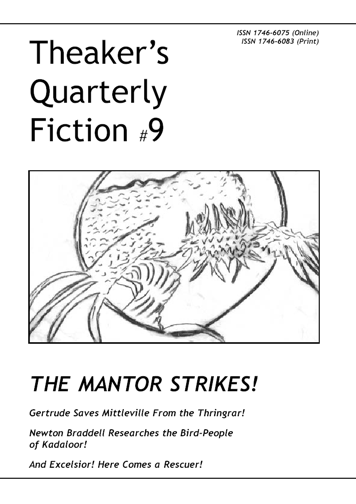
There's not enough room in this issue for a real editorial – we have far too much material to fit in! But in the little space we have [inside the magazine, that is] I would like to welcome John Greenwood, one of our consistent contributors, as co-editor, and congratulate Howard Phillips on actually completing a novel. More of His Nerves Extruded will appear next issue. Thanks to all readers and contributors! – SWT


Contents

Newton Braddell And His Inconclusive Researches Into the Unknown

  • The Bird-People of Kadaloor, by John Greenwood

The Saturation Point Saga: His Nerves Extruded, by Howard Phillips

  • The Beautiful Beautiful Palanquinettes
  • A Struggle to Breath
  • Ferry Worrying
  • We Fight Back. For Love, For Victory, For Honour!
  • Heist You Later
  • Action Is Mine!
  • Eggshell in the Void
  • Tears in Transit
  • First Steps on a Far-Off World
  • The Mantor Strikes!
  • Laugh While the Iron’s Hot!

Gertrude and the Thringrar

  • By Ranjna Theaker

Excelsior

  • Rescuer, by Steven Gilligan

Saturday, 1 October 2005

Theaker's Quarterly Fiction #8

pdf |

This is the eighth issue of my magazine, and just like every issue so far, it is the best yet. But it is slightly unusual, in that it contains no less than four distinct tales, by four entirely different authors, whereas in the past I have been more likely to present my readers with one or two long pieces. It is very interesting, I feel, that I launched this magazine mainly in order to encourage myself to sit down to write at least four times a year, only to be eventually pushed out of it by the submissions of other people. I would vow to ruin them all for stymieing my plans were it not for their stories being so much better than anything I would have been likely to write.

If there is a theme to this issue, it is probably highlighted best by “The Hidden Game”, intended by the author, John Greenwood, the editor of our sister journal, November Spawned, to be the first in a series – Newton Braddell And His Inconclusive Researches Into the Unknown. Planned to be of indefinite length, John has promised, if it is within his writerly power, to send an instalment for several issues to come. Let’s hope that he does not waver in that resolution after seeing that, in my guise as illustrator, I decided to clothe his character in a costume rather similar to that of Elvis in his Vegas years. I have no explanation – I am only a beginner when it comes to art, so I am as yet at the mercy of my muse.

Anyway, back to the theme I mentioned. The key word in John’s story, so far as this issue is concerned, is Inconclusive. None of this issue’s items reaches a conclusion. I hope that nevertheless the issue will stand alone, as a good read in itself, but it is worth alerting the reader to the fact before he or she plunges in.

As already mentioned, Newton Braddell's adventures are intended to be an ongoing series. The story submitted by my sometime friend Howard Phillips is the beginning of an autobiographical epic, in which he will, step-by-step, take us through the assembly of what some claim to be the greatest rock band of all time, Howard Phillips and the Saturation Point. This is the beginning of The Saturation Point Saga – mark this moment well! This first, introductory, story deals with the fate of his former band, The Sound of Howard Phillips (who he discussed at some length in last issue’s editorial), and with this published, he then plans to assault us with a series of novels and stories, each of which will report how he recruited one or another of the band. Now, longtime Silver Age readers will be fully aware of the number of projects Howard has undertaken but not completed, but he seems very enthusiastic, so I will not be the one to discourage him. He has all the makings of a multi-media triple threat, at the very least, so if I am nice now maybe he will tip his hat to the SAB at some opportune time in the future.

Steven Gilligan has blessed us with the first half (or less, depending on how the rest of the story plays out) of "Excelsior", the heartwarming tale of a young man and his giant robot. The eponymous metal star can be seen on the cover of this issue, as interpreted by your hard-working editor. He ended up looking quite a bit like Jet Jaguar, but was that in Steven’s descriptions of the robot, or was that just how I interpreted his words? Resolve this conundrum by reading it now! Steven also created the hilarious cartoon that graces the back cover.

The fourth piece in this issue is the fascinating prologue to Valiant Razalia, the first science fiction novel by Michael Wyndham Thomas, better known as a poet and historical novelist. I have never read anything quite like it. In all honesty, from someone writing their first science fiction novel, I expected a certain amount of reinventing the wheel, being hit over the head with the hoariest of old tropes (that’s the role my fiction plays in this magazine!), and a story that struggled to breathe through the condescension to genre, but that is not what we have here. This is a unique piece of writing – dense and atmospheric, yet wilful, whimsical and playful. Initially perhaps somewhat forbidding in its tumult of adjectives and similes, to the careful reader it reveals a rich bounty of laughter and mystery. It might take you a few paragraphs or pages to settle into its rhythms, but take the time, make the effort, and at the end ask yourself when the rest of the novel will be available to read. The author has said he may submit further instalments to this journal, but I can only hope to be so lucky.

Observant readers may notice that the format of the publication has had a revamp this issue. It was not by choice – all our files were lost in a hard drive failure, and so, starting again, we decided to make a few changes. I hope you like them. – SWT


Editorial

The Issue With No Resolution

Stephen William Theaker

The Saturation Point Saga: MY RISE AND FALL

Howard Phillips

A Dream ~ The Sound and the Saturation ~ My Career Takes Off ~ Meditation and Self-Medication

Newton Braddell And His Inconclusive Researches Into the Unknown

The Hidden Game

John Greenwood

Valiant Razalia

Prologue

Michael Wyndham Thomas

Excelsior

Steven Gilligan

Prisoner ~ Visitor

Friday, 12 August 2005

Theaker's Quarterly Fiction #7

pdf |

It falls once more to me, Howard Phillips, to introduce the reader to Theaker’s Quarterly Fiction, since the Editor likes to avoid writing about his own work, where possible. It is not a happy day for me, so I will not go out of my way to make it a happy day for you. This seems to be a penance I have to serve. I am, they say, indentured to the magazine, or at least obligated to its editor.

True, he found me stumbling along beside the canal in Birmingham’s city centre, desperately begging for money for alcohol from passers-by, drinking the dregs from abandoned glasses, and generally making a fool of myself, but I had had a difficult few years. My writing had not progressed in the direction which I would have wished, my poetry had stalled, and my plays had fallen into the ditch, unperformed.

True, he allowed me to write once more for his family of publications. He gave me another chance, knowing that in doing so he was taking one himself.

But it isn’t for any of those things that I owe the editor of this magazine. The thing for which I truly owe him is that he showed me music. He lent me an old Yamaha keyboard, told me to download Audacity for the PC, and put a microphone in my hands. In a matter of days I had formed a band, and that band was called The Sound of Howard Phillips. You might have heard of us, listened to one of our songs, or dreamed of going to one of our gigs, but have you been introduced to the band yet?

I, Howard Phillips, sing. You may know me as a letter-writer to New Words, a writer of unfinished novels, and a poetry of not enough repute, but till you have heard my falsetto, we have not properly met.

On the keyboard is Jack “The Space” Tom. They call him The Space because the gaps between notes are as meaningful as the notes themselves. Perfectly suited to the Sound, Jack “The Space” Tom rarely comes to the studio, preferring to conceptualise the music at home. He says he cannot concentrate on music unless his grey cat, Harry, is there with him, and unfortunately I detest cats. We have been able to work around Jack’s absence from the studio by jerry-rigging a fax machine to receive his incoming jams.

On guitar we have Quids McCall, a genius who was all set for stardom in the 1970s till he broke up his band, The Crazy Quids. He does attend the studio, so I have tried to ask, now and again, what happened, why did he throw it all away?

He simply shrugs and says, “Howard, if you are ever in the same position, and with these amazing songs you might well be one day, then you will have to make a decision too. You might make the same decision I made, or you might not. You might change your life, or you might not. I can’t tell you what to do, Howard, and I can’t tell you what I did.”

He says that every time. I am trying to persuade him to dig some of the old Crazy Quids songs out of the attic, but he won’t hear of it.

“If The Sound of Howard Phillips ever does cover versions,” he always says, “then before you get to my stuff, there’s a whole world of classics to do first.”

He is remarkably self-effacing, as you can tell.

On drums, and other percussion as needed, we have the amazing Lumley Clark. There is nothing I can tell you about him that will still be true by the time I have finished writing this editorial. He is the ultimate chameleon of fashion, leading the pack by day, chasing it back to the kennel at night. He drums like the wind, and plays the tambourine like he was born with one stitched to his hand.

That just leaves our bassist, saved till last because I cannot remember his name, but he is very good.

So, till we meet again, perhaps I in the stage, and you in the audience, stay true!

Howard Phillips
Editorialist and Edutainer

Monday, 30 May 2005

Theaker's Quarterly Fiction #6

pdf |

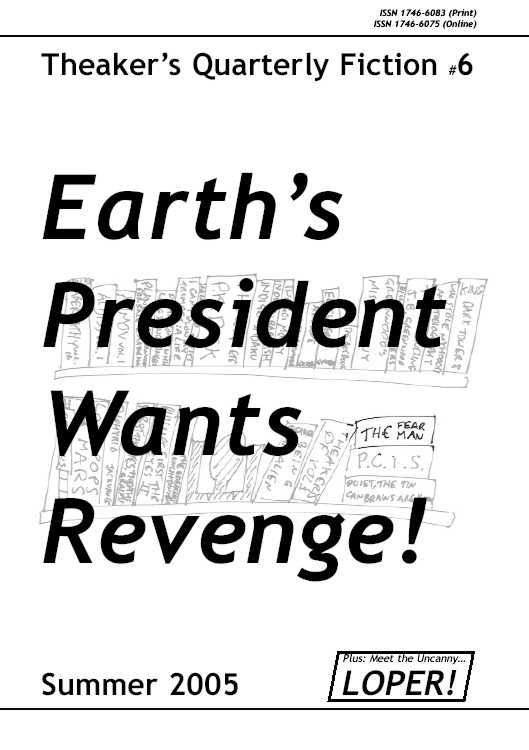
I am sure most readers will join me in commiserating that this issue is devoted to the feeble-minded fool of a writer who has placed his name in the title of this magazine. More to the point, next issue will follow suit, featuring the second half of his addle-brained semi-fascistic power fantasy, The Fear Man. He has tried and failed to earn himself such an appellation among the staff at the Silver Age offices, resulting only in lowering their opinion of him to such levels that astound even such a confirmed enemy of Theaker as I.

Should I make allowances for him having published my transcript of a motion picture dream in issue four? I think not – look at the way he chose to introduce it! "Stink has not faded", indeed! And here, in The Fear Man, while choosing to quote large passages of one of my unfinished novels, First the Eyes, Then the Brains, he describes me as a hack, and my novel as one that a reader of the future would be ashamed to be seen reading!

Were that not enough to earn the squat-faced ninnyhammer my opprobrium, consider his editorial to the previous issue, where he talks of "the maggot-ridden corpse of verse" in such disparaging terms. I thank the reader who took umbrage at this appalling display of ignorance on the part of Theaker.

This gentleman wrote as follows:

"Dear Sir,

Thank you for informing me of the appearance of the latest issue of Theaker’s Quarterly Fiction. However, I must take issue with the editorial comments contained therein, particularly as regards the negative comments directed at the field of poetry and the practitioners thereof. Only if one is to take, for example, the so-called ‘science-fiction poetry’ of Howard Philips as representative of the form, can the editor's scorn of verse be justified.

I remain,

A Reader."

Perhaps I should have read that letter to the end before committing it to paper! Never mind, this typewriter goes only forward, ever on, and obstacles of that kind will be met with the crushing force of intelligence they deserve. And if my intelligence fails me, I shall find the writer of that letter and confront him, bottle in one hand and an epee in the other, and we shall see whose scorn is justified.

Thank goodness, then, that we can leave that matter to one side for the moment, to look forward to the final piece to appear in this issue. You must wade through page after tedious page of Theaker to get there, but at the end of this issue you will find a wonderful short story by the hand of John Greenwood, "The Loper". Should we call it Lovecraftian? It is in many ways, and the story’s "halls of academia" opening may seem distressingly similar in tone to that of The Fear Man, but persist and you will be rewarded.

And so my stewardship of this column comes to a perhaps temporary end. In three months time, given the chance, I will return, to help build your strength in preparation for another thirty pages of Theaker. If it becomes too much, retreat to last issue, where you were graced by Gilligan’s pure adventure, or the issue before that, where you were able to step into my nightmares.

If I may, I will end with a short poem:

"Ending come / And we are done / Finished in the eyes of June

But stay a while / Remember to smile / And we will meet again soon."

Regards and friendship, always ours to share, Howard Phillips