Showing posts with label TQF76. Show all posts

Tuesday, 30 April 2024

Theaker's Quarterly Fiction #76: now out!

free epub | free pdf | print UK | print USA | Kindle UK | Kindle US

Welcome to Theaker's Quarterly Fiction #76, edited by Stephen Theaker and John Greenwood!

Theaker’s Quarterly Fiction #76 features four short stories, a non-fiction article, and fifteen reviews. In “The White Body” by Harris Coverley, shipwrecked sailors encounter a dread being on the open seas. Scottish master of surrealism Douglas Thompson provides “The Apparatus of Yearning” and “Cupid and Psyche”. “Controlling the Lights from Above” by Charles Wilkinson is a tale concerning the long-term consequences of workplace bullying. In “Cultures of Climate Change, Changes of Climate Cultures”, Rafe McGregor considers fiction’s role in the face of ecological disaster. Then Stephen Theaker and Douglas Ogurek review books by Adam Cesare, Grady Hendrix, Kazuo Ishiguro, Rumaan Alam and C.J. Cooke, plus the films Aquaman and the Lost Kingdom, The Creator, Dream Scenario, Godzilla Minus One, No One Will Save You and Office Invasion, and the television shows Ahsoka, Doctor Who, Invasion and Monarch: Legacy of Monsters.

The cover art for this issue was generated using Wombo Dream.


Here are the contumacious contributors to this issue.

Charles Wilkinson’s publications include The Pain Tree and Other Stories (London Magazine Editions, 2000). His stories have appeared in Best Short Stories 1990 (Heinemann), Best English Short Stories 2 (W.W. Norton, USA), Best British Short Stories 2015 (Salt), Confingo, London Magazine and in genre magazines/ anthologies such as Black Static, Interzone, The Dark Lane Anthology, Supernatural Tales, Theaker’s Quarterly Fiction, Phantom Drift (USA), Bourbon Penn (USA), Shadows & Tall Trees (Canada), Nightscript (USA) and Best Weird Fiction 2015 (Undertow Books, Canada). His collections of strange tales and weird fiction, A Twist in the Eye (2016), Splendid in Ash (2018), Mills of Silence (2021) and The Harmony of the Stares (2022), appeared from Egaeus Press. Eibonvale Press published his chapbook of weird stories, The January Estate, in 2022. He lives in Wales. His work previously appeared in TQF41 (“Notes on the Bone”), TQF44 (“A Lesson from the Undergrowth”), TQF46 (“Petrol-Saved”), TQF48 (“A Thousand Eyes See All I Do”), TQF54 (“Septs”), TQF56 (“Mr Kitchell Says Thank You”), TQF59 (“The Constant Providers”), TQF60 (“Evening at the Aubergine CafĂ©”), TQF64 (“September Gathering”), TQF70 (“July Job Offer”) and TQF73 (“The Arrival of an Acquaintance”).

Douglas J. Ogurek is the pseudonymous and sophomoric founder of the unsplatterpunk subgenre, which uses splatterpunk conventions (transgressive/gory/gross/violent subject matter) to deliver a positive message. His short story collection I Will Change the World … One Intestine at a Time (Plumfukt Press), a juvenile stew of horror and bizarro, aims to make readers lose their lunch while learning a lesson. Ogurek also guest-edits the wildly unpopular UNSPLATTERPUNK! “smearies”, published by Theaker’s Quarterly Fiction. These anthologies are unavailable at your library and despised by your mother. Ogurek reviews films and fiction for that same magazine.

Douglas Thompson has published more than twenty short story and poetry collections and novels from various publishers in the UK, Europe and the Americas, including The Brahan Seer from Acair Books (2014) and most recently Stray Pilot from Elsewhen Press (2022). He won the Herald/Grolsch Question Of Style Award in 1989, 2nd prize in the Neil Gunn Writing Competition 2007, and the Faith/Unbelief Poetry Prize in 2016. His work previously appeared in TQF28 (“Anatomy of a Wounded House”), TQF29 (“Madame Mortadore & the Clouds”), TQF37 (“Apoidroids”), TQF39 (“Escaladore”), TQF41 (“DogBot™”), TQF43 (“Quasar Rise”), TQF44 (“Black Sun”), TQF60 and TQF61 (“Yttrium”). See https://douglasthompson.wordpress.com/ for more details.

Harris Coverley has had more than a hundred short stories published in Penumbra, Crimeucopia, JOURN-E, and The Black Beacon Book of Horror (Black Beacon Books), amongst many others. A former Rhysling nominee, he has also had over two hundred poems published in journals around the world. He lives in Manchester, England. He previously appeared in TQF70 (“See How They Run! See How They Run!”); TQF72 (“Father Figure”); TQF73 (“The Scorpion”); TQF74 (“Kung Fu Sue: Origins”) and TQF75 (“Kleptobiblia”).

Rafe McGregor is a critical theorist publishing on culture, climate justice, and policing. He is the author of thirteen books, including Literary Theory and Criminology (2023), Narrative Justice (2018), and The Adventures of Roderick Langham (2017). He can be found online @rafemcgregor.

Stephen Theaker’s reviews, interviews and articles have appeared in Interzone, Black Static, Prism, Dark Horizons and the BFS Journal. His story “The Reader-Queens of Tranck” appeared in the BFS anthology Emerging Horizons, edited by Allen Ashley. He has written many novels, none of them well-regarded. The full range of his enthusiastic literary endeavours may be viewed on his ISFDB summary bibliography: https://isfdb.org/cgi-bin/ea.cgi?137563.


As ever, all back issues of Theaker's Quarterly Fiction are available for free download.

Monday, 15 January 2024

Monarch: Legacy of Monsters, Season 1 | review by Stephen Theaker

Shortly after the events of the excellent 2014 Godzilla film, a young American woman, Cate Randa (played by Anita Sewai), and a young Japanese man, Kentaro Randa (Ren Watabe) discover that they share the same father: Hiroshi Randa (Takehiro Hira), who disappeared after Godzilla fought the two MUTOs in San Francisco. He didn't die in the fight, he just said he had important things to do and scarpered, a bigamist abandoning both his families to the vagaries of an increasingly dangerous world. Cate's search for answers brings her to Kentaro, then to Lee Shaw (Kurt Russell), a mothballed Monarch monster-hunter with his own agenda, and then brings them eye-to-eye with a monster or two. For Cate and Kentaro it's the adventure of a lifetime, but this isn't Shaw's first monster mash.

Tuesday, 9 January 2024

The Final Girl Support Group (Berkley) by Grady Hendrix

Disjointed, drawn-out and dull mystery comments on society’s obsession with violence toward women in film.

The Final Girl Support Group details Lynnette Tarkington’s journey from justifiable paranoia and reclusiveness – she’s a two-time survivor of attacks from killers who wiped out people close to her – to a focus on being part of a group and helping others. The novel also explores a collective obsession with films in which women get mutilated and murdered by crazed men, as well as why attractive, able-bodied white women dominate the final girl stereotype.

Lynnette, whose best friend is a plant, belongs to the Final Girl Support Group led by therapist Dr Carol Elliot. Each group member is the sole survivor of a killer’s rampage. Their ordeals have also spawned horror films whose storylines echo those of classics such as Scream, The Texas Chain Saw Massacre, Halloween, and Friday the 13th. The most entertaining final girl is the drug-abusing Heather, an abrasive type who drops f-bombs and isn’t beyond flicking a cigarette butt into a swimming pool.

When Lynnette, whose own brutal Christmastime trial inspired Slay the Halls (invented by the author), suspects someone is trying to kill everyone in her group, she goes on high alert and tries to warn the others. As the talky first-person narrator gets closer to unveiling the killer, the danger intensifies. 

Throughout the novel, author Grady Hendrix interweaves snippets from different fictitious sources such as horror fanzine articles, scholarly film critiques, text from the back cover of a VHS tape, and police interview transcripts. Despite their attempts to create a commentary on the horror genre’s fixation with harming women, these asides detract too much from the main story. All this shifting about makes it hard to get invested in Lynnette or the other characters. 

Several drawn-out scenes lack compelling content. When Lynnette is in a car with a teenage girl, for instance, nothing happens to advance the story. The two seem to repeat the same basic ideas just to keep the story going. 

The novel’s saving grace is its focus on women uniting to combat male aggression. Another aspect worth commendation is the juxtaposition of the quick, violent deaths of horror films with the slow, exhausting deaths of reality.—Douglas J. Ogurek **


Monday, 8 January 2024

Invasion, Season 2 by Simon Kinberg, Dan Dietz, et al (Apple TV+) | review by Stephen Theaker

As season two of Invasion begins, it is 121 days since the alien invasion began (though you would think it at least a year or three from how much the children have grown), and humanity is losing the war. Benya Mabote, World Defense Coalition President (played by Moshidi Motshegwa), leads the war effort. The aliens, of whom we've seen nothing but their killing machines, have already transformed a quarter of the planet to suit themselves and show no signs of stopping. Weird new plants are growing and their spores make the air unbreathable for humans. Millions are dead.

In season one our Japanese, English and American protagonists reached their various destinations, and helped to bring down an alien ship. Unfortunately an even larger ship arrived soon after, and so they must return to the fray. The most significant character is Mitsuki (Shioli Kutsuna), who is abducted to the Amazon jungle to communicate with a downed alien ship. The man responsible is tech bro Nikhil Kapoor. Apple TV+ shows often seem to feature a Steve Jobs visionary type, and this one is played by Shane Zaza, whose line readings are peculiarly reminiscent of Commandant Lassard at the podium.

Monday, 1 January 2024

Aquaman and the Lost Kingdom | review by Stephen Theaker

It’s a shame that Aquaman and the Lost Kingdom, Jason Momoa’s sixth appearance as Aquaman, seems likely to be his last for now. In his cameos, in Batman vs Superman, Peacemaker and The Flash, and his full appearances in Justice League and Aquaman, his exuberance and commitment to the role made him a joy to watch. I wish there were more films to come, but at least we got more of his Aquaman than we did of his equally enjoyable Conan the Barbarian.

Whether this film takes place after the multiverse-changing events of The Flash or not isn't established, but doesn't make a great deal of difference. Sensibly, it's a direct sequel to the first Aquaman film, continuing its storylines and themes. Many of its actors return. As this film begins, Aquaman is thoroughly bored of his job as king of Atlantis. He is nodding off during audiences, and frustrated by the constraints on his power. He has much more fun playing with his baby son and battering pirates.

Wednesday, 20 December 2023

Godzilla Minus One | review by Stephen Theaker


It’s a good time to be a Godzilla fan! His next encounter with King Kong is in cinemas next year, the Monarch tv series is currently showing on Apple TV+, and now we have Godzilla Minus One, already the highest-grossing live-action Japanese film ever in both the UK and the US. Most Japanese Godzilla films are sequels to the original Godzilla (1954), while often overwriting each other, but like Shin Godzilla (2016) this is a complete reboot.

Shin Godzilla, from the creator of Neon Genesis Evangelion, was very enjoyable, but it was quite radical in its approach to the monster: for most of the film he wasn't recognisably Godzilla at all, although he did have a spectacularly impressive tail by the end. Most of the fun of the film came from the comedy of a calcified bureaucracy responding to a giant monster attack with a series of ever-growing meetings.

Friday, 15 December 2023

Office Invasion | review by Douglas J. Ogurek

If you like dumb, watch this horror/sci-fi/comedy mash-up. If you like humour, don’t.

Melusi Nkosi (Kabomo Vilakazi), the merciless new leader at mining company AMI, takes some extreme cost-cutting measures that put the three heroes of Office Invasion in financial peril:  geologist Sam (Rea Rangaka) can’t afford medication for his ailing daughter, accountant Prince (Kiroshan Naidoo) needs to stay in the finance department for five years to get access to his trust fund and therefore escape his tyrannical father’s hold on him, and security guard Junior (Sechaba Ramphele), frustrated by his mooching flatmates, just needs to make ends meet. 

Melusi sells the South African business to an international firm represented by a patently duplicitous trio consisting of Gregory (Greg Viljoen), a chipper Australian with bad hair, Badrick (Stevel Marc), a Jamaican ready to throw down, and Anya (Aimee Ntuli), a conniving Eastern European. 

The desperate heroes hatch a plan to steal some Zulcanoid, the liquid metal at AMI mines, and then sell it to a Chinese gangster who says he’s going to use it for benevolent purposes.   

Overarching all of this is an impending alien invasion, implied by the attack that opens the film and toward which it builds. It takes a long time – too long, in my opinion – before the aliens appear. 

The film’s primary shortcoming is its lack of humour stemming from an imbalance in characters: while the leads lack the eccentricity that would have made them more compelling, the secondary characters’ performances feel overblown and derivative. The outrageously idiotic Paul (aka Knobface), for instance, is clearly a rip-off of Brick (Steve Carell) in the Anchorman series. 

The protagonists have their moments, the best of which involve Prince and Junior showing their frustration. Prince has visions of extreme violence, but they seem tossed into the film for no other reason than to shock the viewer. 

Most of the scenarios in which the trio finds themselves end up feeling stagnant. When Junior loses his gun as part of the cost cuts, he gets sent to a training session where a supposed-to-be-funny-but-not-funny overly serious instructor shows security guards how to defend themselves with typical office supplies.

Office Invasion plays the typical, stale feel-good cards like victims revolting against corporate oppressors and putting the needs of others before personal needs. Yawn.—Douglas J. Ogurek **

Monday, 11 December 2023

Doctor Who 60th Anniversary Specials | review by Stephen Theaker

During the lockdowns, Russell T Davies (former Doctor Who showrunner), David Tennant (the tenth Doctor) and Catherine Tate (Donna Noble) came up with a plan to return to their previous roles for a special story, initially intended to be a flashback. As plans developed, it turned out that the former showrunner would follow on from Chris Chibnall as the next showrunner, and so we have three whole episodes, now integrated into the ongoing story, with Tennant as a fourteenth Doctor and Catherine Tate as an older, slightly wiser Donna. The unspoken hope is that they can bounce the ratings out of the crater before the new Doctor, Ncuti Gatwa, takes over.

I think the problem for Chris Chibnall and his thirteenth Doctor, Jodie Whittaker, had been that Steven Moffat set the bar so high with his stories for Doctors eight through twelve: a recent poll placed five of his stories in the all-time top ten. How do you top that? Instead of taking the show in a more serious, dramatic direction, Chris Chibnall tried to carry on in a similar vein. But though everyone acted like they were still in the same, hilarious programme, the dialogue wasn’t as funny, and wasn’t as impactful. Watch “The Night of the Doctor”, the eight-minute episode Moffat wrote for Paul McGann: it has more quotable lines than the entire thirteenth Doctor era combined.

Returning to the show presents Russell T Davies with the same problem. Can he top what Moffat did? Can he top his own best stories?

Friday, 24 November 2023

The Lighthouse Witches by C.J. Cooke (Berkley) | review by Douglas J. Ogurek

Runes, grimoires, hexes, and bone triangles: three timelines weave together a complex tale of female empowerment.  

Something strange has happened on the Scottish island of Lòn Haven, and the answer hinges on a horrible occurrence at a lighthouse called The Longing. 

The Lighthouse Witches moves between three different timelines. The central story, which takes place in 1998, focuses on British artist Olivia “Liv” Stay and her three daughters facing economic peril. The wealthy and conspicuously absent owner of the ramshackle lighthouse commissions Liv to paint odd symbols on its interior. Liv meets a man named Fin and gradually learns more about Lòn Haven’s residents and history. She also learns there’s much more to the lighthouse than the water on the floor and the bats on the ceiling; this lighthouse has a history that is not favourable toward women.

This first portion also dips into the point of view of Liv’s combative oldest daughter Saffy, who seeks to learn more about the lighthouse by exploring the caves beneath it. 

The second timeline occurs in 2021 and is told from the perspective of Luna, Liv’s middle daughter and presumably the only surviving member of the family. Luna, now pregnant, is haunted by a sketchy memory of getting tied to a tree in a forest while her mother and two sisters disappeared. When Luna’s long-lost younger sister Clover resurfaces, her appearance and behaviour shock Luna and lead to complications. 

The third story, narrated by Patrick Roberts through his grimoire, takes place in 1662. It details his travails on the island, including a relationship with a special friend named Amy and an accusation made against his mother. 

Cooke pulls off an impressive balancing act with the alternating timelines, breadth of years, and variety of points of view (i.e. first-person past, first-person present, third-person present). She also uses Lòn Haven’s gloomy weather to thicken the pall of mysteriousness that shrouds the island, a place whose residents fear supernatural creatures called wildlings and where some children have numbers branded on their arms. Perhaps the novel’s greatest accomplishment is its treatment of the age-old problem of the suppression of women.—Douglas J. Ogurek ****


Monday, 13 November 2023

Dream Scenario | review by Stephen Theaker

Paul Matthews (Nicolas Cage) is a mid-to-late-career professor with tenure. He is married to a beautiful wife (Julianne Nicholson), has two daughters, and lives in a big gorgeous house, but he is still dissatisfied with life. He dreams of finding a publisher for his book on ant intelligence, but has never actually got around to writing it. His classes are poorly attended, engagement from students is low, and he can't do anything about an old colleague who is planning to build on his unpublished work.

Sunday, 5 November 2023

Clown in a Cornfield by Adam Cesare (HarperTeen) | review by Douglas J. Ogurek

Town mascot turned madman: young adult slasher tale with political underpinnings explores the battle between tradition and change.

Have you ever been in a situation where you thought older people weren’t listening to you? Of course you have. What about a scenario where younger people push for a change you don’t want? Admit it: you’ve been there as well. These are the issues at play in Adam Cesare’s Clown in a Cornfield, though the stakes are likely much higher than you’ve ever encountered. 

When financial hardship hits, Dr Glenn Maybrook and his teenage daughter Quinn move from Philadelphia to Kettle Springs, Missouri. Here, elders view teens as a threat to their rural town’s hallowed traditions, and teens suspect adults are trying to impose their values on them. 

Quinn soon meets Cole Hill, a charismatic quarterback. You know the type: attractive, confident, admired by his peers yet haunted by his past. She gets involved in Cole’s group of ne’er-do-wells: Janet, Ronnie (who clearly likes Cole), the bodyguard-like Tucker, and the beer-swigging party boy Matt. Power-hungry Sheriff George Dunne, resenting the changes happening under his watch, has his sights set on the teens. 

Overshadowing all of this is Frendo, the unofficial town mascot invented by Cole’s grandfather. Initially, the only evidence of Frendo that Quinn sees is the faded painting of the clown on a burned-down factory across the cornfield next to her house. But Frendo will make more appearances, and not all Frendos in Kettle Springs are kid friendly. 

Though there’s nothing groundbreaking about this young adult horror story in which characters gradually get picked off by someone or something, it zips along and keeps the reader engaged. The over-the-top weaponry (e.g., chainsaw, circular saw, machete) fits the typical slasher fare. 

Not only does Cesare defend the voice of young people, but he also combats the notion that heroines need to be rescued by a male figure. Quinn Maybrook is a strong, thoughtful, and brave young woman not prone to swooning at the slightest threat. Cesare also explores the complexities of Quinn’s relationship with her father and how her mother’s drug problem complicated their lives.

At its core, the novel advocates for youth-inspired change, which is nothing to clown around about.—Douglas J. Ogurek***


Sunday, 22 October 2023

Leave the World Behind by Rumaan Alam (Ecco) | Review by Douglas J. Ogurek

Details and tangents detract from dystopian tale.

Something bad has happened, but what? Such is the concept that propels Leave the World Behind, Rumaan Alam’s apocalyptic novel about two families converging at a rental home in the Hamptons amid a mysterious catastrophic event. 

Many compelling works – Paul Tremblay’s The Cabin at the End of the World and M. Night Shyamalan’s Signs come to mind – have successfully used this strategy. Characters are confined to a remote location, where they speculate and gradually learn about what has happened in the larger world. 

This work, however, suffers from two major problems. First, the characters and their behaviors/conflicts are not compelling enough to keep the reader engaged. It takes far too long to get to the inciting incident (i.e., the knock on the door). Vacationers Amanda and Clay and their two nondescript children are surprised when G.H. and Ruth Washington, owners of the property, show up amid what they believe could be a disaster. 

My second gripe against this book is that Alam goes on too many tangents and whips up a whirlwind of irrelevant details. An encountered object, for instance, stops the novel’s progress and allows a character to reflect on a memory. I often found myself thinking, Wait. Why are you stopping here? Don’t tell me about that. This is most apparent at the beginning, where the author gets mired in the mediocrity of middle-aged parenthood. I don’t need a list of what Amanda’s buying at the grocery store. 

The omniscient narration compounds the problem. Although this strategy enables Alam to slip in hints about what’s happening beyond the Hamptons, dipping into each character’s head slows the progress. Moreover, the narrator tends to break into the story and state, in effect, what the character didn’t know was that [fill in the blank] was happening or what was happening was much worse than they were imagining.

Nevertheless, some details, such as changes in characters’ bodies or the local wildlife, are intriguing. The novel does get better and the tension escalates near the end, but it’s not enough to recommend this one.—Douglas J. Ogurek**


Monday, 9 October 2023

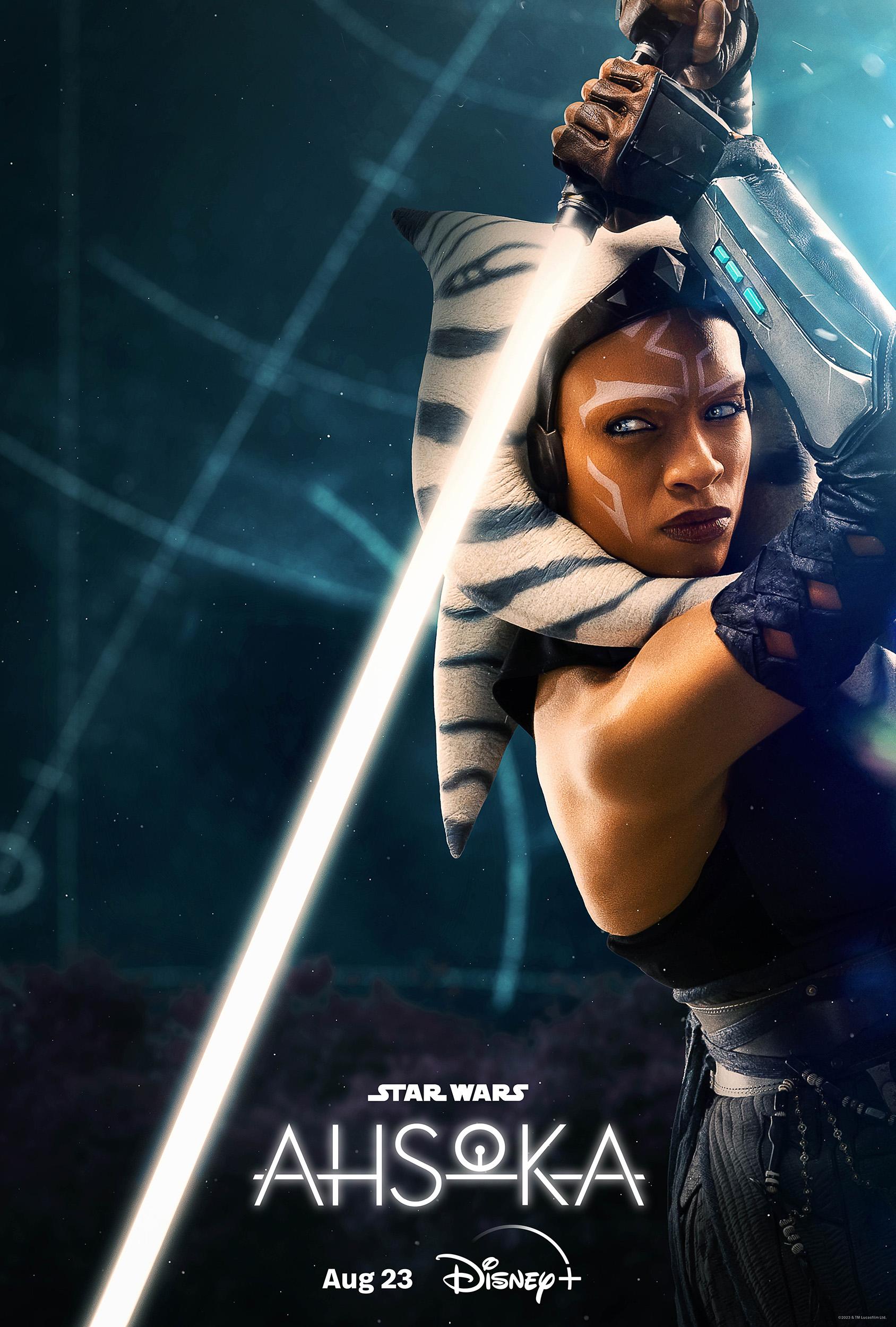
Ahsoka, Season 1 | review by Stephen Theaker

Ahsoka is a sequel to several projects all at once, as well as setting up projects to come. This eight-episode season follows on from The Mandalorian and The Book of Boba Fett, in which Ahsoka Tano, as played by Rosario Dawson, made an appearance (and met Luke Skywalker), and it also follows on from two animated series: Star Wars: The Clone Wars, which showed Anakin Skywalker take her on as an apprentice during the war with the Trade Federation and its allies, and Star Wars: Rebels, about a ragtag bunch of rebels who appear in Ahsoka too: Sabine Wren (Natasha Liu Bordizzo), Hera Syndulla (now a general, and played by Mary Elizabeth Winstead) and Ezra Bridger (Eman Esfandi).

The latter's disappearance during the rebellion (round about the events of Return of the Jedi, I think) is what motivates Ahsoka and Sabine in this show. They think he's still alive, somewhere, and they think they can find him -- but only if they can repair their broken relationship, and Hera can keep the jobsworths and penny-pinchers and traitors in the New Republic administration off their backs.

The problem is, Ezra wasn't the only one to go missing that day. So did Grand Admiral Thrawn (played here, as in Star Wars: Rebels, by Lars Mikkelsen), and efforts are afoot to find him too. Leading the search are two fallen jedi, Baylan Skoll and Shin Hati, the former played so brilliantly by the late Ray Stevenson that the show is almost spoilt by the knowledge that he won't be returning. If they manage to find Thrawn, what will follow?

Dedicated fans will remember Timothy Zahn’s sequel trilogy from the 1990s, which breathed new life into Star Wars, and in which Thrawn was the primary antagonist.

For such fans, especially those who watched the two animated series, I’m sure that Ahsoka had all sorts of resonances that passed me by. But I still loved it. You don't need to have watched anything else to understand why Sabine wants to rescue her friend, or why everyone is afraid of a powerful grand admiral from the Empire. I found it gripping, and although there were moments here and there that dragged, the overall effect was rather majestic.

Ahsoka herself is an interesting character. She knows by this point that her master, Anakin, became Darth Vader, and she struggles with that knowledge – her fear of that happening again damaged her relationship with her own apprentice. But she also remembers what was good about him, before his turn to the dark side. Her movements in combat are perhaps a bit less fluid and precise than one might expect from a jedi; it would be interesting to know if this was a deliberate choice, to reflect the character's age at this point, or if perhaps the actor needed a bit more time on combat training. By the final episodes that's much less of an issue, with multiple jedi engaging in combat and all sorts of fun things happening. Sabine's combat style is particularly entertaining: a jedi in a Mandalorian suit of armour, fighting with both pistol and lightsaber, is truly a sight to behold!

The special effects are, just like The Mandalorian, almost unfairly good. The ominous approach of Thrawn's damaged imperial destroyer to a tower was particularly stunning, but the space whales and David Tennant's ancient robot character Huyang were also excellent. If we have passed the high-water mark of Disney's spending on science fiction shows, as the cancellation of Lando and Marvel cutbacks might suggest, it's a shame, but one can understand why such extravagance wouldn't be sustainable.

Hopefully the story will be concluded, whether that's in another programme bringing all these characters together, or in a feature film. If not, Ahsoka is still worth watching on its own merits, for the spectacle, for all the lightsaber battles, for the performances and for the surprises, which I won't spoil here… Stephen Theaker ****

Wednesday, 4 October 2023

The Creator | reviewed by Stephen Theaker

In 2055, Los Angeles was devastated by a nuclear bomb. Artificial intelligence was blamed, and the US government decides that all AIs must be destroyed, both within its borders and outside them. The AIs in this film are individual beings, each with their own robotic bodies, who talk and emote in ways that seem very human. Some, known as replicants, are given humanoid faces, replicas of existing people. Others are more obviously robotic, with big blocky heads.

The determination of the US to wipe them all out leads to war with the East, where AI beings have more or less integrated into society.

Joshua (John David Washington) was an undercover operative in that war, on a mission in the East to uncover Nirmata, the father of AI, but he fell in love with his target, Nirmata's daughter (Gemma Chan). When an impatient US government attacks the rebel base, using their deadly new sub-orbital weapons base, the USS Nomad, Joshua loses his wife, his unborn child, and his desire to keep on fighting. He takes a job clearing up the mess of LA.

Five years later, his old bosses get a lead on a new superweapon being developed by the AI, and they show Joshua photos of his wife at the scene. He reluctantly rejoins. By one twist and another that leads to him on the run in Asia, with an adorable AI child in tow, pursued by and under fire from all sides.

I loved watching this film. I've wondered how much of that was the rare pleasure of seeing an original science fiction film in the cinema. (And one that uses the full width of the cinema screen too! This really is a film to see on the big screen if you can.) But I didn't react like that to 65. Yes, the plot of this is very similar to something like Children of Men, and yes, its portrayal of AI as very human, individual intelligences, rather than the networked, alien consciousness it would more likely be, felt a bit old-fashioned. But it does everything so incredibly well.

Take the special effects, for example, which are magnificent. Compare it to Expendfourbles, in cinemas the same weekend, which was set in the real world but looked completely fake throughout. The Creator portrays a near-future science fictional world and makes it look utterly realistic, a place that could be right around the corner. The director Gareth Edwards has talked about the innovative approach he took to making the film: shooting the whole thing first, much of it on location, using a small, indie-style crew whenever possible, before applying all the effects in post-production. The results would be stunning on a budget twice the size.

Like many of the most popular science fiction films, it is also a great action film, but the action is grounded in plot and character. John David Washington, his character put through the wringer, physically and emotionally, is as good here as he was in Tenet, a film with a similar tone. Let's hope he makes a habit of starring in such intelligent science fiction thrillers. Little kids can be hard to cast, but Madeleine Yuna Voyles is also very good in a demanding role, while Allison Janney makes a superb villain (or last-ditch desperate defender of humanity, depending on your point of view). That their performances distract the viewer’s attention from the stunning scenery and effects is impressive in itself.

Whether it's robot children with cooling holes running through their heads, or gigantic wartech that looks like it emerged from a Chris Foss book cover, the film delivers. And thematically it has much to offer too: about change, and how to adapt to it, and what our species is willing to do to stay on top. If like Children of Men this takes a while to find its audience, that will be a shame, but there’s no doubt it'll happen. If there were a film like this on at the cinema every weekend, I would be at the cinema every weekend. Highly recommended. Stephen Theaker ****

Sunday, 1 October 2023

Klara and the Sun: a Novel by Kazuo Ishiguro (Vintage) | Review by Douglas J. Ogurek

Superhuman observational skills meet childlike naivety in moving AI story that shines light on hope

Klara and the Sun is a testament to the power of friendship, a eulogy to broken relationships, and above all, an ode to hope. Klara, the story’s protagonist, is a solar-powered artificial intelligence with the power to discern human emotions and navigate the complexities of relationships while remaining calm and somewhat detached. And yet, she repeatedly tugs at the reader’s heartstrings. 

When sickly 14-year-old Josie adopts Klara as her Artificial Friend (AF), the latter leaves the metropolitan retail shop where she’s lived her short “life” and enters a whole new, much more rural world. The book focuses mainly on Klara’s interactions with and responses to Josie, Josie’s mother and father, and a wise-beyond-his-years boy named Rick, who has known Josie for many years and plans to marry her. 

When she discovers Josie is suffering from an illness, Klara hatches a plan involving the sun and “his nourishment” for banishing the illness. The plan and its miraculous implications are preposterous from a human point of view, but not necessarily from an AI’s perspective. Josie’s mother, who is no stranger to life-threatening illness, has another plan. It involves the man – there’s something fishy about him – whom she has commissioned to do Klara’s portrait.

Not all scenes in this novel are riveting. For instance, Ishiguro details a game that Josie and Rick play. She draws pictures of children with dialogue bubbles and Rick fills in the words. It’s meant to be complex communication between the two of them, but it’s rather dull. More interesting in these scenes is Klara, who pretends to stare out the window and instead listens to and watches the reflections of Josie and Rick. 

By making Klara the tale’s first-person narrator, Ishiguro aligns the reader with her as she experiences not only her adoptive human family but also a near-future society in which some children are “lifted,” meaning that they have more opportunities to succeed in life. Not too foreign a concept, really. Moreover, the author is careful not to impose human emotions on the protagonist. What a strange brew of outrage, pity, and helplessness the reader feels when Klara remains polite and calm despite the quarrels and manipulations that surround her. When Josie and her mother use Klara as a tool against each other, for example, the AI remains neutral and attempts to handle the situation judiciously.   

One of the most fascinating aspects of Klara is the contradictory nature of how she views the world. On the one hand, she skilfully reads human emotions and intentions via their facial expressions and hand gestures. Typically, such details would weigh down a story; here they add authenticity. Ishiguro describes how Klara’s vision splits into different boxes that enable her to analyse people. At one point when talking with the mother, Klara “could see joy, fear, laughter, sadness in the boxes.” She draws from this data to make decisions, most of them wise. On the other hand, Klara has a skewed – one could even say juvenile – perception of the sun as a godlike entity that can be bargained with so it will intervene in human affairs. From her viewpoint, when the sun sets, it physically lands in a place near Josie’s home. A party pooper might question why such a technologically advanced being fails to understand the science behind the sun. A more illuminated reader, however, will recognize Klara’s sun as a powerful symbol of her hope, determination, and… um… heart?—Douglas J. Ogurek**** 


Monday, 25 September 2023

No One Will Save You | review by Stephen Theaker

Brynn, a seamstress in her early twenties, lives alone in a house in the woods. She isn’t popular. Her postman deliberately throws her packages around, anonymous callers shout abuse at her on the phone, and when she comes to town she is met with hostility and disgust. It’s unclear why, though we can guess it relates to the death of her best friend, ten years ago, at the age of twelve. She doesn’t speak to anyone, she dances on her own, she writes letters to her dead friend.

From there the film could have developed into a tedious emotional drama about isolation, trauma and small-town life, but thankfully evil aliens intervene! Brynn is woken by what she assumes is an animal going through her bins. She gets up to investigate, but then hears footsteps downstairs. It’s a grey alien, one of those with an oval head and big black eyes, and, as she unfortunately finds out, it has telekinetic powers which let it pick her up, throw her around and, erm, open and close the refrigerator doors.

Brynn knows that no one is coming to save her – that no one would even want to save her. For the entire film, through one brush with extraterrestrial danger after another, she has only herself to rely on, and we root for her as she does it. That’s partly thanks to an excellent performance from Kaitlyn Dever, previously so good as the teenage wannabe kingpin in Justified. Even without dialogue, she conveys Brynn’s desperation perfectly, and comes close to making it a very good film.

The main problem is that it is so clearly a mish-mash of greatest hits from other films: Signs, 10 Cloverfield Lane, Spielberg’s War of the Worlds, Nope, Skyline, Communion, etc. It synthesises them well to produce some alarming scenes, but it hews so close that with a few jokes at key moments it would feel like a parody. Younger viewers who haven’t seen those films will enjoy it the most, I think, and perhaps on a second viewing I would enjoy it more for what it is, rather than seeing the jigsaw pieces.

Apart from the aliens’ weird finger-toes, the most original aspect of the film for me was how it has you cheering for the violence she inflicts on the various types of alien she encounters, sometimes by luck, sometimes by design, but then asks you to consider whether that capacity for violence is a good thing, even as it is saving her life. The ending will be divisive. I thought it was perfect, but I was wholly unconvinced by the route the film took to get there. See what you think. Stephen Theaker ***