Superheroes continue their assault on moviegoer pocketbooks, while innovative suspense/horror quietly captivates audiences.
America loves its superheroes… and so does the rest of the world. In 2016, four of the top ten grossing films at the box office (US) were of the superhero variety. The following year, superheroes claimed half the top ten spots. Last year, the masked, caped and clawed adventurers broke the halfway mark with six top ten spots. Will this upward trend continue until superheroes occupy all the top ten? Or will the kryptonite of sameness finally strike a blow to these films?
Wednesday, 30 January 2019
Wednesday, 23 January 2019
Mary Poppins Returns | review by Douglas J. Ogurek
Over 50 years later, the magic returns in respectful sequel that celebrates positive thinking and the power of the imagination.
Since she floated down to London to help the Banks family in the 1964 film that bears her name, Mary Poppins has been an internationally beloved representation of patience, wisdom and imagination. Mary Poppins Returns, directed by Rob Marshall, stays true to the inventiveness of its predecessor, while presenting a more 21st century-relevant (i.e. economically-driven) story-worthy problem.
Saturday, 19 January 2019
Twin Peaks: the Return, by David Lynch (Sky Atlantic) | review
The original Twin Peaks was a remarkable programme, easily liked for its quirky characters in a lovable town, but utterly terrifying as that lovable town’s dark secrets bubbled to the surface. It was said to have lost its way after the revelation of Laura Palmer’s murder, but I don’t remember ever being anything less than desperate to watch the next episode. I remember talking about it in the school library with other fans, lending out my copy of The Diary of Laura Palmer. The film came after I had gone to university, and I was very unhappy when the promised follow-ups never appeared. (We didn’t have ww.boxofficemojo.com back then, so I had no idea that it had not been a financial success.) Like many who enjoyed the show, I was extremely excited to hear that a third season was on the way, with David Lynch writing and directing, and many of the original cast returning. My feelings while watching the revival varied from scene to scene. I never stopped being glad that the new episodes existed. I was glad that a television channel had given a genius and his clever colleagues the money, time and space to indulge himself. But it did sometimes feel like it was taking the mickey.
Sunday, 13 January 2019
The Punisher, Season 1, by Steve Lightfoot et al. (Netflix) | review
Jon Bernthal returns as The Punisher, Frank Castle, after being so good in the second season of Daredevil. That makes this that rarest of things, a non-fantasy spin-off from a fantasy show. (NCIS is another, being a spin-off of JAG which featured, at least in the episodes I saw, a psychic whose powers helped her solve crimes.) There are no resurrected ninjas in this one, no super-powers, just lots of violent people with lots of guns. The events of Daredevil left everyone thinking that Frank Castle was dead, and he’s pretty much finished wiping out the organised crime gangs involved in the gunfight that led to the death of his wife and family. However, a guy going by the name of Microchip (Ebon Moss-Bachrach), who is also pretending to be dead, has tracked him down, and wants help clearing his name, so that he can return to his own lost family. What’s more, Dinah Madani of Homeland Security (Amber Revah) has returned from Afghanistan with a mission of her own, to find who killed her partner, and that’s going to lead her into Frank’s sights. This is a very well made action programme. Bernthal, a serious actor, is given lots to chew on, and he conveys both Frank’s heart-rending pain over losing his family and his bottomless rage concerning everyone involved. When he’s upset, you believe it, and when he lashes out, it looks like it hurts. The action, whether it involves guns, knives or fists, is always well-staged, clear and exciting. There is a formula to these Marvel shows, with the airtime divided between the titular heroes, their allies and the villains, and Iron Fist showed how it could hurt the show if any of those are less than compelling. Here, all the story threads are compelling, and viewers are unlikely to feel that there hasn’t been plenty of Frank in the show. It’s really good. Stephen Theaker ****
Saturday, 12 January 2019
Preacher, Season 2, by Sam Catlin et al. (Amazon Prime) | review
Jesse Custer (played by Dominic Cooper) used to be a preacher, albeit not a very good one. His life was turned upside-down, and not for the first time, when he gained the power of Genesis, a heavenly being. It had previously tried to join with Tom Cruise, with explosive results, but seems quite comfortable with Jesse. It gives him the power to command anyone, as long as they can hear him, and as long as they have a soul. By season two he has an uneasy romance with with passionate criminal Tulip O’Hare (Oscar nominee Ruth Negga) and an uneasy friendship with dissolute vampire Cassidy (Joseph Gilgun). (Church helper Emily from season one does not return.) God has wandered away from heaven, but he loves jazz music, so they come to New Orleans in search of him. Meanwhile, the Grail tries to get its teeth into Jesse Custer, the Saint of Killers is on his way, Cassidy has to learn a bit of responsibility, and poor old Eugene Root has to deal with Hitler (a brilliant Noah Taylor). It’s a season that features some of the most shocking scenes ever seen on television. Maybe it’s not quite up to the extremely high standards of season one, but it’s still a great show, and it looks like season three will be a corker, drawing on the comic’s very best issues. Stephen Theaker ****
Monday, 7 January 2019
Aquaman | review by Douglas J. Ogurek
Tiaras, tridents, and explosions: latest DC Universe film goes deep into the ocean to achieve shallow, yet engaging story.
After underwater princess Mera (Amber Heard) magically extracts water from Arthur Curry/Aquaman (Jason Momoa), then uses it to activate a glowing key, Arthur says, “You could’ve just peed on it.” Then Arthur watches the projection of a deceased king dramatically deliver a message. When Mera quizzes him on what he just heard, Arthur says, “Something, something, trident.”
Sunday, 6 January 2019
The Love Witch, by Anna Biller (Anna Biller Productions) | review
“I’m the love witch. I’m your ultimate fantasy!” Elaine Parks (played by Samantha Robinson) is a witch and a former burlesque dancer who comes to a new town, having left behind a poisoned husband. She has buried bodies before, she tells us, and she’ll do it again. She befriends Trish (Laura Waddell), and will later betray her. At the park she lays the whammy on Wayne (Jeffrey Parise), a louche professor. A love potion proves surprisingly successful, leaving him profoundly desperate for her. The strength of her powers is perhaps fuelled by her sublimated fury at the behaviour of men, including a scuzzy former mentor. Eventually her shenanigans will bring a police officer, Sergeant Griff Meadows (Gian Keys), into her life, as an investigator, and a lover.
Saturday, 5 January 2019
Death Note, by Charley Parlapanides and chums (Netflix) | review
In this American adaptation of the Japanese saga, dropped by Warner Bros but then produced by Netflix, Light Turner – yes, that’s his name – is plying his trade, homework for cash, while watching the cheerleaders practice, when out of a cloudy sky falls a battered book with the words Death Note on the front cover. He picks it up, then gets himself punched in the face confronting some bullies. He gets punished for the homework service, the bullies go free, and in detention he has his first encounter with what we will learn is the death god Ryuk, in a scene where the shrieksome Nat Wolff as Light Turner makes you wonder if this is going to be a horror comedy. It’s not, or at least I don’t think it is meant to be, but then, once Ryuk has made his first entrance, it’s not very scary either. It’s more a thriller with supernatural elements. The chatty, persuasive, spiny-backed monster (voice by Willem Dafoe, body by Jason Liles) tells Light that if he writes a name in the book, that person will die. If he specifies how they will die (and it has to be physically possible – no sharks in toilets, he is told), that is how they will die. There are lots of other rules, and bit by bit the film tells us those that will be relevant to the plot. Ryuk tempts Light into using the book, and it’s an easy sell: those bullies are harassing a cheerleader, Mia (Margaret Qualley, from The Leftovers). Soon Light and Mia will become close, and start using the book, but you know she’s a bad influence because she’s smoking in her first scene, and as they expand their death noting it’s not long before L, trained since the age of six to be the world’s greatest detective, is on the hunt for them. L, easily the best character in the film, is played by Lakeith Stanfield, also great last year in Atlanta and Get Out. I wouldn’t have minded seeing a film just about him, and apparently there is a spin-off of the previous Japanese films about the equivalent character.
Sunday, 30 December 2018
Blazing Transfer Students, Season 1, by Yuuko Kawabe and chums (Netflix) | review by Stephen Theaker
Seven students, coincidentally all named Kakeru, start at Tanebi School on the same day, and are thrown into the ring to fight each other. Played by the members of Johnny’s West, a Japanese boy band whose members range from twenty to thirty years of age, they are all distinct types. The trailer describes them as “the excessively zealous fighter”, “the unbelievably smart nerd” (who has very smart glasses), “the young wannabe samurai” (obsessed with old television dramas), “the incredibly average guy” (who seems to be a bit of a creep), “the hoodlum from a bygone era” (who has a magical quiff), “the ultimate crybaby” (who has a Moe haircut) and best of all “the appallingly vain narcissist”, though I’d descibe him more as a lover of beauty in all its forms. After a seven-way special moves brawl, they try to escape, but are recaptured by the other wacky students of this place. Hikari takes them to the principal to learn why they are here: to train as blazing transfer students, who go undercover, two or three at a time, in troubled schools and sort them out. Imagine a cross between 21 Jump Street and Scott Pilgrim Versus The World, with special effects comparable to The Sarah Jane Adventures. Did I mention that the principal, who assigns their missions, is a lifesize mannequin in the form of the lead character from the original manga? It’s posed for different shots, but is never seen moving, and it never ever stops being laugh out loud funny. It also tickled me when, in a later episode, the artist behind the original comic from the eighties turns up to declare he is unhappy with the television adaptation and brings his own replacement team! Other missions include things like a school where all the pupils turn into zombies at night and one whose female pupils have been kidnapping nice boys and keeping them in a cage, to find out what nice boys are like. It’s a shame Hikeru wasn’t directly involved in more of the missions, but it is after all a vehicle for the seven male pop stars. I remember borrowing a friend’s copy of the Doramu Encyclopaedia and being amazed to see how many live action Japanese fantasy programmes there were that I had never heard of. I’m glad Netflix are giving us the chance to check them out. (The Japanese title of this one is Honō no Tenkōsei REBORN.) If you ever wanted to see a programme where one man focuses a jet of wee through the magical quiff of the guy giving him a piggyback, or where two guys in a beauty contest battle it out with magic winks and a visible workman’s aroma, this is it. ***
Saturday, 29 December 2018
Godzilla: Planet of the Monsters, by Gen Urobuchi (Netflix) | review by Stephen Theaker
After half of century of all out attacks, humanity and its alien allies definitively lose the battle against the giant monsters, and the only option remaining is to flee the planet. It takes twenty years in space to reach a potential new home, but an attempt to land on that planet ends in disaster. A return to Earth becomes the least terrible option. One problem is that they have travelled very quickly back and forth, and so time dilation means that thousands of years have passed on Earth in their absence. An even worse problem is that Godzilla – or at least a godzilla, they reason – is still alive, and the planet’s ecology has reshaped itself around him. If humanity wants to recapture Earth, Godzilla will have to go. Captain Haruo Sakaki has a plan to take down the monster, but he’s less than fresh from a spell in the brig and doesn’t yet have the trust of the six hundred lives sent to carry out the mission. Godzilla’s toughness is revealed in this film to be thanks to a personal forcefield, and they have to destroy the organ that generates it if any lasting damage is to be done.
Sunday, 23 December 2018
The Good Place, Season 1, by Michael Schur et al. (Netflix) | review by Stephen Theaker
Kristin Bell plays Eleanor Shellstrop, a young woman who died in a horribly embarrassing way and now finds herself in the Good Place with Michael (Ted Danson). It’s not exactly heaven as people have imagined it – none of the religions quite got it right, Michael tells her – but it seems rather delightful. There’s a soulmate waiting for her, the bookish Chidi Anagonye (William Harper), and wonderful next-door neighbours to hang out with, socialite Tahani (Jameela Jamil) and monk Jason (Manny Jacinto). And the activities on offer! The lovely little village has umpteen frozen yoghurt vendors, flying lessons, grand balls. The only problem is that – and look away here if you want to remain completely unspoiled, because although this is the premise of the show it does come as a twist in the first episode – Eleanor is not supposed to be there. She was an appalling person when alive, selfish, greedy and mean, and she’s only in the Good Place because of a mix-up. But she likes it, and she wants to stay, and so here is where it develops into a programme as Reithian as the Lord could desire: she has to learn to be good, and Chibi tries to teach her. It becomes a programme that makes the point, every single week, that to be a good person you have to do good things, which feels like an important point to be making at the present time. No surprise that it shares a creator with Parks and Recreation, a programme all about the importance of good governance and being involved with civic life. There are a few saucy jokes, but on the whole it’s ideal for watching with children, who will love the special effects while digesting a series of important moral lessons. It’s a good show, and it’s a good show, that educates, informs, and entertains. And season two’s not bad either. ****
Saturday, 22 December 2018
Superboy and the Legion of Super-Heroes, Vol. 1, by Paul Levitz, Mike Grell, James Sherman et al. (DC) | review by Stephen Theaker
The Silver Age Superboy has already been visiting the Legion of Super-Heroes for a while by the time this book begins. It may have only been a year or two for him, but from the Legion’s point of view he’s been visiting since 2959 and now it’s 2978. It’s explained that anti-aging treatments in the thirtieth century extend lifespans and youthfulness, so the Legion still appear to be in their early twenties. Sensibly, Superboy undergoes super-hypnosis before returning to the twentieth century, to avoid interfering with the timeline, though this means, tragically, that he forgets Supergirl every time, and goes back to believing himself the last survivor of Krypton. Originally founded by Cosmic Boy, Saturn Girl and Lightning Lad, the Legion of Super-Heroes has a lot of other members by this point, including Brainiac 5, Phantom Girl, Chameleon Boy, Dream Girl, Mon-El, Shadow Lass, Wildfire, Dawnstar, Princess Projectra, Timber Wolf and, my favourite, Matter-Eater Lad, though he doesn’t play a big role in this book. This volume runs from issue 234 to 240, but the Legion had joined the title of the comic much earlier, with issue 197, while writer Paul Levitz had come on board with issue 225; presumably this volume starts where it does because the previous issues were collected in volume 13 of the expensive Archives collections. It works fine: it helps that it begins with a story from DC Super Stars #17, telling the story of the Legion’s founding. Despite the promise of the sales description, the book does not include issue 238 (a reprint of earlier adventures), only its cover. It does however include the All-New Collectors’ Edition C-55, an extra-length issue featuring the marriage of Saturn Girl and Lightning Lad, in a future derailed by the Time Trapper, not that anyone believes Superboy when he tells them. An important story, it leads to them leaving the Legion, per the rules. It’s hard to review something that’s so precisely what I’m after in a comic that it dissolves my critical senses. It’s not the Legion at its peak, but it’s building up to it, and if the actual plots (e.g. four legionnaires are combined into one composite monster) are not always top notch, the characterisation and the groovy seventies costumes are getting there. Some great names contribute, as well as those on the cover, including Gerry Conway, Jim Starlin, Walt Simonson and Howard Chaykin. And masses of superheroes in space adventures: what could be better? I should say though that I bought it for £3 in a Comixology sale. If I had paid the current price of £25 for it on Comixology, or even worse the current Amazon prices of £32 for the Kindle edition and £45 for the hardback, I might have been significantly less happy with it. ****
Sunday, 16 December 2018
Jimmy’s Bastards, Vol. 1: Trigger Warning, by Garth Ennis and Russ Braun (Aftershock) | review
Jimmy Regent is MI6’s number one man, if we can trust the word of the terrorist on this book’s first page. Regent is a deadly shot with Dan Dare eyebrows and a fine line in double entendres. As his new partner Nancy McEwan discovers, though, he’s not quite the git you might expect. He’s so exceptional with women that he can tell if they aren’t interested, so he’s not a sleaze, and he fights to defend a parliamentary democracy because he believes in the notion of social progress. McEwan wonders if it’s more that he gets to shoot whoever he likes, drive far too fast, and “have sex with beautiful morons”, but he says those are just the fringe benefits. However, although he may have treated women well while he was with them, he didn’t stay with them long, and the consequences of a lifetime of love affairs and one-night stands are going to catch up with him.
Saturday, 15 December 2018
Starstruck, by Elaine Lee and Michael Wm. Kaluta (IDW) | review by Stephen Theaker
Reviewing Starstruck is difficult, since I barely understood a word of what was going on. In that sense, as well as in the detailed art, lettering and beautiful colours, it reminded me of reading French graphic novels – in French. There are people, in space. A ruler, who has a son and daughter who fight. A girl becomes an Amazon and as part of her initiation must battle some half-naked trolls. A psychic little girl climbs into an aquarium exhibit to communicate with the psychic aquatic life forms on display, sending her talent into overdrive, and when she’s older is placed with a fraudulent society of nuns. There’s a lot more going on, and a lot to take in, and I failed at that. Any individual page of it is glorious, and as a whole it’s admirable if baffling. Text pages at the end reveal that it’s all a prequel to a stage play, which helped me to understand it a little better: if I’d read it with a better idea of which characters were the protagonists, and what I was supposed to be rooting for, I would probably have enjoyed it more. And in a print edition, I might have realised sooner from flicking through that there was an extensive glossary; that would have helped too. New readers might be better off starting two hundred and thirty-eight pages in, with the stories of young Brucilla in the Galactic Girl Guides, since they are easier to follow and provide a more straightforward introduction to this universe. Overall, I enjoyed it, I think, but I started reading it in November 2013, and finished it in November 2017, which tells its own story. I would only recommend it if it sounds like something you’d really dig, if you like spending lots on time on each page of a comic, and plan to read it in print or on a tablet with a big screen. Having said that, its fans must have been delighted to have the whole saga collected in one book. ***
Sunday, 9 December 2018
Proof of Concept, by Gwyneth Jones (Tor.com) | review by Stephen Theaker
Kir is a young woman with an AI embedded in her head, and this was done by her mother, Margrethe Patel, who adopted her precisely for this purpose. Kir was born in one of the heavily irrradiated and ever-growing Dead Zones that cover the Earth while most people cram into overcrowded dictatorial Hives. Mum trained her as a scientist, while touring the world so that people could pay for the use of her onboard computer, and now they have gone deep underground on the Needle Voyager mission, in a massive cavern deep under the Giewont mountain in Poland. There are habitats on Mars and the Moon, but the future is not looking great for humanity, and so the hope is that Margrethe and her team can find a way out. Unfortunately part of the deal is that the scientists are joined in the base by the irritating future equivalent of YouTubers, and as events unfold Kir’s trust in her mother is put under increasing stress. Short novels are one of my favourite things, and at 140pp this hits the sweet spot. Yet even I was wondering, with sixteen minutes of reading to go, how it could possibly wrap up all the (personal, political and criminal) plotlines without at least a few hundred pages more. Somehow it does. There’s room for sequels, and people may be surprised by the suddenness of the ending, but no one could complain that they didn’t get enough story. And it’s an inventive story with strong characterisation. It’s impossible not to sympathise with the difficult situation in which Kir finds herself, to worry for her as she sneaks out of the base to chill out in the black abyss, or to keep one’s fingers crossed as she takes her first tentative steps towards a romantic relationship. ****
Saturday, 8 December 2018
Atomic Robo and the Ring of Fire, by Brian Clevinger and Scott Wegener (Tesladyne) | review by Stephen Theaker
The tenth volume in the Atomic Robo series is back in the present day, or at least 2015, with the robot hero out of action and his buddies scattered. His adventures in the Wild West (see Atomic Robo and the Knights of the Golden Circle) left him out of power, without a body, and time-travelling the long way round, while the Tesladyne Organisation has been turned into Task Force ULTRA, a nefarious governmental agency. In this book ULTRA decides that the fight against the giant Japanese monsters known as biomegas is too important to be left to Science Team Super Five, while escapees from Tesladyne’s Venezuelan branch try to revive Atomic Robo before it is too late. As the biggest biomegas to date attack, people are going to have to learn to work together, and Atomic Robo will have to go into space.
Monday, 3 December 2018
The Wildlands Hunt by Martin Charbonneau and Gary Chalk | review by Rafe McGregor
The Wildlands Hunt is the second instalment of the new Lone Wolf gamebook series, which began with The Pit of Darkness in 2017, and follows the adventures of New Order Kai Konor Autumn Snow. Like its predecessor, The Wildlands Hunt is crowdfunded, with progression from funding to delivery proceeding much quicker and smoother the second time around. The project was launched on 28 January 2017, received the required initial funding of €4000 the following day, received €15,000 within a fortnight, and the volume was published in October 2018. Megara Entertainment was founded in 2007 and director Mikaël Louys appears to have been transparent about the company’s financial situation throughout. In March this year, for example, Megara published a hardback collector’s edition of Grey Star the Wizard. This was the first in a short spin-off series – The World of Lone Wolf – that followed the adventures of Grey Star, a Shianti wizard. The four books were written by Ian Page, illustrated by Paul Bonner, and edited by Joe Dever, creator of Lone Wolf and Lone Wolf’s world, Magnamund. Grey Star the Wizard (1985) was succeeded by The Forbidden City (1985), Beyond the Nightmare Gate (1985) and War of the Wizards (1986), making 1985 the most prolific year for the franchise, with The World of Lone Wolf 1–3 published alongside Lone Wolf 4–6 (The Chasm of Doom, Shadow on the Sand and The Kingdoms of Terror). On the Kickstarter updates, Louys reveals that Megara published Grey Star the Wizard at a loss, selling a disappointing two hundred copies. He seems undeterred, however, and after revision of the production model, launched The Forbidden City project as Grey Star the Wizard was released. The campaign has reached €11,845, exceeding its €8000 goal, although the stated delivery date of December 2018 is likely overambitious. For those who have followed the vicissitudes of Lone Wolf publication (which I related in my reviews of Lone Wolf 21: Voyage of the Moonstone and Lone Wolf 29: The Storms of Chai), it will come as no surprise to hear that Megara are currently in the midst of financial problems. The Wildlands Hunt is printed in the same format as The Pit of Darkness (medium octavo hardback), retails at €40 (delivery included), and is only available from the Megara website (www.megara-entertainment.com). I ordered my copy on 12 October (the transaction cost me a total of just under £37, but no doubt this will rise in direct proportion to Brexit chaos). On 12 November, I received an email from Louys stating that there had been a delay caused by issues with investors. The book arrived on 24 November, along with a free copy of the collector’s edition of Fabled Lands 1: The War-Torn Kingdom by Dave Morris and Jamie Thomson (first published in 1996; published by Megara in 2014). My assessment is that Megara are scrupulously honest, but that until the publishing uncertainty is resolved, buyers should be wary. On a related note, I must admit to not contributing to either Autumn Snow Kickstarter project – as much as I long for more Lone Wolf gamebooks, past experience has made me wary of paying any small presses upfront.
Sunday, 2 December 2018
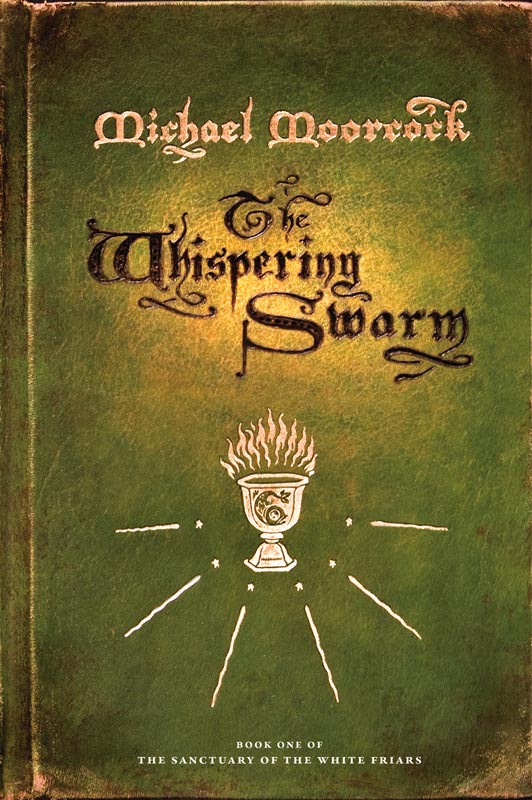
The Whispering Swarm by Michael Moorcock | review by Stephen Theaker
This book (Tor Books ebook, 7569ll) tells the story of Michael Moorcock, a hard-working writer of fantasy, science fiction and literary fiction plagued by the noise of a mysterious swarm. As a teenager, already at work in publishing, Moorcock meets Friar Isidore, who takes him to Alsacia, a magical Sanctuary with connections to all time and space by way of the moonbeam roads. There he meets people like Dick Turpin, Jim Bowie and Buffalo Bill.
Saturday, 1 December 2018
River of Teeth, by Sarah Gailey (Tor.com) | review by Stephen Theaker
In March 1857 Albert Broussard proposed the Hippo Act, which would bring hippopotamuses into the United States to be raised for meat. Hippo ranches began to open in August of that year, and by November the Mississippi river was being dammed to create extra marshes for all the hippos to live in. This area was known as the Harriet. Unfortunately, by January the following year hippos were on the loose, ranching in the Harriet became much more difficult, and in time the area came to be dominated by criminals and cutthroats. Nevertheless, pansexual Blackpudlian Winslow Remington Houndstooth tried real hard to get a ranch going, and he was well on the way when malice struck. Some time later, he’s accepting a mission from the federal government. They want the feral hippos cleared out of the Harriet. He gathers a team: heavily pregnant contract killer Adelia Reyes, explosives expert Hero, meteor-hammer wielding Regina “Archie” Archimbault (and her boy assistant Neville), and fastest gun in the West Calhoun Hotchkiss. The government expects them to catch the feral hippos one by one and escort them off the territory. Houndstooth has a rather quicker method in mind, and he’s also hoping to squeeze in some revenge along the way. One problem they’ll face is that the local crime boss rather likes having the wild hippos around, since they keep civilisation out of the area, making it perfect for his needs, and give him a convenient way of disposing of his enemies.
Sunday, 25 November 2018
Attack on Titan, Vol. 1, by Hajime Isayama (Kodansha) | review
For the last hundred years, the world’s last surviving humans (so far as anyone knows) have lived safely in towns protected by a series of concentric walls, built so long ago that a religion has declared them the work of their god. The walls are tall enough to keep out the giants that have devoured the rest of humanity, but smaller towns are used to focus the titans’ attacks in predictable locations. Only the Survey Corps venture outside, in hope of finding a way to reclaim the world from the titans.
Subscribe to:
Posts (Atom)