Sunday, 27 October 2024

#OcTBRChallenge 2024: a third A to Z of books and audiobooks

I'm taking part in OcTBRChallenge again this month, and this time I'm trying to finish off as many of my short books and audiobooks as I can, in A to Z order. It's been highly enjoyable. My first A to Z of the month is here, and the second is here.

This time A is for Aesthetics, a Very Short Introduction, by Bence Nanay, engagingly read by Alex Wyndham. The discussion of what it's like being on a film award jury was interesting, having just been an award juror myself. I liked the wry humour: "Being a film critic also has a pretty depressing side. You have to spend a lot of time with other film critics…" Not sure I agree with the notion that a critic isn't doing their job unless they teach you how to love a work of art. I was also interested in what the book had to say about the dangers of becoming jaded as a reviewer, if you have decided "the space of possibilities" that a film can explore before it even begins, and how it warns against making a review into nothing but a task of classification. It was interesting to learn about the "mere exposure effect", which'll make perfect sense to anyone who has gradually come to enjoy their kids' awful music, or who suddenly started to love a band they'd always hated – the Smashing Pumpkins are a good example of the latter for me.

B is for Bouncer, Vol. 5: The She-Wolfs' Prey, a violent western written by Alejandro Jodorowsky with marvellous art by François Boucq. The Bouncer helps a female hangman with a rowdy crowd but she wants to kill his dad. This left me very keen to play Red Dead Redemption 2 again!

C is for Chi's Sweet Home, Vol. 7, by Konami Kanata. She's a bit lost! I don't know how I've ended up seven volumes into a manga series about a kitten, but I guess it's a combination of (a) learning about my cat, (b) getting them all cheap, and okay (c) it being totally adorable.

D is for Dead Eyes, Vol. 1, written by Gerry Duggan. John McCrea's art is less cartoonish than usual, more dramatic, still fantastic. Dead Eyes is an infamous crook who comes out of retirement to fund his wife's healthcare. I knew within a couple of pages that I'd love this book.

E is for The End of the Fxxxing World. An American psychopath and his girlfriend go on the run after stealing his dad's car. I liked the tv show (set instead in England), but this didn't do much for me. Not much story, very few panels, lots of padding. Some decent twists, though.

F is for The Fable, Vol. 1, by Katsuhisa Minami. Things get a bit too hot for a legendary hitman and his beautiful assistant, so they are sent to live in Osaka as regular folks for a year, but violence has a way of finding them regardless. I quite enjoyed this, would read more.

G is for A Girl Walks Home Alone at Night, written by Ana Lily Amirpour, with art by Michael DeWeese. Not as I assumed the inspiration for the film, but rather two issues from an unfinished adaptation of it. What there is of it is good, but an absolute cheek to sell it as a book.

H is for Honeybones, a rather brilliant novella by Georgina Bruce about the power of saying no. A teenage girl has to deal with supernatural and sexual threats, and a mum who won't talk to her any more. My first print book of the month, finished off at the Library of Birmingham.

I is for Intruders by Adrian Tomine, from the excellent Faber Stories range. It's the creepy, sad tale of a soldier between tours who accidentally acquires the keys to a house he used to rent, and starts spending the day there. Finished this outside a wedding

J is for John Carter: The End, a Dark Knight Returns for the Edgar Rice Burroughs hero of Mars, written here by Brian Wood and Alex Cox, with stylish art by Hayden Sherman. He let Dejah Thoris think their great-great-etc-grandson was dead, but the boy's grown up to be a dictator.

K is for Killing Time in America, written by Jimmy Palmiotti and Craig Weeden, with art by Justin Norman. Another unpredictable, entertaining Euro-trashy graphic novel from the Paperfilms Humble Bundle. A pseudofamily of four are sent to exact revenge upon American holidaymakers.

L is for Legend of the Scarlet Blades, Vol. 3: The Perfect Stroke, by Severio Tenuta, my first book this month by an Italian writer. In a fantastical, brutal, gorgeously-painted version of medieval Japan, a soldier visits the ruins of his home village, to recover lost memories.

M is for The Millicent Quibb School of Etiquette for Young Ladies of Mad Science, by Kate McKinnon, hilariously read by the author and her sister, Emily Lynne. As much fun as their Audible sitcom, Heads Will Roll (see our review). A Lemony Snicketish tale of a mad scientist who takes three girls under her wing. According to an SNL castmate Kate McKinnon previously wrote fantasy novels under a pseudonym, but no one knows what they were – this is her official debut. It's aimed at kids but go on, no one will judge you for listening to it.

N is for Normandy Gold, by Megan Abbott and Alison Gaylin, art by Steve Scott. The Normandy Gold of the title is a sheriff (her dad died near D-Day) who goes undercover as a high-class prostitute when her sister is killed by a john. It's grotty, exploitative and implausible, but the mystery is pretty good.

O is for Otaku Blue, Vol. 1: Tokyo Underground, written by Richard Marazon with art by Malo Kerfriden. While two unhappy cops investigate a serial killer, a post-grad student researching otaku culture makes fashion-first friends who wangle her an introduction to the ultimate legendary fanboy.

P is for The Pram by Joe Hill, a super story about a couple who move to the country after a tragedy, with horrid consequences. It's great on the stresses of having to hold it together when your partner needs you to be strong for them. And the pram is very creepy!

Q is for Quarry's Climax by Max Allan Collins, read by Stefan Rudnicki. Quarry and partner Boyd are hired to prevent the assassination of a Larry Flynt type. A later novel set back when they still worked for the Broker. Pretty good but felt quite similar to Quarry in the Middle.

R is for Requiem: Vampire Knight, Vol. 1: Resurrection by Pat Mills and Olivier Ledroit. A glitch with the Kindle version (the cover is taller than the rest of the book, so the rest of the book is unnecessarily small) doesn't spoil a crazy saga of a Nazi soldier reborn as a vampire lord in hell. Each panel could be a heavy metal album cover.

S is for Stumptown, Vol. 3: The Case of the King of Clubs, by Greg Rucka and Justin Greenwood. Portland PI Dex Parios tries to figure out why her football chum got badly beaten up after a match. Odd to read a story about football and hooliganism set in the US.

T is for The Time Invariance of Snow, by E. Lily Yu, a short, glittering ebook about the quest undertaken by G, a woman in a world where the devil's magic mirror was shattered, and the pieces fell into our eyes, distorting our perceptions of ourselves and others.

U is for Usagi Yojimbo, Vol. 34: Bunraku and Other Stories, by Stan Sakai. The ronin rabbit watches a spooky puppet show, among other short adventures. The first full volume in colour and it feels a bit odd. Is the art slightly less detailed to leave room for the colour? But the stories are as good as ever.

V is for The View from Mount Improbable by Richard Dawkins. A Penguin 70 which explains how eyes evolved, not once but many times, independently. Nice to read this after seeing him on stage in conversation this week. President of Gallifrey Lalla Ward provides the illustrations!

W is for Wunderwaffen, tome 1: Le pilote du Diable, by Richard D. Nolane and Milorad Vicanovic, set in a world where the D-Day landings failed, Hitler was badly injured by another assassination attempt, and the war went on with new armaments. Great illustrations of the planes.

X is for X, Vol. 1: Big Bad, written by Duane Swierczynski, with art by Eric Nguyen. X is Dark Horse's unpleasant, ultraviolent mix of Batman and the Punisher, and in this he kills a bunch of corrupt people as vigorously as possible. But a trap awaits and he might need a friend.

Y is for Ya Boy Kongming, Vol. 1, by Yuto Yotsuba and Ryo Ogawa. A freebie from March 2023, but if I'd realised it was about master tactician Zhuge Liang from Dynasty Warriors being reborn now and becoming the manager of a wannabe pop star I'd have read it immediately. Hilarious.

Z is for Zenith: Phase Three, by Grant Morrison and Steve Yeowell. Apparently 2000 AD became a colour comic three weeks after this story ended – even without knowing that I'd wondered if it was drawn to be printed in colour, because it was so hard to follow at times. But still an epic story!

So that's my third A to Z of this year's #OcTBRChallenge complete, as well as all the challenge badges! Not sure if there's time to finish a fourth run through the alphabet before the month ends but we'll see.


Friday, 25 October 2024

Kaijumax, Season Two, by Zander Cannon (Oni Press) | review by Stephen Theaker

This review originally appeared in TQF64 (March 2019).

Kaijumax is a prison island for kaiju (giant monsters), a lot like the one in Destroy All Monsters, one of the greatest films of all time. Fans of the Godzilla films and their like will see lots of fun references to them, from the use of giant mecha to fight them down to using little round monster icons on the cover, like those on Godzilla dvds. Season one looked adorable but was in places extremely grim, even for those of us who got through all of Oz. I bought every issue as it came out, so it didn’t put me off, but be warned that the series is totally unsuitable for children – which is a shame because they would love the art. As the author accurately said in a season one letters page, it has “a cartoony style, a jokey high concept, a pitch-black sense of humour, and an undercurrent of dread”. A note at the back of this book expands on the author’s thinking about the book, giving the impression that people have taken issue for example with the slang the monsters use, which can risk sounding like a parody of African-Americans. He admits that the book leans on stereotypes, but asks readers to bear in mind its preposterous premise.

Monday, 21 October 2024

Weird Fiction Old, New, and In-Between VII: Appendix – Rafe McGregor

The seventh of six blog posts exploring the literary and philosophical significance of the weird tale, the occult detective story, and the ecological weird. The series suggests that the three genres of weird fiction dramatize humanity’s cognitive and evolutionary insignificance by first exploring the limitations of language, then the inaccessibility of the world, and finally the alienation within ourselves. This post provides notes on a new series from the British Library, the cases of Kyle Murchison Booth, and the Southern Reach Quartet.


The Weird Tale: The British Library Tales of the Weird

Somewhat to my shame, I only discovered the British Library series while researching this series of posts. I really should have seen it sooner as it has been going since 2018 and published fifty-three titles to date (roughly one a month). The books are all sturdy paperbacks, with colourful, imaginative, and attractive covers and spines and cost £10 or less, depending on where and how one buys them. Each instalment includes a ‘Note from the Publisher’, which serves as a combined trigger warning and ethical rationale and which I reproduce here as exemplary practice:

The original short stories reprinted in the British Library Tales of the Weird series were written and published in a period ranging across the nineteenth and twentieth centuries. There are many elements of these stories which continue to entertain modern readers; however, in some cases there are also uses of language, instances of stereotyping and some attitudes expressed by narrators or characters which may not be endorsed by the publishing standards of today. We acknowledge therefore that some elements in the stories selected for reprinting may continue to make uncomfortable reading for some of our audience. With this series British Library Publishing aims to offer a new readership a chance to read some of the rare material of the British Library’s collections in an affordable paperback format, to enjoy their merits and to look back into the worlds of the past two centuries as portrayed by their writers. It is not possible to separate these stories from the history of their writing and as such the following stories are presented as they were originally published with minor edits only, made for consistency of style and sense.

My only complaint, which prompted me to include this part of the appendix, is that there are no numbers on or in the books, meaning that it isn’t easy to read them in order. I’m sure there is a sound reason for this editorial decision, but all collectors and some readers will want a chronological list. There’s one on Medium compiled by Owen Williams, which is easier to navigate than the British Library’s and which I used as a guide in compiling my own:  

  1. From the Depths and Other Strange Tales of the Sea 
  2. Haunted Houses: Two Novels by Charlotte Riddell 
  3. Glimpses of the Unknown: Lost Ghost Stories
  4. Mortal Echoes: Encounters With the End 
  5. Spirits of the Season: Christmas Hauntings
  6. The Platform Edge: Uncanny Tales of the Railways
  7. The Face in the Glass and Other Gothic Tales by Mary Elizabeth Braddon
  8. The Weird Tales of William Hope Hodgson
  9. Doorway to Dilemma: Bewildering Tales of Dark Fantasy
  10. Evil Roots: Killer Tales of the Botanical Gothic
  11. Promethean Horrors: Classic Stories of Mad Science
  12. Roarings from Further Out: Four Weird Novellas by Algernon Blackwood
  13. Tales of the Tattooed: An Anthology of Ink 
  14. The Outcast and Other Dark Tales by E.F. Benson
  15. A Phantom Lover and Other Dark Tales by Vernon Lee
  16. Into the London Fog: Eerie Tales from the Weird City
  17. Weird Woods: Tales from the Haunted Forests of Britain
  18. Queens of the Abyss: Lost Stories from the Women of the Weird
  19. Chill Tidings: Dark Tales of the Christmas Season
  20. Dangerous Dimensions: Mind-Bending Tales of the Mathematical Weird 
  21. Heavy Weather: Tempestuous Tales of Stranger Climes
  22. Minor Hauntings: Chilling Tales of Spectral Youth
  23. Crawling Horror: Creeping Tales of the Insect Weird 
  24. Cornish Horrors: Tales from the Land’s End 
  25. I Am Stone: The Gothic Weird Tales of R. Murray Gilchrist
  26. Randalls Round: Nine Nightmares by Eleanor Scott 
  27. Sunless Solstice: Strange Christmas Tales for the Longest Nights 
  28. The Shadows on the Wall: Dark Tales by Mary E. Wilkins Freeman
  29. The Ghost Slayers: Thrilling Tales of Occult Detection 
  30. The Night Wire and Other Tales of Weird Media 
  31. Our Haunted Shores: Tales from the Coasts of the British Isles 
  32. The Horned God: Weird Tales of the Great God Pan
  33. Spectral Sounds: Unquiet Tales of Acoustic Weird 
  34. Haunters of the Hearth: Eerie Tales for Christmas Nights
  35. Polar Horrors: Strange Tales from the World’s Ends
  36. The Flaw in the Crystal and Other Uncanny Stories by May Sinclair
  37. The Ways of Ghosts and Other Dark Tales by Ambrose Bierce
  38. Holy Ghosts: Classic Tales of the Ecclesiastical Uncanny 
  39. The Uncanny Gastronomic: Strange Tales of the Edible Weird 
  40. The Lure of Atlantis: Strange Tales from the Sunken Continent 
  41. Dead Drunk: Tales of Intoxication and Demon Drinks 
  42. The House on the Borderland by William Hope Hodgson
  43. Roads of Destiny and Other Stories of Alternative Histories and Parallel Realms 
  44. Circles of Stone: Weird Tales of Pagan Sites and Ancient Rites
  45. Doomed Romances: Strange Tales of Uncanny Love 
  46. The Undying Monster: A Tale of the Fifth Dimension by Jessie Douglas Kerruish
  47. Fear in the Blood: Tales from the Dark Lineages of the Weird 
  48. Out of the Past: Tales of Haunting History 
  49. The Night Land by William Hope Hodgson
  50. Deadly Dolls: Midnight Tales of Uncanny Playthings
  51. The Human Chord by Algernon Blackwood
  52. Eerie East Anglia: Fearful Tales of Field and Fen
  53. The Haunted Trail: Classic Tales of the Rambling Weird

 There are three more titles due for publication, all by the end of this year:

  1. The Weird Tales of Dorothy K. Haynes 
  2. The Haunted Vintage by Marjorie Bowen 
  3. Summoned to the Séance: Spirit tales from Beyond the Veil 


The Occult Detective Story: Kyle Murchison Booth

 In parts III and IV of this series, I praised Sarah Monette’s Kyle Murchison Booth occult detective stories and mentioned that some are, unfortunately, difficult to find. The eighteen stories have been published over a period of twenty years (2003-2023), during which two books have been published: The Bone Key: The Necromantic Mysteries of Kyle Murchison Booth (2007; second edition, 2011), a collection of ten short stories, and A Theory of Haunting (2023), a novella and the most recent story. This is a chronological list of all eighteen, with the original date of publication in parenthesis and my suggestion for the easiest way to find them… 

  1. The Wall of Clouds (2003) – The Bone Key
  2. The Venebretti Necklace (2004) – The Bone Key
  3. The Inheritance of Barnabas Wilcox (2004) – The Bone Key
  4. Bringing Helena Back (2004) – The Bone Key
  5. The Green Glass Paperweight (2004) – The Bone Key
  6. Wait for Me (2004) – The Bone Key
  7. Elegy for a Demon Lover (2005) – The Bone Key
  8. Drowning Palmer (2006) – The Bone Key
  9. The Bone Key (2007) – The Bone Key
  10. Listening to Bone (2007) – The Bone Key
  11. The World Without Sleep (2008) – Somewhere Beneath Those Waves
  12. The Yellow Dressing Gown (2008) – Apex
  13. The Replacement (2008) – Sarah Monette
  14. White Charles (2009) – Clarkesworld
  15. To Die for Moonlight (2013) – Apex
  16. The Testimony of Dragon’s Teeth (2018) – Uncanny
  17. The Haunting of Dr. Claudius Winterson (2022) – Uncanny
  18. A Theory of Haunting (2023) – A Theory of Haunting 

…I only hope that there are many more to come.


The Ecological Weird: Absolution

Jeff VanderMeer’s Southern Reach Trilogy – consisting of Annihilation, Authority, and Acceptance, all published in 2014 – becomes a quartet tomorrow, with the UK release of Absolution in hardback, paperback, Kindle, and Audible. My original intention for this appendix was to provide a synopsis or summary of the trilogy for those who might not want to reread all three books before starting the fourth, but nonetheless need a reminder of the sequence of events. (This is what I wanted, in spite of having read the trilogy several times and having no doubt that I would return to it and the quartet in future.) To cut a long story short, I failed dismally, and will poach Mac Rogers’ reason: ‘There’s really no way to give the Southern Reach pitch without sounding high, so I won’t try.’ I do, however, recommend the first part of Adam Roberts’ review of the trilogy, which provides the best summary I could find with limited spoilers. (The second part is also worth reading, although it’s more interpretative than descriptive.) There was chatter some time ago about a prequel to the Southern Reach and it’s not quite clear whether Absolution is a prequel, sequel, paraquel, or some combination of these categories (reminding me of Heat 2, which nearly ruined one of my favourite films). Here is what VanderMeer himself has to say on his website:

Ten years after the publication of Annihilation, the surprise fourth volume in Jeff VanderMeer’s blockbuster Southern Reach Trilogy.
When the Southern Reach Trilogy was first published a decade ago, it was an instant sensation, celebrated in a front-page New York Times story before publication, hailed by Stephen King and many others. Each volume climbed the bestsellers list; awards were won; the books made the rare transition from paperback original to hardcover; the movie adaptation became a cult classic. All told, the trilogy has sold more than a million copies and has secured its place in the pantheon of twenty-first-century literature.
And yet for all this, for Jeff VanderMeer there was never full closure to the story of Area X. There were a few mysteries that had gone unsolved, some key points of view never aired. There were stories left to tell. There remained questions about who had been complicit in creating the conditions for Area X to take hold; the story of the first mission into the Forgotten Coast—before Area X was called Area X—had never been fully told; and what if someone had foreseen the world after Acceptance? How crazy would they seem?
Structured in three parts, each recounting a new expedition, there are some long-awaited answers here, to be sure, but also more questions, and profound new surprises. Absolution is a brilliant, beautiful, and ever-terrifying plunge into unique and fertile literary territory. It is the final word on one of the most provocative and popular speculative fiction series of our time.

I’m not sure that either more closure or more exposition are required or will enhance the trilogy as it stands, but I am confident that VanderMeer won’t ruin the masterpiece he created a decade ago. So far, there have been surprisingly few advance reviews: Publishers Weekly, Kirkus Reviews, and Scientific American.


More Recommended Reading

Fiction

John Hall (ed.), Five Forgotten Stories (2011).

Rafe McGregor, Eight Weird Tales (2024).

Rafe McGregor, Six Strange Cases (2024).

Nonfiction

Stephen Ellcock & Mat Osman, England on Fire: A Visual Journey through Albion's Psychic Landscape (2022).

Mark Valentine, The Thunder-Storm Collectors (2024).

Timothy Murphy, William Hope Hodgson and the Rise of the Weird: Possibilities of the Dark (2025).

Friday, 18 October 2024

Shoot at the Moon, by William F. Temple (The British Library) | review by Stephen Theaker

This review was originally written for a previous iteration of the British Fantasy Society's website, and then appeared in TQF65 (December 2019).

Part of the British Library Science Fiction Classics range, this enjoyable novel about an ill-fated trip to the moon dates from 1966. Mike Ashley provides an introduction, and it is fascinating – we learn that this novel was very nearly adapted into a Hollywood film – but read it after the novel to save the book’s surprises.

Thursday, 17 October 2024

#OcTBRChallenge 2024: a second A to Z of books and audiobooks

I'm taking part in OcTBRChallenge again this month, and this time I'm trying to finish off as many of my short books and audiobooks as I can, in A to Z order. It's been very good fun. My first A to Z of the month is here.

A is for Abominable, a novella by William Meikle. A lost journal of George Mallory and Andrew "Sandy" Irvine from 1924 is offered for sale. It records their final, fatal ascent of Mount Everest, when they encountered something abominable! With a mouth full of long yellow teeth!

B is for Broken Glass, an audiobook of Arthur Miller's play about a Brooklyn woman in 1938 who, terrified by news of Jewish businesses being smashed up in Berlin, loses the ability to walk. Wonder what she'd make of the same thing happening now in New York. Stars JoBeth Williams. It was staged by LA Theatre Works in 1996. Included in Audible Plus for free.

C is for Creepy Comics, Vol. 1, by various writers and artists, Dark Horse's resurrection of the old horror anthology comic. Found this a trudge, to be honest, with inconsequential, simplistic stories and muddy artwork that was often hard to parse.

D is for The Dark Knight Returns: The Golden Child, by Frank Miller and Rafael Grampa. Bit weird this, originally published as issue 1, but no other issues materialised so now it's published as a book in itself. Batman Cassie Kelly and Superman's kids get into a fight with Darkseid.

E is for Emergency Skin by N.K. Jemisin, the first thing I've read by her, and a Hugo winner, apparently. An agent sent from a colony expects to find Earth in ruins, but in fact it became a utopia after the nasty capitalists fled. A bit cringey, but how they treat him is sweet.

F is Fabius Bile: Repairer of Ruin by Josh Reynolds. I know I'm trying to finish my shortest books and audiobooks, but at only twenty minutes this audiobook is an extreme example! It recounts a skirmish on a demon world in the Warhammer 40K universe. Great sound effects and performances!

G is for Gallifrey 1.2: Square One, by Stephen Cole, starring Lalla Ward, Louise Jameson and John Leesons. I'd forgotten that I bought over a dozen of these audios a couple of years ago and they are quite a treat. This one concerns time trickery at a temporal summit, at which Leela goes undercover as an exotic dancer.

H is for Hellblazer: Rise and Fall, written by Tom Taylor with art by Darick Robertson. Ouch, painful. Makes the New 52 issues look good. I suppose English police officers might carry guns in the DC universe, but I think Hellblazer writers from outside the British Isles do best when setting their stories in their own countries.

I is for Is Kichijoji the Only Place to Live? by Makihirochi, a gentle manga about twins who took over their parents' estate agency, and run it in an unconventional manner, which always seems to involve persuading their clients not to live in Kichijoji, but elsewhere in Tokyo.

J is for The Judge's House by Georges Simenon. Maigret is present during a judge's attempt to dispose of a body. Typical Maigret tale full of grub and grubbiness. Modern-day readers may be surprised at how one chap gets away with what would now be considered a serious crime. We're supposed to feel sorry for him, if anything!

K is for Ka-Zar, Vol. 1, a Tarzan in Marvel's version of New York story by Mark Waid, with art by Andy Kubert and others. I remember this being well-regarded at the time, but it's not easy to see why now. The art is wildly dynamic, but not always to the storytelling's benefit.

L is for The Lover by Silvia Morena-Garcia, a short ebook/audiobook about Judith, a young woman treated as a servant by her more beautiful sister. She dallies with a pair of men, one who gives her books in return for sexual favours, the other her sister's husband.

M is for Melody James by Stephen Gallagher, an intriguing novella about a clever, resourceful fortune-teller recruited in 1919 to vet a journalist, a potential spy for the British secret service in Soviet Russia. Spin-off from a novel, The Authentic William James.

N is for November, Vol. 1: The Girl on the Roof, by Matt Fraction and Elsa Charretier. A stylish and mysterious graphic novel about a dissolute young puzzle fanatic who is paid $500 a day to solve a puzzle in the paper and broadcast the solution from a radio set on her roof.

O is for O Maidens in Your Savage Season, Vol. 1, written by Mari Okada, trans. Sawa Savage, with art by Nao Emoto, a manga book about romantic tension and teenage hormones boiling over in the school book club. It's funny and sweet but gets a bit ruder than expected in places.

P is for Put to Silence by Rose Biggin, a short, tart ebook published by Jurassic London in 2014 about a murder attempt during a performance of Shakespeare's Julius Caesar. The target's Brutus, the client's playing Julius Caesar, the killer's in the chorus.

(I decided not to count it for my A to Z in the end, but for P I also read an excellent novella that will hopefully appear in our twentieth anniversary issue of our magazine. It's the latest story in a long-running series. My favourite thing I've read this month, honest!)

Q is for Queen Crab, a short graphic novel by Jimmy Palmiotti and Artiz Eiguren. On my TBR list since January, when I got it in a Humble Bundle. The tale of a woman betrayed – after a scoundrel tries to drown her on a cruise, she mysteriously gains a pair of powerful crab claws!

R is for The Roman Empire, a Very Short Introduction, by Christopher Kelly, read by Richard Davidson. Explains how the Roman Empire was built, and banishes many illusions about it. Weird to learn that present-day Britain has a higher population than the entire Roman Empire. It looks like these are all leaving Audible Plus this month so I want to listen to a few of them for free while I still can.

S is for Stag by Karen Russell, read by Adam Berger. A lone wolf type of guy attends a divorce party with a one-night stand, and as things take a more serious turn at the previously silly party, he becomes rather obsessed with the divorcing couple's pet tortoise.

T is for Trigger Girl 6, thus named because she's the sixth mysterious super-powered assassin sent to kill the President of the USA. Written by Jimmy Palmiotti and Justin Gray, with very nice art by Phil Noto. Feels more like a French BD album than a traditional American comic.

U is for Ushers by Joe Hill, one of my Amazon First Reads picks this month. Two police officers chat with a young man in a bookshop (where he buys 4000 Weeks by Oliver Burkeman) because he went home before a school shooting happened and got off a train that subsequently crashed.

V is for Venom by Donny Cates, Vol. 1: Rex, with pencils by Ryan Stegman. Eddie Brock learns about the symbiote's cosmic origins. The reason given for Venom's vulnerability to sound and fire was very silly, but there was some cool stuff too; overall the best Venom book I've read.

W is for Wild With Happy, the audiobook of a superb play from writer, director and star Colman Domingo, who plays Gil Hawkins, dealing (or not) with his mother's death by getting off with the funeral director and foregoing any ritual, much to the dismay of his hilarious aunt.

X is for X-Men Grand Design: Second Genesis by Ed Piskor, which pulls together a decade's worth of X-Men issues into one indie-style graphic novel. My 50th book or audiobook of the month! Jamming all these stories – not to mention all the fantastic TQF submissions I've been reading! – into my head at once is making me a little dizzy.

Y is for Yee-Haw: Weirdly Western Poems by Rhys Hughes. Of poetry I know not much, but what my mother said / "Books by that wacky Welshman, must not be left unread!" My favourite bit was a short Samuel Beckett-ish play, "Uneasy Rider", featuring author Max Brand.

Z is for Zero Gravity by Woody Allen, his fifth book of comedic essays and stories. The ideas, writing and jokes are as strong as ever, but the audiobook sounds like it was recorded at the kitchen table! It's almost unlistenable at first, but gets better later on.

Second A to Z complete!

Monday, 14 October 2024

Weird Fiction Old, New, and In-Between VI: Exploring the Ecology Within – Rafe McGregor

The sixth of six blog posts exploring the literary and philosophical significance of the weird tale, the occult detective story, and the ecological weird. The series suggests that the three genres of weird fiction dramatize humanity’s cognitive and evolutionary insignificance by first exploring the limitations of language, then the inaccessibility of the world, and finally the alienation within ourselves. This post introduces the register of the Real.


Hearts of Darkness

Notwithstanding very fine examples by China Miéville, Caitlín R. Kiernan, and M. John Harrison, the most critically and commercially acclaimed novel in what is usually called the new weird and I am calling the ecological weird is almost certainly Jeff VanderMeer’s Annihilation (2014), which is the first of his Southern Reach Trilogy (which will be a quartet later this month) and was successfully adapted to a feature film of the same name by Alex Garland in 2018 (poster pictured). I do not intend to summarise or review either Annihilation or the Trilogy here, because excellent reviews and review essays have already been published in The New Yorker, Los Angeles Times, Los Angeles Review of Books, Textual Practice, and elsewhere. Instead, I want to sketch a literary (and cinematic) lineage for Annihilation in order to shed light on the definition of ecological weird fiction with which I closed part V. The ecological weird, like occult detective fiction, shares the primary features of weird fiction by exploring the limitations of language, the inaccessibility of the world, and the alienation within ourselves. The last of these is particularly important for and to the ecological weird (to the extent that it does or does not constitute a subgenre or subcategory of the weird) and is a development of the inaccessibility of the world (which I explained in terms of the world-without-us in part IV). In ecological (and other) weird fiction, we not only encounter the alien, but recognise it within ourselves and either resist or accept it (it is no coincidence that the third part of the Southern Reach is titled Acceptance).

I have, in consequence, represented what I take to be the lineage from which Annihilation emerged in a schematic (pictured). The link to J.G. Ballard’s The Crystal World (1966) and, by extension, to ‘The Illuminated Man’ (published in Fantasy & Science Fiction in 1964), H.P. Lovecraft’s ‘The Color Out of Space’ (published in Weird Tales in 1927), and Algernon Blackwood’s ‘The Willows’ (published in his collection, The Listener and Other Stories, in 1907) is uncontroversial. The Crystal World is a revision and expansion of ‘The Illuminated Man’ and Ballard appears to have deployed formal (and substantive) elements of Joseph Conrad’s masterpiece, Heart of Darkness (1899), in the course of adapting his own work. There are two points to note about this lineage. First, the inclusion of ‘The Willows’, which is – as I noted in part I – widely acknowledged as the single best weird tale ever written, demonstrates that the themes explored by the ecological weird are not new to the genre, merely developed in a different format (typically the novel rather than the short story). Second, Heart of Darkness draws attention to the crux of the ecological weird: it is not only about the (encounter with the) alien and (our) alienation, but self-alienation. Though criticised for its use of language and adoption of attitudes that are now, with complete justification, regarded as offensive, the novella provides a critique of colonialism so robust that it would keep plenty of social media trolls busy for a long time (assuming they had the intelligence and patience to read it). Conrad’s insight is that colonialism is not only bad for the colonised, who suffer what we would now call genocide, but also for colonisers, for whom the remoteness and expansiveness of the colonies facilitates the flourishing of all that is vicious within them. Despite VanderMeer’s repeated and vehement denials that Andrei Tarkovsky’s feature film, Сталкер (1979, translated as Stalker), had any influence on Annihilation, I made a tenuous link in my sketch on the basis of both narratives being concerned not only with a place that is utterly alien to humanity, but with the effects of that place on the minds of the people who enter it. The latter is essential to the ecological weird, the recognition of the alien within ourselves to which we respond with either resistance or acceptance.


The Weird Within

Psychoanalyst and philosopher Jacques Lacan (1901-1981, pictured) is an even more controversial figure than Jacques Derrida (whom I discussed in part II) because he is regarded by many as a cynical (rather than sincere) charlatan and because there remains no consensus on the value of the vast body of work he produced over a career of five decades. In contrast to Derrida (and Eugene Thacker, discussed in part IV), I make no pretence to understanding Lacan’s overall project or even his individual publications and seminars, but I do think that what is known as his register theory is useful for grasping the self-alienation typically explored by and in ecological weird fiction. Register theory is an account of the modes of human existence and, hence, an ontology (a study of what exists, the way in which existing things exist, and how best to classify and codify existing things). As an ontology, register theory identifies three distinct but intervolved modes of human experience or orders: reality that can be perceived, reality that is socially constructed by language, and reality that remains inaccessible. The Imaginary refers to the world that human beings understand perceptively and non-reflectively and to the way in which human beings understand both that world and themselves as infants, i.e. before they develop the capacity for language. The Imaginary is therefore an innocent and naïve mode of human experience in which human beings are reduced to their perceptual capacities.

The Symbolic refers to the socially constructed world, which human beings access by means of language. The rules of the Symbolic order are revealed by the investigation of the way in which both language and social relations function and Lacan draws on the classic structuralism of Ferdinand de Saussure, whom I introduced in my discussion of Derrida in part II, and Claude Lévi-Strauss, a French anthropologist. The Symbolic cannot be grasped in its entirety, with the result that human beings remain unaware of structures, contexts, and exchanges which have a profound influence on their lives. The Real refers to the ineffable world, which is detectable by human beings indirectly through the unconscious. The ineffable transcends expression and exceeds language, making it very difficult to discuss and impossible to apprehend. The Real can nonetheless be conceived as an objective reality that is inaccessible to subjective and intersubjective perception and cognition, a kind of Kantian noumenon or thing-in-itself (see part IV). The primary means of conceiving the Real is the unconscious, which is why register theory is a significant component in Lacan’s metapsychology. What makes the three orders or registers useful for understanding the ecological weird is that they are not only a taxonomy of the types of thing that exist but also structure the psyche, i.e. human subjectivity. The structure of subjectivity thus consists of all three of the Imaginary, the Symbolic, and the Real and the Real is the alien – or weird – within, the part of ourselves that is impossible to apprehend and can only be conceived partially and indirectly. 

Future Weird

Weird fiction is thriving. Perhaps not quite as much as in its heyday, almost exactly a century ago, but probably in a healthier condition given that it is no longer tied to and dependent on a single format (the short story) or the success of a particular outlet (Weird Tales). I want to close this series with a couple of observations that draw on my short-lived but very enlightening (for me, if not my students) stint as a creative writing tutor. In part V, I discussed the importance of the development of the weird novel to the survival of the genre in the twenty-first century, citing S.T. Joshi’s discussion of the trend in what he terms the modern weird tale. Joshi identifies three ways in which authors have attempted to match literary intention with commercial demand by extending the tale to the novel:

1. Writing a fantastic narrative that has a real-world setting.

2. Writing a mystery narrative with supernatural element.

3. Writing a narrative that is structured around a complex supernatural situation.

He regards the first of these as difficult, although Harrison’s The Sunken Land Begins to Rise Again (2020) shows how it can be achieved. The second is cheating in Joshi’s opinion and while I might agree if the supernatural element is superficial or gratuitous, I think the greater concern is that crime fiction itself is better suited to the novella format (as mentioned in part V). Nevertheless, Miéville and VanderMeer both show how this can be achieved (without cheating) with The City & the City and Finch: A Novel, both published in 2009. The third is Joshi’s recommended approach and assuming that Absolution doesn’t completely change the series’ narrative trajectory, it seems precisely what VanderMeer has done in the Southern Reach.

While I was researching The Conan Doyle Weirdbook (2012), likely in 2009 or 2010, I came across a short guide to writing new weird fiction and scribbled some notes in the inside cover of one of the key texts I keep on my writing desk. In spite of many hours – probably one or two days even – of searching, I’ve never been able to find the guide again. (I assume it was part of an introduction to an anthology, but I really should have found it by now.) There are three recommendations and I think they present a nice complement to Joshi’s list, albeit one focused on reinventing rather than transforming the genre. Based on my notes in the absence of the original, the recommendations are:

1. Extrapolating the internal logic of a speculative (or other) narrative.

2. Rewriting a particular narrative in a different genre.

3. Deconstructing a speculative (or other) narrative.

The first might be said to have been used by Kiernan in her extrapolation of her fascination with the figure of the selkie in The Drowning Girl: A Memoir (2012). I have heard Miéville’s King Rat (1998) described as a retelling of the Pied Piper of Hamelin (c.1300), which is both accurate and an example of the second. I have already provided an example of the third in part III, with Victor LaValle’s The Ballad of Black Tom (2016), although I suspect this method would be difficult to sustain to novel length. (I am also fairly sure that the guide was for writing new weird tales not new weird novels). Whatever form the future of weird fiction takes, I look forward to reading and watching more of it in TQF and beyond!


Recommended Reading

Fiction

Jeff VanderMeer, Annihilation, Farrar, Straus and Giroux (2014).

M. John Harrison, The Sunken Land Begins to Rise Again, Gollancz (2020).

China Miéville, The City & the City, Macmillan (2009).

Nonfiction

Jeff VanderMeer, Caitlín R. Kiernan on Weird Fiction, Weird Fiction Review (2012).

China Miéville, M.R. James and the Quantum Vampire: Weird; Hauntological: Versus and/or and and/or or? Collapse IV (2008).

Robert Weinberg, The Weird Tales Story (2nd ed.), Pulp Hero Press (2021).

Friday, 11 October 2024

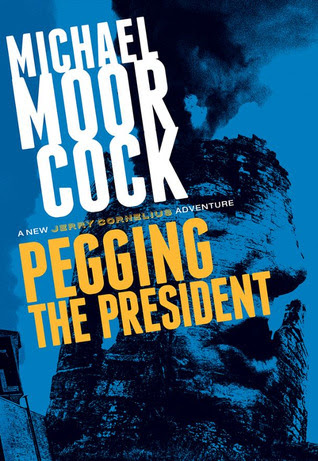
Pegging the President by Michael Moorcock (PS Publishing) | review by Stephen Theaker

This review originally appeared in TQF64 (March 2019).

Like other Jerry Cornelius stories, this brand new novella is a collage of in-jokes, allusions and references, and I doubt I caught more than one in ten of them. Your taste for that kind of thing will have a big effect on how much you enjoy the book. When I first read the Cornelius books, I found all of that funny because it seemed so random, cool and quirky. And even though I’m more used to the techniques being used, I still appreciate it. But I’m not going to pretend that I had a particularly good idea of what was going on in the story. What I did gather was that Jerry Cornelius, his friends, his family and his enemies, seemed to be slipping around in time, through different future and alternate history wars. All the favourites from the books show up: his sister Catherine Cornelius, Una Persson, Miss Brunner, Colonel Pyat, Shakey Mo, Jerry’s mum and dad, Cuban heels, Derry & Tom’s Famous Roof Garden. Even the famous needle gun makes an appearance. Jerry is still young, even though fifty years have (perhaps) passed, and he is able to do things like materialising in the seat of a car that someone else is driving. “The difference between fact and fiction”, Jerry comes to understand at one point, “[was] irretrievably blurred.” Each chapter begins with an extract: there are news items about the war in Syria, for example, and an extensive amount of It Can’t Happen Here by Sinclair Lewis, which has obvious relevance to present-day events in the USA: a capricious president who longs for the absolute power of a dictator, and a significant portion of the population also wishes he had it. It does break up the story a lot, though, and it feels as if you spend more time on the extracts than the adventure. It doesn’t help that a few of the extracts appear more than once, although that does reinforce the message. We thought we had set the ball rolling, thinks Jerry, but “all we’d done is start the pendulum”. Fans are likely to enjoy it very much, and I think it makes a pretty good entry point for those new to Jerry Cornelius – it’s no easier than the others, but it does give you a good idea of what they are like. Stephen Theaker ****

Tuesday, 8 October 2024

#OcTBRChallenge 2024: an A to Z of books and audiobooks

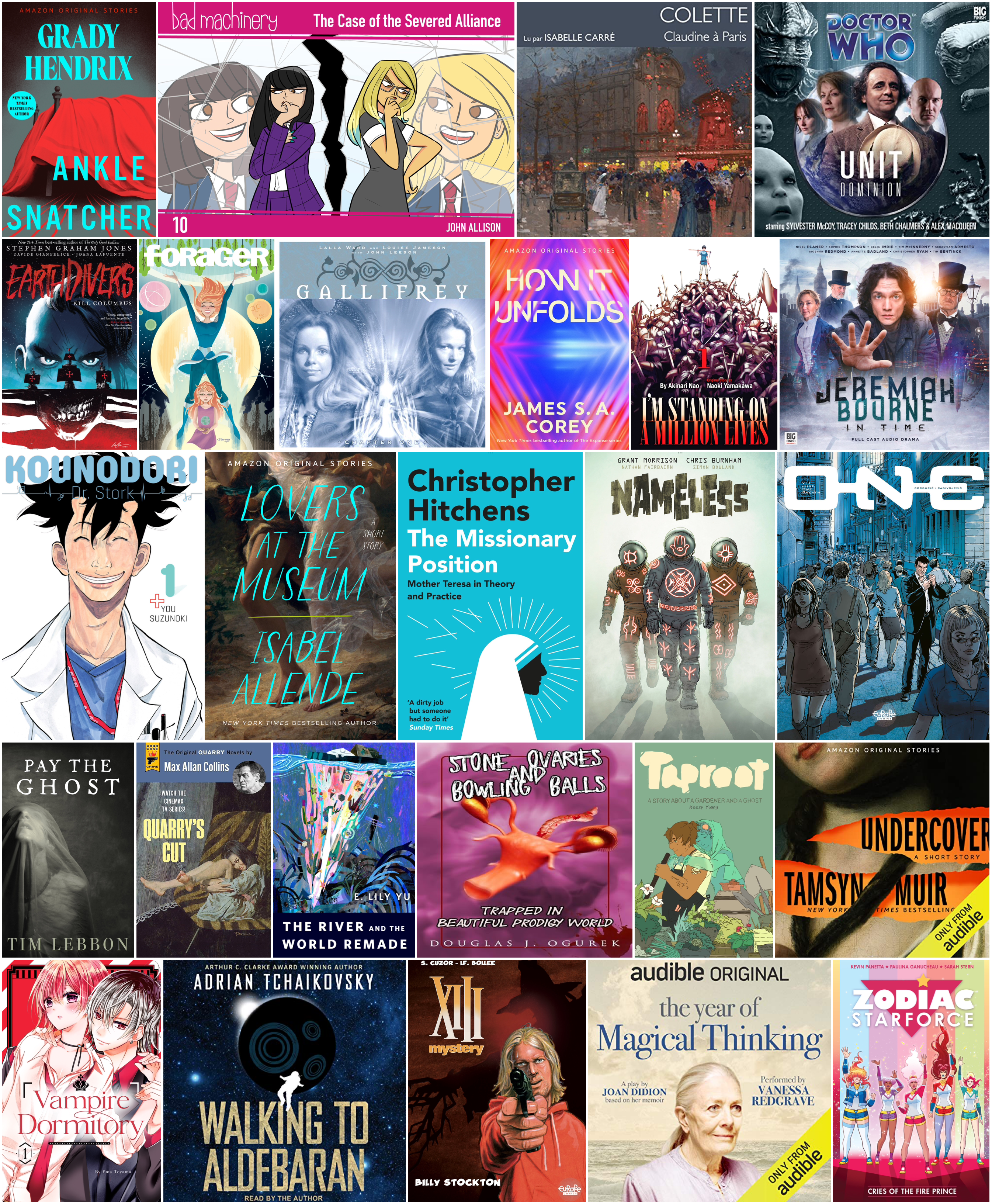
I always look forward to #OcTBRChallenge, where the idea is to clear as many books from your TBR list as possible in a month. I like to slice my collection a different way each year, and this time I'm reading as many of my short books as I can in A to Z order. The first one I finished was Ankle Snatcher by Grady Hendrix, about a family plagued by an actual monster under the bed.

B is for Bad Machinery, Vol. 10: The Case of the Severed Alliance, by John Allison. Her friendship with Shauna on the rocks, Lottie volunteers to work at a local newspaper. She discovers that the Chamber of Commerce is making blood sacrifices! Smashing, but sadly the last volume.

C is for Claudine à Paris by Colette, beautifully read by Isabelle Carré. Finished this, but have to admit I didn't follow it. I've been trying to improve my ear for French, and listening to this definitely helped, but I'm still picking out words and phrases rather than following the story. I listened to some of it with Android captions on, but it defeated the point since I just started reading instead of listening. If I listen to another French audiobook, I'll read a plot summary beforehand, so that I have some kind of framework to drop the bits I understand into, or maybe listen to a book I already know well.

D is for Doctor Who: UNIT Dominion by Nicholas Briggs and Jason Arnopp. As UNIT fends off more interdimensional incursions than the Evangelions, two Doctors turn up to help. One is a Scottish chap with an umbrella, the other is a haughty future Doctor, played by Alex McQueen…

E is for Earthdivers: Kill Columbus, volume 1 in a series written by horror author Stephen Graham Jones, art by Davide Gianfelice. In 2112, the native American survivors of an apocalypse try to fix things with time travel, by murdering Columbus before he reached their continent.

F is for Forager, a short graphic novel by Jimmy Palmiotti, Justin Gray and Steven Cummings. A couple on the rocks take their daughter on a spaceship to Mars, where she makes contact with something alien! Feels like a slightly more rushed version of ace Leo books like Betelgeuse or Aldebaran.

G is for Gallifrey: Weapon of Choice, an entertaining Big Finish Doctor Who spin-off by Alan Barnes, starring four of Tom Baker's companions: the second Romana, the first and second K9s, and the one and only Leela. In this story Romana, now President of Gallifrey, gives Leela a mission.

H is for How It Unfolds by James S.A. Corey, both of him: a short ebook with more ideas than most books ten times the size. It's about Roy, who takes part in an audacious colonisation project. Given how much I loved this, I should probably read the Expanse books.

I is for I'm Standing on a Million Lives, Vol. 1, a manga book by Naoki Yamakawa, with art by Akinari Nao, translated by Christine Dashiell. Stories of Japanese teenagers transported to an RPG game world are ten a penny, but its exploration of the game's mechanics is quite fun.

J is for Jeremiah Bourne in Time, a fun four-part Big Finish audio drama written by Nigel Planer. Jerry time-travels like Christopher Reeve in Somewhere in Time, by focusing on the details. His first accidental trip is to 1910, where he encounters various oddballs played by a splendid cast.

K is for Kounodori: Dr Stork, Vol. 1, by You Suzunoki, a genuinely moving manga book about a doctor who moonlights as an acclaimed and mysterious concert pianist. He cuts performances short when his patients go into labour. I got about 200 of these Kodansha books in a free giveaway.

L is for Lovers at the Museum by Isabel Allende, about a young couple found curled up asleep on the floor of a supposedly secure museum, first thing in the morning. I like how Amazon First Reads now includes some shorter ebooks – this fab fantasy story was a March 2024 selection.

M is for The Missionary Position: Mother Teresa in Theory and Practice, by Christopher Hitchens, where he puts the reputation of this holiest of scammers under the microscope and takes a scalpel to it. Really is shocking to read of her heartless treatment of the sick and dying.

N is for Nameless by Grant Morrison and Chris Burnham, in which a psychic fights god, who turns out to be an otherdimensional alien imprisoned in an asteroid that's hurtling our way. The art is fantastic throughout, but it felt like the writer's magical beliefs rather swamped the story.

O is for One, Vol. 1: Just One Breath, by Sylvain Cordurie and Zivorad Radivojevic, also about a psychic, this time a "bloodcog" called on to investigate why the world is suddenly at peace. I read a lot of this book while the adverts were on during Rings of Power!

P is for Pay the Ghost by Tim Lebbon. A little girl goes missing and a year later her mum returns, sick and wasted away to nothing, ruined by a year of searching in supernatural territory, needing dad's help. I haven't seen the film, but it sounds like it left out some of the best stuff from the book.

Q is for Quarry's Cut by Max Allan Collins. When a former colleague kills a friend, the erstwhile hitman hunts him to an adult film shoot at a ski lodge. I adored Stefan Rudnicki's readings of other Quarry books, but Christopher Kipiniak's grimmer version here is great too.

R is for The River and the World Remade by E. Lily Yu. In a world of permanent flooding, some moved inland, others have floating homes woven from plastic bags and styrofoam; in this ace story a house-weaver battles a storm to save a young rascal from his own folly.

S is for Stone Ovaries and Bowling Balls Trapped in Beautiful Prodigy World, a title that left little room for much else in my tweet about it! An outrageous, hilarious unsplatterpunk tale by Douglas J. Ogurek, full of unhinged, profane wordplay, like Oscar Wilde writing for Rik Mayall. And it's hilariously read by J James – a handful of glitches can be forgiven on what must have been a very challenging production. I'm biased, obviously – Douglas has probably contributed to more TQF issues than me at this point! – but I was laughing out loud throughout.

T is for Taproot, collecting and expanding a webcomic by Keezy Young. A gay ghost has a crush on a bisexual gardener, whose efforts to keep his plants alive unwittingly cross the line into necromancy! The odd pacing reflects its webcomic origins, but it's sweet and the art is lovely.

U is for Undercover by Tamsyn Muir, a twisty-turny urban fantasy story about a tough woman hired to bodyguard a gangster's ghoul, read by Susan Dalian. One of those nice books where if you borrow the ebook in Prime Reading, you can claim the audiobook to keep for good in Audible.

V is for Vampire Dormitory, Vol. 1, by Ema Tōyama, a gay vampire romance manga book very much aimed at female readers, to the point that one of the boys is secretly female and binding her breasts. Has the cute idea that vampires seduce humans because love makes our blood sweeter.

W is for Walking to Aldebaran, the audiobook jauntily read by the author, Adrian Tchaikovsky. British astronaut Gary Rendell is lost in the Crypts, a mysterious interplanetary nexus where various aliens try to survive among the detritus of each other's failed expeditions, and time gets weird.

X is for XIII Mystery, Vol. 6: Billy Stockton, by S. Cuzor and L.F. Bollee, the life story of a supporting character from volume 3 of the main XIII series. It's misery on top of misery as a child who loses his parents in a plane crash grows up to inflict misery on others in turn.

Y is for The Year of Magical Thinking, the audiobook version of a one-woman play by Joan Didion, based on her memoir of the year that followed her husband's death, and led up to her daughter's death, performed by Vanessa Redgrave. I gave the littler Theakers a big hug after this.

Z is for Zodiac Starforce, Vol. 2: Cries of the Fire Prince, written by Kevin Panetta, art by Paulina Ganucheau. A defeated enemy is so desperate for revenge on Zodiac Starforce that she tries to summon a demon goddess, but gets instead the goddess's pet dancer.

A to Z complete!

Friday, 4 October 2024

Too Like the Lightning by Ada Palmer (Head of Zeus) | review by Stephen Theaker

This review originally appeared in Interzone #272 (September–October 2017).

It is the year 2454, and the Seven-Ten lists are about to be published. Produced by the most significant newspaper of each hive, these lists rank the ten most important people in the world. But the list of the Black Sakura has been stolen and taken to the Saneer-Weeksbooth bash’house, apparently with the help of the so-called Canner device, which conceals a traveller's identity. Whoever did this seems to have several purposes in mind, and knows exactly what secrets they want brought into the light.