

Possibly the UK's second longest-running sf/f fiction zine.
Showing posts with label Superman. Show all posts
Showing posts with label Superman. Show all posts
Saturday, 22 December 2018
Superboy and the Legion of Super-Heroes, Vol. 1, by Paul Levitz, Mike Grell, James Sherman et al. (DC) | review by Stephen Theaker


Monday, 4 December 2017
Justice League | review by Douglas J. Ogurek

One-dimensional bad guy threatens to take over or destroy the world. Good guys overcome their differences and unite to take on the bad guy. It’s a scenario that plays out in the most recent batch of superhero films. Justice League, the latest entry in this category, does not offer anything glaringly new. But damn, it was fun to watch! One can’t help but succumb to the spell that its action sequences cast – Wonder Woman spinning and deflecting bullets, Aquaman shooting through the sea, and many others.
Monday, 15 August 2016
Superman: Doomed, by Greg Pak and chums (DC Comics) | review

Friday, 10 July 2015
Book notes #8
Magnus Robot Fighter Archive, Vol. 2 (Dark Horse Comics), by Russ Manning and Philip Simon. Collection of old comics about a guy with super-strength who battles robots who go bad, and when necessary the people who control them. Notable for Russ Manning’s art and the way the bad robots shout “Squeee!” when he knocks off their heads. ***
Nemo: The Roses of Berlin (Top Shelf Productions), by Alan Moore and Kevin O’Neill. These short Nemo books in the world of the League of Extraordinary Gentlemen are instant purchases for me. This one brings in characters from Metropolis and The Great Dictator. ****
Of Whimsies & Noubles (PS Publishing), by Matthew Hughes. Another fabulous Luff Imbry novella. In this one he is apprehended and sent to a prison world. ****
Planet of the Apes, Vol. 1: The Long War (BOOM! Studios), by Daryl Gregory. Set in the continuity (if you can call it that) of the original film series, this was okay but not much fun. ***
Rat Queens, Vol. 1: Sass & Sorcery (Image Comics), by Kurtis J. Wiebe and Roc Upchurch. Funny comic about a group of adventurers whose world is modelled after our world’s roleplaying games. ****
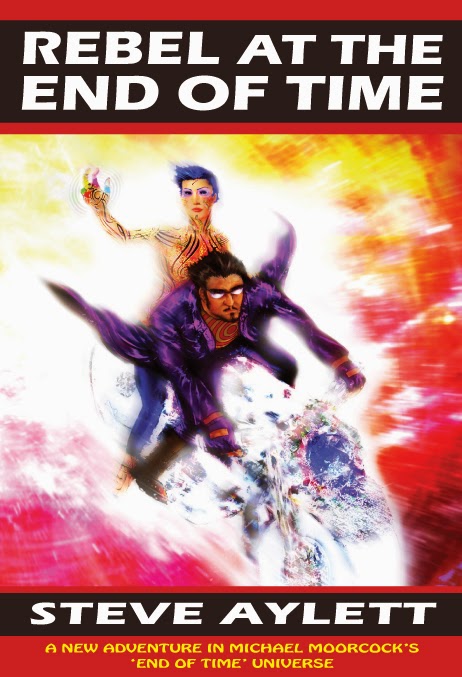
Rebel at the End of Time (PS Publishing), by Steve Aylett and Michael Moorcock. A short novel which throws Leo Del Toro, a 21st century Che Guevera, into the bewildering world of Michael Moorcock’s brilliant Dancers at the End of Time trilogy, where he must battle his despair among people for whom action is meaningless, novelty everything. The difficulty of reading the story comes from the misunderstandings of the people of the future, which leads to surprises in every sentence. Aylett’s story is a great addition to the End of Time, in that it shows us (or speculates on) how a different type of protagonist would handle it. The great man himself Michael Moorcock contributes a twenty-page story to the book, “Sumptuous Dress”, which comes close to causing a meltdown in the space-time continuum by crossing the end of time with the equally confusing Second Ether, producing more bafflement than most readers will be able to bear in a single story ****
Secret Lives (Cheeky Frawg Books), by Jeff VanderMeer. A series of stories written for and about the people who bought the special edition of one of the author’s other books. Not at all as throwaway as their provenance might lead you to expect; some stories are downright excellent. ***
Showcase Presents: Superman Family, Vol. 3 (DC Comics) by Otto Binder, Robert Bernstein, Curt Swan, Stan Kaye, Ray Burnley, Kurt Schaffenberger, Wayne Boring, Dick Sprang, John Forte, Creig Flessel and Al Plastino. I could barely read a page of this without thinking, what the hell, Superman? The description of Descartes’ evil demon fits him perfectly: “as clever and deceitful as he is powerful, who has directed his entire effort to misleading [Lois and Jimmy]”. Here are just a few examples. In “Lois Lane’s Super-Perfume” he proposes marriage to Lois – and then takes it back. It was a ruse to trap some swindlers! In “Three Nights at the Fortress of Solitude” he uses a robot to spank her so hard she can’t sit down the next day! And in “The Cry-Baby of Metropolis” he lets her go through the terror of reverting to a baby while pretending he doesn’t know she’s the baby, to teach her a lesson about inquisitiveness! Sometimes he’s astonishingly reckless: in “The Shocking Secret of Lois Lane” he throws two drill-saws at her head to remove a box she’s using as a mask! It’s so sexist: in “Lois Lane’s Signal Watch” Superman gives her an emergency watch just like Jimmy Olsen’s. She summons the Man of Steel to unstick the zipper on her purse… ***
Sin City, Vol. 3: The Big Fat Kill (Dark Horse Comics), by Frank Miller. The last book I read by Frank Miller was so bad that I’d almost forgotten how good he can be. ****
Sin City, Vol. 6: Booze, Broads & Bullets (Dark Horse Comics), by Frank Miller. Short stories collected from various Sin City one-shots. ***
Smiler’s Fair (Hodder & Stoughton), by Rebecca Levene. Slightly disappointing and unimaginative fantasy. Reviewed for Interzone #254. ***
Star Trek: New Visions (IDW Publishing), by John Byrne. Photo-stories based on the original TV series. Not as much fun as expected. Lots of recapping. **
Monday, 21 July 2014
Injustice: Gods Among Us, Ultimate Edition, reviewed by Stephen Theaker

Sunday, 28 November 2010
DC Comics Presents Superman Team-Ups, Vol. 1

 These stories date from perhaps the dimmest period of DC's history – long after the glories of the Silver Age, but before the 1986 reboots kicked in. Neither classic, nor in continuity, stories from this period don't seem to get referenced or reprinted as much as those before or after. These were the stories being published when I was a child, but they didn't make their way to our local newsagents so most were new to me. Two came with fond memories: I bought a German edition of issue 14 – Superman vs. Superboy! – during a school skiing trip to Austria when I was about ten years old, and issue 26 was reprinted in one of the hardback Superman Annuals: I think it was probably my first Green Lantern story. Reading those stories in the context of the series didn't affect my enjoyment of them for good or ill, but there are nice links here from one story to the next, especially in the first half of the book.
The team-ups feel organic, a natural part of Superman's everyday life, rather than contrived. But this is a very angry, emotional Superman... He's hardly recognisable as the same character. Whether it's his jealousy of teenage girls paying attention to Mister Miracle in Steve Englehart's "Winner Take Metropolis", or leaving Pete Ross's son on an alien world for the slimmest of reasons in Paul Levitz's "To Live in Peace Nevermore", this wasn't my Superman – interesting as he was! In "Plight of the Giant Atom" by Cary Bates, he's all sunshine and light again, calling Ray Palmer "old buddy", and then he's off on a bunch of lightweight, standalone adventures that make for easy reading. Some interesting things happen: Firestorm is invited into the JLA, Superman discovers that magic is simply a form of radiation, and I discovered that Batgirl is merely a brown belt.
Considering the random assortment of writers and artists involved, and the variable tone, this is a surprisingly good book; perhaps that variety is exactly what makes it so readable. No classics here, but lots of entertainment, and the artwork looks fantastic in black and white: I developed a real fondness for the work of Jose Luis Garcia-Lopez and Dick Dillin over the course of this book. I hope we'll see lots more DC comics from the late seventies and early eighties reprinted like this.
DC Comics Presents Superman Team-Ups, Vol. 1
 , Martin Pasko, Jose Luis Garcia-Lopez, and many, many others. DC Comics/Titan Books, tpb, 512pp.
Wednesday, 5 May 2010
Showcase Presents: Superman, Vol. 4 – reviewed

Oddly enough, the final panel is both the saddest and the one that points the way forward for the character. “If I can’t trust the President of the United States of America,” says Superman to JFK in 1964 after entrusting him with his secret identity, “who can I trust?” Within a decade everyone would be asking the same question for different reasons. In the short term, that would leave Superman looking like a relic from a different age, but eventually writers would realise that no matter how big his muscles, ethical and moral dilemmas hit a Superman as hard as any of us.
On a lighter note, Superman shows off a couple of interesting powers in this volume: super-smoking, in “The Goofy Superman”, and super-kissing, in “The Great Superman Impersonation”. “Lois would pass out if she knew it was Superman, my other identity, who kissed her!” thinks Clark to himself after giving Lois a smacker. You have to wonder how pleasant it would be to kiss him. For example we learn in the Goliath-Hercules story that he cannot tan, because the sun cannot damage his skin that way; presumably his lips would be pretty much rock hard. He would be forced to mimic softness by reacting to the movements of your lips at super-speed, but such a calculated procedure could only ever create the illusion of passion!
Showcase Presents: Superman, Vol. 4, by Edmond Hamilton, Curt Swan et al. DC, tpb, 528pp.
Friday, 24 April 2009
Showcase Presents: Supergirl, Vol. 1, Jerry Siegel, Curt Swan and others

 An enjoyable book but not really a remarkable one. Some elements quickly became very repetitive (the robot who fills in as Linda Lee while Supergirl is on adventures, the would-be adoptive parents who must be put off, and so on), but the stories improved as they went on. A few things struck me as interesting…
For one, it seems strange that Supergirl wears a black wig all day long, then takes it off when in costume, even though no one ever sees her (during this period Superman insists on her acting secretly, so that he can keep her in reserve as a secret weapon). For that matter, why does she even wear a bright costume if she doesn’t want to be seen?
The silliest wig-wearing is in the imaginary story “Ma and Pa Kent Adopt Supergirl”, in which the Kents make the poor girl wear a black wig from the age of five (or so), just to lay the groundwork for an adult secret identity! Maybe wigs don’t bother Supergirl: her head is invulnerable, so perhaps it doesn’t get all hot and itchy. But then that would imply that she can’t feel any sensations of hot or cold at all, and I’m pretty sure that she can.
Another story of interest was “Supergirl’s Busiest Day”, in which, just to protect her secret identity, she sucks all the air out of a room to render her fellow orphans unconscious. She exits at super-speed, thinking to herself, “I opened and shut the door so quickly, more oxygen didn’t have time to enter the room! I’ll be back in a flash!” Good job she didn’t get delayed… It’s just another example of the way that rules are above all the most important things in Super-stories of this period.
“Supergirl in Smallville” raised some interesting questions. She travels back to the Smallville of Superman’s youth, in a bid to show him that she could successfully conceal her secret identity while living with a family. So she stays with the Kents, introducing herself to the teenage Clark as an out-of-town cousin. But she is still wearing her Supergirl costume under her clothes… So the whole plot depends upon Clark not using his x-ray vision to look under girls’ clothes. Now I’m not casting aspersions upon Clark’s morality; if there’s one teenage boy in the world who wouldn’t, it’s him (though he did check out Lois’s underwear in the first movie). But it’s sort of funny for the whole story to rely on it.
But how many of the writers of these stories would have expected anyone to still be reading them and picking them apart forty years later? They were designed to be read once by an eager child…
Showcase Presents: Supergirl, Vol. 1
 , Jerry Siegel, Curt Swan and others, DC Comics, tpb, 528pp.
Monday, 4 August 2008
DC Universe: The Stories of Alan Moore

 Any book that contains “Whatever Happened to the Man of Steel?” has to get five stars, straight off the bat. It’s one of the greatest comics ever written, and the finest send-off a character could have (it relates the final story of the original Superman, prior to the John Byrne reboot). Since this also includes “For the Man Who Has Everything” and The Killing Joke, this is one of those times when five stars aren’t nearly enough.
The rest of the contents may not reach those high standards, but still, any fan of Alan Moore’s work will count themselves lucky to find them so conveniently gathered together. The Green Lantern and Omega Men short stories are DC-branded Futureshocks. The Green Arrow and Vigilante stories won’t change your life, but better to find that out here rather than after paying over the odds for the back issues.
DC Universe: The Stories of Alan Moore
 , Alan Moore, DC Comics, tpb, 304pp.
Wednesday, 4 June 2008
Showcase Presents Superman Family, Vol. 2, Otto Binder and Others

 During the fifties the Superman comics were so successful that spin-offs were launched to meet demand. Superman’s Pal, Jimmy Olsen and Superman’s Girlfriend, Lois Lane went on to rack up over a hundred issues each, before the titles were merged into Superman Family, the title DC has used for these books collecting the two titles. The first volume was almost all Jimmy Olsen, his comic having launched earlier, but in this one Lois Lane issues enter the mix.
Reading this book, it’s surprising that Jimmy Olsen has never had his own tv series. The structure of the Jimmy Olsen stories in this huge collection is remarkably similar to that of programmes like Sabrina the Teenage Witch or The Wizards of Waverley Place: Jimmy wants to get ahead in some way (usually he’s after a scoop, or sometimes a pay rise), takes an unnecessary risk or makes an error of judgment, and then runs into trouble, often undergoing a startling transformation of some kind, before either learning his lesson, or finally making the right decision. One difference here, of course, is that while Sabrina or, say, Hannah Montana (someone who shares Superman’s secret identity woes and pleasures) are usually the authors of their own misfortune, here Lois and Jimmy are the ones causing trouble – for Superman – which often casts them in an interesting dual role, as both hero and villain in the same story.
(If my knowledge of current children’s television seems oddly extensive, put it down to how difficult it is to find anything for my little daughter to watch that doesn’t put me in danger of falling asleep at the childcare wheel! Undemanding tweenie sitcoms are better than the alternative!)
In Sabrina and Waverley Place magic tends to play a karmic role, punishing vanity and rewarding selflessness, providing the virtuous lessons deemed necessary for children’s entertainment. In Jimmy Olsen’s adventures, that role is taken on by Superman, who seems to spend as much time teaching Jimmy (and Lois) lessons as he does saving them from danger. He’s a kind of karmic avenger! (On the other hand, if he is as Grant Morrison has said, a typical dad from the 1950s, he could less charitably be seen as a patriarch just doing his best to keep everyone in their right and proper place!)
Anyway, if Krypto can get his own cartoon, I think Jimmy and his many alter-egos deserve a run on Nickolodeon. Almost any one of these stories would form the basis of a wonderful tv episode (see below for one horrifying exception). In many ways they are magnificent. There are few limits on the imagination of the writers – the status quo must be restored within eight pages, but on pages two to seven anything can happen, and often does, usually at the same time as something else that’s equally remarkable! Jimmy himself is cheerful and irrepressible, always ready to be the guinea pig in any scientific experiment, ready to try every strange potion he’s offered by his friend Professor Potter, and always looking for the upside of the disasters that regularly befall him.
One thing that’s very striking about these stories is the lack of supervillains (partly because Superman is so diligent in making sure that no one else can get any powers, or loses them quickly if they do). It’s refreshing to read stories about Superman that don’t just involve him trading mighty punches with flying alien trolls and the like. Most stories revolve around petty gangsters who attempt to kill Superman or disable him long enough to rob a bank or two. The tension almost always stems from the constant rule bounding Superman’s behaviour – he must save the day and restore the clockwork of his life without giving away his secret identity.
The downside of this is that as a result he can be rather a wriggling, shifty and devious Superman, always looking for a way to worm out of awkward situations through sophistry, semantics, technicalities and flat-out lies! Anything to avoid giving the game away.
This is particularly the case in the Lois Lane stories. (If I haven’t said as much about those so far, it’s because they can be a bit dull in comparison to the wild imagination on display in the Olsen tales.) Superman’s stubborn refusal to countenance marriage with Lois, while still wanting to keep her on the hook, always seems odd, despite his protestations that it’s for her own good, especially given the lengths to which he goes to avoid marriage, and the callousness with which he repeatedly ruins her dreams. Should we read him as closeted and gay, keeping Lois around as a beard? Or as an ageing playboy, with Lois as his respectable, chaste girlfriend? I don’t really think he’s either – he’s an eight-year-old boy. He doesn’t want to spend all day around girls, but he still wants them to think he’s the coolest boy in town.
When it comes to showing Superman at his worst, though, one Jimmy Olsen story here really stands out: “The Son of Superman”, by Otto Binder. In it, we learn that Jimmy is an orphan. Out of the blue (literally – he flies down from the sky to make the announcement), Superman offers to adopt Jimmy. The court approves the adoption, and the two of them begin to share a house. At this point Superman starts to be very unpleasant to his new son – for example he incinerates Jimmy’s father’s day gift with his x-ray vision. In the end, a sobbing, heartbroken Jimmy asks the judge to rescind the adoption order, to which Superman says, “If Jimmy wants to call it quits, that goes double for me.” Afterwards, Superman reveals that he was being deliberately rude to drive Jimmy away, because of a misunderstood prediction by his super-computer. Everything sorted out, Superman says he feels terrible that the judge won’t reinstate the adoption order, but they can still be pals…
It’s hard to imagine how anyone could at all admire the cold and cruel Superman of that story! He’s like someone who takes a puppy home at Christmas, finds the poop and hairs a bit inconvenient, and chucks the poor thing in the river!
Luckily the charmlessness of that tale is very much the exception to the rule. In general, Superman’s foibles in these stories are comical, more than anything else, and if they date the stories a bit, that only increases the period appeal. Taken as a whole, this is one of the most charming and delightful collections of comics it is possible to read.
Showcase Presents Superman Family, Vol. 2
 , Otto Binder and Others, DC, tpb, 520pp.
Subscribe to:
Posts (Atom)