Showing posts with label Five-Star Reviews. Show all posts

Thursday, 20 November 2025

Skeleton Crew by Stephen King (Putnam) | review by Douglas J. Ogurek

Storytelling splendour: the enemy has been named, and the enemy isn’t what you’d expect.

Let’s take a moment to explore a trio of stories from a seminal collection by America’s (and arguably the world’s) most-revered living horror writer. Although this year marks Skeleton Crew’s fortieth anniversary, it remains a storytelling model that exemplifies Stephen King’s talent for injecting menace into the mundane, writing concisely with a minimal number of characters (though he can certainly handle a huge cast), and making the most of a looming threat. 

A fall swim with young adults just entering the prime of their lives. A toy monkey. A grandmother. These things are all supposed to bring joy, but not in the master’s hands. 

In “The Raft”, four young adults get trapped on a raft in the middle of a remote lake. The terror floating around them is neither human nor animal, neither ghost nor monster. It is, rather, an amorphous blob of… stuff, toxic stuff with some kind of awareness. And King repeatedly reminds the reader that something bad is going to happen.

The story explores the chummy dynamic – they call each other Pancho and Cisco – between the brainy Randy and the more athletic Deke. Randy, whose perspective the story is told from, is not all that impressed with his girlfriend LaVerne. She has the hots for Deke, who is all but done with his girl Rachel. 

The blob, with its mesmerising colours, becomes an embodiment of the lust and jealousy that jeopardises these relationships as it crawls across the water. Interesting, too, that King names the story not after the threat but rather after the characters’ one means of support. 

“The Monkey” takes the nontraditional monster concept one step further by infusing dread into not only an object but also an object intended to be the opposite of scary: a toy monkey. That’s a bold move. 

Protagonist Hal, now an adult, is surprised that the cursed toy, with its clanging cymbals and creepy smile, has resurfaced after he threw it into a well as a child. 

King weaves in backstory about Hal and his brother discovering the monkey in their vanished father’s closet. The toy, with its portentous chiming, becomes a representation of that father, the mystery surrounding his disappearance, and what he left behind. 

Georgie, the boy protagonist of “Gramma”, keeps watch over his ailing grandmother while his mom takes his brother to the hospital after a baseball game injury. On first read, the story might seem uneventful to a modern reader. But give it another go around, and you will discover a slow burner that grows more terrifying with each page.

As Georgie repeatedly peeks into Gramma’s room, King releases more details about the obese and apparently senile woman: her smell, her flesh, her long fingernails and the sounds they make on the coverlet. Georgie, who has always been afraid of her, suspects something malignant at work.

Backstory filtered through Georgie’s perspective reveals how Gramma is different and aligns the reader with the boy. She gets kicked out of church, for instance, for something to do with books.

He recollects family members expressing apprehension about her through their conversations.

The story’s ending, both shocking and convincing, comments on the hold that our ancestors have on us.

While these are just a few of the gems in Skeleton Crew, they reveal the ingenuity of a master at work, and four decades after their initial publication, they continue to offer lessons in strong writing. ***** Douglas J. Ogurek

Thursday, 4 September 2025

The Ploopy Knob | review by Stephen Theaker

When I tell people that I love my Ploopy Knob, and I can’t stop touching it while I work, they sometimes get the wrong idea. To be fair, when I first heard of it (a science fiction writer was joking about it), I wasn’t even sure the Ploopy Knob was a real device, or if it was an April Fool’s joke. But after I had finished laughing, I looked at the device’s website (https://ploopy.co/knob/), laughed some more (“with a smooth feel and great finish, it’s a Knob you’ll want to touch all day long”), and realised I might actually find it very useful to have a Ploopy Knob. And if it turned out to be a dud, it would be worth the money just for the jokes.

So what is it? Simply a knob that you can turn, an accessory for your Windows or Linux computer (it works less well on Mac), about 5 cm in diameter – which is much smaller than I expected, but turns out to be perfect. Built around a tiny Raspberry Pi, many of its other parts are 3D-printed, and the plans are available for users to print replacements if necessary. It’s not wireless: it needs to be plugged into the computer via USB. You don’t grasp the sides of it, usually, the surface is ridged, so that a finger resting on the top of the Ploopy Knob can easily turn it, without losing grip.

Power users can apparently reprogram the device to do different tasks, but that’s not me, I just use it for scrolling through documents while I read them, and yet I am utterly delighted with it. I’ve bought many similar devices over the years – a number pad to which I could assign macros, a rollerball, a mouse pen, and at one point I even had an Xbox controller hooked up to the PC for scrolling around documents – but none of them were ever so much better than the mouse and keyboard that they earned a permanent spot on my desk.

The Ploopy Knob is different. For one thing it's hilarious. Every time I mention it I laugh. This is not something to be underestimated when working. A chuckle a day adds up to a lot of chuckles over a lifetime. But it also fits onto the desk very neatly: I'm right-handed, so my keyboard (a clicky Das Keyboard) is in the middle, the mouse on the right, and the Ploopy Knob sits on the left, taking up very little space and always ready to use. It feels very nicely balanced. There are keyboards that have similar knobs, but that means hovering over the keyboard, whereas the Ploopy Knob can be placed in more pleasurable locations, so reading becomes much more pleasant.

It is also much more precise and sensitive than using a mouse wheel for the same job. So even if all I ever use it for is scrolling through Word files I’m editing and PDFs I’m checking, it was well worth the money I paid (about fifty quid). The only problem is that it's made me so keen to keep reading on the PC that I've tired my eyes out a bit. If I had a job interview now, I would be obliged to ask whether I would be allowed to use my Ploopy Knob in the workplace. Now I'm accustomed to having a Ploopy Knob, working without one would feel like a needless frustration. Stephen Theaker *****

Tuesday, 29 July 2025

The Wonderful Story of Henry Sugar and Three More | review by Douglas J. Ogurek

Short film quartet relies on shifting views, restrained performances and subtle humour to encourage reflection and underscore the complexity of fiction writing.

If you stare at something long enough and focus exclusively on that one thing, suggests Wes Anderson's Oscar-winning short film The Wonderful Story of Henry Sugar, you can develop the skills of seeing with your eyes closed and seeing through things. These concepts of intense concentration and observation propel the viewer’s experience of The Wonderful Story of Henry Sugar and Three More, a quartet of films not only based on but also infused by the writings of Roald Dahl. One would need to immerse oneself in these labyrinthine films (and by extension the stories) for years to unravel them. And yet, a single viewing is enough to entertain.

It is not difficult to follow what is happening in the films: a cheater finds fulfilment in altruism, a man relates a childhood bullying experience, a rat catcher comes to town to eliminate an infestation, and a bedridden man must remain motionless to avoid death. The challenge, rather, comes in unearthing the films’ extensive subtext and discerning the techniques Anderson calls upon to reinforce subject matter. 

What unites the works is a sense of playfulness and an admiration for the magic of storytelling. In each film, a composed character looks at the camera and recites Dahl’s stories (right down to the dialogue tags) but also partially participates in them. Initially, one might consider this an esoteric move no better than a one-act play at a community college theatre. Further viewings, however, prove these are brilliant contemporary works of art that sharply deviate from typical shallow films and force viewers to reconsider story and point of view. 

Originality suffuses the films: Opening credits fabricate their origins. Characters pretend to hold things (animals and guns, for example) that other characters pretend to see. Actors reappear as different characters among and within the four films. Stage crew members wearing coveralls enter the frame to assemble, disassemble and manipulate settings (and sometimes even pause to look at the camera). Dahl (Ralph Fiennes) also appears as a character who introduces and concludes each story. These techniques strip away the artifice, reveal the author’s presence in the story and draw attention to the mechanics of storytelling. 

Additionally, the camera’s constantly shifting viewpoint – level with the ground, straight up, straight down – underscores the films’ beckoning watchers to consider them from different angles. At one point, a character looks straight up at the camera and speaks to the viewer while he walks.

Although everything is presented soberly and perhaps even stiffly, humour permeates the films. In the main offering, an ultra-serious doctor/narrator and his colleague quickly walk down a corridor. The narrator explains to the viewer that his colleague’s face was rigid with disbelief. The other doctor then turns to show the viewer the rigidity of his face. Another example: for much of The Swan, the boy version of the narrator stands behind him and stares at the camera. Also, the narrator shows the viewer a photo of a boy, but it is too small and too far from the camera for the viewer to see. Now that’s funny. Throughout the films, when a narrator converses with another character, he will turn to the camera and say, “I said” – the viewer never forgets his role as consumer of story.

Multiple viewings are sure to elicit more questions. Why, for instance, does the narrator in The Swan keep looking at the camera and speaking to the viewer but stop moving his lips just before the camera cuts to a different view of the same character now moving his lips? Why are the backgrounds deliberately fake? Why do lights shine in characters’ eyes at certain points? 

While the end credits roll, Fiennes-as-Dahl comments on the gruelling process of writing fiction, clearly a parallel to the meditation practice in the opening episode and an attempt to give a taste of what it feels like to be in his shoes. Kudos to Anderson for challenging the viewer to be still… to interpret… to imagine… to THINK. Douglas J. Ogurek *****

Friday, 25 July 2025

Human Capital, by Moro Rogers (Nakra Press) | reviewed by Stephen Theaker

In the early 21st century, automation went into high gear and robots took over the menial jobs. Then they took over all the other jobs as well, and almost everyone became unemployed: this was known as the “indescribable allusion disaster”. Universal basic income and free housing softened the blow, but if people don’t find a way to make themselves useful the robots encourage them to exist a little bit less. The three most popular options for the survivors are to become artists, swamis or heirs.

Nttl was born a few years after the disaster, and chose the life of an artist. He used to be part of the Poisonous Plant Collective (hence his name, pronounced “nettle”). Since they disbanded, Nttl has struggled on with his painting, Manchineel is extremely successful, Jessamine is part of the Meconium Group, entrusted by the robots with the power to decide the human race’s future, and Upas became an art terrorist: he just blew himself up in an aquarium with a William Morris-patterned artisanal bomb, killing several fish and two humans besides himself.

Friday, 6 June 2025

The Earth No Longer Exists by Ben Fitts (Alien Buddha Press) | review by Douglas J. Ogurek

Pessimism smothered in absurdity with a dash of hope: short story collection substantiates future bizarro heavyweight

Ben Fitts’s bizarro collection The Earth No Longer Exists is custom-made for the media-weary twenty-first-century reader. The writing is clear, concise, and above all, original. The paragraphs are short. The language is modest. Fitts admirably avoids any writerly pretension, and with each entry not only entertains but also tackles contemporary issues with a jocular pessimism that occasionally leans toward hopefulness. Moreover, despite their simplicity, all his stories leave room for interpretation.  

Although absurdity permeates them, these pieces are not merely weird for weirdness’s sake. Fitts’s characters ¬¬– sometimes foolish, sometimes silly, and often flawed – operate from a viewpoint of misunderstanding. Political leaders think that replacing the world’s dead superheroes with janitors is a smart move. A man decides he’s going to become the world’s third-sexiest matador… so he can get with a woman. An artist born into privilege becomes so obsessed with the idea that a successful artist needs to be destitute that he loses sight of what he’s creating and what art is. In an insightful exploration of empty sexual encounters versus lasting love, a young man discovers something unexpected in the shoebox of his new lover.

“Raspberry Heart,” an indictment against the chauvinism that still permeates corporate America, introduces a raspberry interviewing for a job. The raspberry grows agitated because its would-be employer is focused not on its qualifications but rather on the fact he’s interviewing a raspberry. 

Clearly influenced by COVID and current political conflicts, “On the Back of an Octopus” involves a city on the back of a giant octopus. When a shark supporting another city approaches, the politicians and scientists of Octopolis go into the highest tower and debate an appropriate response. The idea of getting along is, if you’ll pardon the pun, unfathomable to them. Leaders refuse to see somebody else’s perspective… and the public suffers. 

The volume’s only non-bizarro work, “Next Year in Jerusalem,” is strong enough to be in a high-end literary journal. After an antisemitic message is scrawled on her son’s locker, a Jewish mother decides to move her family from the U.S. to Israel. Her teenage son resists, partly because he’s terrified of being forced to fight in the Israeli military. This fear plays out in the role playing and video games the young man plays. The story stirs up emotion on many levels, particularly animosity toward the mother, who steamrolls her son’s concerns. 

Several stories cover romantic relationships – some elicit sadness, while others end on a more positive note. The man who falls in love with “The Cactus” suffers because of their relationship. Perhaps the physical pain the man feels is a stand-in for the emotional pain that comes with bad matches. That’s the negative side. On the positive side, if a spouse sticks beside a spouse no matter how much pain, that shows love. Regardless, the story punctures the reader with one irrefutable message: love is painful.

In “My Winter Lips,” another relationship-based tale, Fitts takes the current fascination with body modification to the next level by skilfully introducing a new world while avoiding expository dialogue. People can, for instance, get jacked arms or replace their fingers with something that looks like snakes. Unlike many of his peers, the first-person narrator goes to the “parts store” merely to replace his chapped lips with another pair of normal lips. The employee reveals the store is out of human lips, and what transpires is a humorous conversation and a resolution the narrator does not anticipate. The new lips aren’t just lips — they symbolize how openness to new ideas and personal change can allow one to see others in a more positive light. 

The treasures in The Earth No Longer Exists confirm an emerging author’s potential to rise as a leading voice in the bizarro subgenre. Fitts’s stories grasp the reader and refuse to let go; he knows how long each entry needs to be before it starts losing its potency, and he never gets preachy or pontificates. Douglas J. Ogurek*****   


Tuesday, 21 January 2025

Suckers by J.A. Konrath and Jeff Strand (independently published) | review by Douglas J. Ogurek

Stupid. Ridiculous. Brilliant.

This collection alternates stories between comedy horror masters J.A. Konrath and Jeff Strand, then culminates with “Suckers,” a cowritten longer piece in which their recurring characters Harry McGlade (Konrath) and Andrew Mayhem (Strand) meet and undertake an absurd caper. 

Though each author’s work is distinctive, what unites them is playfulness with language, an avoidance of pompous prose, a comedian’s recognition of everyday absurdities, and often, a deliberate imbecility. “The pain was painful,” observes Konrath’s detective, while Strand’s protagonist, more of a sharp albeit regular guy playing at detective work, questions “fun size” Halloween candy – if it was fun, it would be enormous. Throughout the collection, the action moves quickly, and the dialogue stays tight and rapid fire. 

McGlade is the ultimate jerk. He’s also highly amusing. He’ll check out a woman’s legs while she’s crying or insult someone at their first meeting. He makes fun of others, whether they’re wearing too much makeup or have a face resembling a percussion instrument. He’s a chauvinist and a womanizer, and he doesn’t pay attention to others. At one point, he even admits to lying to the reader. 

Mayhem, on the other hand, is analytical and talky. He points out contradictions in things people say to make them look foolish. He’s also inventive when it comes to defending himself, whether that means using a hardcover copy of Stephen King’s The Stand or a box of grape juice. And Mayhem is more of a family man… but he’s not beyond showing his young son a movie called Blood Blood Blood. 

The differences between the two authors surface in the first two stories. Konrath’s “Whelp Wanted”, in which McGlade is tasked with finding a missing dog, takes place over multiple days. He does shoddy research and makes several mistakes. “Poor Career Choice” by Strand is a dialogue-heavy but by no means dull exchange between Mayhem and a would-be assassin who shows up at his home. The action takes place in real time.

McGlade gets more entertaining as the collection progresses. “Taken to the Cleaners” introduces another incompetent hitman. An attractive young woman who is the wife of a chicken king wants McGlade to kill the man her husband hired to kill the man she hired to kill him. 

In “A Bit of Halloween Mayhem”, Strand’s protagonist and a friend decide to explore a supposedly haunted house. Strand demonstrates the silliness of two grown men doing something kids are more likely to do. 

Next up is Konrath’s “The Necro File”, a magnum opus of humour, disgustingness, and authorial mischief. Client Norma Cauldridge, to whom McGlade repeatedly refers as “Drawbridge” (not to be funny but rather because he’s sloppy), wants him to follow her necromancer husband. This is Richard Laymon level stuff topped with a hearty portion of urine, barf and poop. Moreover, the story exemplifies that going off on tangents isn’t always ineffective. McGlade, for instance, rambles on about the unappetizing look of hot dogs before eating three of them. 

“The Lost (For a Good Reason) Adventure of Andrew Mayhem” recounts how the protagonist met his friend Roger in school detention at age thirteen. They get into trouble when they discover a naked neighbour thrusting around a butcher knife while talking to himself. 

In “Suckers”, the two characters inadvertently meet when Mayhem, running an errand involving spaghetti sauce and mushrooms, confronts McGlade intent on rooting out some “pires” (aka vampires). The reader gets the best of both worlds with the witty Mayhem and the not-as-smart-but-still-absorbing McGlade, who often bends the truth to make himself seem more heroic than he is. 

The story takes a giddy sidetrack when it introduces email communications between the protagonists and their editor Chad. Mayhem begins commenting on the falsity of McGlade’s version of events. When the story resumes, McGlade mocks his coauthor by engaging Mayhem in over-the-top actions inspired by his email comments.

The book ends with Strand interviewing Jack Kilborn (Konrath’s pen name) via email about a forthcoming novel. The exchange has them poking fun at each other and getting silly.

Both authors brought their A game to this collection, whose adventurousness and friskiness enthral the reader’s inner child. Douglas J. Ogurek *****

Sunday, 14 April 2024

Civil War | review by Stephen Theaker

Kirsten Dunst plays Lee, a celebrated and determined photojournalist who hopes to get one last photograph of the US president before his inevitable execution by rebels from the Western Alliance, who are closing in on Washington. Texas and California fight together in the alliance, the traditionally Republican and Democrat states setting their differences aside to depose what the director has called in interviews a fascist president. I don’t think that’s spelt out as clearly on-screen, though I saw it in 4DX and it’s easy to miss dialogue when the fans are blasting away. We do learn that he disbanded the FBI and ordered airstrikes on US citizens, and that something called the antifa massacre happened. Florida has also seceded, and the Portland Maoists are among those taking their guns to the White House. The president is in it so briefly and yet played so perfectly by Nick Offerman that Ned Beatty’s record could be under threat.

Monday, 5 February 2024

All of Us Strangers | review by Stephen Theaker

All of Us Strangers tells the story of Adam (Andrew Scott), a gay writer in his forties, living alone in an empty London apartment block. He writes for film, and, when he has to (as he puts it), for television. He's trying to write a script about his childhood, but struggling, so he heads back to his home town to see his parents. Anyone who has seen the trailer will know already that his parents (played by Claire Foy and Jamie Bell) died in a car crash when he was a child. The film, however, doesn't tell you that they died until after we have met them, though one might guess from the conversation and their relative youth. Adam doesn't seem surprised to meet them, nor do they seem surprised to meet him, though they are aware that time has gone on without them.

In London, a nice chap knocks on Adam's door with a bottle of whiskey, looking for company. They are apparently the only people to have moved into the building yet and the silence is freaking him out. Harry (Paul Mescal) is from a younger generation, but bears similar emotional scars. Adam hates being called queer, because it was an insult thrown at him by bullies in the 1980s. Harry hates being called gay, because it was an all-purpose insult during the Chris Moyles era. Adam went a long time without ever having penetrative sex, because of AIDS, but for Harry's generation HIV would no longer be a death sentence and PrEP (Pre-Exposure Prophylaxis) drugs can prevent transmission. Though Adam understandably turns the drunk young man away at first, he later invites him over, and a tender relationship develops between them.

Eventually, Adam takes Harry to meet his parents.

Friday, 12 January 2024

Star Trek: Picard, Season 3, by Terry Matalas et al. (Paramount) | review by Stephen Theaker

This review originally appeared in TQF75 (November 2023).

The first two seasons of Star Trek: Picard were divisive, to say the least. When it was first announced – with Michael Chabon on board! – I was delighted. The first two seasons of Discovery had been smashing, so I had high hopes. Hopes soon dashed by a programme that seemed to have exactly the same problem as the final film, Star Trek: Nemesis: it had been bent out of shape in order to tempt back its two biggest stars, giving them leaden, actorly storylines.

Patrick Stewart had rejected the proposals for season one several times before finally agreeing to it, and one of the things he didn’t want to do was a mere reunion. And so we had two seasons of a substitute crew running around while Patrick Stewart and Brent Spiner got their teeth stuck into some proper acting. There were episodes I enjoyed, there were others I didn’t, but it was disappointing and often quite dull. The lowest point was Picard persuading Guinan to stay on Earth for humanity’s sake, despite World War III being imminent.

Wednesday, 20 December 2023

Godzilla Minus One | review by Stephen Theaker


It’s a good time to be a Godzilla fan! His next encounter with King Kong is in cinemas next year, the Monarch tv series is currently showing on Apple TV+, and now we have Godzilla Minus One, already the highest-grossing live-action Japanese film ever in both the UK and the US. Most Japanese Godzilla films are sequels to the original Godzilla (1954), while often overwriting each other, but like Shin Godzilla (2016) this is a complete reboot.

Shin Godzilla, from the creator of Neon Genesis Evangelion, was very enjoyable, but it was quite radical in its approach to the monster: for most of the film he wasn't recognisably Godzilla at all, although he did have a spectacularly impressive tail by the end. Most of the fun of the film came from the comedy of a calcified bureaucracy responding to a giant monster attack with a series of ever-growing meetings.

Saturday, 29 July 2023

Terrifier 2 | review by Douglas J. Ogurek

Knives, hammers, and scissors speak louder than words: gore exhibition holds a mirror up to visceral horror and carves out new slasher villain superstar.

Early in Terrifier 2, the part-mime/part-clown known as Art the Clown (David Howard Thornton) uses his own blood to write “ART” on a mirror as his latest victim struggles to stay alive. Yes, this is the deranged villain’s name, but it’s also an announcement that this sequel will hold a mirror up to the cinematic phenomenon known as torture porn. Is Art solely a vessel for shocking the viewer? Or is he an artist? Is Terrifier 2 simply another bloody entry in the pantheon of pointless violence, or is it commenting on the splatterpunk subgenre?

When Art, constantly on the brink of breaking that fourth wall, rapidly raises his eyebrows twice, the mute murderer acknowledges other characters, but he also enlists the viewer and dares them not to turn away from the atrocities he is about to commit. And he takes those atrocities far… really far. 

Terrifier 2 bears the distinction of being both terrible and brilliant. Its weaknesses include bad dialogue, a flimsy plot, poor acting, female objectification, and a fair amount of senselessness. Why, for instance, does the electricity of a haunted house at an abandoned carnival still work? Why is there a little girl version of Art that only he and a few others can see? Also, why aren’t any cops following up on Art’s horrific murders?

High schooler protagonist Sienna (Lauren LaVera), who is destined to encounter Art, has no real goal other than to design a warrior princess Halloween costume that her deceased father sketched. He also left her a sword apparently endowed with special powers. Sienna’s nerdy younger brother Jonathan (Elliott Fullam) is obsessed with the Miles County Massacre that Art committed the previous Halloween. Their moody mother Barbara (Sarah Voigt) tends to berate both Sienna and Jonathan.

The interest level takes a dramatic shift the moment Art enters a scene. What he lacks in words he makes up for with his Ace Ventura-level exaggerated facial expressions and gestures. When he laughs (at the physical or psychological suffering of others), he throws his head back, shakes his shoulders, or puts his hands on his knees. When he sneaks up behind someone, he does so with a cartoon character’s panache. But there are also moments when Art stands motionless, creating a contrast to his typical flamboyance, a contrast that is both creepy and at times funny. 

When the time comes for Art to take centre stage, the story comes to a halt so he can indulge in his art: the brutal, prolonged, unrelenting, over-the-top maiming and killing of people. Art doesn’t just hit, whip or stab someone once. He does it over and over and over. Moreover, the camera doesn’t turn away. The film also empowers victims with near-supernatural stamina that enables them to stay alive and conscious during the attacks. And just when you think Art’s done, he might just come back and do more. 

Despite a contemporary setting, the film has an eighties feel thanks largely to its synthesizer-heavy music, aligning it with the classic horror films and villains of that era. If Art the Clown, with his tiny askew top hat secured with a rubber band, his weapons-filled black garbage bag, his terrible teeth, and the black dot on his nose, continues to appear in films, he may become a name as recognisable as Jason and Freddie. 

Terrifier 2 is Art.—Douglas J. Ogurek *****


Sunday, 30 April 2023

Blood Relations by Kristopher Triana (Grindhouse Press) | Review by Douglas J. Ogurek

Short story collection shifts impressively from gore and smut to grief and nostalgia.

The first Kristopher Triana story I read involved a home invasion. The violence was so over the top that I still remember where I was when I read it. I presumed that Triana was an extreme horror one-trick pony… a blood and guts conjurer whose sole aim was to make the reader cringe at the brutality of his characters’ actions. Blood Relations, Triana’s family-themed (but not family-friendly) collection of short horror stories, proved me wrong. 

Yes, there are the gruesome, flesh-mangling, bone-crunching, and sexually depraved entries. “Womb”, for instance, involves an incestuous brother and sister using the bodies of murder victims to recreate the place they felt safest. In “Jailbait Frankenstein”, a Lolita tale-turned-horror story, a man in his forties who rationalises his attraction to underage girls learns a painful lesson. He grows smitten with a teenage girl who’s a “butterface”, meaning beautiful in every way but her face. Her repulsive facial appearance becomes an embodiment of his shameful attraction. 

The collection, however, also features less graphic though equally entertaining stories, such as the Steven Kingesque “We All Scream”, which comments on children’s need for immediate gratification. This one puts a new spin on the dangerous ice cream truck trope by offering a much subtler and creepier scenario. Children who hear the ice cream truck playing “Turkey in the Straw” know it’s time to return home immediately. Things get out of hand when little Tommy decides to flout that warning and approach the truck. 

Some stories involve characters unearthing shocking secrets about their relatives. In “My Name Is Chad”, for instance, a young man mourning the death of his mother finds disturbing video footage that reveals something about him and his deceased sister. “Kin” is a country bumpkin piece in which a West Virginia family makes an awful discovery about a young man in the family. 

“The Solution”, about a lusty mother and apathetic daughter who use sexuality to extract something from teenage boys, offers such an exaggerated take on the mother’s libido that it is at times laugh-out-loud funny. Look for the hilariously overindulgent similes and metaphors in which Triana compares the sounds the mother makes in the throes of ecstasy to those of animals. 

The details that Triana offers in “The Solution” speak to his skill as a writer – the smells of tobacco and microwave pizza within the mother’s home, for example, or her “layer of trashy desperation” that resembles bacon grease. 

Another curious element within the story is the boy the teenage protagonist sees glued to the TV each time he enters the mother’s home. The boy watches horrific programs like The Texas Chain Saw Massacre or autopsies in which a mortician scoops brains from a corpse. Though he plays no major role, the boy helps set the mood for the oddities the protagonist encounters. 

Did you think those boys in Lord of the Flies had a tough time? Maybe you thought the kids in The Hunger Games were violent? Read “Dog Years”, a story both bloody and nostalgic, and you’ll reconsider both. All the adults are gone, and now gangs of children roam the streets. They are afflicted by a disease that makes their lifespans comparable to those of dogs. Kids in their late teens are in the throes of dementia. Sixteen-year-old narrator Skye reflects on her survivalist father whose advice on female empowerment proves valuable. During one of the more poignant scenes, the children, forced to exist in a world where social media is absent, reflect on the things they miss. Chapstick, for instance. 

When one character in Blood Relations enters a basement to discover a relative doing something sickening to another human being, her response is, “Hey.” The reader will find several such instances of indifference to human suffering within this collection, but the reader will also experience a wide range of the emotions that make us human.—Douglas J. Ogurek *****


Monday, 3 April 2023

Children of Men | review by Rafe McGregor

Climate change allegory.

Children of Men is Alfonso Cuarón’s adaptation of P.D. James’s dystopian novel, The Children of Men. Cuarón was initially uninterested in the project, which he described as “a science-fiction thing about upper classes in a fascist country”, and his adaptation replaces James’s Christian themes with a rich and rewarding exploration of the compatibility of the free market and authoritarian nationalism. The novel was published in 1992 and set in 2021, the film released in 2006 and set in 2027, and both narratives take place in England during an extended global pandemic of human infertility. The film was a critical success and commercial failure (the latter relatively minor, recouping 93% of its budget at the box office). Its critical and cult following rose steadily over the next decade and a half, reaching a wider audience with the coincidence of the novel’s setting and the COVID-19 pandemic. The late music critic Mark Fisher opened his 2009 bestseller, Capitalist Realism: Is There No Alternative, with a discussion of the film’s representation of a dystopia unique to late capitalism, in which “internment camps and franchise coffee bars co-exist” without contradiction. As we approach 2027, the UK is increasingly resembling Cuarón’s depiction, led by a self-selected elite that seems to delight in cruel and unusual punishments of the poor and displaced as much as it delights in exploiting its public service for financial reward. Praiseworthy though this prescience is, the film’s contemporary value lies elsewhere.

As Fisher notes, Children of Men is not simply what Amitav Ghosh would later call disaster fiction set in the future in The Great Derangement: Climate Change and the Unthinkable. The film is neither about adapting to post-apocalyptic conditions nor about anticipating the apocalypse to come. The apocalypse is, rather, already in progress, ‘being lived through’. Creating a compelling and convincing narrative that is neither pre- nor post-apocalyptic is notoriously difficult, challenging enough in a novel or television series but even less likely to be achieved in a two-hour feature film (Children of Men is only 100 minutes from opening to closing credits). Octavia Butler is one of the few narrative artists to succeed, with her peerless 1993 novel, Parable of the Sower. For all Butler’s literal genius (she was awarded a MacArthur Fellowship in 1995), she was unable to continue as successfully in the sequel, Parable of the Talents, and unable to complete the trilogy with Parable of the Trickster, which was unfinished at the time of her death in 2006. Parable of the Talents relies on a conspicuously artificial compression of several decades for credible closure and Butler’s multiple attempts at writing Parable of the Trickster never reached more than fifty pages. Cuarón’s success is akin to Parable of the Sower and his mastery of the multiple temporalities of cinema is exemplary, perhaps even unique.

The fertility crisis in the film is approaching its second decade and the global response has been economic and political collapse, which have only been averted in the UK by the election of an authoritarian government and the establishment of a police state. Refugees are detained on site in streetside cages and transported to sprawling concentration camps like Bexhill-on-Sea, where they are largely left to their own devices. The police have been militarised, a new paramilitary force created, and the Armed Forces placed on internal security duties, providing three overlapping levels of counter-terror and social control. The narrative initially seems to deploy the mythic mode of storytelling characteristic of Hollywood, proceeding from an inciting incident through an initial objective, watershed, and nadir to an unpredictable but inevitable zenith. In retrospect, Cuarón both deploys and subverts the archetype of the hero’s journey, exploiting it to prioritise a specific engagement with the apocalypse that I cannot reveal without spoiling the film’s final few minutes. That hero is Theo (played by Clive Owen), a former activist who is called to action when his estranged wife, Julian (played by Julianne Moore), recruits him to the Fishes, a resistance movement led by Luke (played by Chiwetel Ejiofor). Theo’s mission is to escort a young refugee, Kee (played by Clare-Hope Ashitey), to the south coast, where she will be picked up by a mysterious international organisation known only as the Human Project. Theo has become a cynical alcoholic since his split from Julian, but remains useful to the Fishes because his family connections are sufficient to secure transit papers for himself and Kee. Theo acquires the papers, meets Kee, and then discovers that she is pregnant, about to give birth to the first human baby in eighteen years. The watershed is his decision to complete the mission, in spite of the exponentially increased risk, Julian’s death, and betrayal by Luke.

Children of Men’s style is as nuanced as its form and its cinematography and mise-en-scène are routinely praised by critics and theorists. With respect to the former, philosopher Slavoj Zižek has analysed the film’s apparently inexhaustible visual density, the totality of a world represented with meticulous attention to detail in every aspect, which is both a reflection and critique of the post-9/11 culture of control. With the respect to the former, the narrative is threaded between two magnificent long takes, one of 247 seconds and the other of 379 seconds. The first, which takes place approximately a quarter of the way through, depicts a car chase in which Luke tries to save Theo and Julian from homicidal bikers. The second, which takes place approximately three-quarters of the way through, depicts Theo’s attempt to rescue Kee when Bexhill-on-Sea erupts into a tripartite battle among Islamist revolutionaries, a Romani militia, and the British Army. Together, the two takes constitute a seamless combination of film style and film form, which are deliberately and brilliantly understated to produce a very familiar – and very British – dystopia. The understatement also facilitates the integration of the mythic with the everyday (to which I shall return below): Children of Men is about both ordinary people and the end of the world.

Cuarón’s reproduction of the lived experience of an apocalypse-in-progress is the film’s greatest achievement. But if it is to be anything other than a purely aesthetic accomplishment, then it must matter in some way and Children of Men’s extra-aesthetic values are not immediately obvious. In A Critique of Postcolonial Reason: Towards a History of the Vanishing Present, which was published in 1999, literary critic Gayatri Chakravorty Spivak argues for the ethical and political value of what she refers to as the literary imagination. She focuses on language, reading and literature, but her thesis can be extrapolated from the literary mode of representation to hybrid modes of representation that combine the linguistic with the pictorial, such as cinema. The literary imagination frees the reader from the constraints of truth without severing the text from the world, which is why one is moved by a literary text without believing in it. As such, the literary imagination is a paradigm for value without a commitment to truth and trains one to reconsider, reappraise, and reconceptualise social reality as socially constructed rather than naturally extant. Drawing on a tradition that began in the Romantic era, Spivak calls this training aesthetic education, demonstrates how it transforms the individual by indirect, implicit and figurative means, and concludes that it is “an excellent instrument for a slow transformation of the mind”. The transformation is achieved by a detranscendentalisation of elitism, sexism, homophobia, xenophobia, and other forms of oppression that exposes them as political and plastic and thus susceptible to being dismantled as part of the reconstruction of a more just and sustainable social reality.

The experience of watching Children of Men is the experience of living through the late capitalist apocalypse with Theo, Julian and Kee and recognising that the sequence of events narrated are both fictional and relevant to our own lives. Returning to Fisher (not to be confused with the fictional Fishes), the particular and peculiar relation between the reality of the film and the reality of the world in which we watch the film is the shared experience of what sociologist Jason Moore refers to as the Capitalocene in Capitalism in the Web of Life: Ecology and the Accumulation of Capital. The Capitalocene is the geological epoch during which capitalism has had a significant impact on the Earth’s ecosystems and climate. Capitalist world-ecology began in 1450, drove climate change for over five centuries, and is currently self-destructing in consequence of the copious amounts of waste it generates. Children of Men detranscendentalises the Capitalocene in the way Fisher suggests, by dramatising, exaggerating and anticipating the epoch’s final decades. The relevance of the film’s reality to our own is all too easy to identify – it is what lies ahead in a few decades or in a few years, during another global pandemic, one far more destructive than COVID-19. Sadly, this world is much easier to identify in 2023 than it was in 2006, which was after 9/11 but before the Great Recession. The crucial point, however, is that we are already living in and through this more destructive pandemic and the relations among our reality, the film’s reality, and the Capitalocene are articulated by the figurative element in Spivak’s aesthetic education.

The setting of Children of Men is an extended fertility crisis at the literal level of narrative meaning and a foreclosure of human futures that represents climate change at the symbolic level of narrative meaning. The fictional fertility crisis is the real climate crisis: both will destroy the human species if they are not averted or ameliorated; both occur across rather than within generations; and both create contemporaneous economic, social, and political crises. They are also both turning points in the web of life, the response of an overpopulated and exhausted planet to the numbers of people it is required to sustain and – much more importantly – the concurrent and exponential increase in resource consumption. In the fiction, this response is human infertility, which will reduce consumption by reducing the population. In reality, this response is climate change, which Moore describes as capital being forced to internalise the cost of its own waste, which is in turn the beginning of the end of the Capitalocene. The significance of this symbolism to the narrative’s thematic content means that Children of Men is best understood as an allegory. Traditionally, allegories took religion as their subject, integrating the real, material, and everyday with the figural, spiritual, and divine, which recalls the centrality of Christianity to James’s original novel and the way in which Cuarón combines formal and stylistic devices to portray the everyday experience of the apocalypse-in-progress. Allegories do not impose a single or even twofold meaning on a narrative, but function so as to reveal a structure of multiple and intersecting representational and extra-representational levels of meaning. They are, in consequence, ideal vehicles for the detranscendentalisation of the complexities of the late Capitalocene, in which multiple crises combine to exacerbate multiple inequalities and multiple injustices. All of which is to say, I cannot recommend this film enough. If nothing else, it helps us make sense of the complicated, confusing, and contradictory world in which we find ourselves in the first quarter of the twenty-first century. As such, Children of Men exemplifies the great writer Samuel Johnson’s criterion for poetry, that its purpose is ‘to instruct by pleasing’: Cuarón has provided us with one of the most pleasurable lessons we are ever likely to receive on one of the most unpleasant subjects possible. *****

Sunday, 26 March 2023

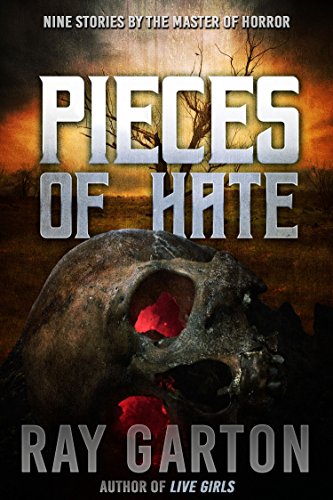
Pieces of Hate by Ray Garton (Crossroad Press) | Review by Douglas J. Ogurek

Horror collection shows gorging on hatred has stomach- and mind-churning consequences 

Most of the stories within this horror collection feature characters who hate something: cats, homosexuals, bullies, heavy metal, themselves. There’s even a guy who’s not sure why he’s so full of hatred. And most of the time, the hatred does not pay off. 

Garton has a talent for transforming a seemingly inane situation – a talk show interview or hospital room interaction, for instance – into an attack of ancient Roman barbarity. Some stories have all the subtlety of a hook through the cheek, while others go out on (or detach) a limb to show the repercussions of abuse, moral rigidity, and herd mentality. 

In “Bait”, one of my favourite splatterpunk (and extremely controversial) stories, a nine-year-old boy and his younger sister living in a seaside town discover what’s been happening to the missing children seen on milk cartons (yes, that used to be a thing). The short but terrifying read shows mankind’s potential for cruelty. It also slips in an ecological message, as well as a warning about taking the focus off our children.

The heavy metal musician protagonist of “The Devil’s Music” dies and meets Satan but refuses to believe it’s him. The story, reversing the common belief that the devil likes heavy metal, takes a shot at censorship and politicians who take a moral high ground. 

“A Gift From Above” starts like a Hallmark Channel film and warps into a bloodbath worthy of early Stephen King. Margaret, once spurned by her classmates and living in her sister Lynda’s shadow, has reinvented herself as an attractive and successful advertising agent. Then she receives a supernatural gift of healing but is warned it could “sour” her. The story offers a supernatural take on the ramifications of holding on to grudges. 

In “Cat Hater”, a feline version of Alfred Hitchcock’s The Birds, Clive Allen Trumbles (note the initials) has always hated cats. He thinks them conniving, snobby, and even intent on taking women’s attention away from him. When he accidentally kills one, he starts to believe the cats in his neighbourhood are conspiring against him. 

“Ophilia Raphaeldo” – the name is a clever mixture of once-popular talk show hosts – takes a jab at exploitative talk shows. Four women watch a show hosted by the titular character. An interview with a novelist devolves into an indictment against him for not calling a woman back after a first date and an attack on his chauvinistic writing. Though the author’s explanations seem perfectly rational, Raphaeldo fans the flames growing within her female audience. The story comments on how groupthink can cause one to abandon one’s beliefs and even rationality. 

The lead character in “Choices” embraces capital punishment, rails against abortion, and shames those who think differently from him. A severe electrical storm projects him into a bleak future, where he discovers his way of thinking may have consequences. 

In “Pieces,” Garton substitutes the typical psychological impact of sexual abuse with a physical one. The resulting short tale achieves a surprisingly moving outcome. 

“God’s Work” is a story that every Christian (or anyone who aspires to be a good person) should read at least once a year. Paster Gill Freeman – that surname is no coincidence – is new to his congregation, whose members like to cast judgment on others who clash with their ideals. The story, flipping between Freeman’s sermon about acceptance and the congregation’s protest of a horror author doing a signing at a bookstore, offers a rare Christian argument for free speech. 

Though neither victim nor perpetrator is likely to escape unfazed in Garton’s tales, the reader will likely emerge with more to chew on than flesh – that’s something that doesn’t always happen in horror.—Douglas J. Ogurek*****


Saturday, 21 January 2023

The Cabin at the End of the World by Paul Tremblay (William Morrow) | Review by Douglas J. Ogurek


Ambiguity infiltration: a home invasion story unlike any you’ve encountered.

The typical home invasion story involves a group of malicious individuals who physically and psychologically torment their victims. The motivation might be economic, or it could be simply to have fun. In Paul Tremblay’s The Cabin at the End of the World, however, the intruders and their purpose are much more complicated… and elusive. 

The opening scene in which seven-year-old Wen, the adopted daughter of Eric and Andrew, collects grasshoppers in a jar foreshadows what Tremblay does with his seven characters (and the reader): he stuffs them into a remote cabin in New Hampshire. It’s appropriate that the girl’s name is Wen because we as readers wonder when? When will this come to a head? When will the truth behind what’s happening be revealed?

The leader of the invading foursome is 24-year-old Leonard, whose calm and rational approach makes the barbarity of his request that much more perplexing. The fear he provokes comes not from righteous indignation or anger – he has neither – but rather from the strength of his conviction. Leonard models a new kind of villainous leader… if a villain is what he is. 

The trespassers, and especially Leonard, frequently checking his watch and the news, want this family to do something unspeakable for a reason that seems senseless. Just as they hold the family captive, Tremblay holds the reader bound to a question: is what Leonard and his cohorts want pure insanity, or is it legitimate? 

The differences between Eric’s and Andrew’s shifting perspectives compound the ambiguity. While one constantly considers ways of escape, the other, absorbing the extremity of the situation, starts to lose touch with reality. Or maybe not. The backstory, which provides some explanation of the two men and their motivations, may or may not involve one of the invaders. Even the intruders’ strange implements, long wooden poles with sharp objects at the end, lead one to wonder whether they are tools or weapons.

The point of view shifts between that of Eric, Andrew, and Wen. At one point, a jarring, though no doubt purposeful shift into first-person collective point of view (i.e., “we,” “us”) underscores a united understanding between key characters. 

Tremblay has a talent for stretching out scenes to maximize tension. The porch showdown early on, for instance, becomes a master lesson in tension. The visitors withhold their motives, which makes the situation even more alarming. 

The protagonists in the distorted love story that is The Cabin at the End of the World confront a question that all of us will encounter at some point in our lives: when it feels as if the world is crashing down, will we give in, or will we keep fighting?—Douglas J. Ogurek*****

Sunday, 27 March 2022

Candy Coated Madness by Jeff Strand (Independently Published) | Review by Douglas J. Ogurek

Sweetly preposterous: comedy horror collection offers cartoonish violence, linguistic mischief, and eccentric characters

After causing a horrific death, a murderer in one Candy Coated Madness story says, “Nice.” When the corpse’s loved one walks into the room and can’t see the body, the murderer moves to offer a better view. Such scandalous flippancy and blatant sadism are the hallmarks of Jeff Strand’s fiction, and thankfully, they emerge repeatedly within this collection of comedic horror. 

No surprise that within his fourth short story collection, Strand keeps the reader entertained with his patented characters ranging from dumb to sociopathic and, in many cases, indifferent to the suffering of others. And what do these characters want? To kill a family while in human (versus werewolf) form. To score with a date by showing bravery on a haunted ride. To stab a thousand people with candy canes. To rob a bank while wearing green suits that are too small. The ludicrousness of these objectives alone solidifies Strand’s reign as the foremost comedy horror author. 

Like its predecessors, Candy Coated Madness puts new spins on the typical horror fare (e.g. cannibalism, stabbing, delimbing). Sometimes, Strand’s characters completely strike out and end up humiliated, their objectives foiled. Other times, they achieve what they set out to do, but still don’t get what they really want. 

The reader gets treated to major doses of Strand’s characteristic snappy dialogue, whether his characters are using rational arguments to persuade irrational people or arguing whether you blow a person’s brains or brain out. In “Captain Pistachio’s Charming Rampage”, the titular character, made of pistachios, encourages a woman’s children to eat the nuts. She points out that it’s strange he’s encouraging people to eat what he is. That doesn’t make him happy.

Then there are the amusingly abrupt violent deaths. A character, weary of talking, stabs someone in the neck. A man can’t reply to another character because he’s been eaten by something. 

The idiocy of many of Strand’s characters knows no bounds. When a character uses a slingshot to fire a silver bullet at a neighbour he suspects is a werewolf, the bullet bounces off the neighbour’s chest. A performance artist puts his own spin on popular ’80s songs by playing the original version on his phone and singing his slightly altered lyrics over the vocalist. Leave it to Strand to transform such an innocuous hobby into a bloodbath. 

The ultimate ignoramuses make their appearance in “Giant Mutant Cockroaches in the Old West Versus Zombies”. When Doc Rollins Jr. asks the townsfolk how to defeat the zombies, for instance, one character suggests dinosaurs.

Typically, it’s a no-no to use characters prone to deep reflection. But Strand’s contemplative players pull it off because of the absurdity of what they’re thinking. In “Faerie”, the mentally unstable narrator questions himself whether the faerie he sees is real or a figment of his imagination. 

The collection has several stories I read in other venues. No problem. They were a pleasure to reread… and will be a pleasure when I read them yet again. One such work is “Pointy Canes”, the story that made me aware of the sweetly piercing personality of Strand’s short prose. The first-person narrator’s Uncle Jack wants to start a “blood ritual” for a nefarious purpose. His means of doing so is delightfully illogical. 

Another familiar story, “Beware! The! Beverage!”, introduces two teenagers discussing Rocketship, an energy drink made of Martian blood… from the planet of Martia, of course. When one tries Rocketship for the first time, he feels incredibly powerful. Violence ensues.

If you asked me what happens in a story and I told you, “Two guys talk,” you’d likely want to avoid that story at all costs. And yet, “Dismemberment Fraud” is one such story that manages to be engaging from start to finish. In it, an unscrupulous lawyer speaks with a prospective client who has wanted to kill somebody since he was eight… and who has killed a prostitute because he couldn’t bring himself to kill a dog. Not a problem for this lawyer – if everyone was the same, he reasons, life would be dull. 

No Strand collection would be complete without a hearty measure of selfish jerks. Candy Coated Madness doesn’t disappoint. Readers get a commitment-avoiding fellow whose girlfriend starts making connections between the gross sore on his back and the Book of Revelation, a young man who wants to smash someone’s head in like a pumpkin, a doctor with a flagrant disregard for his patient’s well-being, and many more. 

Another enjoyable aspect of this collection is its attention to language, particularly the thoughtless or contradictory things that people say or the things that other horror authors gloss over. Strand even has fun at his own linguistic expense. One character mentions the “weird, indescribable – except for calling it weird – sound of” something. Another psychopath realizes he’s repeating himself, then proclaims, “I’ll be as redundant as I want in my own narrative.”

Stories pay tribute to films both classical and contemporary. They include a warped version of West Side Story involving grotesque lab experiments, an anticlimactic take-off on the Hostel film series, and a fantasy-infused tribute to the “Great Stone Face” Buster Keaton of silent film fame.

A couple of stories offer more serious – as serious as Strand gets in this collection – subject matter. “The Fraud” introduces the goings-on within an asylum while a sandstorm brews outside. In “Rotten Eggs”, a girl tells her younger siblings if they don’t find some buried Easter eggs, the Easter Bunny, who has fangs, will be angry and hurt them. 

Not a Dud in the Batch

The author-protagonist of “Gave up the Ghost” has fourteen unpublished novels and a high opinion of himself… so high he thinks his latest magnum opus is going to get a Nobel Peace Prize. Something goes to extreme (and hysterical) lengths to prevent the distribution of the novel. 

Fortunately, this author-protagonist is not Jeff Strand. Every story in Candy Coated Madness is a hit, whether it involves a character who wants to avoid tomatoes on his burger or a serial killer who compares sawing off arms to eating cake. The author never lets the language get the better of him by resorting to million-dollar words. And if he ever did such a thing, he’d surely call himself out. 

Warning: after you read this, any attempts at serious horror fiction might seem a little silly to you. – Douglas J. Ogurek *****


Wednesday, 11 August 2021

Full Throttle by Joe Hill (William Morrow) | Review by Douglas J. Ogurek

Hill conjures another masterwork of genre fiction with a literary bent. 

“I’m always ready to see Another Marvelous Thing. Are you?” So says the narrator in “Late Returns,” one of thirteen stories in Full Throttle. That narrator’s comment relates to the magic of books, but it’s also author Joe Hill’s invitation to readers to drop their concerns and come along for a ride . . . and such a memorable ride it is. Are you open to thinking about how different things could be . . . and maybe are? Are you ready to accept that all may not be as it seems? 

Full Throttle is a fitting title for Hill’s fourth collection—the stories grab the reader and refuse to let go as the action barrels forward and the conflicts stack up. I was so captivated by one story, “Fawn,” that I ate half my wife’s bagel without even noticing. 

Though Hill references “full-throttle” action films and books in his intro, these stories are far from shallow—they plunge far beneath the surface with a potent mixture of themes, backstory, and perspectives, while charming the reader with sensory details (a house that smells like “Bengay and neglect,” for example). 

The characters within these tales straddle a wide spectrum. Sometimes, a would-be villain turns out to be a hero. Other times, an ultra-conservative bigmouth—these turn up several times in this collection—surprises the reader with a glimpse of compassion. Some of Hill’s characters undergo dramatic changes. Others seem on the brink of a major shift, but instead revert back to their old ways thanks to Hill’s refusal to conclude every tale on a positive note. 

In the introduction, Hill talks about his literary ascent. How inspiring it must have been to see your parents, Stephen and Tabitha King, pounding away at their typewriters and keyboards day after day. Hill reflects on the books his parents would read to him, bumps in the literary road, his pivotal experiences with makeup artist Tom Savini on the Creepshow set, and his switch from more literary writing to horror. 

The opening story, “Throttle,” cowritten with Stephen King, is a pedal-to-the-metal ride in which a demented trucker goes after a motorcycle gang. It’s a masterful story that offers intense, brutally violent scenes, but also explores tension between characters. 

Don’t start reading “Dark Carousel” if you have something to do—you won’t be able to put it down. The story, which Hill refers to as “a cover” of his father’s work, reminded me of one of the lovely Creepshow 2 (1987) segments called “Old Chief Wood’nhead.” This time, four teens run into a conflict at a carnival and something awful happens as a result. This story exemplifies Hill’s knack for details, especially with the carnival. He writes about the smells of cotton candy, the puke with popcorn floating in it, and the carousel operator’s lips. The “chill factor” of this story is off the charts.  

In “Wolverton Station,” a satirical piece about class and capitalism, an idealistic youth turned American corporate scoundrel opens a coffee business that employs children in foreign countries and decimates mom and pop shops. Saunders is the kind of guy who fires a pregnant woman with a dismissive text. His life changes when an atypical passenger sits right next to him on an otherwise empty first-class train car in Britain. Astonishingly, Saunders isn’t afraid to talk back to this rather intimidating character, who has some negative things to say about Americans who think they can bring their moneymaking franchises into other countries. 

Brothers Joel and Ben Quarrel (interesting surname) and their friend Gail London discover a dead plesiosaur that has washed ashore in “By the Silver Water of Lake Champlain,” a multi-layered story about our inability to control death. A fog surrounds not only the children, but also the reader (as it relates to our understanding of death). Is the creature, essentially a symbol of death, nothing more than a large rock as the characters initially suspect? Or is it an actual dinosaur? The story, which also takes on loneliness and parental abuse, is at once still and sinister.

“Faun,” a fairy tale version of Jurassic Park, follows a group of trophy hunters who get the opportunity to pursue prey unlike anything they’ve encountered, but there is a cost. This one has everything one could possibly want in a story: characters with depth, plot twists, a fantastical setting, and much more. “Fawn” condemns not only people who perpetuate crimes against the environment, but also those who sit back and do nothing about it. 

In “Late Returns,” a man gets a job on a bookmobile, where he encounters some visitors with unresolved issues. He discovers a way to comfort them by letting them borrow books. In the hands of a less capable author, this story would have been a disaster: clichéd, boring, etc. But Hill pulls it off. 

“All I Care About Is You” is a sci-fi story that is in some ways Cinderella-like and in other ways, the opposite. The 16-year-old girl protagonist wants to wear a mask that gives her a different face that will impress her friends—it’s like an expensive pair of blue jeans or sneakers today. Hill explores the figurative masks that people wear and the idea of being content with what you have versus always wanting more. 

Mal (that means “bad”), the female protagonist in “Thumbprint,” has returned from Iraq, where she and her fellow soldiers did some questionable things while interrogating an Iraqi prisoner called the “Professor.” The story comments on trust and how war affects different individuals. 

Paragraphs in “The Devil on the Staircase” look like steps. A little gimmicky, but entertaining nonetheless. After protagonist Calvino commits a horrific crime, he descends an outdoor staircase that purportedly leads to hell. He then meets a boy who gives him a bird that releases a beautiful song every time a lie is told. 

“Twittering from the Circus of the Dead” is told in tweets from a teenage girl whose family stops by a circus after a vacation. During the first half of the story, she’s bored to tears and fed up with her mom, but she does enjoy her jokester brother’s antics. Then they stop at a circus and things change… Hill was wise to use tweets to tell the story, which explores the negative impacts of social media. 

“In the Tall Grass,” also cowritten with Stephen King, might be classified as “eco horror.” It details the travails of an adult brother and sister who enter a field of tall grass in Kansas with hopes of finding a child they hear calling for help. The first third of the story is superb: the siblings discover that within this grass, direction and distances are skewed. Leap up to see above the grass. A church appears on the horizon in one spot. Leap up again and the church appears to have moved. The prospect of returning to their car grows dimmer. At one point, the reader feels a bit disjointed with what’s happening in the story, but perhaps that’s how getting lost in a field of tall grass would feel. 

“Mums” focuses on thirteen-year-old Jack, whose father is a right-wing southern separatist who plans to do something extreme. The story starts strong, but the eventual introduction of supernatural plants speaking in a cryptic fashion is a bit silly. However, I appreciate the point that Hill is trying to make about the nation being divided and the role of the environment in our ascension. 

The collection concludes on a note that is both beautiful and frightening in “You Are Released,” a tense story that merges three-dimensional characters and deep meaning. It focuses on an event as experienced by passengers on a flight. Hill releases evidence of the catastrophe not in one massive explosion, but rather in much more frightening fragments. The reader feels the seriousness of the situation and the terror of the passengers. The narration jumps into the perspectives of a diverse cast of characters that encapsulates all the divisiveness, complexity, and potential of humans. Though the action is restricted to the goings on within a single airplane, the story acknowledges that humans are, for better or worse, stuck together. 

The stories in Full Throttle are so diverse that it’s hard to fathom that they were written by the same author. Most of them achieve the rare distinction of entertaining on the first read, but also tempting the reader to return to them to discover new insights. 

Within this volume, you will find characters who will astound you and piss you off, characters who are heroic and characters who are irredeemably selfish. One story will drag you down, then the next will lift you up. Up and down Hill goes.*****—Douglas J. Ogurek

Sunday, 8 August 2021

A Quiet Place Part II | review by Douglas J. Ogurek

Suspense and a reluctant hero speak volumes in a world where the slightest sound means death.  

Returning director John Krasinski plunges us back into the muted existence of the Abbott family in A Quiet Place Part II. The family’s surviving members leave the safety of their home to find potential allies while evading blind aliens with super-sensitive hearing. And make no mistake . . . these invaders are vicious creatures whose killing sprees involve impaling and throwing around humans like rag dolls. 

The challenge that Krasinski faces in this sequel is whether he can give viewers the same strong doses of suspense as the first film, while bringing something new to the table. He achieves the first hurdle with the ever-present anxiety that comes with characters keeping out of the creatures’ earshot, as well as with new obstacles such as oxygen deprivation and human threats. A favourite scene involves strangers with questionable motives—the new, threatening characters must be silent because of the situation.

The second challenge, that of adding something not in part one, is achieved with the reluctant hero. Cillian Murphy’s Emmett, once a fellow community member of the Abbotts, has managed to survive the aliens at great cost. When he comes across Evelyn Abbott (Emily Blunt) and her three children, Emmett does not want to help them—because of what he’s witnessed since the invasion, he has lost hope in humanity. People, he thinks, are all out for themselves. But Regan Abbott (Millicent Simmonds), the teenage girl who proved her mettle in the first film, has other ideas about people. Worth comment is Murphy’s performance as Emmett: he’s not an overblown maniac, but rather a quiet, standoffish guy living a grim existence. 

The majority of A Quiet Place Part II splits into three scenarios: Emmett and Regan traveling toward an island off the coast of New York, Evelyn going to get medicines for an injured family member, and Evelyn’s son Marcus (Noah Jupe) protecting his new-born sibling. Another treat is the opening sequence, during which a major threat looms. 

One of the film’s biggest (and perhaps most overlooked) strengths, like its forerunner, is the extreme juxtaposition between the hearing abilities of Regan and her adversaries. Talk about an underdog.—Douglas J. Ogurek *****

Read Douglas’s review of A Quiet Place.


Tuesday, 3 November 2020

The Testaments, by Margaret Atwood (Nan A. Talese) | Review by Douglas J. Ogurek

The sequel to the Handmaid’s Tale. Incendiaries, intrigue, and insurrection: finding the female voice in a world “where women might as well be house cats”.

What kind of place relegates women to groups with names like Econowives, Marthas, Handmaids, Pearl Girls, and Unwomen? Where might one see a Particicution in which normally meek and submissive women grow enraged and literally tear apart men convicted of crimes? Gilead, of course… the fictional setting of Margaret Atwood’s The Testaments.   

Friday, 25 September 2020

Susurrus on Mars, by Hal Duncan (Lethe Press) | review by Stephen Theaker


An experimental, gay, fantastical book that one could easily imagine as a Penguin Modern Classic, described by the publisher as a “novella-length collection of ... idylls”. It’s the densely allusive (to myths, legends and botany) story of two chaps who meet on a Mars where plants seem to be conscious of their history back on Earth, and where people can change their own sexuality with a quick mindhack. I was glad to be reading it on Kindle, so that I could look up all the words I didn’t know. *****