This cyberpunk action thriller takes place four years after the end of the Alien World War. Twenty-odd years before that, humans discovered that they had been sharing the planet all along with a secret race of body-hopping aliens, the Quasing, who arrived in a spaceship crash eons ago. Unable to survive unprotected in Earth’s environment, they had lived inside the dinosaurs, then inside the cavemen, and for the last few thousand years – an eyeblink to them – they have lived among us. Despite the Quasing pulling the strings, history played out pretty much how it did in our world.
When the invention of Penetra scanners revealed their foggy existence, things changed forever. At first they were hunted. This particular book (Angry Robot pb, 424pp, £8.99), which follows a previous trilogy (The Lives, Deaths and Rebirths of Tao) doesn’t say how that went, but given the Quasing’s immense political influence one imagines it went quite badly for the hunters. The war then saw the countries of the world taking sides between two Quasing factions: the Genjix, a nasty bunch who think progress comes from conflict, and hence encourage it at all times, and the Prophus, who began to feel guilty about the misery they had caused.
Our brave young hero is Ella Patel, who doesn’t know much about any of that. She knows the war lasted a decade, that it left India shattered, that it took her from Singapore and left her an illiterate orphan in Surat. Unsurprisingly, this has left her rather cantankerous, though not so much that it’d put anyone off reading about her: the way she irritates and needles everyone she meets is one of the most enjoyable aspects of the book. Whether it’s the other inhabitants of Crate Town, a desperate slum built out of shipping containers, or deadly Genjix super-assassins, she’ll do their heads in something rotten; it’s always amusing.
She annoys no one so much as the title character, Io, one of the least impressive of the Prophus Quasings. Long after the others left the Yucatán crash site and swam into the ocean in search of life to glom on to, Io was still trying to get communications working. She’s been catching up ever since, and it doesn’t help that her host humans have a habit of getting themselves killed, from the first sailor she possessed, to General Custer, through to secret agent Emily Curran, leaving Io in need of yet another new host: Ella, who doesn’t even pretend to respect her uninvited new passenger. She thinks Io is boring, full of dumb talk, but if they don’t learn to work together, neither will survive.
It’s a good set-up for a novel. Right next to the shipping containers of Crate Town a secret facility is in development, and, as Ella and Io work to investigate it, the narrative benefits of the protagonist having an onboard frenemy become clear. They can have lots of little arguments, debate the best course of action, and get at each other all they want without any need to explain why no one else acts during the conversation. Ella’s impoverished background means there’s a lot she needs to know, and we can learn it along with her. It also means she’s extremely scrappy and determined, a con artist and thief who leaps at the chance to join the good guys because it pays better.
The other side of it is that she’s not ready to fight. She’s underweight, unhealthy, and still carrying the physical and emotional scars of living a very hard and lonely life. So although there are action scenes, the book has to keep Ella away from the main mission at first. It takes five months of training and over half the book before she goes on her first solo job as an operative: this is very much the first book of a series. It works fine as a jumping-on point for those who haven’t read the previous trilogy, but less so as a standalone novel. Star Wars wouldn’t be the same film if the Death Star was still in one piece at the end of it, and while that isn’t exactly what happens here, the book may leave readers with a similar sense of anticlimax.
However, there is plenty to enjoy before that. The action is well done, Ella is a fine character, and there are signs that after this book’s tight focus on Crate Town and its surroundings the next one may open out a bit more. It sets up plenty of future conflict, and fans planning already to read the entire series will probably be very happy with it. ***
This review originally appeared in Interzone #266.
Showing posts with label Interzone. Show all posts
Saturday, 1 February 2020
Sunday, 1 December 2019
World of Water by James Lovegrove | review by Stephen Theaker
Dev Harmer died at Leather Hill, the worst battle of a terrible decade-long war between humanity and Polis+, AI zealots who see an atheistic humanity as their natural enemy. The war ended in a truce, Harmer's consciousness was saved, and now he is downloaded by Interstellar Security Solutions into one genetically modified host form after another. His job: to foil the plots of spies and saboteurs working for Polis+. This is the second book of his adventures, but like the Dumarest books of E.C. Tubb you could begin with any of them. He was having adventures well before the first book began, and he'll have many more after this one ends, unless he earns enough credit at last to buy himself a new copy of his original body.
Not so fresh from his gruelling adventures on Alighieri in World of Fire, Harmer now continues his fight against the "digimentalists" on Robinson D in the Ophiuchus constellation, also known as Triton. His previous body was that of a miner suited to work on an extreme thermoplanet: short, heavyset, muscular and stumpy, with nocturnal vision and the face of a boxer who had gone a few too many rounds. This time he has high cheekbones, protective eye membranes, webbed fingers, gills on either side of his neck, and a face that can flash bioluminescent messages to those that can understand them. This is his first time as an amphibian – but the body has been compromised. It'll be dead in three days.
He needs an amphibious body because Triton is an ocean planet. It was an ice giant until a small shift in axial rotation warmed things up. That event persists in the legends the indigenous Tritonians tell of the Ice King, who sleeps in the ice at the heart of the world and will awaken when the time is right. None of the indigenous people are happy to have forty thousand humans building habitats on the ocean surface, and those angry enough to fight in the name of the Ice King are able to find plenty of support, and, predictably enough, Dev soon finds that the colonists are less than innocent.
It's his job to bring peace to this world, and in the process uncover any Polis+ activity. In three days. Before he can get started, he'll need to get his gills working, and that means a merciless swimming lesson, where his ISS liaison pushes him fifteen metres down into the ocean. Just when he's about to black out, he breathes in the cold seawater, and feels it rush down his throat, and out through his neck, giving him oxygen as it passes through – even after just two books, it's clear that a big pleasure of this series will be the way Harmer adjusts to the quirks of each body, and works with the skill set of each. This is not a body built for brawls in bars, for example, and Dev almost comes a cropper when he gets drawn into one. But at least it gives him a lead… And in the water it's a different matter, as we see when he encounters a seven-metre long thalassoraptor and all its teeth.
Harmer is absolutely the star of the show here (at least until the story's ultimate – and extremely epic – enemy is revealed), but he has a strong supporting cast. He forms an alliance with a Tritonian who has no love for humans but wants a peaceful resolution to it all. Her true name is a complex configuration of geometric patterns, an emotional autograph designed to convey an attitude of determination, resolve and desire for justice, and she more than lives up to that in the course of the book. On the human side, he is teamed up with First Lieutenant Sigursdottir and her band of brave and heroic female Marines. Dev takes an instant liking to her, but it'll take some work to earn her trust.
This is a book (Solaris ebook, 384pp, £5.99) for anyone who thinks they don't make 'em like that any more. Well, they do, and to all the action and thrills you could possibly want James Lovegrove adds a good deal of intelligence, tackling post-colonial issues head-on while showing us a fascinating alien culture, all in chapters that end in cliffhangers and are short enough to entice the most reluctant adult reader. The series has a great premise, but it's not a formula: this book offers a completely different experience to the first. The ebook is clever too: switch to publisher fonts to see how they are used to distinguish between different types of non-verbal speech. A brainy blockbuster. ****
This review originally appeared in Interzone #265.
Not so fresh from his gruelling adventures on Alighieri in World of Fire, Harmer now continues his fight against the "digimentalists" on Robinson D in the Ophiuchus constellation, also known as Triton. His previous body was that of a miner suited to work on an extreme thermoplanet: short, heavyset, muscular and stumpy, with nocturnal vision and the face of a boxer who had gone a few too many rounds. This time he has high cheekbones, protective eye membranes, webbed fingers, gills on either side of his neck, and a face that can flash bioluminescent messages to those that can understand them. This is his first time as an amphibian – but the body has been compromised. It'll be dead in three days.
He needs an amphibious body because Triton is an ocean planet. It was an ice giant until a small shift in axial rotation warmed things up. That event persists in the legends the indigenous Tritonians tell of the Ice King, who sleeps in the ice at the heart of the world and will awaken when the time is right. None of the indigenous people are happy to have forty thousand humans building habitats on the ocean surface, and those angry enough to fight in the name of the Ice King are able to find plenty of support, and, predictably enough, Dev soon finds that the colonists are less than innocent.
It's his job to bring peace to this world, and in the process uncover any Polis+ activity. In three days. Before he can get started, he'll need to get his gills working, and that means a merciless swimming lesson, where his ISS liaison pushes him fifteen metres down into the ocean. Just when he's about to black out, he breathes in the cold seawater, and feels it rush down his throat, and out through his neck, giving him oxygen as it passes through – even after just two books, it's clear that a big pleasure of this series will be the way Harmer adjusts to the quirks of each body, and works with the skill set of each. This is not a body built for brawls in bars, for example, and Dev almost comes a cropper when he gets drawn into one. But at least it gives him a lead… And in the water it's a different matter, as we see when he encounters a seven-metre long thalassoraptor and all its teeth.
Harmer is absolutely the star of the show here (at least until the story's ultimate – and extremely epic – enemy is revealed), but he has a strong supporting cast. He forms an alliance with a Tritonian who has no love for humans but wants a peaceful resolution to it all. Her true name is a complex configuration of geometric patterns, an emotional autograph designed to convey an attitude of determination, resolve and desire for justice, and she more than lives up to that in the course of the book. On the human side, he is teamed up with First Lieutenant Sigursdottir and her band of brave and heroic female Marines. Dev takes an instant liking to her, but it'll take some work to earn her trust.
This is a book (Solaris ebook, 384pp, £5.99) for anyone who thinks they don't make 'em like that any more. Well, they do, and to all the action and thrills you could possibly want James Lovegrove adds a good deal of intelligence, tackling post-colonial issues head-on while showing us a fascinating alien culture, all in chapters that end in cliffhangers and are short enough to entice the most reluctant adult reader. The series has a great premise, but it's not a formula: this book offers a completely different experience to the first. The ebook is clever too: switch to publisher fonts to see how they are used to distinguish between different types of non-verbal speech. A brainy blockbuster. ****
This review originally appeared in Interzone #265.
Saturday, 5 October 2019
Hunters & Collectors by M. Suddain | review by Stephen Theaker
The mother of Jonathan Tamberlain threatened to kill him if he ever squandered his gifts on criticism, and she wasn't just speaking metaphorically, he tells us, she told him exactly how she would do it. She was an art collector, his father a poet; the two of them met at a boxing match. Sparring with his father left Tamberlain in a coma, and he woke up with an amazing nose, one that can catch the scent of a wine from half a mile away.
So he did exactly what his mother didn't want: he became a food critic, though that's not what he calls himself. He follows the example of his hero, Eliö Lebaubátain, in claiming the title of "forensic gastronomer". It's not entirely clear why, since there's no legal aspect to his work – or at least there wouldn't be, if he didn't always get himself into so much trouble.
The book (Jonathan Cape pb, 506pp, £14.99) begins with snatches of writing from and about his early career, showing his rise to fame, but by the time the narrative settles down to its main adventure, he's had the time to develop a long and intense relationship with his bodyguard, the marvellously formidable Gladys. To her he's "like a grandpa you spend time with out of guilt", and for him she's like the annoying cousin your family takes on day trips, but they share an utter dedication to their respective jobs that is one of the novel's most interesting features.
Unfortunately, Gladys wasn't there the day he went to the Fair.
While Tamberlain grew up in the Western Hemisphere with a pair of liberal parents, the Eastern Hemisphere lived under the absolute control of Vlada Yinknokov, the Great Butcher. She had a billion people murdered during her revolution, including thousands of architects and doctors. She outlawed hospitals, declaring that from then on diseases would be cured by the will of the people. And she came to the Fair too.
Tamberlain only attended to make amends to an old friend. In that he failed miserably, and after a contretemps involving a bomb threat he didn't mean to make he was taken away to the Great Butcher's yacht, waking up to find a gas mask on his face and everyone including the dictator dead, following a nerve gas attack. Arrested and taken to the Eastern Hemisphere for interrogation, he fell into another coma, and it's when he wakes up that the story proper begins.
Dr Rubin Difflaydermaus is a batty psychiatrist with a habit of showing up in Tamberlain's head. He also has his book (Infinity Remastered: Engineering the Post-Human Species (and Why Our Great-Grandchildren Might Not Even Need Bodies)) delivered wherever Tamberlain is sleeping. The copy waiting after the critic's latest coma contains a clue: a laundry ticket from the legendary Hotel Grand Skies.
Tamberlain has long dreamt of eating at its famous restaurant, the Undersea. Nothing will stop him getting to the hotel, and once he gets there, nothing will stop him eating that meal. He'll literally wade through blood to get it, and he'll need to, because the staff have completely lost their minds and every interaction brings with it the threat of ultraviolence. Ace literary agent Daniel Woodbine and bodyguard Gladys will do their best to keep him alive as the severed heads pile up, but he won't make it easy for them.
Hunters & Collectors is quite reminiscent of Transmetropolitan, by Warren Ellis and Darick Robertson, and may appeal to the same people. Instead of political writer Spider Jerusalem and his filthy assistants we have here a food critic, but he adopts a similarly misanthropic worldview ("To me the greatest possible horror is not that humanity might end, but that our Empire of Stupidity might last forever") to protect a heart similarly sensitive to the horrors of his world. Like that comic, this is not an entirely serious book, but it does have moments that are truly shocking, and others that feel surprisingly sincere.
The sf ideas at its heart, on the other hand, may not come as great surprises, at least not to people who have a holodeck episode of Star Trek: The Next Generation, but the book is after all being sold as modern contemporary fiction rather than sf, and it uses its rusty tools to tell quite a sharp story. Equally, what seems at first to be quite an experimental novel, beginning with a hundred-page flutter of notes, letters, fragments and diagrams, settles down after that to provide quite a conventional first-person narrative that nevertheless does the job.
That's the book in a nutshell: a bit less ambitious than it looks, but still quite good, and rather well executed. Just like the guests at the Hotel Grand Skies. ***
This review originally appeared in Interzone #265.
So he did exactly what his mother didn't want: he became a food critic, though that's not what he calls himself. He follows the example of his hero, Eliö Lebaubátain, in claiming the title of "forensic gastronomer". It's not entirely clear why, since there's no legal aspect to his work – or at least there wouldn't be, if he didn't always get himself into so much trouble.
The book (Jonathan Cape pb, 506pp, £14.99) begins with snatches of writing from and about his early career, showing his rise to fame, but by the time the narrative settles down to its main adventure, he's had the time to develop a long and intense relationship with his bodyguard, the marvellously formidable Gladys. To her he's "like a grandpa you spend time with out of guilt", and for him she's like the annoying cousin your family takes on day trips, but they share an utter dedication to their respective jobs that is one of the novel's most interesting features.
Unfortunately, Gladys wasn't there the day he went to the Fair.
While Tamberlain grew up in the Western Hemisphere with a pair of liberal parents, the Eastern Hemisphere lived under the absolute control of Vlada Yinknokov, the Great Butcher. She had a billion people murdered during her revolution, including thousands of architects and doctors. She outlawed hospitals, declaring that from then on diseases would be cured by the will of the people. And she came to the Fair too.
Tamberlain only attended to make amends to an old friend. In that he failed miserably, and after a contretemps involving a bomb threat he didn't mean to make he was taken away to the Great Butcher's yacht, waking up to find a gas mask on his face and everyone including the dictator dead, following a nerve gas attack. Arrested and taken to the Eastern Hemisphere for interrogation, he fell into another coma, and it's when he wakes up that the story proper begins.
Dr Rubin Difflaydermaus is a batty psychiatrist with a habit of showing up in Tamberlain's head. He also has his book (Infinity Remastered: Engineering the Post-Human Species (and Why Our Great-Grandchildren Might Not Even Need Bodies)) delivered wherever Tamberlain is sleeping. The copy waiting after the critic's latest coma contains a clue: a laundry ticket from the legendary Hotel Grand Skies.
Tamberlain has long dreamt of eating at its famous restaurant, the Undersea. Nothing will stop him getting to the hotel, and once he gets there, nothing will stop him eating that meal. He'll literally wade through blood to get it, and he'll need to, because the staff have completely lost their minds and every interaction brings with it the threat of ultraviolence. Ace literary agent Daniel Woodbine and bodyguard Gladys will do their best to keep him alive as the severed heads pile up, but he won't make it easy for them.
Hunters & Collectors is quite reminiscent of Transmetropolitan, by Warren Ellis and Darick Robertson, and may appeal to the same people. Instead of political writer Spider Jerusalem and his filthy assistants we have here a food critic, but he adopts a similarly misanthropic worldview ("To me the greatest possible horror is not that humanity might end, but that our Empire of Stupidity might last forever") to protect a heart similarly sensitive to the horrors of his world. Like that comic, this is not an entirely serious book, but it does have moments that are truly shocking, and others that feel surprisingly sincere.
The sf ideas at its heart, on the other hand, may not come as great surprises, at least not to people who have a holodeck episode of Star Trek: The Next Generation, but the book is after all being sold as modern contemporary fiction rather than sf, and it uses its rusty tools to tell quite a sharp story. Equally, what seems at first to be quite an experimental novel, beginning with a hundred-page flutter of notes, letters, fragments and diagrams, settles down after that to provide quite a conventional first-person narrative that nevertheless does the job.
That's the book in a nutshell: a bit less ambitious than it looks, but still quite good, and rather well executed. Just like the guests at the Hotel Grand Skies. ***
This review originally appeared in Interzone #265.
Saturday, 3 August 2019
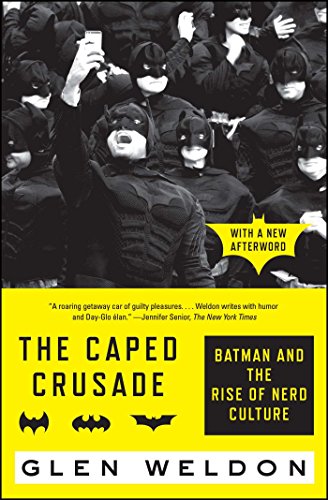
The Caped Crusade: Batman and the Rise of Nerd Culture by Glen Weldon | review by Stephen Theaker
Glen Weldon is a respected writer on books and comic books for NPR, the American equivalent of Radio 4, and a panellist on their excellent weekly podcast, Pop Culture Happy Hour, where his enthusiastically lugubrious voice, ad hoc taxonomies, and ever-readiness with an overarching theory make his contributions always entertaining. Though this sadly isn't a review of the audiobook edition, his distinctive voice can still be heard in every sentence, making this book (Simon & Schuster, hb 336pp, £16.99) a real pleasure from start to finish. Literally to the finish, since the bibliography is annotated with comments from him, and because he's a very interesting chap those comments are very interesting too.
The book is dedicated to Bill Finger, the original Batman writer, and it does a great deal to show how important his contributions to the character were. Even those who have read Batman books by the dozen may be surprised to learn that Bob Kane, “creator” of the Bat-Man, did so by tracing an Alex Raymond drawing of Flash Gordon on a rope swing, colouring his outfit red and blue, and giving him a domino mask. Milton “Bill” Finger was a quiet kid who wrote the scripts, and none of Bob Kane's editors even knew he existed, but Weldon tells us that Finger suggested the ears, the cape, the gloves and the colour scheme.
The dark knight's lack of regard for human life in his latest cinematic outing, Batman v Superman: Dawn of Justice – the result, perhaps, of a death in the family – has provoked much controversy, but it's worth remembering that this is a guy who even at his jolliest still punches and kicks a number of people very hard in the face every night. Chances are, that would be enough to rack up quite the body count even without guns mounted on the Batmobile.
From Weldon we learn how little that violence conflicts with the character's early days: in his first year he killed twenty-four men, two vampires, a pack of werewolves and several giant mutants. Weldon argues that it's to this “grim, violent proto-Batman” that Denny O'Neil returned in 1970, establishing that as the “real” Batman once the swinging sixties were over: making the loner, badass Batman the default inspiration for later retellings by Frank Miller, Tim Burton, Christopher Nolan and Grant Morrison.
This isn't a book that trundles along with the critical orthodoxy; it has its own ideas at every turn. Apparently the Batman tv series was not well-liked among American fans, despised even, which may be a surprise to those of us brought up to think of it as a bona fide television classic. But this book sticks up for it, and identifies the neverending (and not so positive) effects of the ensuing backlash, which even now has barely petered out. When Weldon talks about Dr Fredric Wertham and his crusade against comics, readers may be shocked to see him say that, at least with regard to Batman, “The guy had a point.”
Being gay, the young Glen Weldon didn't just notice the “subtle atmosphere of homoeroticism” in the comic, he rather enjoyed it. Of course he notes how Wertham manipulated and misrepresented the evidence (for example deleting statements that the young men were much more strongly aroused by Tarzan in his loincloth and Marvel's Sub-Mariner in his skimpy swim trunks), but also praises how passionate and progressive he was in calling out racist and sexist stereotypes.
What Weldon really tries to get at is why Batman works. Why he appeals to nerds and why he is popular with normals (to use his words for those groups), why virtually all his films are huge financial successes, why so many of the comics, games and cartoons work so well, whatever the mood, whatever the style, from the sublime Batman: the Animated Series, which Weldon adores, to the technicolour team-up Batman: The Brave and the Bold, the finale of which he describes as a tour de force.
Partly, of course, this is because the character is owned by a huge multimedia company which can invest in paying the best talent to work on him. Put all that talent to work on Bouncing Boy and you'd still end up with some great comics, games and movies. For Weldon, though, what sets Batman apart, what creates the bond between Batman and Batfans, is a very specific thing: “the oath”, Bruce Wayne's candlelight vow to spend the rest of his life warring on all criminals to avenge the deaths of his parents. That is to say, he is just as obsessed as his fans. ****
This review originally appeared in Interzone #264.
The book is dedicated to Bill Finger, the original Batman writer, and it does a great deal to show how important his contributions to the character were. Even those who have read Batman books by the dozen may be surprised to learn that Bob Kane, “creator” of the Bat-Man, did so by tracing an Alex Raymond drawing of Flash Gordon on a rope swing, colouring his outfit red and blue, and giving him a domino mask. Milton “Bill” Finger was a quiet kid who wrote the scripts, and none of Bob Kane's editors even knew he existed, but Weldon tells us that Finger suggested the ears, the cape, the gloves and the colour scheme.
The dark knight's lack of regard for human life in his latest cinematic outing, Batman v Superman: Dawn of Justice – the result, perhaps, of a death in the family – has provoked much controversy, but it's worth remembering that this is a guy who even at his jolliest still punches and kicks a number of people very hard in the face every night. Chances are, that would be enough to rack up quite the body count even without guns mounted on the Batmobile.
From Weldon we learn how little that violence conflicts with the character's early days: in his first year he killed twenty-four men, two vampires, a pack of werewolves and several giant mutants. Weldon argues that it's to this “grim, violent proto-Batman” that Denny O'Neil returned in 1970, establishing that as the “real” Batman once the swinging sixties were over: making the loner, badass Batman the default inspiration for later retellings by Frank Miller, Tim Burton, Christopher Nolan and Grant Morrison.
This isn't a book that trundles along with the critical orthodoxy; it has its own ideas at every turn. Apparently the Batman tv series was not well-liked among American fans, despised even, which may be a surprise to those of us brought up to think of it as a bona fide television classic. But this book sticks up for it, and identifies the neverending (and not so positive) effects of the ensuing backlash, which even now has barely petered out. When Weldon talks about Dr Fredric Wertham and his crusade against comics, readers may be shocked to see him say that, at least with regard to Batman, “The guy had a point.”
Being gay, the young Glen Weldon didn't just notice the “subtle atmosphere of homoeroticism” in the comic, he rather enjoyed it. Of course he notes how Wertham manipulated and misrepresented the evidence (for example deleting statements that the young men were much more strongly aroused by Tarzan in his loincloth and Marvel's Sub-Mariner in his skimpy swim trunks), but also praises how passionate and progressive he was in calling out racist and sexist stereotypes.
What Weldon really tries to get at is why Batman works. Why he appeals to nerds and why he is popular with normals (to use his words for those groups), why virtually all his films are huge financial successes, why so many of the comics, games and cartoons work so well, whatever the mood, whatever the style, from the sublime Batman: the Animated Series, which Weldon adores, to the technicolour team-up Batman: The Brave and the Bold, the finale of which he describes as a tour de force.
Partly, of course, this is because the character is owned by a huge multimedia company which can invest in paying the best talent to work on him. Put all that talent to work on Bouncing Boy and you'd still end up with some great comics, games and movies. For Weldon, though, what sets Batman apart, what creates the bond between Batman and Batfans, is a very specific thing: “the oath”, Bruce Wayne's candlelight vow to spend the rest of his life warring on all criminals to avenge the deaths of his parents. That is to say, he is just as obsessed as his fans. ****
This review originally appeared in Interzone #264.
Saturday, 1 June 2019
If Then by Matthew de Abaitua | review by Stephen Theaker
James is the bailiff of Lewes. When the Process decides that people – a village, a family, a child – must be removed, he cannot resist for long the urge to put on the armour and abandon himself to it, stomping around the countryside, scooping up those who refuse exile. He tries the peaceful approach first, popping round for a chat to see if they will leave freely, but of course even then he wears personal body armour in case of ambush.
Taking this job was the price of being allowed into Lewes after the economy collapsed and everyone became unemployed, destitute, desperate and homeless. Ruth, James’s wife, worked in a library in Hackney in the run-up to the great Seizure, and as other public institutions closed she saw it become the final destination of hundreds of people with nowhere else to go for help – and then there was nowhere at all.
Now that Ruth and James, and about ten thousand others, are a part of the Process, she works as a seamstress in the evenings and a schoolteacher in the day. The other people in town, all of them bearing the telltale data stripe from their crowns to their necks, fear her, because of her husband, believing that the Process will want to keep him happy, and thus will keep his wife happy. They also pity her: he’s not quite the man he used to be.
This relationship, which has already survived so much, faces a new crisis when the name Agnes appears on the eviction list. No one is surprised to see drunks, criminals and other undesirables on the list, though their families may fight tooth and nail to prevent their eviction, but Agnes is a child, one of Ruth’s pupils. “If you evict Agnes,” she says, “it will be difficult for me to love you.” James wonders, “Are we evil? Is this what evil looks like?”
The Process does have a benevolent side. On allocation day everyone, from Lewes and the nearby estates and villages, comes to the old supermarket, where “peeling posters showed bleached photographs of bygone normality, goods and prices, smiling faces, times of plenty, the strangeness of the lost everyday”. Now the shelves are filled by transparent boxes, containing the goods allocated to each person by the Process, sometimes even scraps of advice.
The strangeness of this life, this peculiar society, and the pressure it puts on this couple and everybody else, would be interesting enough in itself – this part is called If – but where a science fiction novel of the sixties or seventies might have stopped, this book takes a new direction: Then. The Process isn’t simply concerned with its participants’ wellbeing, it’s not something that happens to them: they are a part of it, and of each other, and it’s drawing them further in.
At the book’s beginning James finds Hector, a new-made soldier, hanging from barbed wire, “not quite a man”, a creation of the Process. His wounds reveal “spokes of tightly-packed crimson seeds like a pomegranate”. He wears a khaki tunic, puttees, hob-nailed boots, woollen trousers and an overcoat; a lifesize World War I toy soldier. James takes him to the Institute, an addled group of scientists on the fringe of the Process, mutated by their own experiments.
But Hector is only the beginning. Later come rifles, shells, cannons, “miles of barbed wire, legions of horse”, and, as the need for production overtakes capacity, men “with greatcoats fused to their skin and no feet in their boots”, until at last the humans of the Process themselves are co-opted into a phoney war, their memories muddled, their behaviour reshaped like the landscape, so that they fight and die in a replica of the coastline of Gallipoli.
This is a powerful novel (Angry Robot pb, 416pp, £8.99), both in its portrayal of the horrors of World War I, the wasteful loss of life, the dreadful conditions, the failures of those who let the war happen, and also in showing how easily the systems that support our modern-day lives could fall apart. And of course the book is all about the correlations between the two, about what happens when people get to experiment or play war games with the mass of human life, when we are treated as an expendable resource.
When Ruth enters the war in search of James, she meets a replica of Noel Huxley. “Every day is strange, threatening and uncertain,” she says of the future. “We are not in control of our lives.” To which Huxley replies, “That is a description of the soldier’s life.” The book suggests how much of ourselves we’d give up for a quiet life, and it’s hard to argue with its conclusions. ****
This review originally appeared in Interzone #261.
Taking this job was the price of being allowed into Lewes after the economy collapsed and everyone became unemployed, destitute, desperate and homeless. Ruth, James’s wife, worked in a library in Hackney in the run-up to the great Seizure, and as other public institutions closed she saw it become the final destination of hundreds of people with nowhere else to go for help – and then there was nowhere at all.
Now that Ruth and James, and about ten thousand others, are a part of the Process, she works as a seamstress in the evenings and a schoolteacher in the day. The other people in town, all of them bearing the telltale data stripe from their crowns to their necks, fear her, because of her husband, believing that the Process will want to keep him happy, and thus will keep his wife happy. They also pity her: he’s not quite the man he used to be.
This relationship, which has already survived so much, faces a new crisis when the name Agnes appears on the eviction list. No one is surprised to see drunks, criminals and other undesirables on the list, though their families may fight tooth and nail to prevent their eviction, but Agnes is a child, one of Ruth’s pupils. “If you evict Agnes,” she says, “it will be difficult for me to love you.” James wonders, “Are we evil? Is this what evil looks like?”
The Process does have a benevolent side. On allocation day everyone, from Lewes and the nearby estates and villages, comes to the old supermarket, where “peeling posters showed bleached photographs of bygone normality, goods and prices, smiling faces, times of plenty, the strangeness of the lost everyday”. Now the shelves are filled by transparent boxes, containing the goods allocated to each person by the Process, sometimes even scraps of advice.
The strangeness of this life, this peculiar society, and the pressure it puts on this couple and everybody else, would be interesting enough in itself – this part is called If – but where a science fiction novel of the sixties or seventies might have stopped, this book takes a new direction: Then. The Process isn’t simply concerned with its participants’ wellbeing, it’s not something that happens to them: they are a part of it, and of each other, and it’s drawing them further in.
At the book’s beginning James finds Hector, a new-made soldier, hanging from barbed wire, “not quite a man”, a creation of the Process. His wounds reveal “spokes of tightly-packed crimson seeds like a pomegranate”. He wears a khaki tunic, puttees, hob-nailed boots, woollen trousers and an overcoat; a lifesize World War I toy soldier. James takes him to the Institute, an addled group of scientists on the fringe of the Process, mutated by their own experiments.
But Hector is only the beginning. Later come rifles, shells, cannons, “miles of barbed wire, legions of horse”, and, as the need for production overtakes capacity, men “with greatcoats fused to their skin and no feet in their boots”, until at last the humans of the Process themselves are co-opted into a phoney war, their memories muddled, their behaviour reshaped like the landscape, so that they fight and die in a replica of the coastline of Gallipoli.
This is a powerful novel (Angry Robot pb, 416pp, £8.99), both in its portrayal of the horrors of World War I, the wasteful loss of life, the dreadful conditions, the failures of those who let the war happen, and also in showing how easily the systems that support our modern-day lives could fall apart. And of course the book is all about the correlations between the two, about what happens when people get to experiment or play war games with the mass of human life, when we are treated as an expendable resource.
When Ruth enters the war in search of James, she meets a replica of Noel Huxley. “Every day is strange, threatening and uncertain,” she says of the future. “We are not in control of our lives.” To which Huxley replies, “That is a description of the soldier’s life.” The book suggests how much of ourselves we’d give up for a quiet life, and it’s hard to argue with its conclusions. ****
This review originally appeared in Interzone #261.
Saturday, 6 April 2019
Armada by Ernest Cline | review by Stephen Theaker
Zack Lightman’s dad died in an explosion at a sewage treatment plant, and it made the papers so everyone knows. That was back in 1999. A bully called Douglas Knotcher once took the mickey about it, and got battered to a pulp after Zack went into a blind rage. He’s been trying to live it down, but it hurts to miss his dad so much while finding his death so humiliating. His mum kept all his dad’s stuff in boxes up in the attic. Zack watched his videos, played his games, and wore his jacket covered in high score patches.
A notebook he found there, back when he was ten, made him think his dad had lost it, and chapter two takes us through it. A four-page chronology begins with Space War in 1962 and Star Trek in 1966, then works its way through Star Wars, Close Encounters, Ender’s Game, Battlezone, Elite, The X-Files, Contact and Galaxy Quest, to pick out a few. His dad thought they were all connected, part of a conspiracy controlled by the U.S. military, preparing humanity for an alien invasion.
Now it’s 2018. After Zack sees a Sobrukai Glaive Fighter streaking around outside his high school in Beaverton, Oregon, he thinks he might be cracking up too. It looks pretty cool, like the blade of a two-headed battle axe with a black prism sitting between its serrated wings, but it’s from Armada, his favourite video game, created by Chaos Terrain, who, in a suspiciously Watchmenesque move, hired the best of the best to work on it, people like Gabe Newell, Shigeru Miyamoto, James Cameron, Peter Jackson, John Williams and Morgan Freeman.
The gamer plays a pilot, one of many defending Earth against an invading fleet of alien ships, controlled by anthropomorphic extraterrestrial squids from Tau Ceti. Players often complain about the unbalanced gameplay and the unbeatable missions (uh-oh!), like the one where the Disrupter, with its shields that drop for just three seconds, locks on to Earth and disables all the drones, but that hasn’t harmed its popularity, and Zack, especially, and fortunately, isn’t one to give up when the odds are against him.
There’s a terrestrial spin-off where you pilot a mech, Terra Firma, and Zack plays it sometimes, but just so his pals will join him for the big Armada missions. That’s his passion: it took three years of daily practice to crack the top one hundred, a few months more to make the top ten, and now he’s the sixth best player in the world. His handle is IronBeagle. (Later on, when an attractive young woman gets that it’s a reference to Snoopy vs the Red Baron and Iron Eagle, he’ll know she’s the one.)
The alien ship he saw? Not a hallucination. An alien armada is on the way for real, and Earth really does needs Zack to defend it. Just as he’s about to wallop Douglas Knotcher with a tyre iron after another altercation, an Earth Defence Alliance shuttle arrives to scoop him up. There are more secrets in Zack’s life than he could ever have guessed, and that life will be shorter than he could ever have ever imagined if his gaming skills aren’t sufficient to meet the alien challenge.
This isn’t a book (Century hb, 355pp, £12.99) that provoked strong feelings in me. It was entertaining enough in a three-star Hollywood sort of way: the author’s previous book, Ready Player One, will soon be a Spielberg film, and this one has half a dozen roles into which you could slot a movie star. It might make a good film; it’s not as if we’re overwhelmed with outer-space action, and its conclusion, though a bit cheesy on the page, might still seem novel in cinemas.
The constant referencing of pop culture (apparently a big part of Ready Player One’s popularity) feels a bit ingratiating, and even patronising: if your characters are going to talk about losing their goram shields and being out of frakkin’ power, let us feel clever for recognising them (or at least like we’ve spent our television time wisely). Don’t have another character name the two shows, just in case we didn’t get it.
Maybe this is aimed at younger readers, though they might wonder why this teenager has the cultural touchstones of a middle-aged man. Missing your dad is one thing, but he has apparently watched all the shows and played all the games it’s taken me forty years to get through. That stuff dies down once Zack is out in space and it becomes a decent action adventure, but, even then, I’m not sure tipping your hat to The Last Starfighter makes it okay to nick its plot – even if this is in truth more of a Phantom Menace.**
This review originally appeared in Interzone #260.
A notebook he found there, back when he was ten, made him think his dad had lost it, and chapter two takes us through it. A four-page chronology begins with Space War in 1962 and Star Trek in 1966, then works its way through Star Wars, Close Encounters, Ender’s Game, Battlezone, Elite, The X-Files, Contact and Galaxy Quest, to pick out a few. His dad thought they were all connected, part of a conspiracy controlled by the U.S. military, preparing humanity for an alien invasion.
Now it’s 2018. After Zack sees a Sobrukai Glaive Fighter streaking around outside his high school in Beaverton, Oregon, he thinks he might be cracking up too. It looks pretty cool, like the blade of a two-headed battle axe with a black prism sitting between its serrated wings, but it’s from Armada, his favourite video game, created by Chaos Terrain, who, in a suspiciously Watchmenesque move, hired the best of the best to work on it, people like Gabe Newell, Shigeru Miyamoto, James Cameron, Peter Jackson, John Williams and Morgan Freeman.
The gamer plays a pilot, one of many defending Earth against an invading fleet of alien ships, controlled by anthropomorphic extraterrestrial squids from Tau Ceti. Players often complain about the unbalanced gameplay and the unbeatable missions (uh-oh!), like the one where the Disrupter, with its shields that drop for just three seconds, locks on to Earth and disables all the drones, but that hasn’t harmed its popularity, and Zack, especially, and fortunately, isn’t one to give up when the odds are against him.
There’s a terrestrial spin-off where you pilot a mech, Terra Firma, and Zack plays it sometimes, but just so his pals will join him for the big Armada missions. That’s his passion: it took three years of daily practice to crack the top one hundred, a few months more to make the top ten, and now he’s the sixth best player in the world. His handle is IronBeagle. (Later on, when an attractive young woman gets that it’s a reference to Snoopy vs the Red Baron and Iron Eagle, he’ll know she’s the one.)
The alien ship he saw? Not a hallucination. An alien armada is on the way for real, and Earth really does needs Zack to defend it. Just as he’s about to wallop Douglas Knotcher with a tyre iron after another altercation, an Earth Defence Alliance shuttle arrives to scoop him up. There are more secrets in Zack’s life than he could ever have guessed, and that life will be shorter than he could ever have ever imagined if his gaming skills aren’t sufficient to meet the alien challenge.
This isn’t a book (Century hb, 355pp, £12.99) that provoked strong feelings in me. It was entertaining enough in a three-star Hollywood sort of way: the author’s previous book, Ready Player One, will soon be a Spielberg film, and this one has half a dozen roles into which you could slot a movie star. It might make a good film; it’s not as if we’re overwhelmed with outer-space action, and its conclusion, though a bit cheesy on the page, might still seem novel in cinemas.
The constant referencing of pop culture (apparently a big part of Ready Player One’s popularity) feels a bit ingratiating, and even patronising: if your characters are going to talk about losing their goram shields and being out of frakkin’ power, let us feel clever for recognising them (or at least like we’ve spent our television time wisely). Don’t have another character name the two shows, just in case we didn’t get it.
Maybe this is aimed at younger readers, though they might wonder why this teenager has the cultural touchstones of a middle-aged man. Missing your dad is one thing, but he has apparently watched all the shows and played all the games it’s taken me forty years to get through. That stuff dies down once Zack is out in space and it becomes a decent action adventure, but, even then, I’m not sure tipping your hat to The Last Starfighter makes it okay to nick its plot – even if this is in truth more of a Phantom Menace.**
This review originally appeared in Interzone #260.
Sunday, 4 November 2018
The Galaxy Game by Karen Lord | review by Stephen Theaker
Rafi Abowen Delarua, Moo to his friends, also known as Rafidelarua, lives on the planet Cygnus Beta. For the last year he has attended the Tlaxce National Lyceum, and he’s getting bored, even though it’s a school for training “rogue and random psi gifted” to use their powers wisely. He is only fourteen when the book begins, but everyone is worried about him: his notorious father was immensely powerful, and did not use his powers for good.
Staff at the Lyceum leverage Rafi’s interest in the sport of wallrunning to persuade him to wear a cap, which will let them monitor the development of his powers more closely. The results are worrying: his psi powers manifest when he dreams about sex, and the dreams come with “a truly astonishing amount of fear”. He sneaks away from school over the weekend, and heads offworld, to the planet Punartam, where he’ll wallrun for shady Baranngaithe.
The galactic background to all of this is that the planet Sadira was devastated by a surprise biological attack, leaving “its biosphere locked in toxic regeneration for centuries to come” and its people scattered. Old Sadira had been the “leader of the galaxy… or at least policeman and judge and occasional executioner”, in part thanks to the psychic abilities of its people. Their absence from galactic affairs leaves a power vacuum and opportunities for the ruthless.
The government of New Sadira is desperate to bring female survivors to their new world. As a result “Sadiri women are now the galaxy’s rarest and most valuable commodity”, whether they like it or not, including those in a community of Sadiri recently established on Cygnus Beta. Meanwhile, Terra is out there, until now cut off from all these shenanigans, to allow us time to reach full maturity. The myths claim that endangered branches of humanity were brought long ago from Earth to Cygnus Beta to thrive in safety.
This was a disappointing book, for reasons that are a bit difficult to explain: it has what should be a satisfying array of mysteries, interplanetary politics, future sports, and interesting societal structures. Being lost for the first tenth of it didn’t help. The prologue is five thousand words long, a flood of information that simply serves to obscure the book’s main plot: a boy who leaves his home planet to play sports just as the galaxy gets crazy; it’s like the beginning of the Alan Smithee Dune, if each planet had names in three different languages.
That’s not the only aspect of the book that felt unnecessarily obfuscatory and foggy. For example, certain passages about a minor supporting character, Ntenman, and only him, are in the first person. The novel explains itself as a compilation of information recovered from datachips, audioplugs, data vaults and filigree, so perhaps the in-story explanation is there, but why him and no one else? It leads to the confusing assumption that he will be much more important to the plot than he really is.
Stories of future sports can be thrilling – they feature for example in Ben Bova’s The Duelling Machine and Jack Vance’s Trullion: Alastor 2262 – but wallrunning doesn’t sound particularly compelling. Two teams of players must run from the bottom of a wall to the top, guided by a strategist’s signals, conveyed through grav-bands on their wrists. Rafi plays as a booby, a deliberately useless player who lets everyone else practise how to handle team-mates’ mistakes. His skills don’t improve, but the teams around him do, almost preternaturally so.
Though the walls can sometimes be tilted by the players’ concerted movements, and some courses feature gravity twists, it sounds pretty much like bulldog’s charge with everyone running in the same direction, which is hard to imagine being much fun to play or watch. That the sport is also known as Forerunner is perhaps too big a clue to where the book will take it, and this heavy-handed hint is offered long before the reader has had a chance to start caring about the sport or its secret purpose.
Maybe that is what makes it a hard book to like: it assumes from the beginning that the reader is fully invested, in all its information, in all its characters and planets, in their multitude of names, in everything it wants to say. The plot takes a while to get going, and starts winding down with a quarter of the book still to go. However, the plot pieces do fall into place neatly towards the end, and a later scene where Rafi watches Dllenahkh, a Sadiri, return briefly to his home planet was extremely moving. I wouldn’t mind reading more from the author, but I’d want to start with the first in the series. ***
This review originally appeared in Interzone #258.
Staff at the Lyceum leverage Rafi’s interest in the sport of wallrunning to persuade him to wear a cap, which will let them monitor the development of his powers more closely. The results are worrying: his psi powers manifest when he dreams about sex, and the dreams come with “a truly astonishing amount of fear”. He sneaks away from school over the weekend, and heads offworld, to the planet Punartam, where he’ll wallrun for shady Baranngaithe.
The galactic background to all of this is that the planet Sadira was devastated by a surprise biological attack, leaving “its biosphere locked in toxic regeneration for centuries to come” and its people scattered. Old Sadira had been the “leader of the galaxy… or at least policeman and judge and occasional executioner”, in part thanks to the psychic abilities of its people. Their absence from galactic affairs leaves a power vacuum and opportunities for the ruthless.
The government of New Sadira is desperate to bring female survivors to their new world. As a result “Sadiri women are now the galaxy’s rarest and most valuable commodity”, whether they like it or not, including those in a community of Sadiri recently established on Cygnus Beta. Meanwhile, Terra is out there, until now cut off from all these shenanigans, to allow us time to reach full maturity. The myths claim that endangered branches of humanity were brought long ago from Earth to Cygnus Beta to thrive in safety.
This was a disappointing book, for reasons that are a bit difficult to explain: it has what should be a satisfying array of mysteries, interplanetary politics, future sports, and interesting societal structures. Being lost for the first tenth of it didn’t help. The prologue is five thousand words long, a flood of information that simply serves to obscure the book’s main plot: a boy who leaves his home planet to play sports just as the galaxy gets crazy; it’s like the beginning of the Alan Smithee Dune, if each planet had names in three different languages.
That’s not the only aspect of the book that felt unnecessarily obfuscatory and foggy. For example, certain passages about a minor supporting character, Ntenman, and only him, are in the first person. The novel explains itself as a compilation of information recovered from datachips, audioplugs, data vaults and filigree, so perhaps the in-story explanation is there, but why him and no one else? It leads to the confusing assumption that he will be much more important to the plot than he really is.
Stories of future sports can be thrilling – they feature for example in Ben Bova’s The Duelling Machine and Jack Vance’s Trullion: Alastor 2262 – but wallrunning doesn’t sound particularly compelling. Two teams of players must run from the bottom of a wall to the top, guided by a strategist’s signals, conveyed through grav-bands on their wrists. Rafi plays as a booby, a deliberately useless player who lets everyone else practise how to handle team-mates’ mistakes. His skills don’t improve, but the teams around him do, almost preternaturally so.
Though the walls can sometimes be tilted by the players’ concerted movements, and some courses feature gravity twists, it sounds pretty much like bulldog’s charge with everyone running in the same direction, which is hard to imagine being much fun to play or watch. That the sport is also known as Forerunner is perhaps too big a clue to where the book will take it, and this heavy-handed hint is offered long before the reader has had a chance to start caring about the sport or its secret purpose.
Maybe that is what makes it a hard book to like: it assumes from the beginning that the reader is fully invested, in all its information, in all its characters and planets, in their multitude of names, in everything it wants to say. The plot takes a while to get going, and starts winding down with a quarter of the book still to go. However, the plot pieces do fall into place neatly towards the end, and a later scene where Rafi watches Dllenahkh, a Sadiri, return briefly to his home planet was extremely moving. I wouldn’t mind reading more from the author, but I’d want to start with the first in the series. ***
This review originally appeared in Interzone #258.
Saturday, 4 August 2018
Willful Child by Steven Erikson | review by Stephen Theaker
“Dad! First contact! Vulcans!” “Wish it was, boy,” Harry replied. “More like… idiots.” Three-eyed aliens visiting Earth in the “Age of Masturbation” leave behind a spaceship and get us started on a programme of galactic expansion. A century or so later Captain Hadrian Alan Sawback finagles his way into command of the starship Willful Child. He’s a terrible sexist, obsessed with trying to have sex with the female crew members and making sure male crew members know their place: not on away missions and well out of the limelight.
Halley Sin-Dour is his Spock, Saavik and Number One. She makes announcements in “in a deep, full-throated voice that rolled out, came back, and landed in Hadrian’s groin”. Combat specialist Lieutenant Galk comes from a world where the dictionary entry for mundanity runs to thirty pages, and Doctor Printlip deflates whenever he speaks for too long. Pilot Jocelyn Sticks was personally selected by the captain on the basis of her file photo, and he looks forward to the way that “from his position in the command chair, she would have to twist her upper body round to address him”. Hm.
The captain remembers television. He wears a polyester uniform, records a personal log, and insists on a view of the stars when they are in transit. The ship’s ongoing mission, according to him, is to “to seek out strange new worlds on which to plant the Terran flag, to subjugate and if necessary obliterate new life-forms”. Their first assigned mission is to investigate the smuggling of knockoff Terran sports apparel in the Blarad System, but the ship gets infected with a mysterious AI, Tammy, who takes them off to the Exclusion Zone, deep inside Radulak-Klang territory. This leads to an appropriately episodic series of adventures that provide plenty of novelty and surprise.
Science fiction satire may be a departure for Steven Erikson from the fantasy of the Malazan Book of the Fallen and the brilliant Bauchelain and Korbal Broach novellas, but this isn’t a feeble Game of Groans parody of a genre’s surface quirks; it retains the abrasive intelligence that characterised those novellas, and applies it to a deep understanding of the foibles and structures of Star Trek. Steven Erikson credits his wife for telling him “screw everything – just write the damned thing!” It feels like a passion project rather than an opportunistic cash-in on the success of John Scalzi’s Redshirts.
“See what comes with standardizing every approach on the ecliptic?” observes the captain after a near miss with a heavy freighter. “Ridiculous, you’d think we were boats or something.” (Star Trek II: The Wrath of Khan famously took its cues on everything from uniforms to space battles from the Horatio Hornblower series.) The book references everything from Wesley Crusher to the way Kirk cheated on the Kobayashi Maru test, while constantly interrogating the premise of the show. Would the human race be wise to hang its hopes on a Captain Kirk? Would a galaxy dominated by humans (“a voracious, appallingly shortsighted sentient species”) be such a good idea?
The problem is that the book’s affectionate spoofing of sex-obsessed Kirk means it features a good deal of sexism itself, and though it’s coming from a particular character’s mouth and point of view some readers may find it a bit too much. To add another example to those above, at one point the captain watches a “marine cross the bridge, gaze fixing on the meaty sway of her behind”. As a thirteen-year-old I might well have thought “meaty sway of her behind” the most evocative phrase I had ever read, and I’d probably have thought this the best book ever written. Being an adult, I enjoyed it despite the lechery, rather than because of it.
The captain does turn out to have rather more to him than at first appears, which makes for an interesting plot, and along with the number of times he comes a cropper it’s hard to think the book endorses his behaviour. It reminded me of the animated television series Archer. Archer, a secret agent, is another gifted, overconfident and oversexed buffoon, but he is partnered with Lana, who constantly calls him on his sexism, and reminds viewers to laugh at him, not with him. A Lana might have done Captain Sawback some good.
“Hostile planets, hostile aliens. Hostile aliens on hostile planets,” says the captain, “and out there, in that unending cavalcade of danger, I intend to enjoy myself.” Many readers will enjoy themselves too, but read a preview before buying, just in case. I’d like to read a sequel or two – it has the vigour, sauce and sense of adventure that latter-day Star Trek sorely lacked – but I wouldn’t argue with anyone who loathed every word. ***
This review originally appeared in Interzone #256.
Halley Sin-Dour is his Spock, Saavik and Number One. She makes announcements in “in a deep, full-throated voice that rolled out, came back, and landed in Hadrian’s groin”. Combat specialist Lieutenant Galk comes from a world where the dictionary entry for mundanity runs to thirty pages, and Doctor Printlip deflates whenever he speaks for too long. Pilot Jocelyn Sticks was personally selected by the captain on the basis of her file photo, and he looks forward to the way that “from his position in the command chair, she would have to twist her upper body round to address him”. Hm.
The captain remembers television. He wears a polyester uniform, records a personal log, and insists on a view of the stars when they are in transit. The ship’s ongoing mission, according to him, is to “to seek out strange new worlds on which to plant the Terran flag, to subjugate and if necessary obliterate new life-forms”. Their first assigned mission is to investigate the smuggling of knockoff Terran sports apparel in the Blarad System, but the ship gets infected with a mysterious AI, Tammy, who takes them off to the Exclusion Zone, deep inside Radulak-Klang territory. This leads to an appropriately episodic series of adventures that provide plenty of novelty and surprise.
Science fiction satire may be a departure for Steven Erikson from the fantasy of the Malazan Book of the Fallen and the brilliant Bauchelain and Korbal Broach novellas, but this isn’t a feeble Game of Groans parody of a genre’s surface quirks; it retains the abrasive intelligence that characterised those novellas, and applies it to a deep understanding of the foibles and structures of Star Trek. Steven Erikson credits his wife for telling him “screw everything – just write the damned thing!” It feels like a passion project rather than an opportunistic cash-in on the success of John Scalzi’s Redshirts.
“See what comes with standardizing every approach on the ecliptic?” observes the captain after a near miss with a heavy freighter. “Ridiculous, you’d think we were boats or something.” (Star Trek II: The Wrath of Khan famously took its cues on everything from uniforms to space battles from the Horatio Hornblower series.) The book references everything from Wesley Crusher to the way Kirk cheated on the Kobayashi Maru test, while constantly interrogating the premise of the show. Would the human race be wise to hang its hopes on a Captain Kirk? Would a galaxy dominated by humans (“a voracious, appallingly shortsighted sentient species”) be such a good idea?
The problem is that the book’s affectionate spoofing of sex-obsessed Kirk means it features a good deal of sexism itself, and though it’s coming from a particular character’s mouth and point of view some readers may find it a bit too much. To add another example to those above, at one point the captain watches a “marine cross the bridge, gaze fixing on the meaty sway of her behind”. As a thirteen-year-old I might well have thought “meaty sway of her behind” the most evocative phrase I had ever read, and I’d probably have thought this the best book ever written. Being an adult, I enjoyed it despite the lechery, rather than because of it.
The captain does turn out to have rather more to him than at first appears, which makes for an interesting plot, and along with the number of times he comes a cropper it’s hard to think the book endorses his behaviour. It reminded me of the animated television series Archer. Archer, a secret agent, is another gifted, overconfident and oversexed buffoon, but he is partnered with Lana, who constantly calls him on his sexism, and reminds viewers to laugh at him, not with him. A Lana might have done Captain Sawback some good.
“Hostile planets, hostile aliens. Hostile aliens on hostile planets,” says the captain, “and out there, in that unending cavalcade of danger, I intend to enjoy myself.” Many readers will enjoy themselves too, but read a preview before buying, just in case. I’d like to read a sequel or two – it has the vigour, sauce and sense of adventure that latter-day Star Trek sorely lacked – but I wouldn’t argue with anyone who loathed every word. ***
This review originally appeared in Interzone #256.
Saturday, 2 June 2018
Black and Brown Planets, ed. by Isiah Lavender III | review by Stephen Theaker
Subtitled The Politics of Race in Science Fiction, this book (University Press of Mississippi, hb) aims to show “what SF criticism means when joined with critical race theories and histories of oppression”. Part one, Black Planets, features essays about African-Americans and sf. Lisa Yaszek introduces the idea of “The Bannekerade: Genius, Madness, and Magic in Black Science Fiction”, explaining how Benjamin Banneker’s life has inspired stories of “black technoscientific genius”. The essay identifies several interesting works, but it’s not clear that there are many distinct examples of the Bannekerade.
In “‘The Best Is Yet to Come’; or, Saving the Future: Star Trek: Deep Space Nine as Reform Astrofuturism”, De Witt Douglas Kilgore writes about the episodes that threw Commander Sisko into the life of a black writer in the fifties, and wonders whether Star Trek’s racism-free future is as positive as it seems. In “Far Beyond the Star Pit: Samuel R. Delany”, Gerry Canavan reads that story “as an allegory for life under the regime of legal and customary segregation known as white supremacy”.
As well as the introduction, Lavender writes “Digging Deep: Ailments of Difference in Octavia Butler’s ‘The Evening and the Morning and the Night’”, where he suggests that Butler’s story can be read as an allegory for race in America. In “The Laugh of Anansi: Why Science Fiction Is Pertinent to Black Children’s Literature Pedagogy” Marleen Barr argues that children’s sf featuring black heroes “causes a wrinkle in time, a respite from the history of oppression”.
Part two, Brown Planets, ranges further afield, though surprisingly not to India (“Africa and Asia are beyond the scope of this collection”).
In “Haint Stories Rooted in Conjure Science: Indigenous Scientific Literacies in Andrea Hairston’s Redwood and Wildfire” Grace Dillon explains how that novel incorporates “indigenous scientific literacies, a forward-thinking way of characterizing indigenous knowledge in opposition to Euro-Western characterizations of ‘native superstition’ and magic”. In “Questing for an Indigenous Future: Leslie Marmon Silko’s Ceremony as Indigenous Science Fiction” Patrick Sharp makes similar points, while comparing post-apocalyptic narratives with a novel about a town affected by uranium mining.
The view of science put forward in those essays seems almost Victorian, all taxonomies and determinism. In “Monteiro Lobato’s O presidente negro (The Black President): Eugenics and the Corporate State in Brazil”, M. Elizabeth Ginway explains how science earned that bad reputation, using a 1926 “chilling fictional experiment in genocide” to illuminate the thinking behind the Brazilian eugenics movement. A highlight is Lobato’s honest surprise that no US publisher wanted his racist book.
In “Mestizaje and Heterotopia in Ernest Hogan’s High Aztech” Lysa Rivera reads Hogan’s novel as a science fictionalization of José Vasconcelos’s theory that the melting pot of Mexico might eventually produce a cosmic “fifth race”, which will lead us into enlightenment. Matthew Goodwin’s “Virtual Reality at the Border of Migration, Race, and Labor” critiques the notion of cyberspace as post-racial utopia, considering, for example, how it provides cheap labour without allowing immigration. In “A Dis-(Orient)ation: Race, Technoscience, and The Windup Girl” Malisa Kurtz applies the concept of “raced” characters, who may not face problems relating to their ethnicity, but are marked in other ways, such as Emiko’s built-in physical stutters.
Though it’s a reprint, “Yellow, Black, Metal, and Tentacled: The Race Question in American Science Fiction” is worth reading first, as Edward James provides a useful overview of how American sf has tackled race (or not). It gives context to the more tightly focused essays, though his concerns about “the problem of the recognition of race in SF” – the risk of assuming sf is about race and not, say, technology – aren’t shared by many contributors.
In “The Wild Unicorn Herd Check-In” Robin Reid notes the variety of fans who asserted their presence after Racefail, and catalogues how they described their ethnicity and nationality. It addresses the book’s title: “white readers of SF … simply did not see all the planets (black and brown and many other colors) that exist and have existed, independent of white observers”. Like “new” planets now being discovered, minority readers and writers of sf were always out there.
Like any book of literary criticism, it can be dull, but that’s outweighed by the issues, authors and stories it works so carefully to bring to our attention. A few essays make great claims without much evidence, but all provide much to think about; it opens up the conversation, rather than having the last word. Walter Mosley is quoted inside as saying: “The power of science fiction is that it can tear down the walls and windows, the artifice and laws by changing the logic, empowering the disenfranchised or simply by asking, What if?” Black and Brown Planets shows how writers and critics are doing just that. ****
A slightly shorter version of this review appeared in Interzone #255.
In “‘The Best Is Yet to Come’; or, Saving the Future: Star Trek: Deep Space Nine as Reform Astrofuturism”, De Witt Douglas Kilgore writes about the episodes that threw Commander Sisko into the life of a black writer in the fifties, and wonders whether Star Trek’s racism-free future is as positive as it seems. In “Far Beyond the Star Pit: Samuel R. Delany”, Gerry Canavan reads that story “as an allegory for life under the regime of legal and customary segregation known as white supremacy”.
As well as the introduction, Lavender writes “Digging Deep: Ailments of Difference in Octavia Butler’s ‘The Evening and the Morning and the Night’”, where he suggests that Butler’s story can be read as an allegory for race in America. In “The Laugh of Anansi: Why Science Fiction Is Pertinent to Black Children’s Literature Pedagogy” Marleen Barr argues that children’s sf featuring black heroes “causes a wrinkle in time, a respite from the history of oppression”.
Part two, Brown Planets, ranges further afield, though surprisingly not to India (“Africa and Asia are beyond the scope of this collection”).
In “Haint Stories Rooted in Conjure Science: Indigenous Scientific Literacies in Andrea Hairston’s Redwood and Wildfire” Grace Dillon explains how that novel incorporates “indigenous scientific literacies, a forward-thinking way of characterizing indigenous knowledge in opposition to Euro-Western characterizations of ‘native superstition’ and magic”. In “Questing for an Indigenous Future: Leslie Marmon Silko’s Ceremony as Indigenous Science Fiction” Patrick Sharp makes similar points, while comparing post-apocalyptic narratives with a novel about a town affected by uranium mining.
The view of science put forward in those essays seems almost Victorian, all taxonomies and determinism. In “Monteiro Lobato’s O presidente negro (The Black President): Eugenics and the Corporate State in Brazil”, M. Elizabeth Ginway explains how science earned that bad reputation, using a 1926 “chilling fictional experiment in genocide” to illuminate the thinking behind the Brazilian eugenics movement. A highlight is Lobato’s honest surprise that no US publisher wanted his racist book.
In “Mestizaje and Heterotopia in Ernest Hogan’s High Aztech” Lysa Rivera reads Hogan’s novel as a science fictionalization of José Vasconcelos’s theory that the melting pot of Mexico might eventually produce a cosmic “fifth race”, which will lead us into enlightenment. Matthew Goodwin’s “Virtual Reality at the Border of Migration, Race, and Labor” critiques the notion of cyberspace as post-racial utopia, considering, for example, how it provides cheap labour without allowing immigration. In “A Dis-(Orient)ation: Race, Technoscience, and The Windup Girl” Malisa Kurtz applies the concept of “raced” characters, who may not face problems relating to their ethnicity, but are marked in other ways, such as Emiko’s built-in physical stutters.
Though it’s a reprint, “Yellow, Black, Metal, and Tentacled: The Race Question in American Science Fiction” is worth reading first, as Edward James provides a useful overview of how American sf has tackled race (or not). It gives context to the more tightly focused essays, though his concerns about “the problem of the recognition of race in SF” – the risk of assuming sf is about race and not, say, technology – aren’t shared by many contributors.
In “The Wild Unicorn Herd Check-In” Robin Reid notes the variety of fans who asserted their presence after Racefail, and catalogues how they described their ethnicity and nationality. It addresses the book’s title: “white readers of SF … simply did not see all the planets (black and brown and many other colors) that exist and have existed, independent of white observers”. Like “new” planets now being discovered, minority readers and writers of sf were always out there.
Like any book of literary criticism, it can be dull, but that’s outweighed by the issues, authors and stories it works so carefully to bring to our attention. A few essays make great claims without much evidence, but all provide much to think about; it opens up the conversation, rather than having the last word. Walter Mosley is quoted inside as saying: “The power of science fiction is that it can tear down the walls and windows, the artifice and laws by changing the logic, empowering the disenfranchised or simply by asking, What if?” Black and Brown Planets shows how writers and critics are doing just that. ****
A slightly shorter version of this review appeared in Interzone #255.
Saturday, 7 April 2018
The Beauty by Aliya Whiteley | review by Stephen Theaker
The Beauty (Unsung Stories) is a story told by Nathan. Telling stories has been his job ever since the women and girls first began to fall sick and he stood up at the commune’s campfire and retold the story of a famous boy wizard to keep away the silence of the night. It has now been six years since the last women in the valley died, all of them victims of an aggressive fungal infection. The future is bleak, but he tells the surviving men and teenage boys tales of the past, doing his best to keep the women alive, in their thoughts at least. For sex and love the younger men make do with each other. That brings comfort, but there’s no future in it for the species, and no hope, even for a community that was self-sufficient before the disaster.
That is, until Nathan’s encounter in the woods with what he calls the Beauty, a being very like a woman in some ways, disturbingly different in others: “It has breasts, globes of yellow, and rounded hips that speak to me of woman, of want, and that disgusts me beyond words.” His return to the commune with his Beauty, and a crowd of others like it, changes everything, and those changes are not welcomed by all. But he finds an unexpected ally in his Uncle Ted, who till now had lived out in the woods, up to who knows what, and the teenagers are very enthusiastic about the new situation: they “wear skirts, and cite the ease of joining with their Beauties – no more zips to undo, simply lift the material!”
This is a short book with a lot to say, all of it interesting. About what people are prepared to do in order to survive, and how far others will go to prevent change; or, if we step back from Nathan’s point of view, a book about collaborators, and how collaboration can corrupt and degrade. On another level it’s about how men are affected by the absence of women, and later how they might react to losing their ill-earned place as the dominant gender: some with relief, others with murderous rage. Or it could be taken as an interrogation of that male fantasy, the all-sex all-the-time relationship, the always-available partner; it suggests how quickly life with a sexbot (or here, a sex mushroom) might lose its shine. Though it’s not quite a horror novella, its awful transformations of the flesh would do David Cronenberg proud.
Most of all it’s about the power of storytelling to preserve our past and shape our future, and so one can see why it would appeal to an imprint called Unsung Stories; on this evidence a name to look out for. The Beauty is intellectual and visceral, frightening and thoughtful, an adventure and a meditation. Letting my copy of Whiteley’s Mean Mode Median go unread for so long has clearly been a huge mistake. ****
This review originally appeared in Interzone #254.
That is, until Nathan’s encounter in the woods with what he calls the Beauty, a being very like a woman in some ways, disturbingly different in others: “It has breasts, globes of yellow, and rounded hips that speak to me of woman, of want, and that disgusts me beyond words.” His return to the commune with his Beauty, and a crowd of others like it, changes everything, and those changes are not welcomed by all. But he finds an unexpected ally in his Uncle Ted, who till now had lived out in the woods, up to who knows what, and the teenagers are very enthusiastic about the new situation: they “wear skirts, and cite the ease of joining with their Beauties – no more zips to undo, simply lift the material!”
This is a short book with a lot to say, all of it interesting. About what people are prepared to do in order to survive, and how far others will go to prevent change; or, if we step back from Nathan’s point of view, a book about collaborators, and how collaboration can corrupt and degrade. On another level it’s about how men are affected by the absence of women, and later how they might react to losing their ill-earned place as the dominant gender: some with relief, others with murderous rage. Or it could be taken as an interrogation of that male fantasy, the all-sex all-the-time relationship, the always-available partner; it suggests how quickly life with a sexbot (or here, a sex mushroom) might lose its shine. Though it’s not quite a horror novella, its awful transformations of the flesh would do David Cronenberg proud.
Most of all it’s about the power of storytelling to preserve our past and shape our future, and so one can see why it would appeal to an imprint called Unsung Stories; on this evidence a name to look out for. The Beauty is intellectual and visceral, frightening and thoughtful, an adventure and a meditation. Letting my copy of Whiteley’s Mean Mode Median go unread for so long has clearly been a huge mistake. ****
This review originally appeared in Interzone #254.
Saturday, 3 February 2018
Smiler’s Fair by Rebecca Levene | review by Stephen Theaker
“They say the fair holds one example of all that there is in the world – every food, every spice, every pleasure and every vice,” says nobleman Lahiru, who, though married with three children, will be “hunting the finest boy flesh to be had for many miles” during his visit. Smiler’s Fair is a travelling city, drawn by mammoths from place to place, because no one stays still for too long in this world. Do so and the worm men will get you! The fair, home to scoundrels, scum and psychopaths, takes a daily census of its inhabitants and visitors, and when the first death comes the fair moves on. For our cast of characters, all roads pass through this exciting, squalid, movable feast.
The eyes of Krish have silver irises, and so King Nayan, his birth father, wanted him dead to undo a prophecy. Cut from his mother’s belly and stolen away, Krish knows nothing of that, and lives as a shepherd until a brush with the king’s flying squad sets him on the run. Lady Nethmi has been sent by her uncle to marry old Lord Thilak, but he already has a good woman to share his bed.
Eric is a teenage sellcock, growing too old for the sleazy customers of his owner, Madam Aeronwen. He decides to follow his favourite client home from the fair. Dae Hyo, perhaps the last of his tribe, would avenge the murder of his people and reclaim his homeland; trouble is, he’s also a recovering alcoholic chased out of town after he fell asleep on the job and got a team of miners killed by the worm men.
Smiler’s Fair is very much the first part of a series, and doesn’t work brilliantly as a standalone novel. The protagonists move around the board, but few of their stories progress very far. It feels like threads were added till there were enough to fill the pages, rather than because they were truly needed. There’s a common theme to some of them, of scorned and mistreated wives: the woman who adopted Krish, beaten by the husband she always wanted to leave; Nethmi, an unwilling wife with an uncaring husband; Babi, wife of gay lord Lahiru, humiliated by the lover brought into their home. But with no common catalyst, it feels oddly coincidental that these life-changing adventures all begin at once.
The prose style feels uncomplicated and perhaps even deliberately simplified: in one five-page section I looked at, ninety-five per cent of the text was made up of one and two-syllable words, with only two of eighteen hundred words reaching five syllables. It feels like the language is pitched at someone with the reading age of eleven or twelve, though the content is far too salty for that age group. This makes it an easy and accessible book to read, but once you notice it’s hard not to feel like the book is talking down to you.
Levene’s editorial work on the excellent Doctor Who line from Virgin Books was very well regarded, and this feels rather like a book written by a canny editor who has surveyed the market, thought about what will be marketable (it will appeal to fans of Game of Thrones), and produced a book designed to fit the bill. Some parts are a bit corny – one man becomes the captive of a society of women, who of course require impregnation! – but it’s a solid adventure and I enjoyed reading it. I’m sure it will find fans, though I probably won’t read any sequels: I’m not worried about the characters, nor really intrigued by the trundly setting.
The worm men are frightening at first, but the premise of the book, that they can’t dig up into your home if it’s on the move (because the sun poisons the land against them), was unconvincing, and felt like an arbitrary way to set this world in motion. For me that world is in some ways too similar to our own: there are mammoths, but also snakes, cows, horses, goats, rats, etc. Maybe it is our world, or maybe it’s just parallel evolution, but the inclusion of Earth Prime animals in a fantasy novel always feels to me like a wasted opportunity. It’s ironic that fantasy is often less adventurous than science fiction when it comes to these things.
Promisingly, events later in the book suggest that the Hollow Gods of the series title might play a bigger role in future volumes. More weirdness and magic would certainly have made this book more appealing, and it might prove easier to take an interest in the lives of these mostly unpleasant characters if they were set in opposition to gods who are even worse. ***
This review originally appeared in Interzone #254.
The eyes of Krish have silver irises, and so King Nayan, his birth father, wanted him dead to undo a prophecy. Cut from his mother’s belly and stolen away, Krish knows nothing of that, and lives as a shepherd until a brush with the king’s flying squad sets him on the run. Lady Nethmi has been sent by her uncle to marry old Lord Thilak, but he already has a good woman to share his bed.
Eric is a teenage sellcock, growing too old for the sleazy customers of his owner, Madam Aeronwen. He decides to follow his favourite client home from the fair. Dae Hyo, perhaps the last of his tribe, would avenge the murder of his people and reclaim his homeland; trouble is, he’s also a recovering alcoholic chased out of town after he fell asleep on the job and got a team of miners killed by the worm men.
Smiler’s Fair is very much the first part of a series, and doesn’t work brilliantly as a standalone novel. The protagonists move around the board, but few of their stories progress very far. It feels like threads were added till there were enough to fill the pages, rather than because they were truly needed. There’s a common theme to some of them, of scorned and mistreated wives: the woman who adopted Krish, beaten by the husband she always wanted to leave; Nethmi, an unwilling wife with an uncaring husband; Babi, wife of gay lord Lahiru, humiliated by the lover brought into their home. But with no common catalyst, it feels oddly coincidental that these life-changing adventures all begin at once.
The prose style feels uncomplicated and perhaps even deliberately simplified: in one five-page section I looked at, ninety-five per cent of the text was made up of one and two-syllable words, with only two of eighteen hundred words reaching five syllables. It feels like the language is pitched at someone with the reading age of eleven or twelve, though the content is far too salty for that age group. This makes it an easy and accessible book to read, but once you notice it’s hard not to feel like the book is talking down to you.
Levene’s editorial work on the excellent Doctor Who line from Virgin Books was very well regarded, and this feels rather like a book written by a canny editor who has surveyed the market, thought about what will be marketable (it will appeal to fans of Game of Thrones), and produced a book designed to fit the bill. Some parts are a bit corny – one man becomes the captive of a society of women, who of course require impregnation! – but it’s a solid adventure and I enjoyed reading it. I’m sure it will find fans, though I probably won’t read any sequels: I’m not worried about the characters, nor really intrigued by the trundly setting.
The worm men are frightening at first, but the premise of the book, that they can’t dig up into your home if it’s on the move (because the sun poisons the land against them), was unconvincing, and felt like an arbitrary way to set this world in motion. For me that world is in some ways too similar to our own: there are mammoths, but also snakes, cows, horses, goats, rats, etc. Maybe it is our world, or maybe it’s just parallel evolution, but the inclusion of Earth Prime animals in a fantasy novel always feels to me like a wasted opportunity. It’s ironic that fantasy is often less adventurous than science fiction when it comes to these things.
Promisingly, events later in the book suggest that the Hollow Gods of the series title might play a bigger role in future volumes. More weirdness and magic would certainly have made this book more appealing, and it might prove easier to take an interest in the lives of these mostly unpleasant characters if they were set in opposition to gods who are even worse. ***
This review originally appeared in Interzone #254.
Wednesday, 29 November 2017
The Very Best of Kate Elliott | review by Stephen Theaker
This excellent book is currently available as part of a Tachyon Humble Bundle, which includes several other books that went down very well here at TQF Towers, such as Pirate Utopia by Bruce Sterling, Yesterday's Kin by Nancy Kress and Slow Bullets by Alastair Reynolds.
Short stories don’t seem to have played a major part in Kate Elliott’s career. The twelve collected in The Very Best of Kate Elliott (Tachyon Publications pb, 384pp, $15.95) include all her published stories; none appeared in magazines; all are from anthologies or previously unpublished. She’s had twice that number of novels published, so it’s a fair bet that in truth her very best work lies there. And yet no reader would guess that from how good these stories all are. The book also includes four essays and an introduction, “The Landscape That Surrounds Us”, which sets out an explicit agenda.
She aims to write fantasy and science fiction stories about female characters, “to build landscapes of possibility and expansion”, to challenge “received wisdom, of ossified expectation, and of unchallenged assumptions”. The book is full of characters who do this. Like Eili, in “Making the World Live Again”, who wants to see the world, and persuades her family to let her go to the big temple in Eridu instead of accepting the offer of six sheep and a brindled ox from a suitor’s family. Now she’s a woman she will get her chance to take the priestess’s test, and then learn how the world really turns.
This isn’t a book of Red Sonjas; more often these stories show female courage as an everyday part of living in a male-dominated world. As in “With God to Guard Her”, where young Merofled takes the fancy of the Duke Amalo, who sends his servants to seize Merofled “like a sack of grain”. They bring her to his bed to “accept the honor of the Duke’s attention”. Where classic fairy tales like “The Princess and the Frog” or “Beauty and the Beast” advise women to accept unwelcome marriages, Elliot’s story shames men who would abuse their power. In “On the Dying Winds of the Old Year and the Birthing Winds of the New”, a queen who left her king is watched by his spies; any man she sleeps with will be killed.
Elliott’s women are never passive, even if their actions might be forgotten or elided by the grand sweep of history, like those of Anna, the brave hero of “Leaf and Branch and Grass and Vine”. A general loyal to the king lies injured, and she must take word of the treachery to the king’s sister; her age lets her pass by enemy soldiers unmolested. Sometimes their actions are subtle but the effects are great, as in “The Queen’s Garden”, where cloistered Princess An and Princess Yara bring down a king with a handful of short, exquisite notes.
Though settings range from the fantastical pre-Roman to the far future, all show determined women getting important things done in difficult situations. Cannons bombard the city of Trient in “The Memory of Peace”; children like Stepha loot the ruins for food. In “A Simple Act of Kindness”, Daniella, out in a storm at twilight to collect a lost black sheep, encounters twelve whispering, dark shapes; they hunt a stranger hiding in the village church. Daniella volunteered to find the sheep in part to avoid sexual harassment from her cousin Robert, in part because she likes storms.
The common thread in the four essays is we should all try a little bit harder. “The Omniscient Breasts: The Male Gaze through Female Eyes” draws attention to fiction that drifts from the limited third person perspective to omniscience when the author wants the reader to ogle his female characters. “The Status Quo Does Not Need World Building” defends “obsessive world-building” against the criticism of Damien Walter, arguing that the creation of detailed fantasy and science fiction worlds prevents writers and readers from assuming that the status quo applies.
“And Pharaoh’s Heart Hardened” pleads for tolerance, arguing that the diversity of immigration makes the USA strong, while “The Narrative of Women in Fear and Pain” explains how much Elliott is creeped out by Hollywood “scenes of young women in poses of sexual passivity being terrified and mutilated and screaming screaming screaming”. But she says that “there is an important and even vital place in our literature (books, films, etc.) for strong, fearless depictions of suffering and injustice, so we don’t lose sight of what we must strive to change”.
We see that throughout this collection. Mary hangs in a cage at “The Gates of Joriun”, her own name almost forgotten, her brother is the rightful king. We see how she keeps it together, to lend the strength of her endurance to her brother’s cause: “Let me not weaken. It is so hard.” Kereka, in “Riding the Shore of the River of Death”, wants to be a warrior not a wife, and so goes in hunt of a head, only to find herself the captive of a wizard; she ends up taking a mad risk for a chance at freedom.
A couple of stories are funny, making it clear that the absence of humour elsewhere is just a matter of maintaining an appropriately serious mood. The sunniest story in the book is “To Be a Man”, a sex comedy about Felicia and Ami, who shelter and bathe Rory Barr, the handsome were-sabre-toothed-cat who ate their lady’s nasty little pug, Coco. “My Voice Is in My Sword” is comedic sf, about actors on a brief tour to an alien planet, performing the Scottish play with a pair of big stars on board, one of whom takes advantage of his position to grope his castmates in character.
The two sf stories in the book were among my favourites. The other is “Sunseeker”, in which a bunch of spoiled rich kids who circle the world on a promotional jaunt are snatched. One of them manages to flee, but ends up in the hands of commercial pirates with a grudge. As ever, the fortitude of the protagonist is uplifting, and her pride: Eleanor has refused to remove the birthmark on her cheek, a rebuke to a father who cares about celebrity and career more than his daughter.
This author’s agenda doesn’t lead to didactic, hectoring stories, but to stories with variety, high stakes, interesting perspectives, and different pleasures. Strength isn’t just slaying enemies with a broadsword; it can mean saying no to powerful men and women, or to a society that stands against you. Elliott’s characters dominate the pages, and live on when the stories are over. If this were the best of collection by an author who had published five hundred short stories you wouldn’t expect it to be any better.
This review originally appeared (after editorial amendment) in Interzone #257 (March–April 2015).
Short stories don’t seem to have played a major part in Kate Elliott’s career. The twelve collected in The Very Best of Kate Elliott (Tachyon Publications pb, 384pp, $15.95) include all her published stories; none appeared in magazines; all are from anthologies or previously unpublished. She’s had twice that number of novels published, so it’s a fair bet that in truth her very best work lies there. And yet no reader would guess that from how good these stories all are. The book also includes four essays and an introduction, “The Landscape That Surrounds Us”, which sets out an explicit agenda.
She aims to write fantasy and science fiction stories about female characters, “to build landscapes of possibility and expansion”, to challenge “received wisdom, of ossified expectation, and of unchallenged assumptions”. The book is full of characters who do this. Like Eili, in “Making the World Live Again”, who wants to see the world, and persuades her family to let her go to the big temple in Eridu instead of accepting the offer of six sheep and a brindled ox from a suitor’s family. Now she’s a woman she will get her chance to take the priestess’s test, and then learn how the world really turns.
This isn’t a book of Red Sonjas; more often these stories show female courage as an everyday part of living in a male-dominated world. As in “With God to Guard Her”, where young Merofled takes the fancy of the Duke Amalo, who sends his servants to seize Merofled “like a sack of grain”. They bring her to his bed to “accept the honor of the Duke’s attention”. Where classic fairy tales like “The Princess and the Frog” or “Beauty and the Beast” advise women to accept unwelcome marriages, Elliot’s story shames men who would abuse their power. In “On the Dying Winds of the Old Year and the Birthing Winds of the New”, a queen who left her king is watched by his spies; any man she sleeps with will be killed.
Elliott’s women are never passive, even if their actions might be forgotten or elided by the grand sweep of history, like those of Anna, the brave hero of “Leaf and Branch and Grass and Vine”. A general loyal to the king lies injured, and she must take word of the treachery to the king’s sister; her age lets her pass by enemy soldiers unmolested. Sometimes their actions are subtle but the effects are great, as in “The Queen’s Garden”, where cloistered Princess An and Princess Yara bring down a king with a handful of short, exquisite notes.
Though settings range from the fantastical pre-Roman to the far future, all show determined women getting important things done in difficult situations. Cannons bombard the city of Trient in “The Memory of Peace”; children like Stepha loot the ruins for food. In “A Simple Act of Kindness”, Daniella, out in a storm at twilight to collect a lost black sheep, encounters twelve whispering, dark shapes; they hunt a stranger hiding in the village church. Daniella volunteered to find the sheep in part to avoid sexual harassment from her cousin Robert, in part because she likes storms.
The common thread in the four essays is we should all try a little bit harder. “The Omniscient Breasts: The Male Gaze through Female Eyes” draws attention to fiction that drifts from the limited third person perspective to omniscience when the author wants the reader to ogle his female characters. “The Status Quo Does Not Need World Building” defends “obsessive world-building” against the criticism of Damien Walter, arguing that the creation of detailed fantasy and science fiction worlds prevents writers and readers from assuming that the status quo applies.
“And Pharaoh’s Heart Hardened” pleads for tolerance, arguing that the diversity of immigration makes the USA strong, while “The Narrative of Women in Fear and Pain” explains how much Elliott is creeped out by Hollywood “scenes of young women in poses of sexual passivity being terrified and mutilated and screaming screaming screaming”. But she says that “there is an important and even vital place in our literature (books, films, etc.) for strong, fearless depictions of suffering and injustice, so we don’t lose sight of what we must strive to change”.
We see that throughout this collection. Mary hangs in a cage at “The Gates of Joriun”, her own name almost forgotten, her brother is the rightful king. We see how she keeps it together, to lend the strength of her endurance to her brother’s cause: “Let me not weaken. It is so hard.” Kereka, in “Riding the Shore of the River of Death”, wants to be a warrior not a wife, and so goes in hunt of a head, only to find herself the captive of a wizard; she ends up taking a mad risk for a chance at freedom.
A couple of stories are funny, making it clear that the absence of humour elsewhere is just a matter of maintaining an appropriately serious mood. The sunniest story in the book is “To Be a Man”, a sex comedy about Felicia and Ami, who shelter and bathe Rory Barr, the handsome were-sabre-toothed-cat who ate their lady’s nasty little pug, Coco. “My Voice Is in My Sword” is comedic sf, about actors on a brief tour to an alien planet, performing the Scottish play with a pair of big stars on board, one of whom takes advantage of his position to grope his castmates in character.
The two sf stories in the book were among my favourites. The other is “Sunseeker”, in which a bunch of spoiled rich kids who circle the world on a promotional jaunt are snatched. One of them manages to flee, but ends up in the hands of commercial pirates with a grudge. As ever, the fortitude of the protagonist is uplifting, and her pride: Eleanor has refused to remove the birthmark on her cheek, a rebuke to a father who cares about celebrity and career more than his daughter.
This author’s agenda doesn’t lead to didactic, hectoring stories, but to stories with variety, high stakes, interesting perspectives, and different pleasures. Strength isn’t just slaying enemies with a broadsword; it can mean saying no to powerful men and women, or to a society that stands against you. Elliott’s characters dominate the pages, and live on when the stories are over. If this were the best of collection by an author who had published five hundred short stories you wouldn’t expect it to be any better.
This review originally appeared (after editorial amendment) in Interzone #257 (March–April 2015).
Wednesday, 24 August 2016
Contributor news: Charles Wilkinson, Rafe McGregor, Douglas Ogurek
Hope you’ve been enjoying issue fifty-five, which was as ever free to download and as cheap as we could possibly make it in print. We don’t expect anything in return, other than your unquestioning love, but if you want to show your thanks in less romantic fashion, there’s no better way than having a look at our contributors’ other publications.
Charles Wilkinson has a collection of strange tales out now from Egaeus Press, A Twist in the Eye, which includes two stories that first appeared here. In his introduction, Mark Samuels calls it “the most exciting collection of weird fiction … that I have read for many years”. Charles’s work has appeared in Supernatural Tales, Shadows & Tall Trees, Horror Without Victims and Strange Tales V (Tartarus Press) amongst other places. The book is available to buy from the Egaeus Press website.
Rafe McGregor’s seventh book, The Value of Literature, was due for publication by Rowman & Littlefield International in hardback in August 2016 and in paperback in February 2018. Learn more.
Douglas J. Ogurek’s unsplatterpunk extravaganza “Maim Street” was selected for The Best Weird Fiction Vol. 6 (Morpheus Tales Publishing). Prick of the Spindle published his satirical piece “Thomas Sageslush’s Support of the Moronvia Heights Pit Bull Ban”. The Literary Hatchet (PearTree Press) picked up his oft-anthologized (and highly juvenile) “Stool Fool”. The Great Tome of Forgotten Relics and Artifacts (Bards and Sages Publishing) featured “The Binding Agent.”. Learn more.
Finally, check out the current Interzone #265 for my reviews of Hunters & Collectors by M. Suddain and World of Water by James Lovegrove, plus the upcoming Interzone #266 for my review of The Rise of Io by Wesley Chu and – honour of honours! – my guest editorial, where I talk a bit about running the British Fantasy Awards, where I think awards can go awry, and why I love them anyway.
Charles Wilkinson has a collection of strange tales out now from Egaeus Press, A Twist in the Eye, which includes two stories that first appeared here. In his introduction, Mark Samuels calls it “the most exciting collection of weird fiction … that I have read for many years”. Charles’s work has appeared in Supernatural Tales, Shadows & Tall Trees, Horror Without Victims and Strange Tales V (Tartarus Press) amongst other places. The book is available to buy from the Egaeus Press website.
Rafe McGregor’s seventh book, The Value of Literature, was due for publication by Rowman & Littlefield International in hardback in August 2016 and in paperback in February 2018. Learn more.
Douglas J. Ogurek’s unsplatterpunk extravaganza “Maim Street” was selected for The Best Weird Fiction Vol. 6 (Morpheus Tales Publishing). Prick of the Spindle published his satirical piece “Thomas Sageslush’s Support of the Moronvia Heights Pit Bull Ban”. The Literary Hatchet (PearTree Press) picked up his oft-anthologized (and highly juvenile) “Stool Fool”. The Great Tome of Forgotten Relics and Artifacts (Bards and Sages Publishing) featured “The Binding Agent.”. Learn more.
Finally, check out the current Interzone #265 for my reviews of Hunters & Collectors by M. Suddain and World of Water by James Lovegrove, plus the upcoming Interzone #266 for my review of The Rise of Io by Wesley Chu and – honour of honours! – my guest editorial, where I talk a bit about running the British Fantasy Awards, where I think awards can go awry, and why I love them anyway.
Thursday, 5 November 2015
Interzone #261: coming soon!
Interzone #261 will be out soon, and it features my review of If Then by Matthew De Abaitua, plus lots, lots more that you can read about here.
I've also been putting together BFS Horizons #2, which features among many other things a cover from our own Howard Watts. The only way to be sure of getting a print copy of that is to join the society before the issue goes to press, but, if you can't join right now, ebook versions will be available in the society's archive.
Monday, 1 December 2014
Shadows of the New Sun: Stories in Honor of Gene Wolfe / review by Stephen Theaker
Not to be confused with the book of critical writings by the same name about the same author, Shadows of the New Sun (Tor, hb, 416pp) is an anthology of fiction celebrating the work of Gene Wolfe. Two of his own stories bookend the collection. In “Frostfree” Roy Tabak gets home to find a new refrigerator with unusual capabilities has been delivered. The story develops in interesting directions, but in itself isn’t quite enough to demonstrate why Wolfe is the kind of writer to deserve a tribute. Closing story “Sea of Memory” is more reminiscent of the work for which he is lauded. Adele is helping to build a colony, but memories are foggy and time seems strangely confused. The conclusion disappoints, but the disorientation is convincing.
Neil Gaiman may attract as many readers to this book as Gene Wolfe, and “A Lunar Labyrinth” won’t disappoint them. An aficionado of rural attractions goes to see a maze which visitors would wander at night, until the locals decided to burn it. Less superstarry names offer stories that are just as good. Steven Savile’s “Ashes” is a moving, subtly magical story about Steve, whose sweetheart died; in desperation he goes on the honeymoon they had planned. “...And Other Stories” by Nancy Kress plays on the fiction-hopping of “The Island of Doctor Death and Other Stories”, telling the story of Caitlin, cursed by her grandmother to live through the most miserable of fictional lives. Jack Dann’s “The Island of Time” riffs on the same source, but this time fiction is an escape from abuse. The stories here are generally short, but Aaron Allston’s fifty-page “Epistoleros” justifies the space it’s been given, from its clever title – it’s a story of gunslingers told through a series of letters – to its equally clever ending.
The notes don’t always identify the stories to which these are paying tribute, and most can be enjoyed without having read the originals, though that means you get Wolfe’s ideas secondhand. “The She-Wolf’s Hidden Grin” by Michael Swanwick, about the daughters of a wealthy perfumier, and whether they are the descendants of colonists or the descendants of natives who murdered and replaced the colonists, is one of the best stories here, but “The Fifth Head of Cerberus” deserves to be read first. Mike Resnick and Barry Malzberg’s “Tourist Trap” visits the protagonists of “The Marvelous Brass Chessplaying Automaton” in a Bavarian prison, and makes much more sense read after the original story.
Despite the title, disappointingly few stories connect to the Book of the New Sun, though of course there’s more to Wolfe than that quartet. “In the Shadow of the Gate” by William C. Dietz has Severian, between Shadow and Claw, targeted by an offworld assassin and battling beast men while passing through the great wall surrounding Nessus. The queerness of Severian’s world is captured better by Jody Lynn Nye in “The Dream of the Sea”, set after the coming of the new sun; the Order of Esoteric and Practical Knowledge sends Nedel on a quest to find the missing Autarch. Severian makes a guest appearance (as does Wolfe) in Joe Haldeman’s “The Island of the Death Doctor”, a “To Your Scattered Bodies Go” with fictional rather than historical characters.
Surprisingly, Wolfe is revealed as a friendly, convivial figure, quite unlike his stern, unforgiving narrative style: “what would you do to earn a Gene Wolfe approving chuckle?”, asks Judi Rohrig, while Nye describes him as “a courtly gentleman with a twinkle and a sense of humor, modest, patient, appreciative”. The notes mention convention encounters as often as his fiction, creating a sense that many contributors were chosen as much for their friendship with Wolfe as their artistic affinity with his work. Songs of the Dying Earth introduced Jack Vance’s readers to writers with similar sensibilities; that’s less likely to happen here, but the range of stories will encourage readers to explore Wolfe’s rich back catalogue.
Michael Stackpole’s “Snowchild” is a good adventure story – a soldier and a war-mage form an unhappy alliance to rescue a girl from the maggot-folk – and his X-Wing novels have their admirers, but one wouldn’t especially recommend them to Wolfe’s fans. Timothy Zahn”s ‘A Touch of Rosemary” is a fun, clever fantasy, as the Wizard Knight sees off an invading witch king by inviting him to dinner. Todd McCaffrey’s “Rhubarb and Beets” has a nice line in casual cruelty – a fairy girl who gloats about her father’s cleverness to a man he stole from his family – and ends very well. “The Log” is a good story by David Brin about Russian families living miserable lives to be near exiled dissidents. There are no dull stories here, just a couple that are confusing, and most are very good. Novices might prefer to read The Very Best of... first, but if not they’ll still enjoy this.
After a bit of editing, this review appeared in Interzone #247, back in 2013.
Neil Gaiman may attract as many readers to this book as Gene Wolfe, and “A Lunar Labyrinth” won’t disappoint them. An aficionado of rural attractions goes to see a maze which visitors would wander at night, until the locals decided to burn it. Less superstarry names offer stories that are just as good. Steven Savile’s “Ashes” is a moving, subtly magical story about Steve, whose sweetheart died; in desperation he goes on the honeymoon they had planned. “...And Other Stories” by Nancy Kress plays on the fiction-hopping of “The Island of Doctor Death and Other Stories”, telling the story of Caitlin, cursed by her grandmother to live through the most miserable of fictional lives. Jack Dann’s “The Island of Time” riffs on the same source, but this time fiction is an escape from abuse. The stories here are generally short, but Aaron Allston’s fifty-page “Epistoleros” justifies the space it’s been given, from its clever title – it’s a story of gunslingers told through a series of letters – to its equally clever ending.
The notes don’t always identify the stories to which these are paying tribute, and most can be enjoyed without having read the originals, though that means you get Wolfe’s ideas secondhand. “The She-Wolf’s Hidden Grin” by Michael Swanwick, about the daughters of a wealthy perfumier, and whether they are the descendants of colonists or the descendants of natives who murdered and replaced the colonists, is one of the best stories here, but “The Fifth Head of Cerberus” deserves to be read first. Mike Resnick and Barry Malzberg’s “Tourist Trap” visits the protagonists of “The Marvelous Brass Chessplaying Automaton” in a Bavarian prison, and makes much more sense read after the original story.
Despite the title, disappointingly few stories connect to the Book of the New Sun, though of course there’s more to Wolfe than that quartet. “In the Shadow of the Gate” by William C. Dietz has Severian, between Shadow and Claw, targeted by an offworld assassin and battling beast men while passing through the great wall surrounding Nessus. The queerness of Severian’s world is captured better by Jody Lynn Nye in “The Dream of the Sea”, set after the coming of the new sun; the Order of Esoteric and Practical Knowledge sends Nedel on a quest to find the missing Autarch. Severian makes a guest appearance (as does Wolfe) in Joe Haldeman’s “The Island of the Death Doctor”, a “To Your Scattered Bodies Go” with fictional rather than historical characters.
Surprisingly, Wolfe is revealed as a friendly, convivial figure, quite unlike his stern, unforgiving narrative style: “what would you do to earn a Gene Wolfe approving chuckle?”, asks Judi Rohrig, while Nye describes him as “a courtly gentleman with a twinkle and a sense of humor, modest, patient, appreciative”. The notes mention convention encounters as often as his fiction, creating a sense that many contributors were chosen as much for their friendship with Wolfe as their artistic affinity with his work. Songs of the Dying Earth introduced Jack Vance’s readers to writers with similar sensibilities; that’s less likely to happen here, but the range of stories will encourage readers to explore Wolfe’s rich back catalogue.
Michael Stackpole’s “Snowchild” is a good adventure story – a soldier and a war-mage form an unhappy alliance to rescue a girl from the maggot-folk – and his X-Wing novels have their admirers, but one wouldn’t especially recommend them to Wolfe’s fans. Timothy Zahn”s ‘A Touch of Rosemary” is a fun, clever fantasy, as the Wizard Knight sees off an invading witch king by inviting him to dinner. Todd McCaffrey’s “Rhubarb and Beets” has a nice line in casual cruelty – a fairy girl who gloats about her father’s cleverness to a man he stole from his family – and ends very well. “The Log” is a good story by David Brin about Russian families living miserable lives to be near exiled dissidents. There are no dull stories here, just a couple that are confusing, and most are very good. Novices might prefer to read The Very Best of... first, but if not they’ll still enjoy this.
After a bit of editing, this review appeared in Interzone #247, back in 2013.
Monday, 24 November 2014
John Brunner by Jad Smith / review by Stephen Theaker
Sarah Pinborough once said that “anyone who thinks any writer, bestseller or on the breadline, writes for the money, is a fool”, but it would be equally foolish to think money has no effect on what they write – and especially on what we get to see of their work. This book on John Brunner (University of Illinois Press, hb, 196pp), who gave up scholarships and well-paying jobs to concentrate on writing, but frequently focused his efforts on fulfilling the particular needs of the market, illustrates both sides of the coin. Smith draws a picture of him as a writer often stranded in “interzones” (a word used here so frequently that a review in these pages was surely inevitable): too pessimistic and unpredictable for American readers, too market-orientated for the new wave; a devoted fan (after leaving the RAF he hoped to “spend a year at home writing ... and fanning”), but apparently unpopular on the convention scene.
Though coming from a university press – it forms part of the Modern Masters of Science Fiction series from the University of Illinois – this book isn’t steeped in literary criticism or swamped in jargon; general readers interested in the subject will find it perfectly accessible. Where it is polemical, it’s in support of the author’s ideas rather than his politics, in particular his thesis that Brunner’s whole oeuvre is worth studying, not just the books that won awards; he wants to situate “his better-known works within the larger arc of his career”. He shows how Brunner’s writing career did not progress neatly from Ace entertainments to hardback Hugo-winning literature. Rather, the two types of book intertwined throughout his career, as he rushed some books out to fund the concentrated spells of attention that more ambitious works required.
That Stand on Zanzibar was released to a hostile reception, and treated as a commercial, American appropriation of the New Wave, may be a surprise to readers accustomed to regarding it as a well-established part of the science fiction canon. A review of Telepathist in Vector described it as the kind of affected intellectualism “one might expect from an author who sports a goatee and a wine-coloured corduroy jacket”. Although the book is very much on Brunner’s side in such matters – Moorcock, Aldiss and Platt are portrayed as nothing short of schoolyard bullies – it does acknowledge his moodiness and, for example, Zanzibar’s immense debt to Dos Passos. Asides such as that describing “John and Marjorie’s relationship as sexually open and emotionally tumultuous” suggest a biography proper would be worthwhile.
Given that this is a book which, very usefully, draws on several hard-to-find primary sources – fanzines, letters and convention speeches, for example – it’s disappointing that it is so parsimonious with its quotations, rarely providing more than a line or two of Brunner himself. While that contributes to its readability, it does mean the reader is left to accept the author’s paraphrases and interpretations of Brunner’s words, rather than being able to come to their own conclusions. A short interview is included, from 1975, but that gives us only a snapshot of a particular period of his writing, a single mood. An extensive bibliography takes up the book’s last quarter, so at least signposts to the original texts are there for those who want to investigate further.
The book doesn’t provide a radical new way of looking at Brunner’s work – the overall effect is of a well-crafted and lengthy encyclopaedia entry written by someone with a slight bias towards to the subject – but it argues well for the continuing interest and relevance of his work. Hard to argue with that when Smith’s summary of The Sheep Look Up sounds like a week’s worth of headlines from The Independent: “Fish stocks are depleted. Natural bee populations have collapsed ... Human bodies fester with once-controlled but now drug-resistant diseases.” Smith is also right to highlight the strangeness of such a book coming from the same writer as, say, The Super Barbarians and its goofy portrayal of human exceptionalism.
Readers unfamiliar with Brunner’s novels would find this a perfect introduction to them (except in so far as it gives away the plots, but that’s only to be expected in a critical study). Even those who have read the award winners may find their interest piqued by discussion of fringe titles: The Atlantic Abomination sounds much better than the title would suggest. Smith mentions in places that certain works were never reprinted, and it’s a sad fact that Brunner was almost entirely out of print at the time of his death, but one pleasure of reading this book is knowing almost all of it is now available (albeit, in some cases, marred by appalling typos) via the SF Gateway. This book left me keen to read more Brunner, and also to read further titles in the Modern Masters range.
After a bit of editing, this review appeared in Interzone #245, back in 2013.
Though coming from a university press – it forms part of the Modern Masters of Science Fiction series from the University of Illinois – this book isn’t steeped in literary criticism or swamped in jargon; general readers interested in the subject will find it perfectly accessible. Where it is polemical, it’s in support of the author’s ideas rather than his politics, in particular his thesis that Brunner’s whole oeuvre is worth studying, not just the books that won awards; he wants to situate “his better-known works within the larger arc of his career”. He shows how Brunner’s writing career did not progress neatly from Ace entertainments to hardback Hugo-winning literature. Rather, the two types of book intertwined throughout his career, as he rushed some books out to fund the concentrated spells of attention that more ambitious works required.
That Stand on Zanzibar was released to a hostile reception, and treated as a commercial, American appropriation of the New Wave, may be a surprise to readers accustomed to regarding it as a well-established part of the science fiction canon. A review of Telepathist in Vector described it as the kind of affected intellectualism “one might expect from an author who sports a goatee and a wine-coloured corduroy jacket”. Although the book is very much on Brunner’s side in such matters – Moorcock, Aldiss and Platt are portrayed as nothing short of schoolyard bullies – it does acknowledge his moodiness and, for example, Zanzibar’s immense debt to Dos Passos. Asides such as that describing “John and Marjorie’s relationship as sexually open and emotionally tumultuous” suggest a biography proper would be worthwhile.
Given that this is a book which, very usefully, draws on several hard-to-find primary sources – fanzines, letters and convention speeches, for example – it’s disappointing that it is so parsimonious with its quotations, rarely providing more than a line or two of Brunner himself. While that contributes to its readability, it does mean the reader is left to accept the author’s paraphrases and interpretations of Brunner’s words, rather than being able to come to their own conclusions. A short interview is included, from 1975, but that gives us only a snapshot of a particular period of his writing, a single mood. An extensive bibliography takes up the book’s last quarter, so at least signposts to the original texts are there for those who want to investigate further.
The book doesn’t provide a radical new way of looking at Brunner’s work – the overall effect is of a well-crafted and lengthy encyclopaedia entry written by someone with a slight bias towards to the subject – but it argues well for the continuing interest and relevance of his work. Hard to argue with that when Smith’s summary of The Sheep Look Up sounds like a week’s worth of headlines from The Independent: “Fish stocks are depleted. Natural bee populations have collapsed ... Human bodies fester with once-controlled but now drug-resistant diseases.” Smith is also right to highlight the strangeness of such a book coming from the same writer as, say, The Super Barbarians and its goofy portrayal of human exceptionalism.
Readers unfamiliar with Brunner’s novels would find this a perfect introduction to them (except in so far as it gives away the plots, but that’s only to be expected in a critical study). Even those who have read the award winners may find their interest piqued by discussion of fringe titles: The Atlantic Abomination sounds much better than the title would suggest. Smith mentions in places that certain works were never reprinted, and it’s a sad fact that Brunner was almost entirely out of print at the time of his death, but one pleasure of reading this book is knowing almost all of it is now available (albeit, in some cases, marred by appalling typos) via the SF Gateway. This book left me keen to read more Brunner, and also to read further titles in the Modern Masters range.
After a bit of editing, this review appeared in Interzone #245, back in 2013.
Monday, 17 November 2014
Jagannath by Karin Tidbeck / review by Stephen Theaker
Karin Tidbeck is a Swedish writer who, frustrated by a lack of local opportunities, began a few years ago [before this review was originally published] to translate her own work into English, leading to appearances in Weird Tales and other US magazines. A previous Swedish collection – Vem är Arvid Pekon? – included all but four of these fourteen stories, but this is her first book in English. There are many points of similarity here with Ekaterina Sedia’s similarly strong collection, Moscow But Dreaming. Both write stories set in parts of the world and featuring legends and character types not yet reduced to cliché by English and American writers, stories that can be rather miserable, about ground-down people and the difficulty of finding love and support in a heartless world; both are part of a tradition of fantasy that takes in Kafka but sidesteps Tolkien.
While Moscow But Dreaming tends to focus on the women being damaged, Tidbeck’s collection is interested in the effects of their absence. Some characters never even met the person they needed. “Arvid Pekon”, for example, who spends his nights alone and works among telephone operators who frustrate the public for unknown purposes, or “Herr Cederberg”, hurt by the casual cruelty of other people – when people spoke of him, “the most common simile was pig, followed by panda, koala, and bumblebee, in no particular order” – and tries to fly away from it all. “I might have gone mad,” Pekon tells his terminal after losing control of his behaviour: that’s a sentiment shared by many of Tidbeck’s characters. The protagonist of “Beatrice” seems equally sympathetic at first, falling in love with an airship. Unfortunately she has been sold, and he settles for Beatrice II. By a landlord’s accident they come to share a warehouse with Anna Goldberg, a printer’s assistant in love with a semi-portable steam engine. This all seems cute and quirky, but an unexpected ending resets the reader’s expectations for the rest of the book.
Beatrice is not the last female lost in these stories: wives, mothers, friends, and in “Reindeer Mountain” a sister: “Cilla was twelve years old the summer Sara put on her great-grandmother’s wedding dress and disappeared up the mountain.” The loss, strangeness and confusion in that sentence give a good sense of the book as a whole. “Some Letters for Ove Lindstrom” are written by a daughter after his drunken, lonely death, his life ruined by his fey wife’s disappearance from the commune in which they lived. “Rebecka” is a friend lost first to pain and then to divine judgment; it begins with her outline scorched against a wall, “arms outstretched as if to embrace someone”. God exists, but let a horrific attack last three days before interceding. The “Aunts” are three immense women fattened by Nieces until their grotesque bodies are ready to produce the next generation. As so often here, an interesting idea is pushed that little bit further, showing how the Nieces try to cope when the Aunts fail to reproduce, reflecting our own efforts to deal with tragedy and bereavement.
Like “Aunts”, many stories have the feel of dark fantasy but can be read as science fiction. One such is “Brita’s Holiday Village”, where the narrator stays in a resort unchanged since the seventies. In May, “white, plum-sized pupas hang clustered under the eaves” of the bungalows, and in June she dreams of distant relatives who stay in the cottages and hold increasingly odd summer parties. “Pyret” takes the form of an academic article, presenting evidence that this mythical mimic is not “a cryptid but a real being”. After examining historical accounts of the creatures, including, most eerily, the Sjungpastorn, who held mass and sang a wordless song to isolated churchgoers, the writer comes to worrying conclusions. Title story “Jagannath” is the last in the book, the second longest (albeit at just eleven pages), and the most straightforwardly science-fictional, in which the much-altered survivors of a great disaster live and work inside Mother – but she can’t survive forever. She’s the last and most important lost woman of the book.
Ann and Jeff VanderMeer are highly respected editors, and their first publication as proprietors of Cheeky Frawg is sure-footed, from the intriguing cover onwards. The print edition is handsome, the ebook perfectly set up (rarer than it should be, even with major publishers), the introduction ideal, the author’s afterword fascinating. The print version is perhaps slim for its price, so the cheaper ebook may prove attractive for UK readers, but the stories are so intensely emotional that you wouldn’t necessarily want it to be any longer. I spent much of my last holiday reading the much shorter books in the Penguin Mini Moderns series: Barthelme, Calvino, Petrushevskaya, Borges, Jackson, and so on. The remarkable stories of Jagannath (Cheeky Frawg Books pb, 160pp) would be perfectly at home in that company.
After a bit of editing, this review appeared in Interzone #244, back in 2013.
While Moscow But Dreaming tends to focus on the women being damaged, Tidbeck’s collection is interested in the effects of their absence. Some characters never even met the person they needed. “Arvid Pekon”, for example, who spends his nights alone and works among telephone operators who frustrate the public for unknown purposes, or “Herr Cederberg”, hurt by the casual cruelty of other people – when people spoke of him, “the most common simile was pig, followed by panda, koala, and bumblebee, in no particular order” – and tries to fly away from it all. “I might have gone mad,” Pekon tells his terminal after losing control of his behaviour: that’s a sentiment shared by many of Tidbeck’s characters. The protagonist of “Beatrice” seems equally sympathetic at first, falling in love with an airship. Unfortunately she has been sold, and he settles for Beatrice II. By a landlord’s accident they come to share a warehouse with Anna Goldberg, a printer’s assistant in love with a semi-portable steam engine. This all seems cute and quirky, but an unexpected ending resets the reader’s expectations for the rest of the book.
Beatrice is not the last female lost in these stories: wives, mothers, friends, and in “Reindeer Mountain” a sister: “Cilla was twelve years old the summer Sara put on her great-grandmother’s wedding dress and disappeared up the mountain.” The loss, strangeness and confusion in that sentence give a good sense of the book as a whole. “Some Letters for Ove Lindstrom” are written by a daughter after his drunken, lonely death, his life ruined by his fey wife’s disappearance from the commune in which they lived. “Rebecka” is a friend lost first to pain and then to divine judgment; it begins with her outline scorched against a wall, “arms outstretched as if to embrace someone”. God exists, but let a horrific attack last three days before interceding. The “Aunts” are three immense women fattened by Nieces until their grotesque bodies are ready to produce the next generation. As so often here, an interesting idea is pushed that little bit further, showing how the Nieces try to cope when the Aunts fail to reproduce, reflecting our own efforts to deal with tragedy and bereavement.
Like “Aunts”, many stories have the feel of dark fantasy but can be read as science fiction. One such is “Brita’s Holiday Village”, where the narrator stays in a resort unchanged since the seventies. In May, “white, plum-sized pupas hang clustered under the eaves” of the bungalows, and in June she dreams of distant relatives who stay in the cottages and hold increasingly odd summer parties. “Pyret” takes the form of an academic article, presenting evidence that this mythical mimic is not “a cryptid but a real being”. After examining historical accounts of the creatures, including, most eerily, the Sjungpastorn, who held mass and sang a wordless song to isolated churchgoers, the writer comes to worrying conclusions. Title story “Jagannath” is the last in the book, the second longest (albeit at just eleven pages), and the most straightforwardly science-fictional, in which the much-altered survivors of a great disaster live and work inside Mother – but she can’t survive forever. She’s the last and most important lost woman of the book.
Ann and Jeff VanderMeer are highly respected editors, and their first publication as proprietors of Cheeky Frawg is sure-footed, from the intriguing cover onwards. The print edition is handsome, the ebook perfectly set up (rarer than it should be, even with major publishers), the introduction ideal, the author’s afterword fascinating. The print version is perhaps slim for its price, so the cheaper ebook may prove attractive for UK readers, but the stories are so intensely emotional that you wouldn’t necessarily want it to be any longer. I spent much of my last holiday reading the much shorter books in the Penguin Mini Moderns series: Barthelme, Calvino, Petrushevskaya, Borges, Jackson, and so on. The remarkable stories of Jagannath (Cheeky Frawg Books pb, 160pp) would be perfectly at home in that company.
After a bit of editing, this review appeared in Interzone #244, back in 2013.
Wednesday, 12 November 2014
Forthcoming Theaker
Theaker's Quarterly Fiction #49 will be with you on Friday. (Sorry for the delay!) While you're waiting, here is information on three other forthcoming publications that feature my work, as well as the contributions of many other people whose names you may recognise:
Interzone #255: includes my review of a fascinating book of essays, Black and Brown Planets, edited by Isiah Lavender III, plus columns by Jonathan McCalmont and Nina Allan, a story by Thana Niveau, and much, much more.
Black Static #43: includes my review of The Unquiet House by Alison Littlewood, as well as many, many more reviews by the peerless Peter Tennant, stories by Ralph Robert Moore, Andrew Hook and Aliya Whiteley, and loads more.
BFS Journal #13: will contain quite a few bits by me, thanks to a bit of a crisis at BFS Towers, including an interview with Lavie Tidhar, a piece going through the results of the BFS president's recent survey, an article about my experiences at FantasyCon 2014, and a round-up of responses from former BFS chairs to my questions about that hot seat. Almost two hundred pages of stories, poetry and articles! The link for this one will take you to the Join the BFS bit of the BFS website, because that's the only way you can get hold of this fine publication. I'll be sending it to press on November 17, more or less, so make sure you've joined by then to get onto the mailing list. The cover (selected by the outgoing editor) is by our own Howard Watts.
Interzone #255: includes my review of a fascinating book of essays, Black and Brown Planets, edited by Isiah Lavender III, plus columns by Jonathan McCalmont and Nina Allan, a story by Thana Niveau, and much, much more.
Black Static #43: includes my review of The Unquiet House by Alison Littlewood, as well as many, many more reviews by the peerless Peter Tennant, stories by Ralph Robert Moore, Andrew Hook and Aliya Whiteley, and loads more.
BFS Journal #13: will contain quite a few bits by me, thanks to a bit of a crisis at BFS Towers, including an interview with Lavie Tidhar, a piece going through the results of the BFS president's recent survey, an article about my experiences at FantasyCon 2014, and a round-up of responses from former BFS chairs to my questions about that hot seat. Almost two hundred pages of stories, poetry and articles! The link for this one will take you to the Join the BFS bit of the BFS website, because that's the only way you can get hold of this fine publication. I'll be sending it to press on November 17, more or less, so make sure you've joined by then to get onto the mailing list. The cover (selected by the outgoing editor) is by our own Howard Watts.
Monday, 3 November 2014
Seven Wonders by Adam Christopher / review by Stephen Theaker
The supervillains of the world are gone – defeated, retired, arrested – leaving two to fight the bad fight: The Cowl, billionaire industrialist by day, conscience-free killer by night (and sometimes by day too), and Blackbird, his untrustworthy sidekick with a heart of ice. Gangs throughout San Ventura, California wear his omega tag with pride. The city cowers. With no other supervillains to battle, the world’s superheroes have retired too, leaving just the Seven Wonders – Aurora’s Light, Bluebell, Sand Cat, Linear, Hephaestus, SMART and The Dragon Star – to deal with The Cowl, a job they handle with staggering and apparently wilful ineptitude.
Into this comes Tony, who wakes in the night with energy powers, then gains strength, bulletproof skin and flight, that last while interfering with The Cowl’s bank robbery. New friend Jeannie trains him and creates a costume with her atomic sewing machine, but the question for Tony is: what to do with these powers? Take out The Cowl? But if that’s obvious to him after just a few days of having powers, why haven’t the Seven Wonders done it? That question also troubles Sam Millar, detective on the SVPD SuperCrime unit, her husband one of thousands killed by The Cowl.
From that point on, Seven Wonders (Angry Robot, pb, 480pp) by Adam Christopher could be admired for not going where expected – this isn’t The Boys – but where it goes instead could have been more interesting. Though the novel has a detective at its heart, it gives her very little to detect; she doesn’t get to unmask anyone, for example. Bluebell’s ability to manipulate minds casts doubt over much of the novel’s action, but if we take events as read this is a simple story of power that corrupts. The incorruptible heroes are those without character flaws. Those corrupted can be set straight by siphoning off their powers.
Recent comics dealing with similar themes have given us the superbly evil Batman of Nemesis, the genocidal Superman of Irredeemable, and Invincible battling his own father to defend the human race from enslavement. In Seven Wonders there are no grand revelations, no ethical conflicts, no great insights into the way power corrupts over time or the immense pressure that would come with such immense responsibility. Everyone is pretty much what they appear to be, and that’s generally either bland or angry. Had the novel’s finale revealed the Seven Wonders as Billy Batsons pretending to be grown-ups it wouldn’t have surprised.
Happily, an alien invasion ends the book on a high, its cosmic fire and fury playing to the strengths of the novel and its heroes better than earthbound plots. The heroes and villains that assemble in space are entertaining and imaginative (Lucifer Now! Lady Liberty and her team of android Presidents! Connectormatic! A Terrible Aspect!), as is, earlier, the explanation for Aurora’s Light’s awkward name: supervillain Red Tape’s “final act of bureaucratic terror”, a contract so binding it would wrench the West Coast apart if broken! It’s a shame such fun ideas don’t play a bigger role in the novel.
After a bit of editing, this review appeared in Interzone #242, back in 2012.
Into this comes Tony, who wakes in the night with energy powers, then gains strength, bulletproof skin and flight, that last while interfering with The Cowl’s bank robbery. New friend Jeannie trains him and creates a costume with her atomic sewing machine, but the question for Tony is: what to do with these powers? Take out The Cowl? But if that’s obvious to him after just a few days of having powers, why haven’t the Seven Wonders done it? That question also troubles Sam Millar, detective on the SVPD SuperCrime unit, her husband one of thousands killed by The Cowl.
From that point on, Seven Wonders (Angry Robot, pb, 480pp) by Adam Christopher could be admired for not going where expected – this isn’t The Boys – but where it goes instead could have been more interesting. Though the novel has a detective at its heart, it gives her very little to detect; she doesn’t get to unmask anyone, for example. Bluebell’s ability to manipulate minds casts doubt over much of the novel’s action, but if we take events as read this is a simple story of power that corrupts. The incorruptible heroes are those without character flaws. Those corrupted can be set straight by siphoning off their powers.
Recent comics dealing with similar themes have given us the superbly evil Batman of Nemesis, the genocidal Superman of Irredeemable, and Invincible battling his own father to defend the human race from enslavement. In Seven Wonders there are no grand revelations, no ethical conflicts, no great insights into the way power corrupts over time or the immense pressure that would come with such immense responsibility. Everyone is pretty much what they appear to be, and that’s generally either bland or angry. Had the novel’s finale revealed the Seven Wonders as Billy Batsons pretending to be grown-ups it wouldn’t have surprised.
Happily, an alien invasion ends the book on a high, its cosmic fire and fury playing to the strengths of the novel and its heroes better than earthbound plots. The heroes and villains that assemble in space are entertaining and imaginative (Lucifer Now! Lady Liberty and her team of android Presidents! Connectormatic! A Terrible Aspect!), as is, earlier, the explanation for Aurora’s Light’s awkward name: supervillain Red Tape’s “final act of bureaucratic terror”, a contract so binding it would wrench the West Coast apart if broken! It’s a shame such fun ideas don’t play a bigger role in the novel.
After a bit of editing, this review appeared in Interzone #242, back in 2012.
Thursday, 8 May 2014
Interzone #252 coming soon (featuring a page by me)
Interzone #252 is out soon, including my review of Nnedi Okorafor's Lagoon. Appearing in Interzone will never stop being exciting, even if it is jolly hard work - I can't quite blather, gush or rant like I do in my more self-indulgent reviews for TQF.
Other reviewers in this issue are Nick Lowe, Tony Lee, Andy Hedgecock, Jo L. Walton, Paul F. Cockburn, Paul Kincaid, Duncan Lunan, Simon Marshall-Jones, Matthew S. Dent, Maureen Kincaid Speller, Jack Deighton, Barbara Melville, Lawrence Osborn and Peter Tennant.
There are six stories in this issue: The Posset Pot by Neil Williamson, The Mortuaries by Katharine E.K. Duckett, Diving Into The Wreck by Val Nolan, Two Truths And A Lie by Oliver Buckram, A Brief Light by Claire Humphrey, Sleepers by Bonnie Jo Stufflebeam. And those are illustrated by Richard Wagner, Warwick Fraser-Coombe, Wayne Haag and Martin Hanford.
There's also the next instalment of Jonathan McCalmont's excellent and provocative Future Interrupted column, David Langford's Ansible Link, and an interview with Neil Williamson about his new novel The Moon King (which is already on my Kindle).
More information and subscription details on the TTA Press website.
PS. Look out too for Black Static #40. Doesn't feature me this time, but it's from the same publisher and is produced to the same high standard.
Other reviewers in this issue are Nick Lowe, Tony Lee, Andy Hedgecock, Jo L. Walton, Paul F. Cockburn, Paul Kincaid, Duncan Lunan, Simon Marshall-Jones, Matthew S. Dent, Maureen Kincaid Speller, Jack Deighton, Barbara Melville, Lawrence Osborn and Peter Tennant.
There are six stories in this issue: The Posset Pot by Neil Williamson, The Mortuaries by Katharine E.K. Duckett, Diving Into The Wreck by Val Nolan, Two Truths And A Lie by Oliver Buckram, A Brief Light by Claire Humphrey, Sleepers by Bonnie Jo Stufflebeam. And those are illustrated by Richard Wagner, Warwick Fraser-Coombe, Wayne Haag and Martin Hanford.
There's also the next instalment of Jonathan McCalmont's excellent and provocative Future Interrupted column, David Langford's Ansible Link, and an interview with Neil Williamson about his new novel The Moon King (which is already on my Kindle).
More information and subscription details on the TTA Press website.
PS. Look out too for Black Static #40. Doesn't feature me this time, but it's from the same publisher and is produced to the same high standard.
Subscribe to:
Posts (Atom)