Showing posts with label British Fantasy Society. Show all posts

Friday, 29 December 2023

FantasyCon 2023 | report from Stephen Theaker

This report originally appeared in TQF75 in November 2023.

FantasyCon 2023 took place from 15 to 17 September 2023, at the Leonardo Royal Hotel Birmingham. The same hotel (then called Jurys Inn) was the location for FantasyCon 2021, and I was glad it was back there. The suite of smaller rooms is perfect for hosting several strands of events, the bar is downstairs out of the way so no need to wade through boozy blokes to get to anything, and best of all it’s in Birmingham so we (Mrs Theaker and I) can get home in a taxi at the end of the night.

Sunday, 29 May 2022

Emerging Horizons, edited by Allen Ashley (The British Fantasy Society)

I have a story in this anthology, so it would be unethical for me to rate and review it, but I will talk about it a bit. My history with this book goes back a long way. In September 2015 the British Fantasy Society's publishing schedule was running late, as usual, and so I proposed producing a quick anthology. No need, said the society's chair, because one is already in the works. And this is it, published in December 2021, a mere six years later! Part of the problem was a change of chairs at the society: an incoming chair apparently didn't fancy publishing it, and then the chair who took over in 2021 didn't want to have it printed either, so it crept out at last as an ebook-only publication.

Reading it was an odd experience, then, because I was on the alert for clues as to why successive chairs declined to publish a print anthology that members had been promised so long ago, and to which members had been asked to contribute, especially when the society's publishing programme has been so threadbare. (I'm writing in May 2022, and this is the only BFS publication, ebook or otherwise, to have been released since July 2021, and that one (BFS Journal #22) was the only print publication the society has released in the 17 months since December 2020. Were the stories in this terrible? Was it badly edited? (Obviously not, with the ever-conscientious Allen Ashley in charge, but I knew that certain other BFS publications had been delayed for that reason.) Was there something problematic about the book?

Now obviously I'm biased, as a contributor, but I thoroughly enjoyed it. The premise of the anthology is that all the authors are at the beginning of their fiction writing careers, including me (I've written and published quite a lot of fiction, but only in my own magazines, and for the purposes of this anthology self-publishing didn't count), but the stories are, on the whole, as good as anything I've read in other BFS publications. None of the stories offered any clues as to why the anthology hasn't seen print.

The only story I could imagine anyone classing as problematic was "The Hanging Tree" by Kim Gravell. It's about hanged witches and the desire of their descendants for justice, but I suppose that, looked at from another angle, you might say it's about a woman who realises she is in love with the man strangling her to death and afterwards says to him that "love and hope are strong enough to conquer anything". But it's still an interesting story and I can't imagine anyone would think it so problematic as to compromise the anthology.

I suppose there isn't much sword and sorcery for a fantasy anthology, but "The Uninvited" by Nicola Gifford offers some as valkyrie battle the Devil, his wyvern and an army of zombies. The sword in "The Giant's Rib" by Elliott Simpson only ever gets used against a couple of trees, rather than the half-giants the protagonists encounter. Another story that leans more towards the fantastical end of fantasy is "The Mysterious Mister Fox" by Liz Tuckwell, a fairy tale about Betsy Heysham, who can see through the wiles of a handsome soldier, while her smitten sisters cannot.

"Wayland" by Mark A. King is written in an unusual, declamatory style that I found rather appealing. It's about a magical place where children who died young get to live for a lifetime in the course of a single day. "The Return of the Zookeeper" by Robin Lupton is about a chap with psychic powers who uses them to control his troupe of performing animals; it all starts to go wrong after he wears them out and finds himself in a pool with two uncontrollable crocodiles. "Archon Joe's Creation" by Nigel Robert Wilson is another story with mythical and biblical elements, this time about the guy who kept working on what seems to be our planet after the original Creator left.

Darker stories include "Skin" by Suzy A. Kelly, about mother and daughter selkies held captive by a drunken man, and "The Conveyor of Souls" by Dolly Garland, about Maithli, who almost died and can now communicate with troubled souls to uncover the grievances still binding them to our world. In "The Darkness Inside" by Michael J. Nicholson a curtain-twitcher and her husband see something peculiar happening out on the street. A good story, but I wasn't sure about its characteristation of a "typical marriage" as one in which the husband fantasises about killing his wife! "Eyeballs" by Michael Button is about two chaps whose favourite hobby is to pick a person each to stalk for the day and then meet up to compare notes. Although it is very good – perhaps my favourite in the book – and extremely creepy, it's not a fantasy story so far as I could tell, so perhaps an odd inclusion in a fantasy anthology.

My story, "The Reader-Queens of Tranck", is wisely placed at the end. I say wisely for a couple of reasons. Firstly, because the goofy tone of it is completely different to the rest of the book, which tends to be very serious, whatever the subject matter. I think it's also the only story that doesn't take place on Earth. And secondly, because the premise of the story is that as typos start to creep into the text, the protagonists notice and realise that the integrity of their world is crumbling. If it had been the first story in the book, readers might have assumed from the first few typos that the book was poorly edited, but by the end of the anthology it will have earned their trust.

I submitted the story for the anthology so long ago that (a) I have since written three entire novels about the main characters and (b) I had forgotten about the deliberate typos myself. So as I reached the first one I thought, oh my god, how did I miss this? How did Allen Ashley miss this? But as it went on it I realised what was happening and it really tickled me. There were many bits that made me laugh out loud, a few very nice turns of phrase, and even some excellent advice for proofreaders. I'm not ashamed to say that I'm one of my own favourite writers: what's the point of being a writer if it's not to write exactly the stories you want to read, with the sort of jokes that really make you laugh?

Overall, one of the best BFS publications I've read in a while, even if I am biased. If more anthologies were this length, instead of rambling on for five or six hundred pages, I'd read a lot more of them.

If you like the sound of it, the way to get the anthology is by joining the British Fantasy Society. Their monthly bulletin for members includes a Dropbox link to a selection of past publications, including this one.

Monday, 15 February 2021

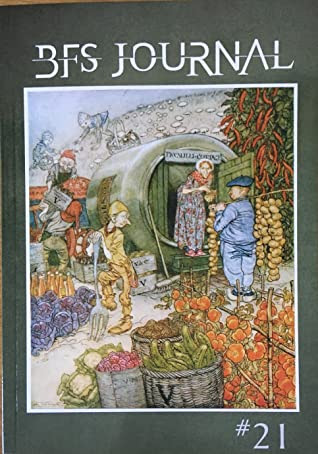
BFS Journal #21, by Sean Wilcock and Sarah Deeming (eds) (The British Fantasy Society) | review by Stephen Theaker

At the time of writing (July 2020), it’s been four years since the release of a new issue of the BFS Journal was last mentioned on the British Fantasy Society’s website, and almost four years since the society last announced a new issue on Twitter, but new issues are still being regularly released.

The last issue I reviewed was BFS Journal #18, edited by Allen Stroud (see TQF64). For this issue he moves on to Advisory Editor, while Sean Wilcock takes over as editor. Sarah Deeming is introduced as Reviews Editor, a review section making its welcome return to the publication after an absence of some years.

The first couple of articles are quite hard work. The first tries to persuade us by way of Jungian theory that mazes, water and eating are traditionally feminine. Taking a theory and shoe-horning a few cherry-picked moments from books into it doesn’t tell us anything very much about the books or the usefulness of the theory.

The second, about “Jung’s Concept of the Anima in Fantasy and Science Fiction Pulp”, has a similar problem, and puts forward the nonsensical idea that the UFO craze of the fifties resulted from a Buddhist symbol springing from the “collective unconscious” relating to “the totality of the self”. Hm.

The third article, “When Fantasy Meets Uchronie” by Pascal Lemaire, is genuinely interesting and knowledgeable, telling us about an area of science fiction I knew nothing about: French alternate histories. I’ll be reading some of them in future. It also introduced me to the excellent phrase used for vampire romance in France: bit lit.

The fourth article is a lengthy history of Ladbroke Grove counterculture, taking in people like Pink Floyd, Mick Farren and Michael Moorcock. It’s interesting – I hadn’t known for example how the Notting Hill carnival had begun – but not rigorously academic: many quotations are unsourced, and sometimes even the speaker is unidentified.

Three shorter articles include Allen Ashley’s visit to a witchcraft exhibition at Oxford’s Ashmolean Museum, Jessica Pascoe on a guided tour of Middle-Earth filming locations, and three academics talking about a seminar series on international fantasy at the University of Leeds, and setting out their mission statement.

The review section starts with a six-page review of Netflix’s The Haunting of Hill House which devotes only a few paragraphs to Netflix’s The Haunting of Hill House rather than the book. A review of the Nicholas Eames book Bloody Rose tells the reader that we might “love him or hate him”, without explaining why we might hate him.

There are also informative reviews of The Godserfs’ Trilogy, The Girl King and Dragon Heart, all of which make it clear how good (or otherwise) the reviewers thought the books were, which I always appreciate. The issue’s one editorial wobble comes with a review of Kingdom of the Wicked: Rules, which seems to have been published in an early draft.

Otherwise, the egregious errors that plagued #18 have gone, and once you get past the thirty pages of Jungian nonsense at the beginning, there are some good articles with useful knowledge to share. Also, the bibliographies now have the date immediately after the authors’ names, making them much easier to use.

Overall, a good deal of improvement since the last issue reviewed. ***

Sunday, 7 April 2019

The British Fantasy Society's monthly pdf chapbook series

Did you know that British Fantasy Society members have been getting an exclusive pdf chapbook every month for the last three years? And that they are edited by none other than Allen Ashley, one of our contributors? Did you know that anyone who joins the society can download all 36 of them from an archive? It's all true, and it only costs £20 for a digital membership!

I've been working (very slowly) on a article for TQF (or maybe a booklet) to celebrate the society's 50th anniversary in 2021, and as part of that I made the following list of Allen's short story series:
  • #1: Journal of the Eldritch Plains by Allen Stroud. 20pp.
  • #2: The Drinker of Tears by Sandra Unerman. 14pp.
  • #3: Poison Tree by Gary Couzens. 16pp.
  • #4: Feast of Fools by Nicky Peacock. 17pp.
  • #5: The Travellers by M.D. Kerr. 17pp.
  • #6: Mind of its Own by Geoff Nelder. 13pp.
  • #7: The Rat Catcher's Dance by Andrew Knighton. 13pp.
  • #8: Summer of Ants by Pauline E. Dungate. 15pp.
  • #9: You Have Reached Your Destination by Peter Sutton. 15pp.
  • #10: Ella by Jemma Picken. 18pp.
  • #11: Ash Flower by James Brogden. 12pp.
  • #12: Empire Is No More by Nigel Robert Wilson. 20pp.
  • #13: Putting on a Brave Face by Rowena Harding-Smith. 10pp.
  • #14: Mycul Zas by Clint Wastling. 26pp.
  • #15: The Contract by Lisa Farrell. 19pp.
  • #16: Milk by Rowan Bowman. 14pp.
  • #17: Only the Broken Remain by Ian Steadman. 12pp.
  • #18: Our Ghost by Sandra Unerman. 15pp.
  • #19: Elise Ridley, There Are Castles in the Sky But Not for You, M.M. Lewis. 16pp.
  • #20: The Final Act by Edmund Glasby. 17pp.
  • #21: The Boom Show by Anne Wrightwell. 13pp.
  • #22: Coquetry, She Disdained by Stephen Theaker. 16pp.
  • #23: Daddy by Rowena Harding-Smith. 8pp.
  • #24: Five Black Bolts by Michael Button. 13pp.
  • #25: The Gaze of the Abyss by Edmund Glasby. 13pp.
  • #26: Bicycle by Marilyn Thompson. 12pp.
  • #27: The Silence by Lisa Farrell. 11pp.
  • #28: Emeralds of Eros by Clint Wastling. 25pp.
  • #29: Lenore! by Cheryl J. Sonnier. 15pp.
  • #30: The Curse of Narcissus by Suzy A. Kelly. 16pp.
  • #31: The Manual by Robin Lupton. 15pp.
  • #32: Soul Cages by Lucy Stone. 17pp.
  • #33: Next in Line, by A.N. Myers. 9pp.
  • #34: Afore the Master by Suzy A. Kelly. 7pp.
  • #35: Ice Heart by Marilyn Thompson.
  • #36: Monster for Hire by Jason Gould. 20pp.
Worth £20 on their own, quite apart from the other benefits of BFS membership, and I hear that #22 is particularly good!

Sunday, 21 October 2018

British Fantasy Awards 2018: the winners (and my guesses!)

The British Fantasy Awards have just been announced, at FantasyCon 2018 in Chester. I kept my thoughts about what might win to myself until now, since I might be thought to have inside knowledge about the juries I wasn't on. I didn't – there was no crossover between the jury I was on and any of the others – but better safe than sorry. Note that the jurors given below are those that were originally announced; I haven't seen any announcements that anyone dropped out or was replaced, but it is possible. So here, after the fact, are the guesses I made, and more importantly the actual winners:

Anthology
Winner: New Fears, ed. Mark Morris (Titan Books)
My guess: New Fears, ed. Mark Morris (Titan Books)
Jurors: Adam Baxter, Pauline Morgan, Pete Sutton, Maz Wilberforce, Virginia Wynn-Jones

Artist
Winner: Jeffrey Alan Love
My guess: Victo Ngai
Jurors: Ruth Booth, Alex Gushurst-Moore, Helen Scott, Catherine Sullivan, Tania Walker

Audio
Winner: Anansi Boys, by Neil Gaiman, adapted by Dirk Maggs for Radio 4
My guess: Tea & Jeopardy (Emma Newman and Peter Newman)
Jurors: Susie Prichard-Casey, William Shaw, Allen Stroud

Collection
Winner: Strange Weather, by Joe Hill (Gollancz)
My guess: Tender: Stories, by Sofia Samatar (Small Beer Press)
Jurors: Richard Barber, Peter Coleborn, Katherine Inskip, Shona Kinsella, Laura Langrish

Comic/Graphic Novel
Winner: Monstress, Vol. 2, by Marjorie Liu and Sana Takeda (Image)
My guess: Tomorrow, by Jack Lothian and Garry Mac (BHP Comics)
Jurors: Ed Fortune, Emily Hayes, Elaine Hillson, Kiwi Tokoeka, Susan Tarrier

Fantasy Novel (the Robert Holdstock Award)
Winner: The Ninth Rain, by Jen Williams (Headline)
My guess: The Ninth Rain, by Jen Williams (Headline)
Jurors: David Allan, Rebecca Davis, Michaela Gray, Caroline Hooton, Kirsty Stanley

Film/Television Production
Winner: Get Out, by Jordan Peele (Universal Pictures)
My guess: The Good Place, Season 1, by Michael Schur et al. (Netflix)
Jurors: Kimberley Fain, Theresa Derwin, Craig Sinclair, Gareth Spark, Paul Yates

Horror Novel (the August Derleth Award)
Winner: The Changeling, by Victor LaValle (Spiegel & Grau)
My guess: The Changeling, by Victor LaValle (Spiegel & Grau)
Jurors: Charlotte Bond, Sarah Carter, Amy Chevis-Bruce, Ross Warren, Mark West

Independent Press
Winner: Unsung Stories
My guess: Unsung Stories (George Sandison)
Jurors: Stewart Hotston, Georgina Kamsika, Aleksandra Kesek, Joni Walker

Magazine/Periodical
Winner: Shoreline of Infinity, ed. Noel Chidwick
My guess: Black Static, ed. Andy Cox (TTA Press)
Jurors: Colleen Anderson, Helen Armfield, Dave Jeffery, Alasdair Stuart, Chloƫ Yates

Newcomer (the Sydney J. Bounds Award)
Winner: Jeanette Ng, for Under the Pendulum Sun (Angry Robot)
My guess: R.J. Barker, for Age of Assassins (Orbit)
Jurors: Eliza Chan-Ma, Elloise Hopkins, Steven Poore, Erica Satifka, Neil Williamson

Non-fiction
Winner: Gender Identity and Sexuality in Science Fiction and Fantasy, ed. F.T. Barbini (Luna Press)
My guess: No Time to Spare: Thinking About What Matters, by Ursula K. Le Guin (Houghton Mifflin Harcourt)
Jurors: Laura Carroll, Lee Fletcher, D Franklin, Emeline Morin, Graeme K. Talboys

Novella
Winner: Passing Strange, by Ellen Klages (Tor.com)
No guessing required, I was on this jury, and it was a very enjoyable experience!
Jurors: Joel Cook, Alicia Fitton, Susan Oke, Rosanne Rabinowitz, Stephen Theaker

Short Fiction
Winner: Looking for Laika, by Laura Mauro (Interzone #273)
My guess: Four Abstracts, by Nina Allan (New Fears)
Jurors: Andrew Hook, Terry Jackman, Juliet Kemp, Tim Major, Sam Mohsen

The Special Award (the Karl Edward Wagner Award)
Winner: N.K. Jemisin
My guess: I had no idea.
Jurors: the BFS committee (currently Katherine Fowler (BFA admin), James Barclay, Phil Lunt, Andy Marsden, Lee Harris, Shona Kinsella, Tim Major, Allen Stroud, Helen Armfield, Neil Ford, Karen Fishwick, Allen Ashley and Christopher Teague; though not everyone necessarily takes part and the committee can change over the course of the year).

A Legends of FantasyCon award was also announced. This isn't a British Fantasy Award; it's awarded by the FantasyCon committee. The winners this year were Alasdair Stuart and Marguerite Kenner.

I haven't read N.K. Jemisin's work yet, but she seems like a perfect choice for the Karl Edward Wagner Award. I do think it's a problem, though, that the BFS membership wasn't invited to make suggestions, contrary to the award rules.

Last year I guessed six right, this time only four. The current system is based on people, usually BFS members or FantasyCon attendees but perhaps less so this year, sitting down to read the nominees and deciding the awards on that basis, and that makes it hard to predict (and indeed quibble with) the results unless you've read all of them too. And this year there were more jurors than usual that I didn't know, making it even harder than usual to predict what they would like. Next year I'm going to try reading a few of the categories: it'll be interesting to see if that helps my guesswork!

Anyway, congratulations to all the winners, and all the nominees, and as a BFS member, thank you to the jurors who devoted so much of their summers to helping out with our society's awards, and also to Katherine Fowler, the awards administrator, who once again pulled it all together. I think it is a very respectable list.

Thursday, 12 July 2018

Nominations for the British Fantasy Awards 2018!

This year's nominees in what are now my second-favourite set of awards, the British Fantasy Awards, were announced last Friday, July 6.

Don't get excited, we are not nominated, I'm afraid! I did however contribute in the tiniest of ways to three of the five nominees in the magazine/periodical category during the relevant period – to the magazines Interzone (three reviews, I think) and Black Static (four reviews), and to the website Ginger Nuts of Horror (they were kind enough to host my piece shilling our Red Nose Day fake reviews). So you know who to root for!

The BFS's announcement is here, although note that at the time of writing it isn't quite accurate regarding the voting process: same as in previous years since 2011, there was only one round of voting from the members of the British Fantasy Society and FantasyCon 2017 and 2018, not two.

That was preceded by anyone interested contributing to a crowdsourced suggestions list – mostly writers, editors and publishers, looking at the way it built up day by day, in little clumps of related books and stories. I spent quite a lot of time researching suitable suggestions, checking word counts and publication dates and things like that, and it's been cheering to see many of those make it through to the shortlists.

Make sure your work is on there next year, and make sure it's in the right category!

After the voting was over, the four best-placed eligible items in each category went forward as the provisional shortlist (or five where there was an unbreakable tie), and then juries had the opportunity to add up to two additional items as egregious omissions (which could be on the grounds of quality, genre relevance, gender balance, etc).

The resulting nominees are:

Best Anthology
2084, ed. George Sandison (Unsung Stories)
Dark Satanic Mills: Great British Horror Book 2, ed. Steve Shaw (Black Shuck Books)
Imposter Syndrome, ed. James Everington & Dan Howarth (Dark Minds Press)
New Fears, ed. Mark Morris (Titan Books)
Pacific Monsters, ed. Margret Helgadottir (Fox Spirit)

Best Artist
Ben Baldwin
Jeffrey Alan Love
Victo Ngai
Daniele Sera
Sophie E. Tallis
Sana Takeda

Best Audio
Anansi Boys (by Neil Gaiman, adapted by Dirk Maggs for Radio 4)
Brave New Words podcast (Ed Fortune and Starburst Magazine)
Breaking the Glass Slipper podcast (Lucy Hounsom, Charlotte Bond & Megan Leigh)
Ivory Towers (by Richard H Brooks, directed by Karim Kronfli for 11th Hour Audio Productions)
PseudoPod podcast (Alasdair Stuart and Escape Artists)
Tea & Jeopardy podcast (Emma & Peter Newman)

Best Collection
Norse Mythology, by Neil Gaiman (Bloomsbury)
Strange Weather, by Joe Hill (Gollancz)
Tanith by Choice, by Tanith Lee (Newcon Press)
Tender: Stories, by Sofia Samatar (Small Beer Press)
You Will Grow Into Them, by Malcolm Devlin (Unsung Stories)

Best Comic / Graphic Novel
Bitch Planet Vol 2: President Bitch, by Kelly Sue DeConnick, Taki Soma and Valentine de Landro (Image)
Grim & Bold, by Joshua Cornah (Kristell Ink)
Monstress, Vol. 2, by Marjorie Liu and Sana Takeda (Image)
Tomorrow, by Jack Lothian and Garry Mac (BHP Comics)
The Wicked + The Divine Vol 5: Imperial Phase Part 1, by Kieron Gillen and Jamie McKelvie (Image)

Best Fantasy Novel (the Robert Holdstock Award)
Age of Assassins, by R.J. Barker (Orbit)
The Court of Broken Knives, by Anna Smith Spark (HarperVoyager)
The Ninth Rain, by Jen Williams (Headline)
Under the Pendulum Sun, by Jeanette Ng (Angry Robot)

Best Film / Television Production
Black Mirror, Series 4, by Charlie Brooker (Netflix)
Get Out, by Jordan Peele (Universal Pictures)
The Good Place, Season 1, by Michael Schur (Netflix)
Star Wars: The Last Jedi, by Rian Johnson (Lucasfilm)
Stranger Things, Season 2, by Matt & Ross Duffer (Netflix)
Twin Peaks: the Return, by Mark Frost & David Lynch (Sky Atlantic)
Wonder Woman, by Zack Snyder, Allan Heinberg & Jason Fuchs (Warner Bros.)

Best Horror Novel (the August Derleth Award)
Behind Her Eyes, by Sarah Pinborough (HarperCollins)
The Boy on the Bridge, by M.R. Carey (Orbit)
The Changeling, by Victor LaValle (Spiegel & Grau)
The Crow Garden, by Alison Littlewood (Jo Fletcher Books)
Relics, by Tim Lebbon (Titan Books)

Best Independent Press
Fox Spirit
Grimbold Books
NewCon Press
Salt Publishing
Unsung Stories

Best Magazine / Periodical
Black Static, ed. Andy Cox (TTA Press)
Ginger Nuts of Horror, ed. Jim Mcleod
Grimdark Magazine, ed. Adrian Collins
Interzone, ed. Andy Cox (TTA Press)
Shoreline of Infinity, ed. Noel Chidwick

Best Newcomer (the Sydney J Bounds Award)
R.J. Barker, for Age of Assassins (Orbit)
S.A. Chakraborty, for The City of Brass (HarperVoyager)
Ed McDonald, for Blackwing (Orion)
Jeanette Ng, for Under the Pendulum Sun (Angry Robot)
Anna Smith Spark, for The Court of Broken Knives (HarperVoyager)

Best Non-Fiction
Gender Identity and Sexuality in Science Fiction and Fantasy, ed. F.T. Barbini (Luna Press)
Ginger Nuts of Horror, ed. Jim Mcleod
Luminescent Threads, ed. Alexandra Pierce & Mimi Mondal (12th Planet Press)
No Time to Spare: Thinking About What Matters, by Ursula K. Le Guin (Houghton Mifflin Harcourt)
Paperbacks from Hell: The Twisted History of 70s and 80s Horror Fiction, by Grady Hendrix (Quirk)
Twin Peaks: Fire Walk with Me, by Maura McHugh (Electric Dreamhouse Press)

Best Novella
Brother’s Ruin, by Emma Newman (Tor.com)
Cottingley, by Alison Littlewood (NewCon Press)
The Murders of Molly Southbourne, by Tade Thompson (Tor.com)
Naming the Bones, by Laura Mauro (Dark Minds Press)
Passing Strange, by Ellen Klages (Tor.com)
A Pocketful of Crows, by Joanne Harris (Gollancz)

Best Short Story
The Anniversary, by Ruth E.J. Booth (Black Static #61)
Four Abstracts, by Nina Allan (New Fears)
Illumination, by Joanne Hall (Book of Dragons)
The Little Gift, by Stephen Volk (PS Publishing)
Looking for Laika, by Laura Mauro (Interzone #273)
Shepherd’s Business, by Stephen Gallagher (New Fears)

Lots of cool stuff, even if this year only five out of forty-two things I voted for made it to the shortlist! I think that's my lowest score for a while. I had really hoped to see The Adventure Zone in the audio category, and the Coode Street Podcast. I thought Amatka by Karin Tidbeck might have squeaked into best fantasy novel. Same for Legion in film/television, though that category is very strong. I thought The Book of Swords might make it into the best anthology category, but I have to admit I haven't read it yet. Bit of a shame to see two two all-male shortlists, but many categories are well-balanced.

The one real oddity I'm aware of is that Stephen Volk's domestic thriller The Little Gift is up for best short story, because as far as I could tell there wasn't any fantasy in it at all (it's about a bloke who has an affair). Maybe other people thought the mean cat was a demon or a reincarnation or something? There is another thriller on the best horror novel shortlist, but I was assured by none other than Ramsey Campbell that there is a fantasy element to that one.

The jurors have also been announced:

  • Anthology: Adam Baxter, Pauline Morgan, Pete Sutton, Maz Wilberforce, Virginia Wynn-Jones
  • Artist: Ruth Booth, Alex Gushurst-Moore, Helen Scott, Catherine Sullivan, Tania Walker
  • Audio: Susie Prichard-Casey, William Shaw, Allen Stroud
  • Collection: Richard Barber, Peter Coleborn, Katherine Inskip, Shona Kinsella, Laura Langrish
  • Comic/Graphic Novel: Ed Fortune, Emily Hayes, Elaine Hillson, Kiwi Tokoeka, Susan Tarrier
  • Fantasy Novel (the Robert Holdstock Award): David Allan, Rebecca Davis, Michaela Gray, Caroline Hooton, Kirsty Stanley
  • Film/Television Production: Kimberley Fain, Theresa Derwin, Craig Sinclair, Gareth Spark, Paul Yates
  • Horror Novel (the August Derleth Award): Charlotte Bond, Sarah Carter, Amy Chevis-Bruce, Ross Warren, Mark West
  • Independent Press: Stewart Hotston, Georgina Kamsika, Aleksandra Kesek, Joni Walker
  • Magazine/Periodical: Colleen Anderson, Helen Armfield, Dave Jeffery, Alasdair Stuart, ChloĆ« Yates
  • Newcomer (the Sydney J. Bounds Award): Eliza Chan-Ma, Elloise Hopkins, Steven Poore, Erica Satifka, Neil Williamson
  • Non-Fiction: Laura Carroll, Lee Fletcher, D Franklin, Emeline Morin, Graeme K. Talboys
  • Novella: Joel Cook, Alicia Fitton, Susan Oke, Rosanne Rabinowitz, Stephen Theaker
  • Short Fiction: Andrew Hook, Terry Jackman, Juliet Kemp, Tim Major, Sam Mohsen

There are a lot of names I don't recognise, but that's not a bad thing. I don't subscribe to the idea that the jurors need to be famous writers – they just need to be keen readers. Great to see lots of female jurors involved. Interesting that there is a quartet of BFS committee members on the juries this time, something the society has often tended to avoid, given the conflict of interest concerns that led to the introduction of the jury system.

I'm there on the best novella jury. It's been an extremely enjoyable experience – an excuse to prioritise reading! We had only a fortnight or so to consider our egregious omissions, so I had a hectic time reading as many likely candidates as I could. Once that was over, it only took a couple of days to read all the nominees, so I've been idling rather since then. A big difference from last year, where I had a year's worth of 2000 AD to read at this stage!

Fun as it has been both times, I don't think I'll volunteer again next year. Other people should get a chance – if you have the same people on the juries over and over things can get stale – and also because I'd like to do what I did back in 2009, and read and review a category or two as a summer reading challenge on the blog next year.

Anyway, best of luck to all the nominees! The winners will be announced on October 21, at FantasyCon 2018. Ticket information here. If you would like to vote in next year's British Fantasy Awards, join the British Fantasy Society. A bargain at £20!

Thursday, 5 November 2015

Interzone #261: coming soon!

Interzone #261 will be out soon, and it features my review of If Then by Matthew De Abaitua, plus lots, lots more that you can read about here.

I've also been putting together BFS Horizons #2, which features among many other things a cover from our own Howard Watts. The only way to be sure of getting a print copy of that is to join the society before the issue goes to press, but, if you can't join right now, ebook versions will be available in the society's archive.

Wednesday, 12 August 2015

Pork pies in the gardens: my FantasyCon 2014

FantasyCon 2015 is coming up soon. Not sure yet if I'll be there this year, but if you're on the fence about going and wondering what it's like, here's my report on last year's event, originally written in November 2014 for the BFS Journal #13.

Eating a pork pie in the lovely grounds
of the Royal York Hotel.
Friday

I wasn’t in a great mood heading off for this year’s FantasyCon, which took place from September 5 to September 7. The plan had been to go with Mrs Theaker and both children, but a school entrance exam on Saturday torpedoed that plan, and so I made my way to York alone. The hotel (a charming Premier Inn five minutes from the convention hotel) already had the children’s beds ready, so that made me rather glum.

But the 75% reduction in Theakers at the convention had some benefits: I saved a good deal of money, and I didn’t have to wait till the kids were back from school to set off. So I arrived at the hotel in good time for the opening ceremony. It was overshadowed by the absence of Graham Joyce, obviously not a good sign given what we already knew of his health. FantasyCon chair Lee Harris filled in, and introduced us to Kate Elliott, Toby Whithouse, Charlaine Harris and Larry Rostant, each of them taking a turn to make a few comments.

The first panel I attended was the end of Doctor Who: Space Messiah, where Guy Adams, Mark Morris, Juliet E. McKenna, Caroline Symcox and Joanne Harris were being moderated by Jonathan Oliver. I wasn’t there long enough to hear much, but what I heard was interesting.

Paul Cornell and Caroline Symcox hosted a FantasyCon edition of Pointless, which was very good fun. Lots of audience participation, good-natured hosts, challenging questions – even the crying of a hungry baby couldn’t spoil things. It was nice to see an event at which regular attendees (as the contestants) were the main focus of attention.

I didn't spend much time in the dealers' room, not having much money free to spend or anywhere in the house to keep any books I might buy, but I was surprised to see one blogger selling off pristine, unread review copies and ARCs for a pound each. Selling ARCs is frowned upon at the best of times, never mind doing it in direct competition with booksellers and publishers in the same hall.

In the evening I was on my first panel since 2010 (panels not being something I ever volunteer for), my first ever as an actual panellist, on “Awards and their value. What are they good for? Which are the important ones? Who really benefits?” The moderator was Glen Mehn, who did a brilliant job of bringing everyone into the conversation. The other panellists were publisher Simon Spanton, agent Juliet Mushens, and author Charlaine Harris (who talks exactly like Sookie in True Blood), which meant there was a wide range of views on the panel. Apologies if I spoke too loud – I didn’t realise there were microphones!

What I learnt then about preparing for a panel is to focus on your own position and perspective; that’s why you’re there. The publisher, author and agent talked about how awards affected them, so all my notes covering those angles were useless. I should have concentrated on what awards mean to me as a reader, a fan and an awards administrator.

There wasn’t much programming at this convention for later in the evenings, certainly none of the entertainingly blotto midnight panels I’ve attended in the past. I spent a bit of time in the Joel Lane bar, where a karaoke began. Many attendees proved to be skilled in the art of making tuneful noises come out of their mouths, not least the FantasyCon chair himself.

Once it got to the point that most of the singers taking part were young women, I felt any further interest I showed in the event might be open to misinterpretation, and headed up to the main bar to send some maudlin texts to Mrs Theaker and make notes for the AGM. I got a delicious pizza from the bar, and had a good chat with the BFS’s new events organiser Richard Webb, who seems like a very sensible chap, as well as some other nice people whose names I failed to note.

Saturday

“The Pen vs the Sword” (“Writers who also happen to be swordfighters discuss the myths and realities of the sword in fiction – and demonstrate their skills with the blade!”) featured Marc Aplin as moderator, with Fran Terminiello, Juliet E. McKenna, Adrian Tchaikovsky and Clifford Beale on the panel. The discussion was fascinating, and extremely useful for anyone whose fiction features people fighting with melee weapons. (So pretty much everyone at FantasyCon!)

Fran Terminiello and Juliet E. McKenna
show us how to fight.
The only problem was that they left it a bit too late to get onto the meat of the practical demonstration, and took it into the adjoining room, which tempted away much of the potential audience for guest of honour Charlaine Harris’s conversation, and it made quite a racket until the doors were solidly closed.

Adele Wearing soldiered on, and did a great job of interviewing Harris, who cheerfully laid out the failures that led to her current success. It was good as well to hear that her political differences with Alan Ball, and the direction in which he had taken True Blood, hadn’t affected her respect for him as a writer.

I left the panel “Surprise!” (“Why do some shock twists leave an audience in awe and others make them feel cheated?”) as soon as a panellist said “I’m sure everyone knows the ending of…” because it was clearly going to be a spoiler-heavy hour, and I’m the kind of person who doesn’t read the Radio Times listings till after I’ve seen Doctor Who. My own silly fault: what was I expecting?

Charlaine Harris and Adele Wearing
in conversation.
“Beyond Grimdark” (“Is the trend for mud, misery and moral bankruptcy on the wane in SFF, and if so, what’s next?”) featured a certain amount of eyerolling on the panel as one panellist explained why his novel really did need a rape scene, because it was an integral part of his female character’s story.

“She Ain’t Heavy, She’s My Sister” was I think my least favourite event of the convention, with the moderator Roz Kaveney and one panellist talking at length between themselves, even to the point of leaning back to literally talk behind the back of the panellist sitting in the middle. It didn’t feel well-prepared, the moderator not having many questions, and the panellists unable to offer many examples of female friendships in fantasy and seeming to assume they don’t exist.

All seemed a bit odd to me, given that my television had been tuned by the children to the “female friendships in fantasy” channel for the whole of the school holidays: Winx Club, Monster High, Ever After High, the Tinker Bell movies, The Wizards of Waverley Place, Aquamarine, H20: Mako Mermaids, Rainbow Magic, Every Witch Way, etc.

I haven’t read any books by guest of honour Kate Elliott yet, but listening to her in conversation was enough to make me want to change that. (The forthcoming Very Best of… looks like a good place to start.)

I left the panel “Who’s Missing?”, a discussion about authors you should be reading, fairly soon after it began, because my stomach was threatening to drown out the panellists. After eating, I arrived late for “Tea and Jeopardy” with Toby Whithouse, and entrance was denied (or at least discouraged) because it was so full. A shame for me, but good that the event was so popular. I suppose if you asked the three hundred or so people at FantasyCon for their favourite writers, you’d get hundreds of different replies, but podcasts are more like television and films, in that they are not so numerous and there’s more commonality.

Latimer, the butler from Tea and Jeopardy, stayed on to be scoremaster for my favourite part of FantasyCon, “Just a Minute”, hosted by Paul Cornell. The guests were Kate Elliott, Stephen Gallagher, Gillian Redfearn and Frances Hardinge, and what made it so enjoyable is that this year they played it for real, with challenges flying thick and fast. Stephen Gallagher’s win was well-deserved.

If my fellow Theakers had been there, the FantasyCon Disco (sponsored by Gollancz) might have been another highlight of the convention. As it was, I looked on with a frown for a few seconds and scarpered upstairs.

That took me to the Super Relaxed Fantasy Club, a long, free-form event at which I felt rather like an intruder. At the beginning, everyone sat in a circle and took turns to say who they were, receiving a round of applause in return. It felt a bit culty, a bit happy-clappy, but it was a good event to have at FantasyCon, because it got lot of people talking and gave anyone (like me) who didn’t fancy the bar scene a chilled-out, friendly place to go. The interview with Gollancz’s Simon Spanton was fascinating, with readings from Laura Lam and Edward Cox being warmly received. The latter talked about how his novel had been completely rewritten to make it more commercial.

By the second break in SRFC I was pretty worn out and approaching a certain level of grumpiness, and I had the AGM in the morning, so I headed back to the hotel and watched Solomon Kane on TV. (Not a great movie, but better than expected.)

Sunday

Sunday morning we had a short meeting of the BFS committee in the bar, and it was good to meet the people I’ve been working with for the last year. The AGM (on a bit later this year, at 11 a.m.) was rather less fun, because I refused to change one of my proposals to suit everyone else, leading one attendee to yell, “They’re not your awards, Stephen!” No, but it was my proposal and I’m glad I didn’t change it, even if that meant it failed! I’d rather have the proposal I wanted fail than have a proposal I didn’t want go through in my name.

The awards ceremony was in the afternoon, after the banquet. I missed the beginning of the banquet, because I was gluing the names of the award-winners onto the awards – which were still a bit sticky. Next year we’ll know to get them unpacked sooner so that they have time to dry. But I soon caught up and the food was the best I’ve had at a FantasyCon banquet. The ceremony itself went a bit haywire at first, with the PowerPoint setup getting muddled up – at one point thumbnails of all the slides appeared on screen at once. But host Paul Cornell handled it all with grace and aplomb.

I had to go on stage to accept the prize for best comic or graphic novel, on behalf of Becky Cloonan for Demeter. Slight panic in that Paul, when reading out the nominees, did not say the name Demeter in the way I’ve said it all my life. What to do? Say it his way or mine? I assumed he was right and said it his way, but felt my inner nine-year-old scowling at my capitulation. He knows I’m always right, even when I’m wrong.

So that was my FantasyCon. I’m not really a convention person, I think. I’m not a pub person either, and the social side of a convention feels like a big pub to me. But there were lots of interesting panels to attend, lots of interesting panels I didn’t have time to attend, and a very pleasant, welcoming atmosphere. It was good to see so many new faces on the panels. Elsewhere, I was constantly amazed at how generous people were with their time (and how often talking to people would garner choice nuggets of gossip!). It’s not really my thing, socially, but approached as a work convention for my publishing hobby I found it very useful.

I was right about one thing, the Very Best of Kate Elliott was a very good place to start – I recommend it highly! FantasyCon 2015 will take place 23–25 October 2015, at the East Midlands Conference Centre and Orchard Hotel, Nottingham, UK. FantasyCon is one of the cheapest conventions around, especially for BFS members, and even more so if you book early. Even now, tickets are only £55 for BFS members. Join the convention here.

Friday, 4 April 2014

BFS Journal #11: out now!

Sorry that things have been so quiet on the TQF blog this year – paying work has been keeping me very busy (can’t and won’t complain!) but work is progressing on the next issue of Theaker's Quarterly Fiction – and about 25 reviews I have at various stages of unreadiness.

One distraction has been that I was asked to help out on the BFS Journal for a couple of issues after it had stalled, to give the new managing editor time to train up. You can only get this 184pp paperback if you’re a BFS member, but we’ve ordered a handful of extra copies, so if you join today there’s still a chance of getting it.

Sarah Newton is the editor of this issue’s fiction:

  • The Switch, Mark Lewis
  • Electricity, Gary Couzens
  • Pawnarchy, Mark Huntley-James
  • The Eden Paradigm, Allen Ashley and Madeleine Beresford
  • A Barrow on the Border, Rima Devereaux
  • The Need to Create, Emma Newman
  • The Lost Name, Sandra Unerman
  • Baby 17, Jonathan Oliver
  • The Long Hard Road Out of Hell, M.E. Lerman

Stuart Douglas edits the non-fiction:

  • Jennie Gyllblad, interviewed by Max Edwards
  • Freda Warrington, interviewed by Alex Bardy
  • The Adventures of Brak, Mike Barrett
  • Tim Powers, interviewed by Stuart Douglas
  • Nick Campbell on The Child Garden
  • Forbidden Fruits, Ray Cluley

And Ian Hunter edits the poetry:

  • Cybernetic Mary, Deborah Walker
  • Protecting Veil, Megan Kerr
  • A Paranormal Romance, Allen Ashley

There’s also a controversial editorial by Max Edwards, a controversial chairman’s chat by Mark Barrowcliffe, and a BFS news section that has not yet attracted any controversy (but maybe no one has read it yet). Cover art by Jennie Gyllblad.

Saturday, 1 February 2014

BFS Journal #10, out soon

During January I helped out on organising and typesetting #10 of the BFS Journal. It’s one hundred and sixty-eight pages of fantasy fun, weirdness and even a dash of controversy, edited by Max Edwards, Sarah Newton, Stuart Douglas and Ian Hunter.

Contributors include Al Kratz, Allen Ashley, Anne Lyle, Anne Shah, Anton Sim, Cav Scott, Clare Le May, David Buchan, David Gullen, Erik T. Johnson, Gary Budgen, Jaine Fenn, James Barclay, Juliet Boyd, Juliet McKenna, Mark Barrowcliffe, Mike Chinn, Paul Magrs, Pye Parr, Richard Farren Barber, Stuart Douglas, Tammy O’Malley, Zoe Gilbert and frequent TQF contributor Douglas Thompson.

The cover art, originally from Blood and Feathers: Rebellion by Lou Morgan, is by Pye Parr, who is interviewed by Cavan Scott about his work on that and other books.

BFS periodicals aren’t generally available to non-members. However, we ordered 25 spares and they will be sent out to new members and renewals as long as stocks last, along with two BFS exclusive hardback anthologies, The Burning Circus and Unexpected Journeys, edited by Johnny Mains and Juliet McKenna respectively. Contributors to those books include Kate Elliott, Stephen Volk, Muriel Gray and Adam Nevill. Join here.

Saturday, 7 December 2013

British Fantasy Awards 2014: add your favourites to the eligibility list!

I'm running the British Fantasy Awards again next year. I plan for voting to begin on 1 January 2014, so now is the time to add your favourite works of 2013 to the BFS's eligibility list:

Submit your items here: http://tinyurl.com/suggestions2014

They will appear on the list here: http://tinyurl.com/list2014

You do not have to be a member to contribute to the list.

The list is especially short on newcomers, magazines, films/tv, comics and artists, so get racking your brains. Last year I could tell that a lot of voters were using the list – the text of many votes had been copied and pasted from it.

And check the list for your own work. Let me know about any mistakes, typos, misattributions, etc you spot so that I can correct them. Last year a mention of "Subterannean Press" made it all the way to an actual awards envelope before I finally noticed it. Some proofreader I am!

Unfortunately this great magazine of ours, all the marvellous stories and non-fiction and artwork we publish, and any books we put out are all ineligible, because of my involvement. I know, it sucks, we'd be sure to win otherwise. But anything fantastical you've published elsewhere during 2013 is eligible.

Tuesday, 17 September 2013

Theakerly thoughts #6: audiobooks on Kindle, author firewalls, Mike Barrett

Thought 1. I’d forgotten how much I liked listening to audiobooks on my Kindle v.3 (the grey ones, now renamed Kindle Keyboards). Unlike an iPod it has little speakers that are fine for speech, and there’s a headphone jack for playing the books out to stereos, speakers and headphones. The older Kindles are even compatible with Audible files, and keep your place in them. Best of all, you can’t do anything else with the device while you’re listening. I have a bad habit of playing an audiobook on, say, the iPad, then wondering what else I could do while listening, and five minutes later turning off the audiobook because I’m reading a newspaper article and not paying the book any attention. You can’t do that with the old Kindles.

Thought 2. Ironic that the staunchest defender of an author who dived into a comment thread to set a reviewer straight is the same fellow who said this last May when explaining why he doesn’t review self-published books:

We don’t know how you’ll react. The erratic behaviour of the author mentioned in [another article] is a strong illustration of why we don’t read self-published authors. We don’t have a firewall between us and the writer. Books from publishing houses that don’t have any self-published books give a level of detachment between what we write and the reaction we’ll get.”

So last year it was all about firewalls and detachment from the author’s reaction, this year “I welcome author’s [sic] comments” and those who don’t are bullies. Perhaps it’s different when the author is relatively famous.

Thought 3. During the all-too-brief time I edited Dark Horizons for the British Fantasy Society, some of my favourite articles were those by Mike Barrett on the history of fantasy and horror publishing. Some of those articles, plus several others, have now been collected in an Alchemy Press collection, Doors to Elsewhere, with an introduction by Ramsey Campbell. The articles were carefully researched, educational and well worth your time. More information here.

Wednesday, 30 January 2013

What contributors did next #2

Last April I interviewed Rhys Hughes for the British Fantasy Society’s journal. Due to production problems the journal wasn’t published until September, and Rhys finally received his contributor copy this month. All a bit frustrating, but the interview turned out well and Rhys blogs about it here.

Ace reviewer Jacob Edwards takes a turn as Andromeda Spaceways Inflight Magazine editor with #55, and includes fiction from Tom Holt, Stephen Gallagher, Deborah Kalin and Lisa A. Koosis, among others, as well as an interview with Glen Duncan and a “musical interlude” with Richard O’Brien. More details here.

David Tallerman’s novel Crown Thief is now out, a sequel to the very enjoyable Giant Thief (reviewed by me here), and a third in the series will follow soon. He’s written an interesting article on his late realisation that the first two books failed the Bechdel test: read it here.

(I realised a while ago that there was a similar problem with my Howard Phillips novels, and became quite maudlin till I realised it gave me an excellent plot for the fifth book. Well, I say excellent – excellent by the standards of my Howard Phillips novels..!)

Richard Ford, who contributed “Dead Gods” to Dark Horizons #55, has a new novel Herald of the Storm coming from Headline. It’ll be out in April this year. For more info see his blog: www.richard4ord.wordpress.com.

Our cover artist extraordinaire Howard Watts has set up a DeviantArt page, including some TQF cover pieces. Prints available! Here’s the link: http://hswatts.deviantart.com/

Thursday, 10 January 2013

Shelflings #4: one hundred and fifty pages of fantasy reviews!

An email will shortly going out to BFS members with download links for issue four of Shelflings, the BFS's electronic reviews ezine. In response to popular demand there is now a pdf version available as well as the usual mobi and epub ebook versions.

This 150pp issue collects reviews originally appearing on the British Fantasy Society website in October, November and December 2012, by Carl Barker, Catherine Mann, Chris Limb, Craig Knight, David Brzeski, David Rudden, Elloise Hopkins, Glen Mehn, Guy Adams, Jim McLeod, Katy O’Dowd, Laurel Sills, Mario Guslandi, Matthew Johns, Pauline Morgan, Phil Ambler, Phil Lunt, R.A. Bardy, Rebekah Lunt, Steve Dean and Stewart Horn.

Saturday, 15 September 2012

Shelflings #3 is imminent!

Shelflings is a British Fantasy Society members-only ezine compiled by me from reviews edited by Craig Lockley, Phil Lunt and Jay Eales for the BFS website.

Links for downloading issue three will soon be emailed out to members, so, if you're one of them, make sure the BFS has your current email address on file, especially if you didn't receive the emails sent out for previous issues. Send updates to the BFS membership secretary at secretary@britishfantasysociety.org. If you're not a member, this would be a perfect time to join.

Wednesday, 15 August 2012

Shelflings #2 - NOT available for free download from the British Fantasy Society!

The British Fantasy Society has made issue two of its reviews ezine available for free [accidentally, as it turns out - see below] to the general public. That means you!

SHELFLINGS #2 has been compiled by Stephen Theaker (me!) from reviews edited by Craig Lockley, Phil Lunt and Jay Eales for the British Fantasy Society website. It features almost 30,000 words of reviews by Carl Barker, Chris Limb, Craig Knight, David A. Riley, David Brzeski, David Rudden, Elloise Hopkins, Glen Mehn, Jacob Howard, Jay Eales, Katy O’Dowd, M.P. Ericson, Mario Guslandi, Matthew Johns, Mike Chinn, Pauline Morgan, Phil Lunt, R.A. Bardy, Rebekah Lunt, Selina Lock, Steve Dean and Stewart Horn.

Thursday, 10 November 2011

Sword Man on a one-star Goodreads rampage!

Returning to the blog for a minute – and no, my novel isn't going well at all, thanks for asking! – to note that Goodreads has got itself an amusing new anonymous member, going by the moniker of Sword Man, who has been handing out one star reviews like he or she bought a big box of them at a fire sale.

See if you can spot a connection between the people whose books are getting slammed:

  • The Taken, Sarah Pinborough
  • Torchwood: Into the Silence, Sarah Pinborough
  • A Matter of Blood, Sarah Pinborough ("Really badly written")
  • Zombie Apocalypse, Stephen Jones (ed.)
  • Mammoth Book of Zombies, Stephen Jones (ed.)
  • Mammoth Book of Vampires, Stephen Jones (ed.)
  • Shadows Over Innsmouth, Stephen Jones (ed.)
  • The Art of Coraline, Stephen Jones 
  • Department Nineteen, Will Hill
  • The Deluge, Mark Morris ("Weak")
  • The Silent Land, Graham Joyce ("Dull Characters and an unoriginal setting")
  • TQF36, Stephen Theaker [and John Greenwood] (eds.)
  • TQF Year OneStephen Theaker (ed.)
  • TQF Year TwoStephen Theaker [and John Greenwood] (eds.)
  • TQF Year ThreeStephen Theaker [and John Greenwood] (eds.)
  • TQF Year FourStephen Theaker [and John Greenwood] (eds.)

Most of the reviews were posted on October 16, with a few more added today after I started following his/her reviews. S/he has also voted two of Sarah Pinborough's books onto the Worst Books of All Time list.

But you'll be glad to hear Sword Man is not all negative!

Sword Man has, just in case you haven't made the connection to the BFS awards brouhaha yet, given five star reviews to Sam Stone ("She calls hersle the New Queen of Vampire Ficion on her website and I'm inclined to agree"), Raven Dane ("Well written and a golly good read") and Rules of Duel from Telos.

The highlight for me is the one-star review of Theaker's Quarterly Fiction: Year Two, which states:

"This man really has no clue at all when it comes to reviews and reviewing. It seems to me that Theaker enjoys writing self-indulgent twaddle - nasty gibes - and spends most of his time writing negative, not informative reviews. I haven't seen one he's written that I would say I agreed with."

The funny thing is that there are no reviews in that book. None whatsoever!

Sword Man strikes – and fails!

The irony is that this is exactly the kind of behaviour that seems to have got the BFS and its awards into hot water into the first place. So while Sword Man may feel like s/he is hitting back, s/he is really just confirming that people were right to suggest that there might be a bit of a problem.

Saturday, 29 October 2011

The British Fantasy Awards kerfuffle: a view from a former awards admin

My post from September 2010 on Withdrawing TQF from the British Fantasy Awards now seems unfortunately prophetic, given the doorway the BFS and its awards walked into at FantasyCon a year later. Among other things I said (emphasis added in bold):

"The BFS is now taking recommendations for next year's awards, and I've decided to withdraw Theaker's Quarterly Fiction from the Best Magazine/Periodical award for as long as I'm the awards administrator, or as long as I'm the editor of the magazine – whichever tenure comes to an end first. …

That's partly because I'd have been profoundly embarrassed to win the award over a shortlist that included for example Black Static and Interzone, magazines to whom, for all our good qualities, we can't hold a candle. But also because a win for us in that category would have cast not just my integrity into doubt, but the integrity of the entire awards."

Monday, 10 October 2011

The British Fantasy Society

The British Fantasy Society is going through a rough patch at the moment, which has prompted me to get out this piece I wrote for the FantasyCon 2010 souvenir booklet; perhaps it might encourage people to get involved with the society. The publications and people have changed, as has my own level of involvement, but my feelings about the society haven't. 

Thanks for coming to FantasyCon, the annual convention of the British Fantasy Society. If you’re not a member of the Society, no worries, you’re more than welcome – like Radio 4, we judge ourselves by our reach as much as our ratings! But if this weekend you enjoy the camaraderie of FantasyCon, note that being a member of the Society means you get that happy feeling all year round – or at least in four quarterly mailings.

We’re a really ambitious little society. For our size we really try to do a little too much at times: ten or so publications a year, fourteen awards, a three-day annual conference, a short story competition that’s doubled in size two years running, and other events through the year and around the country, not to mention a website and forum. This past year we’ve been stretched quite thin, but I hope you’ll agree that this convention was worth a few hiccups in other areas.

For our promotional postcard for the World Horror Convention this year I picked out a quote from Stephen Jones, from our anniversary book, The British Fantasy Society: a Celebration. “Whenever a fledgling horror or fantasy writer comes up to me, at a convention or somewhere else,” he wrote, “and asks me how they can get their work published, I invariably advise them that their first step should be to join the British Fantasy Society.”

Joining the BFS isn’t enough on its own to make you a great writer, of course (at least it hasn’t worked for me!), or to get you published, but that isn’t what he means. What it will do is give you the opportunity to talk (or at least listen, which is perhaps the better option at first) to experienced writers, editors, publishers and artists, and learn from them. People like Jo Fletcher, Peter Crowther, Les Edwards, and our glorious President-for-Life Ramsey Campbell.

And those are the professionals: the BFS is also rich with people doing all the same things for fun in their spare time. You couldn’t spill a pint of beer at FantasyCon or a BFS Open Night without drenching someone who’s up to something creative! Writers, actors, jewellers, sculptors: the BFS is a social network – a creative network – that began to bring interesting people together thirty years before Facebook opened for business.

One other great thing about the BFS: it’s a really easy society to get involved with. I’d been a member for just a year before being offered the editorship of Dark Horizons in March 2008, and a member less than three years when I became chair (albeit temporarily), after Guy Adams stepped down to concentrate on this year’s convention. It’s a clichĆ© that working on a committee like this is thankless, but that’s not been my experience at all: there’s the odd complaint here and there, many of them perfectly justified, but I’ve had bucketfuls of gratitude as well.

(And when the complaints you get are from people like Robert Silverberg (he was chasing up a book), bring them on! Though perhaps that’s a bad example: he could have been emailing to insult my children and I’d still have been delighted.)

And if all of that sounds far too much like hard work, just sit back and appreciate the results of our hard work: we’ll send you a bundle of varied reading materials every three months. Prism contains dozens of reviews every issue, often of unusual books and films that don’t attract the attention of other magazines. Dark Horizons and New Horizons leapfrog through the year, the former bringing poetry, fiction, articles and art across all the fantastic genres, the latter focusing on slipstream, new writers and new approaches. And once or twice a year we produce special publications to stop things getting too routine. Recent years have brought chapbooks, calendars, literary criticism, original fiction, and all sorts of unusual, collectable items.

But that’s what we do, rather than what we’re about. Ours is a society built very much on love. Stop laughing. It is. It may seem like we argue quite a lot for people in love (though as Brian Keene recently observed, we argue very politely!) but that’s because we’re all in love with slightly different things, and have very strong ideas about them. Science fantasy like Moorcock and Vance, weird fantasy like Machen or Lovecraft, heroic or high fantasy like Howard or Tolkien: this is a society that was founded to celebrate all of them. Even more, it’s here to help people discover new books and new writers in a similar vein.

In the age of the internet, is there a need for a fantasy society – can we not just congregate on websites? Well, we can, and we do, but a society feels so much grander! Once upon a time, Conan and Cthulhu appeared in the same magazine, Weird Tales. As bookshops and publishers push us apart, slotting authors and books into ever-narrower, more easily marketable categories, the BFS is needed more than ever, to bring us back together again, to celebrate the fantastic genres as a whole, and, sometimes, to celebrate those writers who don’t fit neatly into boxes.

Stephen Theaker
September 2010

www.britishfantasysociety.org
www.facebook.com/britishfantasysociety
twitter.com/britfantasysoc

Saturday, 1 October 2011

A few thoughts on BFS Journal #4

The new issue of the BFS Journal arrived in the post this week, looking very handsome in its Clive Barker cover art. I haven’t read any of the fiction yet (it generally takes me ages to get around to reading it all), so I won't review it properly, but here are my thoughts so far...

I’ve enjoyed David Riley’s seven Prisms (although I’m very pleased that his replacement will be Lou Morgan). For one thing, he’s published an awful lot of my writing! This issue’s Prism section, his last, has a solid seven pages by me (pages 57 to 63), all written at speed over a weekend thanks to a last minute deadline change.