Showing posts with label Two-Star Reviews. Show all posts

Thursday, 19 March 2026

It Waits in the Woods by Josh Malerman (Amazon Original Stories) | review by Douglas J. Ogurek

There’s a line between suspense and annoyance – this story crosses it. 

Josh Malerman’s It Waits in the Woods is the third instalment in Amazon’s creature feature series of short stories written by high-profile horror writers. 

The story’s first problem is inherent in its title. Haven’t we seen enough of these monster in the woods stories? This time, the threat is a faceless creature – Malerman calls it an “imp” – that lures people and takes their faces. Add a bridge. Add a mirror. Insert enough of these tropes and hopefully the reader will assume some symbolic significance.

When her sister and another girl go missing, aspiring filmmaker Brenda travels into the woods and films her quest to find her sister. Her aim is to go where police and parents haven’t gone.

The story repeatedly reminds the reader that during a television broadcast, Brenda’s parents partly blamed her for her sister’s disappearance. All right already, I thought to myself, I get it! 

There comes a point when hammering the reader over the head with the same information knocks you out of the story. 

Despite these shortcomings, It Waits in the Woods gets more suspenseful as the climax approaches, thanks to Malerman’s strong storytelling abilities. His cinematic writing style makes it difficult to turn away. Alas, this strength is only exhibited for a brief portion of an otherwise banal story. Douglas J. Ogurek **

Monday, 8 September 2025

Megalopolis | review by Rafe McGregor

Self-reflexive or self-indulgent?


Like many Anglophone readers of my generation, I suppose, I first came across ‘megalopolis’ in one of the many Judge Dredd comics published in 2000 AD magazine during the 1980s. The word was used to describe Dredd’s beat, ‘Mega-City One’, a gargantuan city covering the Eastern Seaboard of North America from Miami to Quebec City. I assumed both ‘megalopolis’ and ‘mega-city’ were science fiction inventions, but the Oxford English Dictionary taught me otherwise. ‘Megalopolis’ was used as far back as 1828, as a synonym for ‘metropolis’, and is now more commonly used to describe the contiguous built-up area formed when metropolises expand into one another (beginning with Los Angeles in the 1960s). ‘Megacity’ came much later, in 1967, and identifies a metropolis with more than 5 million residents (beginning with the Dallas-Fort Worth conurbation). In case anyone is interested, the biggest megacity in the world is currently Tokyo, with a population of approximately 39 million, and the biggest megacity in the US, New York, with 19 million. The setting of Francis Ford Coppola’s Megalopolis is ‘New Rome’, an alternative, future New York, and the title also alludes to megalon, a material or mineral with magical properties that can regenerate and restore both cities and the people that live in them. When the narrative opens, protagonist Cesar Catalina (played by Adam Driver) has recently been awarded a Nobel Prize for his creation of megalon.

I first heard about Megalopolis long before it was released in September 2024 – not because of any especially effective marketing strategy, but because of the conditions of its conception and production. Coppola began thinking about it in the late 1970s and began work on it in the early 1980s. The original idea seems to have been something like a cinematic Ulysses (1922), James Joyce’s monumental reimagining of Homer’s Odyssey in 1904 Dublin (which is, in my opinion, the greatest novel ever published and ever likely to be published). Joyce’s source material was the most celebrated story ever told in the Western canon (or the second most celebrated, if you prefer the Iliad, which most scholars don’t), but Coppola’s was a curious choice. He had already tried something similar with Apocalypse Now (1979), a magnificent reimagining of Joseph Conrad’s brilliant novella, Heart of Darkness (1899), in South-East Asia during the Vietnam War. Megalopolis would, in contrast to both Apocalypse Now and Ulysses, reimagine a historical event, the Catilinarian conspiracy in the Roman Republic of 63 BCE, in a faintly futuristic New York. The conspiracy was an attempted coup d’état by Catilina, aimed at seizing power from consuls Cicero and Hybrida, and never passed into popular culture. (Though I consider myself an amateur historian, I had to look it up). Perhaps more problematic, where the monstrous complexity of Ulysses is to at least some extent clarified by knowledge of the Odyssey, knowledge of the historical conspiracy actually complicates the film: the fictional Catalina is called ‘Cesar’, but (Julius) Caesar (who is absent from the film) played a historical part; the attempted insurrection is by Clodio Pulcher (played by Shia LaBoeuf) whereas Clodius Pulcher opposed the coup; Hybrida and Cato have no fictional counterparts and there are several major characters without historical counterparts. Notwithstanding, Megalopolis is a reimagining, of Fritz Lang’s Metropolis (1927), one of the first feature length science fiction films and one of the greatest films ever screened.

By the turn of the century, Coppola had decided he would fund his ‘passion’ (or perhaps ‘vanity’) project himself and began shooting cityscapes of New York. At the turn of the next decade, he started writing the script. Eight years later, on the day before his 80th birthday, he announced that he’d finished the script, raised $120 million for a budget, and was ready to start interviewing actors. Filming began in 2022 and rumours of Coppola’s erratic behaviour soon spread, followed by allegations that he was under the influence of cannabis for lengthy periods, had sexually assaulted extras, and exceeded the budget by $16 million. It’s difficult to know how much of this to take seriously, but when I read about it, the whole enterprise reminded me of Frank Pavich’s Jodorowsky’s Dune (2013), a documentary about Alejandro Jodorowsky’s unsuccessful attempt to film Frank Herbert’s novel, Dune (1965), in the 1970s. Jodorowsky’s venture was hubristic to the point of insanity, ethically dubious, and doomed to failure, although the documentary acquired both critical acclaim and a cult following. Immediately after watching Megalopolis, I discovered that Coppola commissioned director Mike Figgis to make a documentary of the making of his film, which was released this month as Megadoc (2025). I wonder if Coppola’s motivation for the documentary was vanity or finances? Probably a bit of both.

Megalopolis begins with truly masterful exposition: we are shown almost everything we need to know about what will follow in the first 12 minutes (of 133 from opening to closing credits). One is simultaneously struck by the film’s idiosyncratic yet impressive style, a unique combination of filmed theatre, tasteful CGI, breathtaking cinematography, and beautiful mise-en-scène. Very quickly, we learn that Catalina has a utopian vision for New Rome at odds with Mayor Franklyn Cicero (played by Giancarlo Esposito) and the ability to stop time, which works on everyone except for Cicero’s wayward daughter, Julia (played by Nathalie Emmanuel). The plot is briskly set in motion when Catalina’s ambitious girlfriend, television presenter Wow Platinum (played by Aubrey Plaza), realises he is still in love with his dead wife and seduces his aged uncle, Hamilton Crassus III (played by Jon Voight), the wealthiest man in New Rome. Meanwhile, Crassus’ son, Pulcher, a spoiled wastrel jealous of the success of everyone around him, is desperate to make a name for himself. The ingredients are all simmering in the pot and our appetites whetted for making a meal of what follows. Shortly over half an hour in, the stakes are established as the question of whether or not Catalina will succeed in realising his architectural and humanitarian dream and all of Cicero, Wow, Pulcher, and Catalina’s self-destructive guilt about his wife’s death framed as antagonists or obstacles. Later, Wow Crassus and Pulcher will emerge as the villains of the piece. Later still, they join forces and become an apparently unstoppable dystopian threat that raises the stakes and heightens the tension in an altogether satisfying way. So, what goes wrong?

I noted that the reimagined history was confusing. The pseudo-Roman setting constitutes part of Coppola’s distinctive style, which is pleasing on both the eye and the ear, but otherwise pointless. The same is true of the very limited advanced technology that seems to have been responsible for the film being classed as science fiction. While megalon is the means by which Catalina intends to realise his vision, that means could just as easily have been an imagined but mundane mineral or a fictional but plausible construction method. Similarly, the sole purpose of Catalina’s ability to stop time as far as the plot is concerned is to show that there is a genuine connection between him and Julia once they fall in love. If I appear overly critical of the film’s retrofuturism, the categorisation as science fiction in particular brings with it certain expectations, for example that the film will to at least some extent be about advanced technology or about the psychological or political impact (or both) of that technology. Futuristic megalon is as incidental as Catalina’s superpower and, like the Roman retrospection, serves a stylistic function, providing Coppola with the opportunity to present some (once again) aesthetically pleasing CGI. To remain with the plot a little longer, the story is very much that of Catalina’s ambition and the film a vehicle for Driver as Catalina. In that part, he either lacks the charisma or does not bring enough of it to this performance to engage and enthral the audience for the quantity and quality of his screen time. I found myself much more interested in Julia and Wow, watching the narrative as a tug of war between two powerful women with Catalina relegated to the role of the rope. As a final criticism of the plot, once all is lost for Catalina and Julia, the tables are turned by Crassus in a scene that is absolutely ridiculous. I think it’s meant to be amusing rather than dramatic, a deliberate parody of itself, but it’s neither tense nor funny and falls flat.

If Megalopolis is not about the Catilinarian conspiracy and/or its contemporary counterparts or the impact of advanced technology such as megalon, then what is it about? I mentioned Metropolis earlier and while there are several references to Lang’s masterpiece (and no doubt some that I missed), Megalopolis does not share its themes. Aside from a few superficial mentions of immigrants being unwelcome and some gratuitous police brutality, Coppola fails to offer a perspective on social justice and does not represent class conflict or even class consciousness. With politics, technology, and justice stripped away, there isn’t very much left. A theme that emerges with admirable speed in the expert exposition is some elaboration of the relationship between time and creation, the latter in the sense of artistic creativity. As the narrative progresses, a link is established with first utopian desire and then romantic love, all bound up within a temporal horizon. Early in the second half of the film, Catalina tells Julia, ‘I can’t create anything without you next to me’ and one is inevitably reminded of Coppola’s wife of six decades, Eleanor, to whom the film is dedicated and who died shortly before its release. The tyranny of time, the inspiration and perspiration of creation, dreams of a better way of life, loving as a way of living…Megalopolis is a film about itself, about the trials and tribulations of its own creation. Coppola has fictionalised his creative process from conception to production, creating an almost entirely self-reflexive epic. And while that doesn’t make it a poor film, it does mean that it doesn’t have very much to say to its audience, not much more than we could find in Megadoc anyway.

The critical response was initially described as ‘polarised’, but reviews have been largely negative, the only notable exception being Sight and Sound magazine, who placed Megalopolis 17th on their list of the best 50 films of 2024. To me, ‘polarised’ suggests something broad in scope and rich in depth, a work of boldness and ambition that will either flop or be recognised as a work of genius but could never be mediocre. I just don’t see this kind of greatness in it. There are plenty of highlights – Coppola’s style, the slick start, Emmanuel and Plaza’s performances – but more lowlights and Megalopolis is neither a magnum opus nor a nadir. The film has 45% on the Tomatometer, which is not unfair, though I do wonder if critics would have been more generous if they didn’t know that it was the product of 50 years of work. Unfortunately for Coppola, it was also a major commercial failure, only recouping £14.3 million at the box office and costing him $75.5 million by May 2025. At the time of writing, Coppola is 86, which suggests that this is his last film. While it’s a shame to see a career end this way, we should not forget that he is the genius who brought us all three Godfathers, Apocalypse Now, The Outsiders (1983), and Bram Stoker’s Dracula (1992), among many others. I hope he doesn’t forget either.**

Sunday, 17 August 2025

Millionaires Day by Kit Power (French Press Publishing) | review by Stephen Theaker

We cannot be sure if the phenomenon extends beyond Milton Keynes – there is a news blackout – but it seems that everyone in that city who was asleep at 8.04 am on 22 December 2019 woke up with a suitcase containing a million pounds beneath them. You might wonder why, but this novella isn’t very interested in that. Instead, it concerns itself with how various ne’er-do-wells try to get their hands on other people’s suitcases, and how those others try to escape them.

At first we follow three main characters, each of whom hands us off at various points to other people. Henry is a homeless man sleeping in an underpass. He tries to get a first class train to Glasgow but is spotted by police officer Luke, who has been falling out of love with his husband for a while now, ever since their attempt to use a woman as a surrogate fell through. The mother kept her daughter, and the court hasn’t ordered contact despite Luke being the biological father.

Friday, 1 August 2025

Envy by Ash Ericmore | review by Stephen Theaker

Envy is a 45-page, eight-chapter novella, the first in a series of seven about the deadly sins, self-published by the author (with a nod to his Patreon supporters) over the summer of 2025. The Amazon blurb tells us each novella will focus on a different female lead. I don’t think we ever learn the name of this book’s lead character, and if it weren’t for the Amazon description I don’t think we would know her sex for certain either, but I’ll assume for the purposes of this review that the description doesn’t lead us astray.

She lives in a tall, lonely tower block, obsessed with the local drug dealer and his gym-built muscles. He’s called Tony, and she knows that because her neighbour Miriam shouts it several times a night, in the throes of passion. Our protagonist gets in the lift with him at one point, and hopes to be propositioned if not ravished, but he just asks if she wants to buy some drugs. She seems to assume that any man looking at her does so with sexual interest, and perhaps her sleazy anime fan boss is, but he’s not what she’s after.

Wednesday, 25 June 2025

Rollerball | review by Rafe McGregor

Rollerball, by Norman Jewison (20th Century Fox) 

Another Golden Anniversary.

While Jaws turned fifty with much hype and fanfare last week, including here at Theaker’s Quarterly Fiction, it’s Rollerball’s turn today, albeit without the bells and whistles. I’m not sure how, but in spite of being both a science fiction and James Caan fan and familiarity with the premise, I’d never seen the film. I’ve always had a soft spot for Caan’s onscreen persona, an underrated, understated, effortless tough guy tough guy with a very distinctive style (he reminds me of John Wayne, though where Wayne is always in the Old West no matter what part he’s playing, Caan is in a big city somewhen in the nineteen seventies). Caan’s performances in all of The Godfather (1972), A Bridge Too Far (1977), Thief (1981), and Misery (1990) are inspired and Rollerball revolves entirely around him as Jonathan E(vans), the first and only superstar of the world’s most dangerous and popular game in 2018 (forty-three years in the future).

Rollerball’s screenplay was written by novelist William Harrison, who developed it from a short story called ‘Roller Ball Murder’, which was first published in Esquire in 1973. The world of 2018 is a utopia rather than dystopia, a planet of plenty where everyone literally has everything they want and nation states have been replaced by multi-national corporations that coexist in a state of avaricious harmony following a little-talked about and possibly even erased event known as the Corporate Wars. The competitiveness essential to unrestrained capitalism is, it seems, channelled into rollerball in an international tournament in which teams from various cities clash in a spectacle of bloody and vicarious violence for the players and audiences respectively. The actual game is a combination of inline speed skating and Basque pelota with a couple of motorbikes thrown in and the rules are changed regularly to make it more brutal. The top-ranked team is Houston, courtesy of Jonathan’s skill and resilience, and the inciting incident occurs when he is told to retire by the chief executive officer of the corporation running the game (if not the world), Mr Bartholomew (played by John Houseman), who is revealed as the narrative’s antagonist.

There are a couple of things that strike one immediately watching Rollerball fifty years later. First, the extent of the explicit critique of global capitalism with the gloves off. The capacity of the Hollywood film industry to make money from apparently resisting a system of which it is such an integral part never ceases to amaze me…and has been at work for a lot longer than I thought. Second, the science fiction trope of a utopia that turns out to be a dystopia as soon as the surface is scraped is becoming rather dated. It is much easier, for example, to imagine the worlds of Mad Max (1979), Blade Runner (1982), Strange Days (1995), and Children of Men (2006) as or in our future than a land of plenty where we all keep ourselves busy with shopping, pill-popping, and rollerball.

Jonathan doesn’t want to retire and one is never sure why. His lavish lifestyle would not change at all, his existential exploration of the conflict between comfort and freedom is somewhat limited, and he must be nearing the end of his shelf-life anyway. The only plausible explanation is an obsession with the adoration of the bloodthirsty crowds, but even this isn’t entirely convincing. The conundrum exposes one of the two flaws in the film, which may have accounted for a critical reception that did not match its commercial success and has left it with a fair 57% on Rotten Tomatoes: Jonathan is simply not a particularly sympathetic character. (This is not one of Caan’s best performances.) The second is just as damaging. Given that the genre of the film is some mix of action, thriller, sports, etc., the representation of rollerball is really poor. The cinematography and stunts fail to convey the speed and danger of the game, which ends up looking quite camp with its players modelling their rollerskates, leather pants, and almost invisible cosmetic scars. I’ve watched ice hockey games on television that look more dangerous and there isn’t a single missing tooth in Rollerball. The film isn’t terrible, but it’s not great entertainment either.

Talking of ‘terrible’… Rollerball was remade by John McTiernan and released in 2002. Coming from the director of Predator (1987), Die Hard (1988), The Hunt for Red October (1990), The Thomas Crown Affair (1999), and Basic (2003), I was surprised to see the film’s impressive 3% on the Tomatometer. As if that isn’t bad enough, the Los Angeles Times also claimed it was one of the biggest commercial failures of all time. The remake starred Chris Klein, LL Cool Jay, and Jean Reno, all of whose performances I usually enjoy, but Klein was fresh from his role as a lacrosse player in American Pie (1999) and American Pie 2 (2001) so that might be the first clue to avoid it. I’m glad I watched the first Rollerball, but I won’t be wasting seventy-eight minutes of my life on the second.**

Friday, 3 January 2025

Vampire Hunter D by Hideyuki Kikuchi (DH Press) | review by Stephen Theaker

This review originally appeared in TQF73 (April 2023).

Far in our future, long after a nuclear apocalypse, the effects of which were leavened by the intercession of vampires (who then ruled us for millennia), a seventeen-year-old girl, Doris, finds herself at the centre of attention. Count Magnus Lee, an ancient vampire, wants to make her his wife, to his own daughter's dismay. The mayor's oafish son also wants to marry Doris. And Rei-Ginsei, the boomerang-wielding leader of a bandit troupe, takes a fancy to Doris too.

Friday, 22 November 2024

Kill or Cure, by Pixie Britton (Matador) | review by Stephen Theaker

This review was originally written for the previous British Fantasy Society website, and then appeared in TQF65 (December 2019).

The first few chapters of this zombie YA novel are quite run-of-the-mill. Alyx, a seventeen-year-old girl, is desperate to help her poorly younger brother. Back in 2042 or so their parents were eaten by zombies – the Infected – which have successfully taken over the world, leaving humans eking out life in small villages, at risk of being overrun. Alyx has sneaked into the woods to look for medicine. It all feels overfamiliar, as if at every step the decision was made to follow the most obvious route. Then, after his infection is discovered and they are forced to run for their lives, and just when Alyx is ready to send her brother up the stairs to metaphorical Bedfordshire one last time, something unexpected happens. The boy doesn’t turn into a zombie, he morphs...

Friday, 21 June 2024

New Suns: Original Speculative Fiction by People of Color, edited by Nisi Shawl (Solaris Books) | review by Stephen Theaker

This review originally appeared in Interzone #281 (May–June 2019).

When asked about the lack of diversity in their books, English anthology editors all too frequently declare that the quality of the individual stories is all that matters. But if every story had the same plot and the same theme their individual quality would do nothing to stop the anthology from being very dull. Excellent books like We See a Different Frontier and The Apex Books of World SF have shown how diversity of contributors contributes to the quality of an anthology, not least because it tends to contribute to variety in the stories.

Monday, 3 June 2024

Halloween Ends | review by Douglas J. Ogurek

Halloween ends? Let’s hope so.

Whenever a film or television scene involves a man positioned behind a woman and showing her how to hit/shoot/operate something, my cliché radar goes off – a bad sign for the rest of the programme. This radar bleeped rapidly in Halloween Ends when troubled protagonist Corey (Rohan Campbell) sat behind love interest Allyson Strode (Andi Matichak) and showed her how to operate a motorcycle. Vroom vroom. Dumb.

In the original Halloween (1978), Michael Myers, with his jumpsuit, heavy breathing, expressionless white mask, economic movements, and unexplained drive to kill Laurie Strode (Jamie Lee Curtis), carved out a new kind of horror film. He not only spawned countless knockoffs, but he also reappeared in eleven subsequent films within the franchise. Though I haven’t seen all of them, I was intrigued by the bold claim inherent in Halloween Ends (2022) – that the franchise would draw to a close. After watching it, I hope it does – the movie had more flaws than a months-old pumpkin. 

The year is 2019, and Myers’s decades-long psychological grip on the provincial residents of Haddonfield, Illinois remains strong. Nobody is more aware of the serial killer’s spell than Laurie, who continues to live there with her adult granddaughter Allyson while writing her dull memoir consisting of meaningless talk about evil.

The movie does offer an intriguing opening sequence in which Corey, who hopes to study engineering, babysits a bratty boy. What happens derails Corey’s life and earns him a negative reputation among the townsfolk. This, coupled with his overprotective mother and detached father, causes Corey’s life to spiral out of control. 

After witnessing Corey get assaulted by younger higher school students, Laurie decides he’d be a good match for her granddaughter. Not very perceptive. Allyson, remarkably well-adjusted despite her parents being killed by Myers, wants to help Haddonfield’s zero-prospect scapegoat overcome his problems. Corey, now working at his father’s mechanics shop, is going down a dark path thanks to the influence of a certain figure he encounters. 

The film, laden with the typical clichés and foreshadowing as conceived by a child, gets increasingly ridiculous until it culminates in an ending worthy of a musical – it seemed as if the characters were about to break into song.

One of the only interesting aspects of Halloween Ends is that the high schoolers who repeatedly antagonise Corey are not the expected jocks or punks, but rather members of the marching band. It shows how pathetic Corey is. Douglas J. Ogurek **

Wednesday, 22 May 2024

The Night Parade by Ronald Malfi (Kensington) | review by Douglas J. Ogurek

Plague story infected by lack of action and conflict.

The Night Parade, yet another outbreak story, introduces Wanderer’s Folly, a disease that enrages people, makes them lose their minds and eventually kills them. Moreover, the birds have disappeared, and insects are getting larger. 

English professor David Arlen and his eight-year-old daughter Ellie, holding a shoebox with unhatched bird eggs, hit the road after wife/mother Kathy dies in hospital. David is convinced that Kathy was immune to the disease and that the medical establishment tested her to death. Now, those same individuals want to get their hands on Ellie, who has a blossoming special power. 

David, who may or may not be infected with Wanderer’s Folly, disguises Ellie as a boy, and they drive around aimlessly until David decides he wants to go to a relative’s house. Like many fictional children, Ellie displays unrealistic intelligence and wisdom beyond her years. 

Although there are tense passages and the ending ratchets up the action, the novel suffers from stagnation and meaningless scenes and dialogue. The main characters wander around and converse about uninspiring topics. Their psychological underpinnings are weak, and most goals are short-lived. The Night Parade also includes superfluous backstory about the early days of Wanderer’s Folly and Kathy’s death. Moreover, the novel gets bogged down in details that do not support the plot. We do not need, for instance, a step-by-step explanation of David dyeing his hair black. 

When the characters finally get to a potential conflict, Malfi effectively keeps the reader guessing whether strangers’ hospitality is genuine or feigned for some nefarious purpose. Additionally, some characters’ physical characteristics – droopy eyes or lanky bodies, for instance – add to the realism of scenes. Another creepy detail: when face masks run short, some people resort to cheap plastic Halloween masks, while others wear paper plates with eye holes cut out. 

The Night Parade is just as much about a father’s willingness to accept his daughter’s point of view as it is about a rampant disease. Unfortunately, the novel’s wavering nature detracts from the story. Douglas J. Ogurek **


Tuesday, 7 May 2024

Cemetery Boys by Aiden Thomas (Swoon Reads) | review by Douglas J. Ogurek

Young adult novel muddies message of acceptance with lackluster writing.

Sixteen-year-old Yadriel, a trans gay boy (born female, identifies as male, attracted to males) and member of a Latinx family, wants more than anything for his East Los Angeles brujx (a gender-nonconforming variant of the Spanish bruja/o, meaning “witch” or “sorcerer”) community to accept him as a brujo (a male who finds lost spirits and sends them to the afterlife). He plans to do this by summoning the ghost of his murdered cousin Miguel, then guiding him to the afterworld. Alas, Yadriel’s father holds firm to tradition, which prohibits people born female from becoming brujos — they must develop into brujas. The only two who seem to wholeheartedly embrace Yadriel’s identity are his cousin and friend Maritza and his uncle.

Thus, Cemetery Boys is a young adult novel about transitioning, from the spirit world to the afterlife, from female to male, and from one mindset to another.

The trouble begins when Yadriel, accompanied by Maritza, inadvertently summons the ghost of high school classmate and reputed gang member Julian Diaz. Yadriel wants to use his special knife to cut the magical thread that binds Julian’s spirit to Earth and therefore send him to the afterlife. But Julian begs for Yadriel to hold off so he can make sure his friends are okay. Yadriel relents, flaunts the brujx rules, and takes the “reckless and beautiful” Julian through various obstacles while attempting to avoid detection by most people (who can’t see Julian) and Yadriel’s magical kin (who can). 

Yadriel and Julian get to know each other and their shared inner struggles. Clearly, Yadriel is attracted to Julian, who, despite his immaturity, unconditionally accepts Yadriel as a boy. But it seems the feelings aren’t necessarily mutual. Author Aiden Thomas adds tension by setting a deadline: if Yadriel doesn’t send Julian over by Día de Muertos (the Day of the Dead) in just a few days, Julian’s spirit might turn maligno.

The message that this book attempts to convey is a good one. The story, however, falters. It suffers from several repeating elements that become grating. Examples include physical gestures (lip biting, arm crossing, hand raising) intended solely to punctuate dialogue, an obsession with Julian’s dark eyes, meaningless chatter, and frequent mentions of Yadriel’s binder to remind the reader he was born female. Thomas’s excursions into the rituals and foods of Día de Muertos also cause the story to drag, and melodramatic speeches worsen an ending that stretches out too long. Douglas J. Ogurek ** 


Monday, 15 April 2024

Geethanjali Malli Vachindi | review by Stephen Theaker

A much more stylish sequel to the 2014 Telugu film Geethanjali, this 15-rated horror comedy from first-time director Shiva Thurlapati introduces us to an unattractive, middle-aged street food vendor hoping to persuade the military father of his very young girlfriend that he’s a catch worthy of her, even though he obviously isn’t. To this end, he proudly declares that within a year he will be respected by everyone, that they’ll all be calling him “sir”: he is about to star in a film! Unfortunately, the purported director – played by Srinivasa Reddy, returning from the first film – has no film in the works, and has in fact been bilking the vendor to support himself and his two writers.

Friday, 5 April 2024

Every Day, by Jesse Andrews (Orion Pictures et al.) | review by Stephen Theaker

This review originally appeared in TQF65 (December 2019).

“A” is a being of unknown origin who wakes up in a different human body every day, one that’s about the same age as A. When asked if he or she is a boy or a girl, later in the film, A says, “Yes.” I suppose it doesn’t make sense to talk about being male or female if you don’t have a body. Or, to put it another way, in a male body A is male, and in a female body A is female, rather like Doctor Who.

Wednesday, 6 March 2024

Cackle by Rachel Harrison (Berkley) | review by Douglas J. Ogurek

Aimless woman desperate for a man finds mysterious woman desperate for a friend in dully taught lesson on female autonomy.

Cackle is a call for women to stop kowtowing to men and to develop their own voices. Unfortunately, excepting a charming spider and some unruly teens, the story isn’t all that interesting.

Tuesday, 9 January 2024

The Final Girl Support Group (Berkley) by Grady Hendrix

Disjointed, drawn-out and dull mystery comments on society’s obsession with violence toward women in film.

The Final Girl Support Group details Lynnette Tarkington’s journey from justifiable paranoia and reclusiveness – she’s a two-time survivor of attacks from killers who wiped out people close to her – to a focus on being part of a group and helping others. The novel also explores a collective obsession with films in which women get mutilated and murdered by crazed men, as well as why attractive, able-bodied white women dominate the final girl stereotype.

Lynnette, whose best friend is a plant, belongs to the Final Girl Support Group led by therapist Dr Carol Elliot. Each group member is the sole survivor of a killer’s rampage. Their ordeals have also spawned horror films whose storylines echo those of classics such as Scream, The Texas Chain Saw Massacre, Halloween, and Friday the 13th. The most entertaining final girl is the drug-abusing Heather, an abrasive type who drops f-bombs and isn’t beyond flicking a cigarette butt into a swimming pool.

When Lynnette, whose own brutal Christmastime trial inspired Slay the Halls (invented by the author), suspects someone is trying to kill everyone in her group, she goes on high alert and tries to warn the others. As the talky first-person narrator gets closer to unveiling the killer, the danger intensifies. 

Throughout the novel, author Grady Hendrix interweaves snippets from different fictitious sources such as horror fanzine articles, scholarly film critiques, text from the back cover of a VHS tape, and police interview transcripts. Despite their attempts to create a commentary on the horror genre’s fixation with harming women, these asides detract too much from the main story. All this shifting about makes it hard to get invested in Lynnette or the other characters. 

Several drawn-out scenes lack compelling content. When Lynnette is in a car with a teenage girl, for instance, nothing happens to advance the story. The two seem to repeat the same basic ideas just to keep the story going. 

The novel’s saving grace is its focus on women uniting to combat male aggression. Another aspect worth commendation is the juxtaposition of the quick, violent deaths of horror films with the slow, exhausting deaths of reality.—Douglas J. Ogurek **


Friday, 15 December 2023

Office Invasion | review by Douglas J. Ogurek

If you like dumb, watch this horror/sci-fi/comedy mash-up. If you like humour, don’t.

Melusi Nkosi (Kabomo Vilakazi), the merciless new leader at mining company AMI, takes some extreme cost-cutting measures that put the three heroes of Office Invasion in financial peril:  geologist Sam (Rea Rangaka) can’t afford medication for his ailing daughter, accountant Prince (Kiroshan Naidoo) needs to stay in the finance department for five years to get access to his trust fund and therefore escape his tyrannical father’s hold on him, and security guard Junior (Sechaba Ramphele), frustrated by his mooching flatmates, just needs to make ends meet. 

Melusi sells the South African business to an international firm represented by a patently duplicitous trio consisting of Gregory (Greg Viljoen), a chipper Australian with bad hair, Badrick (Stevel Marc), a Jamaican ready to throw down, and Anya (Aimee Ntuli), a conniving Eastern European. 

The desperate heroes hatch a plan to steal some Zulcanoid, the liquid metal at AMI mines, and then sell it to a Chinese gangster who says he’s going to use it for benevolent purposes.   

Overarching all of this is an impending alien invasion, implied by the attack that opens the film and toward which it builds. It takes a long time – too long, in my opinion – before the aliens appear. 

The film’s primary shortcoming is its lack of humour stemming from an imbalance in characters: while the leads lack the eccentricity that would have made them more compelling, the secondary characters’ performances feel overblown and derivative. The outrageously idiotic Paul (aka Knobface), for instance, is clearly a rip-off of Brick (Steve Carell) in the Anchorman series. 

The protagonists have their moments, the best of which involve Prince and Junior showing their frustration. Prince has visions of extreme violence, but they seem tossed into the film for no other reason than to shock the viewer. 

Most of the scenarios in which the trio finds themselves end up feeling stagnant. When Junior loses his gun as part of the cost cuts, he gets sent to a training session where a supposed-to-be-funny-but-not-funny overly serious instructor shows security guards how to defend themselves with typical office supplies.

Office Invasion plays the typical, stale feel-good cards like victims revolting against corporate oppressors and putting the needs of others before personal needs. Yawn.—Douglas J. Ogurek **

Sunday, 22 October 2023

Leave the World Behind by Rumaan Alam (Ecco) | Review by Douglas J. Ogurek

Details and tangents detract from dystopian tale.

Something bad has happened, but what? Such is the concept that propels Leave the World Behind, Rumaan Alam’s apocalyptic novel about two families converging at a rental home in the Hamptons amid a mysterious catastrophic event. 

Many compelling works – Paul Tremblay’s The Cabin at the End of the World and M. Night Shyamalan’s Signs come to mind – have successfully used this strategy. Characters are confined to a remote location, where they speculate and gradually learn about what has happened in the larger world. 

This work, however, suffers from two major problems. First, the characters and their behaviors/conflicts are not compelling enough to keep the reader engaged. It takes far too long to get to the inciting incident (i.e., the knock on the door). Vacationers Amanda and Clay and their two nondescript children are surprised when G.H. and Ruth Washington, owners of the property, show up amid what they believe could be a disaster. 

My second gripe against this book is that Alam goes on too many tangents and whips up a whirlwind of irrelevant details. An encountered object, for instance, stops the novel’s progress and allows a character to reflect on a memory. I often found myself thinking, Wait. Why are you stopping here? Don’t tell me about that. This is most apparent at the beginning, where the author gets mired in the mediocrity of middle-aged parenthood. I don’t need a list of what Amanda’s buying at the grocery store. 

The omniscient narration compounds the problem. Although this strategy enables Alam to slip in hints about what’s happening beyond the Hamptons, dipping into each character’s head slows the progress. Moreover, the narrator tends to break into the story and state, in effect, what the character didn’t know was that [fill in the blank] was happening or what was happening was much worse than they were imagining.

Nevertheless, some details, such as changes in characters’ bodies or the local wildlife, are intriguing. The novel does get better and the tension escalates near the end, but it’s not enough to recommend this one.—Douglas J. Ogurek**


Friday, 13 October 2023

Search Party, Season 5 | reviewed by Stephen Theaker

I would usually be quite reluctant to review the fifth and final season of a television programme, given that it can be hard to do so without revealing spoilers for the entirety of the preceding episodes. But in this case I don’t think that’s a huge problem because season five of Search Party is barely connected to the previous four seasons.

Season one was basically a hipster Nancy Drew show. Dory (Alia Shawkut), Drew (John Reynolds), Elliott (John Early) and Portia (Meredith Hagner) were four aimless New Yorkers. When Dory threw everything into a search for a missing acquaintance from college, the other three were dragged along with her, with consequences both hilarious and tragic.

Seasons two to four, rather than moving on to new mysteries, explored the consequences of season one in ever-greater depth, becoming a gripping psychological comedy-thriller. It took the story in some extremely surprising directions, and to be honest I would have preferred three more seasons of hipster Nancy Drew, but it was still rather brilliant.

Season five – and stop now if you don’t want any spoilers – sees the four protagonists leave all that behind, become the leaders of a cult, start working with a Steve Jobs type played by Jeff Goldblum, who wants to sell whatever they have to the masses (or at least to investors), and then they start a zombie apocalypse. Seriously!

Reading that paragraph back to myself, I think it sounds great. I usually love it when programmes do off-the-wall things, take weird turns, and surprise me. And of course I love fantasy and science fiction television programmes more than any other kind, so why didn’t I love it when Search Party became one too?

I’m not sure. Perhaps it’s because the show abandons any sense of realistic characterisation. It almost felt like they were trying to get cancelled, as if they were sick of making it but contractually had to do more. For a show about the consequences of our actions to have people levitating felt wrong, like it undid everything that came before.

But it didn’t, really. The first four seasons are as good as they ever were, and adding a bizarre epilogue can’t change that. Perhaps I would have felt differently if I hadn’t watched all five seasons in one go on the iPlayer. If I’d watched them over the course of six years, per its US broadcast, perhaps I’d have been ready for a change of pace.

I would still say anyone watching it should watch it right to the end. Speak to me a year from now and I may have forgotten how terrible most of the episodes were, and praise the boldness of ending a television show this way. But now, I just remember how painful it was to watch. Physically so, since I spent almost the entire season frowning in dismay. Stephen Theaker **

Monday, 23 May 2022

Till Death | review by Douglas J. Ogurek

Makeup on a robot: it’s Home Alone 6, starring Barbie! 

There are two things you can be certain about in Till Death, starring Megan Fox as Emma, a chilly trophy wife who spends most of the film dragging around her husband’s corpse and dropping f-bombs. First, despite all the trials that Emma undergoes in a remote cabin in the middle of the winter somewhere in New York, her makeup will not get ruined. Second, no matter what the plot throws at Emma, her tepid responses will fail to gain the sympathy of a discerning viewer.

Emma’s lawyer husband Mark (Eoin Macken), whom she met when he successfully prosecuted the man who attacked her, is the controlling type – he tells her what to wear and what to order off the menu. Mark, who gives no indication he’s aware she’s having an affair with one of his employees, takes her on an ostensibly conciliatory getaway to a remote lake house to celebrate their eleventh anniversary. Then he dies.   

The film, directed by S.K. Dale, offers some of the mysterious note-leaving and brutality of Saw and some of the suspense of the typical home invasion story in which an underdog uses her ingenuity to try to outwit would-be killers. However, Till Death seems to be so focused on maintaining Fox’s Barbie-like complexion that it falls short in other factors. Her robotic performance leaves her cold to her husband, cold to her lover, and unfortunately, cold to the viewer. Moreover, as antagonists pursue Emma within the lake house, one wonders how hard it is for able-bodied men to find a barefooted woman handcuffed to a bloody corpse.

Most log lines about Till Death say something about a woman awakening to find herself shackled to her dead spouse. Not only does the film take too long to build up to that inciting incident, but that description leaves out a technicality that plays into the way the story evolves. Rather than building up to this scenario, a more compelling structure might have started with the handcuffed spouse discovery, then shifted between Emma’s more well-defined past and her attempts to escape. 

The most interesting, albeit weakly explored, facet of this film is the concept of the beautiful young woman kept as an object by an older, wealthier man. Perhaps Till Death would have been much better if its makers dropped the horror aspirations and injected Emma with more backstory, depth, and life.—Douglas J. Ogurek **

Wednesday, 7 October 2020

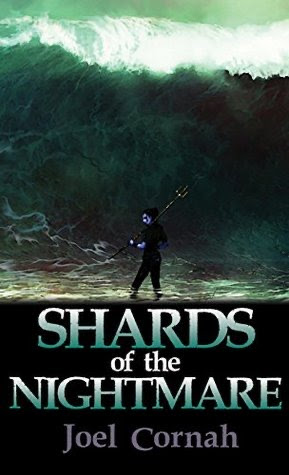
Shards of the Nightmare, by Joel Cornah (Kristell Ink) | review by Stephen Theaker

The Shards of the Nightmare are magical items; what they are shards of remains a mystery. The title also reflects the book’s structure, which throws fragments of a nightmarish life at the reader and hopes we’ll piece it together. It begins by telling us that Sininen – raised as a (somewhat stereotypical) girl on the advice of a seer named Sear the Seer – was born with blue skin and lived for centuries. Then we’re snapped back to when Sini was fifteen, still living in the fortress of Dun Coille, and the least-loved scion of an expansionist king and queen who come into possession of a magical sea-sword. A personal bodyguard, Merri, offers some friendship, before we are thrown ten years into the Sea King’s reign of terror. Confusingly Sini is still only sixteen, but perhaps I misunderstood. At this point Sini and Merri are on a quest for the shards and major developments have occurred off-screen. It feels like the reader has skipped the film and watched only the deleted scenes, but to be fair there’s zero chance I would have read a five-hundred-page version that took us step by step through each moment. It’s just too run-of-the-mill, in story, prose and ideas. The positives: Sini’s mad mum might have been interesting, if we had spent more than a few pages with her, and Merri the bodyguard was likeable, at least until she confessed to having fallen in love with a child. The conclusion, where the Sea King is effectively stabbed until he stops calling Sini his son, was also rather discomfiting. Not recommended. Stephen Theaker **