Showing posts with label Michael Moorcock. Show all posts

Friday, 12 June 2026

J.G. Ballard's World Versus U.S. – Rafe McGregor


The Worlds of J.G. Ballard

J(ames) G(raham) Ballard (1930-2009) was an English author of avant-garde fiction who published nineteen novels and novellas and one hundred short stories, many of which were controversial, prescient, or both. Very broadly, his career can be divided into two stages, science fiction and literature. The first began with the publication of ‘Escapement’ in New Worlds in 1956 and the second with the publication of Empire of the Sun, his eleventh novel, in 1984. Along with Michael Moorcock and Brian Aldiss (1925-2017), Ballard was one of the founders of the New Wave of science fiction, which originated in New Worlds magazine in the mid-nineteen-sixties and reconstituted the genre as an extension of literary modernism focused on the psychological rather than physical impact of technology. Ballard’s science fiction can itself be divided into two stages. His first four novels (or novellas, depending on one’s preferred definition) pioneered Anglophone climate fiction. The Wind from Nowhere (1962), The Drowned World (1962), The Drought (1964), and The Crystal World (1966) constitute an elemental quartet in which civilisation is threatened or destroyed by air, water, fire, and earth respectively. Ballard’s next six novels were much more experimental, putting his ideas about the relationship between the content of science fiction and formal innovation into practice, and include The Atrocity Exhibition (1970) and Crash (1973). The critical and commercial success of Empire of the Sun elevated Ballard to the literary canon and it was released as a Hollywood film directed by Steven Spielberg in 1987. Like his science fiction, Ballard’s literature can also be divided into two stages, with Cocaine Nights (1996) and his last three novels usually referred to as satire.

The last book Ballard published before his death from prostate cancer was Miracles of Life: Shanghai to Shepperton (2008), an autobiography written after his terminal diagnosis. It’s not very often that anyone, let alone a great novelist, has the opportunity to write an autobiography that will include (almost) their entire life story, but I found it for the most part disappointing. Ballard always valued his privacy and the autobiography is strangely unenlightening. The Illuminated Man: Life, Death and the Worlds of J.G. Ballard (2026), a biography that was begun by Christopher Priest (1943-2024) and completed by his wife, Nina Allan, when he died of prostate cancer in 2024, is much more revealing. In his review of Priest and Allan’s book in The Guardian, Adam Sisman concurs with my criticism of Miracles of Life by calling it ‘curiously flat’. There are certainly no insights into Ballard’s creative process or literary practice, which was what I had most hoped to find. When I discovered that his archive had been acquired by the British Library in 2010 and was now available to the public, I thought I’d try there instead, but Ballard’s reticence extended to the private sphere and his habit was apparently to destroy his notes for his fiction as soon as it was published. While the archive contains multiple drafts of multiple novels, including those of three of his four early climate fictions, much of both his process and practice remains opaque.


The J.G. Ballard Papers

In the ‘Works’ section of the archive only three of the one hundred and sixty-two files are described as projects for a new novel or working notes. The first of these is a set of four text collages that were published in New Worlds in 1978, the second a set of five spiral-bound notepads (one of which has only two pages of notes) that were probably used from 2005 to 2008, and the third five typed A4 pages, also likely dated 2005 to 2008. One of the pages, Notepad A, most of Notepad B, and a few pages each in Notepads C and D are notes for a novel that was never written, provisionally titled An Immodest Proposal or How the World Declared War on America and abbreviated as ‘VUS’ ([World] versus US). Allan recounts her visit to the archive in 2024 and discusses these notes and other materials in The Illuminated Man and it was pure chance that I visited less than a month after reading it. Something that comes across very strongly in the biography and was very useful in providing a context for the notes was the extent to which Ballard was affected by the September 11 attacks and what is now known as GWOT, the Global War on Terror.

Ballard’s notes for VUS include everything one might expect to find, from the premise at its most basic to alternative ideas for plot and character, considerations of form and content, and reflections on whether and how he could meet its particular challenges. The proposed narrative is typical of Ballard in being located in an unspecified but imminent future, taking the present rather than the future as its subject, and providing commentary on current social mores and norms. The present with which he is concerned is the increase of the US’ military footprint in response to 9/11, specifically the invasion of Afghanistan in 2001 and Iraq in 2003. Ballard does not connect these to either Panama in 1989, Grenada in 1983, or the US’ military deployments during the Cold War and seems to have regarded GWOT as an unprecedented phenomenon. He is also well aware of the symbolic significance of 9/11 and the care with which both the targets and the date of the four coordinated attacks were planned. I’ll begin my discussion of the novel by setting out the fictional sequence of events on which the narrative would be based. Unlike more precise questions of form and content, on which Ballard is often undecided, the sequence is fairly comprehensive and consistent.


VUS

The setting of VUS is a world in which the US has established an empire reminiscent of the European colonies of an earlier age. America controls all of the Middle East, including Israel, and most of the world’s oil supply. Many countries across the globe are either occupied by the US, have puppet regimes, or are sympathetic to the US. In those countries that are occupied or have puppet regimes, ‘American values are relentless enforced.’ The same values are relentlessly promoted in the countries with sympathetic governments, such as the UK and Germany. The US exerts a global hegemony by the combination of military threat and economic pressure and insists on preferential trade agreements for all of its goods, including oil. France is one of the few countries to remain openly anti-American and tries to import oil from an alternative supplier (Venezuela is mentioned at least twice). In response, the US initiates a naval blockade, which causes skirmishes at sea and anti-American civil unrest globally. There is a naval battle between the US and France, which the US wins, and the United Nations Security Council authorises military action if the US fails to abandon both its preferential trade agreements and foreign military bases. Predictably, the US refuses and the world declares war on the US, led by either the rest of the North Atlantic Treaty Organisation nations or by a combined NATO-Russia alliance.

The war that follows has three stages. In the first, which is a conventional, high-intensity conflict, the US achieves a rapid victory over NATO, using weapons of mass destruction to destroy military and civilian targets and occupying all the nations who have taken up arms against it. US global hegemony is transformed into a global empire. No Pax Americana materialises, however, as multiple insurgencies begin, starting in Iraq, Syria, and Saudi Arabia and then spreading to other countries. This second, unconventional, stage culminates in a series of coordinated attacks aimed at destroying nine icons within the US homeland. The US responds in a similar manner to its response to the declaration of war, causing mass casualties among insurgents and civilians at home and abroad. In the homeland, Black and Muslim communities are targeted, which initiates the third and final stage. Black, Muslim, and other soldiers in the US Army mutiny, violence in the homeland spirals, and America descends into a second civil war. Ballard doesn’t describe the impact of this civil war on the empire, but the implication is that it crumbles and that the world is consequently victorious against the US.

The subject of the novel at its most basic is simply ‘US imperialism’, but Ballard’s concern extended beyond military expansion to America’s dominance of global popular culture, from Hollywood to McDonald’s to Elvis and so much else. He was especially interested in the way in which this cultural hegemony was causing people to see themselves through an American lens and how this succeeded in turning other nations into ‘subservient colonies’ (without the need for puppet regimes or invasion). Ballard has various ideas about how to turn this subject into a theme, the most consistent of which is that the US would be ‘treated as Nazi Germany in 1939-45’ with no characters in the novel permitted to adopt a neutral stance. He was more certain about the characters that would drive the narrative. His initial idea was to use three ‘principle [sic]’ characters and three ‘secondary’ characters. He later refers to these six as an ‘inner core’. The characters would all be of different nationalities and the protagonist, who would be British, and three others would be men. The protagonist is an English university lecturer who teaches American Studies at a university in the Middle East and has an American wife (which is significant because it will allow him to gain entry to the homeland later on). A second principal character, also a man, would be French. The nationalities of the others would be drawn from Japan, Russia, Australia, Germany, an unspecified Muslim country, and possibly Israel. Ballard then thought that one of the women should also be British, which may have been why he expanded his central characters to seven, four men and three women. The characters would either be in professions that would bring them into direct contact with the war, such as the military, media, or medicine, or foreign workers, such as those in oil, education, or diplomacy.

Ballard started to delineate the French protagonist, couldn’t think of anything interesting, and wrote: ‘All need to be thoughtful + of heroic potential.’ He was also convinced that all ‘should have suffrered [sic] in some way from the US — —’ and these two ideas taken together suggest that a major part of the narrative would be the planning, recruitment, and execution of the coordinated attacks on American icons, some or all of which would be suicidal. He wanted to break the stereotype for people that were prepared to sacrifice themselves in this way and noted that the insurgents should be ‘educated, intellectual, even unwilling.’ Whether or not the insurgency would be led by a Muslim cadre was unclear, although his sequence of events identifies it as beginning in Middle Eastern nations. Ballard made several lists of the insurgent targets, which included a wide range from the Empire State Building to the Capitol to Las Vegas and Disneyland. Each of these would be attacked or destroyed using a different tactic, although his list of options for these only ran to eight. At one point, he refers to these as ‘psycho-targets’, drawing attention to their symbolic significance to the US and to the psychological impact of their destruction. The novel would open outside the US embassy in Grosvenor Square in London during the heightened tensions of the naval blockade. After a protest turns violent, US troops open fire on the crowd, who scatter and destroy a nearby McDonald’s in retaliation. The event would either be described in the form of a news report (assuming Ballard’s original idea for his British protagonist) or in the first person by his (alternative) British protagonist. Ballard did not state when the novel would conclude and the options appear to be either the mutiny, the civil war, or the dissolution of the US empire.

Ballard seems to have had much less of a vision as to how he would tell the story of VUS than what the story was. He planned to switch point of view among his principal characters and mix these different points of view with reportage from different media channels. He was not, however, sure whether the novel would be narrated in the first person, by the different principal (or principal and secondary) characters, and whether these narrations would be presented as individual testimonies, oral histories, or diary entries. He also toyed with the idea of opening with an academic-style introduction to the collected testimonies and reports, rather than in medias res. Beyond that, he had very little to say about specific aspects of framework, function, structure, or symbolism. Notwithstanding, his reflections on the genre of the novel are fascinating: ‘Very important Must not allow this to become s-f. That would lower its credibility & impact.’ He was similarly worried that the novel doesn’t become ‘a familiar kind of s-f story.’ Ballard’s approach to science fiction was, as already mentioned, to prioritise the present over the future for the purpose of social commentary, which he often achieved by exploring the impact of either the broader public and political world or the immediate physical environment in which each person lives on their inner, psychological world. These New Wave commitments are completely compatible with what he was trying to achieve with and in VUS so it is curious that he was so determined to avoid the novel ‘becoming’ a work of science fiction. I wonder if the clue to this apparent anomaly isn’t the dating of the notebooks, some thirty years after the decline of the New Wave. What he probably means by ‘becoming’ is ‘being labelled/sold as’ science fiction, which had become a genre very much dominated by series and franchises by the middle of the first decade of the twenty-first century. I think that what he didn’t want was VUS being sold and read as an alternative history or a dystopian or apocalyptic narrative and I’ll return to the question of genre in my conclusion.


The Illuminated Man

Ballard was both confident that his premise was strong and worried about his ability to do it justice. I find this particularly interesting coming from someone who practically invented climate fiction, had established himself as one of Britain’s greatest living authors, and already published eighteen novels and novellas. Although his belief in his ability to develop the premise into a rich and rewarding theme appeared to grow as he built up his body of notes, his modesty and diffidence are evident throughout. For example, he writes: ‘Need to add a specific spin of some kind?’; ‘Need a deeper dimension!’; ‘too depressing & reminiscent of 1984?’. More specifically, he was concerned that the novel would be too long (presumably because of its temporal and spatial scope) and with his competence in writing first person narratives from the point of view of characters from cultures distinct from his own, such as the proposed Middle Eastern, Japanese, and Russian principal or secondary characters. Both of these problems were related to the question of how to present a ‘global sense of the battle against the US?’ Ballard was also concerned about the credibly of what he called ‘The fight back’, i.e. the success of the insurgency: ‘But is it all credible if its [sic] realistically portrayed?’ I ruminated on this myself, the dichotomy between the ease with which the US wins a conventional war against the rest of the world and the speed with which the insurgency leads to the dissolution of the US empire. But I also have no doubt that Ballard would have solved this literary problem as skilfully as he had solved others in his previous novels, novellas, and short stories. He makes a quick reference to a potential solution when he writes: ‘Perhaps visualise it as a film script.’ The process of both writing the notes down and returning to read them later seem to have helped because although there is no way to be certain of the chronological order of either the notepads or notes within them, there is definitely a sense of progress, of the crystallisation of a constellation of ideas as a premise and a sequence of events become a theme and a narrative.

It’s impossible to say know whether Ballard would have proceeded with the project had he not been diagnosed with terminal cancer, but if I had to guess one way or the other I’d say yes, given the escalation of GWOT from 2005 to 2009 and beyond. VUS would definitely have been one of his most controversial novels, perhaps even more so than The Atrocity Exhibition and Crash, and I imagine he would have been accused of both glorifying 9/11 and promoting political violence. I am fairly certain that VUS would have been banned in many US states. Assuming it had been released early in the second decade of the twenty-first century, when Big Tech was achieving its own hegemony, I wonder if the publishers would have actively courted controversy to increase sales or insisted that the novel stay on the science fiction shelf. Like The Drowned World, The Drought, and many of Ballard’s other long and short stories, there is also a sense in which VUS is prescient. Mark Blacklock beat me to that point in his essay in The New Statesman, which refers to the regime change in Venezuela in January 2026 and what is currently being called the 2026 Iran war, although Ballard did not anticipate how divided the (rest of the) ‘world’ would be in the era of VUS. What I can perhaps add to Blacklock and where Ballard and I would disagree, is that this military muscle-flexing is nothing new, just part of an imperial imperative that stretches back to at least the US invasion of Grenada. That was in 1983, the year before Ballard was catapulted into the limelight with Empire of the Sun, a novel about a different empire. As the sun sets on one, it rises on another…

Sunday, 31 May 2026

Notes on Ballard's Notes from Nowhere – Rafe McGregor

J(ames) G(raham) Ballard (1930-2009) was an English author of avant-garde fiction who published nineteen novels and novellas and one hundred short stories, many of which were controversial, prescient, or both. He started his career as a science fiction writer in 1956, was instrumental in the transformation of the genre, and was admitted to the literary canon after the publication of Empire of the Sun (1984), a critically and commercially successful fictionalisation of his childhood experiences in a Japanese internment camp. His first novella, The Wind from Nowhere (1962), was part of a quartet that saw civilisation threatened or destroyed by air, water, fire, and earth and inaugurated Anglophone climate fiction. Along with Michael Moorcock and Brian Aldiss, Ballard was one of the founders of the New Wave of science fiction, which originated in the mid-nineteen-sixties and reconstituted the genre as an extension of literary modernism that was focused on the psychological rather than physical impact of technology. Ballard typically locates his narratives in the present rather than the future, explores the impact of the outer world on the inner, and provides subtle but startling commentary on social mores and norms. Although it spread across the Atlantic, the New Wave was UK-based and primarily driven by the combination of Moorcock’s editing and Ballard’s writing in New Worlds, which began as a fanzine in 1946, was taken over by Moorcock in 1964, became an anthology series in 1971, reverted to a fanzine in 1978, reverted to an anthology series in 1991, and was most recently published by PS in 2021.

The October 1966 issue of the magazine includes a short article from Ballard, ‘Notes From Nowhere: Comments on Work in Progress’, a numbered list of twenty-four notes ranging from a few words to a few sentences each. Moorcock introduced them as follows: ‘Reader interest in J.G. Ballard’s work has been high. We invited Mr Ballard to produce these notes explaining some of his current ideas.’ The level of explanation is, as one might expect from Ballard, limited, but other authors and anyone who is passionate about the creative process or science fiction as a genre is likely to find them as interesting as I did. I was lucky enough to read them in their original form, thanks to Dr Tom Dillon at the University of Liverpool’s Science Fiction Hub, which is the only dedicated science fiction archive in the UK, Europe’s largest catalogued collection of science fiction, and boasts a complete run of Theaker’s Quarterly Fiction courtesy of an anonymous donor. Tom is also the author of a cultural history of New Worlds and has an enviably rich knowledge of magazines, fanzines, and speculative fiction more broadly.

I’m not going to reproduce Ballard’s full list, which you can find on a Canadian archive of his work here, or comment on each point he makes (or sometimes fails to make), but offer five notes of my own instead. His first and longest (along with #16) is about the form of science fiction. Ballard introduces the genre with a delineation of its concern with ‘the immediate present in terms of the future rather than the past’ and claims that because of this thematic content, the standard narrative form of beginning and end, cause and effect, and exposition and resolution is inappropriate. Science fiction should be an arena for formal innovation and he comments on his attempts to play with sequentiality in The Drowned World (1962), The Drought (1964), and The Crystal World (1966), apparently ambivalent about the extent to which he succeeded in replacing temporality with spatiality in each case. This formal experimentation would come to fruition with and in The Atrocity Exhibition (1970), which included the contentious short story, ‘Why I Want to Fuck Ronald Reagan’ (1968).

The tenth note is something of a counterpart to the first, expanding his description of science fiction’s thematic content. Ballard identifies three ‘planes’: the broader public or political world, the immediate physical environment in which each person lives their life, and the inner, psychological world of each person as they live that life. He suggests that these three coordinates provide a starting point for the clarification of contemporary reality and given what he also writes about neurology, I suspect he is referring to clarification in terms of both thought and attempts to communicate thought to others through description or depiction. In combination, notes nine and fourteen establish a close but vague relation between fiction or narrative on the one hand and neurology and what is now called neuroscience on the other. I found this fascinating due to the prioritisation of narrative as a way of thinking over narrative as a mode of communication in recent research. Philosophers, literary theorists, and cognitive scientists such as Peter Goldie, Jonathan Gottschall, and Fritz Breithaupt seem to be showing that the behavioural sciences’ lack of success in evaluating the insights of literary studies is a failure of the former rather than the latter, which is surprisingly compatible with direct scrutiny of the brain’s neural networks.

Notes twenty to twenty-three are all about the failure of science fiction authors to shed light on the concept of outer space. At first glance, this may seem arrogant or flippant, but Ballard is referring to the kind of illumination he described in #10, writing about outer space in a meaningful manner, i.e. one in which the political, physical, and psychological intersect. He mentions a current work in progress about a ‘disaster in space’, which appears to be a reference to ‘The Death Module’, published in New Worlds in July 1967. The eighteenth note is a brief and obscure farewell to The Crystal World, which is probably my favourite Ballard novel and which I used as evidence for including him as a significant contributor to the tradition of weird fiction. The novel (or novella, depending on your preferred definition) was published five months before the publication of his notes, which implies that the notes themselves were submitted to Moorcock several months in advance. In summary, Ballard’s list is an excellent place to begin with his oeuvre and I’m very grateful to have had them drawn to my attention and to have been able to see them in their original form.

Friday, 11 October 2024

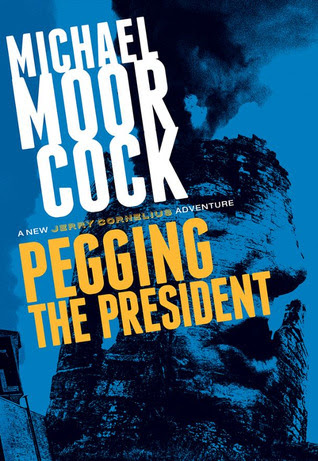
Pegging the President by Michael Moorcock (PS Publishing) | review by Stephen Theaker

This review originally appeared in TQF64 (March 2019).

Like other Jerry Cornelius stories, this brand new novella is a collage of in-jokes, allusions and references, and I doubt I caught more than one in ten of them. Your taste for that kind of thing will have a big effect on how much you enjoy the book. When I first read the Cornelius books, I found all of that funny because it seemed so random, cool and quirky. And even though I’m more used to the techniques being used, I still appreciate it. But I’m not going to pretend that I had a particularly good idea of what was going on in the story. What I did gather was that Jerry Cornelius, his friends, his family and his enemies, seemed to be slipping around in time, through different future and alternate history wars. All the favourites from the books show up: his sister Catherine Cornelius, Una Persson, Miss Brunner, Colonel Pyat, Shakey Mo, Jerry’s mum and dad, Cuban heels, Derry & Tom’s Famous Roof Garden. Even the famous needle gun makes an appearance. Jerry is still young, even though fifty years have (perhaps) passed, and he is able to do things like materialising in the seat of a car that someone else is driving. “The difference between fact and fiction”, Jerry comes to understand at one point, “[was] irretrievably blurred.” Each chapter begins with an extract: there are news items about the war in Syria, for example, and an extensive amount of It Can’t Happen Here by Sinclair Lewis, which has obvious relevance to present-day events in the USA: a capricious president who longs for the absolute power of a dictator, and a significant portion of the population also wishes he had it. It does break up the story a lot, though, and it feels as if you spend more time on the extracts than the adventure. It doesn’t help that a few of the extracts appear more than once, although that does reinforce the message. We thought we had set the ball rolling, thinks Jerry, but “all we’d done is start the pendulum”. Fans are likely to enjoy it very much, and I think it makes a pretty good entry point for those new to Jerry Cornelius – it’s no easier than the others, but it does give you a good idea of what they are like. Stephen Theaker ****

Sunday, 2 December 2018

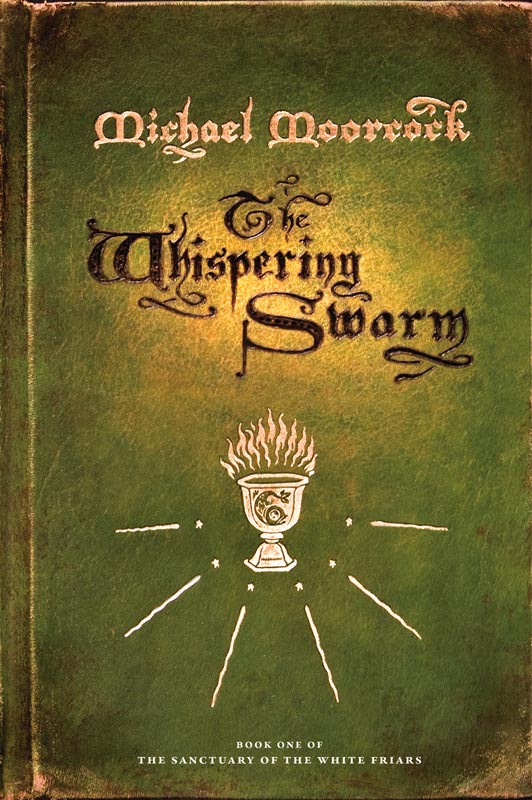
The Whispering Swarm by Michael Moorcock | review by Stephen Theaker

This book (Tor Books ebook, 7569ll) tells the story of Michael Moorcock, a hard-working writer of fantasy, science fiction and literary fiction plagued by the noise of a mysterious swarm. As a teenager, already at work in publishing, Moorcock meets Friar Isidore, who takes him to Alsacia, a magical Sanctuary with connections to all time and space by way of the moonbeam roads. There he meets people like Dick Turpin, Jim Bowie and Buffalo Bill.

Friday, 21 September 2012

Zenith Lives! ed. by Stuart Douglas – reviewed by Stephen Theaker

M. Zenith the Albino is from the rogues’ gallery of Sexton Blake, although a book with the variety and quality of Zenith Lives! (Obverse Books, pb, 2425ll, edited by Stuart Douglas, fourth entry in the Obverse Quarterly series), attracting such high quality contributors as Michael Moorcock and Paul Magrs, makes one wonder whether he might outlive his opponent. I won’t pretend to be an expert on Zenith: all I knew till reading this book was that he had inspired the appearance of Elric of Melniboné; I didn’t even know of his connection to Sexton Blake. Luckily, a couple of stories in, my interest piqued, I was able to refer to Blakiana, a superb website maintained by Mark Hodder, another of the contributors to this book. From there I learnt that the original conception was one that we might now think rather old-fashioned, in that Zenith turned to evil out of bitterness over his albinism, but that aspect isn’t one on which these stories particularly dwell. Unlike Elric, he’s not a weakling; in these stories we read of “his powerful muscles and extraordinary sense of balance”.

Monday, 7 March 2011

Doctor Who: The Coming of the Terraphiles, by Michael Moorcock – reviewed

The eleventh Doctor is on tour with the Gentlemen, having shown some aptitude for the game of whackit. Soon they will play either the Tourists or the Visitors on the dimension-hopping world of Miggea for ownership of the Big Arrer, the Jewelled Shaft of Artemis. Mr Banning-Cannon is concerned that the appearance of his wife’s gravity-defying and spider-resembling hat at dinner will cause him such fear and consequent embarrassment that his reputation and career in planetary development will be ruined.

Lord Robin of Sherwood, Earl of Lockesley, also known as “Bingo”, is engaged to steal the hat. A planet will be his reward, letting him ennoble his friend Hari, who will then be in a position to request the hand of young Flapper Banning-Cannon. Bingo himself has eyes only for Miss Amy Pond. Meanwhile, the universe has been prompted into an early regeneration, and the moment has definitely not been prepared for. General Frank/Freddy Force and his Antimatter Men, agents of law, are on the case and the Doctor will have to turn for help to the corsairs of the Second Aether. Can balance be restored, or is the multiverse doomed?

Many Doctor Who plots sound a little odd when summarised, but this one will take some beating. It probably isn’t a surprise that Michael Moorcock’s first Doctor Who novel throws in elements from his other books – the multiverse, the characters and settings of Blood and its sequels, and the division between law and chaos, for example. What really surprises is that for the most part this reads like a Jeeves and Wooster novel, with posh young things getting into scrapes. This conjunction of styles makes it very peculiar, but like the excellent Michael Moorcock’s Multiverse comic from Vertigo, this isn’t inaccessible or difficult, it’s just odd.

Remarkably for a novel published so soon after broadcast of Steven Moffat’s first season, it captures the voices of the eleventh Doctor and Amy very well, despite the strange story in which they find themselves. Having said that, I suppose you could argue that the performances of Matt Smith and Karen Gillan have been so distinctive and singular that it’s a delight to read any dialogue and imagine it in their voices. As far as the story goes, it would perhaps have fitted best in the Graham Williams/Douglas Adams period of the show.

The Doctor is shown as an informal agent of balance, which fits well with what we’ve seen of his life. We’ve seen him throw worlds into anarchy, seen him help people build new governments, and of course seen his decision to deny both Guardians the Key to Time. In any situation, he cares above all for the people involved. He’s very much at home in Moorcock’s multiverse; if anything he seems rather strait-laced and conventional in comparison to characters like Frank/Freddie Force (two men in one), Captain Cornelius (the pirate in the iron mask) or Captain Abberley and the Bubbly Boys.

I can imagine some Who fans simply dismissing this book as nonsense, but for some lucky fellows it’ll be their entry point into Moorcock’s marvellous oeuvre. Who fans enjoying this book might want to try the aforementioned Multiverse comic, or the Second Aether trilogy, though his most accessible works are probably the early Elric books. Moorcock fans heading in the other direction might enjoy the Who novels of Paul Magrs, or the Iris Wildthyme spin-offs. (I noted in a previous review that Iris herself was a very Moorcockian character.)

One negative point is that some running heads from the print version seem to have sneaked into the text of the Kindle edition, giving us confusing sentences like “He reached for his pipe, the coming of the terraphiles changed his mind” and “It’s been so long since doctor who I was here!” Also, the recaps, though helpful, can be a little repetitive, and in one or two places the book feels slightly underwritten. One might well speculate it was written at speed, given Moorcock’s well-known talent in that area.

Though The Coming of the Terraphiles isn’t a novel for everyone (possibly just for me, and no one else!) I found it witty and wise, silly and serious, nostalgic and innovative, and very affectionate towards the Doctor. Not my favourite Moorcock book, not my favourite Doctor Who book, and I wouldn’t necessarily expect anyone else to like it at all, but I certainly had a very good time reading it.

The Coming of the Terraphiles, Michael Moorcock. BBC Books, Kindle, 5598ll. Amazon US. Amazon UK.

Saturday, 13 November 2010

Fifteen authors who influenced you

Denis, Denis!
It's probably obvious that many of the non-review items on this blog began life as Facebook or forum posts that got a bit out of control… Here's another in that line, a little something to distract me from a backlog of reviews in various stages of composition.

It's the usual kind of thing: fifteen authors (poets included) who've influenced you and that will always stick with you. List the first fifteen you can recall in no more than fifteen minutes. An acknowledgment here to Tej Turner, who tagged me with this on Facebook.

I'm not really a writer these days – or at least not a writer of fiction. It's been a few years since I last completed one of my terrible novels, and I've never really been one for writing short stories. But these are the fifteen writers I came up with, fifteen writers who have done a great deal to shape my thinking about writing, and, by extension, reading.

Jean Racine – for his plotting, his approach to the dramatic unities. In my memory his plays are structured like arrowheads, shiny, sharp and ruthless. I've never written anything like that, but I always begin with that intention.

Jack Vance – for the humour, the creativity, the language, the cruelty, the shared universe of his science fiction. There's very little I don't love about Jack Vance's writing.

Michael Moorcock – for writing novels in three days, and for writing even better ones when he took a bit longer. Stormbringer, The Final Programme, A Cure for Cancer, Count Brass, Byzantium Endures – every one of them was a revelation.

Lionel Fanthorpe – for showing how easy it is to write novels; he taught me to think about what could come next, rather than what should come next. (I have yet to learn how to write good novels.)

Diana Wynne Jones – for being so interesting, for never repeating herself, even in sequels.

Denis Diderot – for Jacques le FatalisteIts narrative playfulness astonished me. In English, Tristram Shandy played similar tricks, but I didn't read that until much later.

Gustave Flaubert – for the care he took over his prose, and Bouvard et Pecuchet. He's not a writer I would ever have had the patience to emulate, but he's important to me nevertheless: Flaubert and Fanthorpe stand at either end of a scale which measures the care you take over your writing.

Stendhal – for the novels, of course, but also for his acceptance of the fact that not everyone would like his work: to the happy few. One particular comment about his work impressed me deeply; whether it was one of my tutors at university, or an essay , or an introduction to his work, I'm not sure: that his sentences will often end with a word or phrase that changes the entire sense of what you thought you had been reading.

Jean-Paul Sartre – for plays like Les Mains Sales and Huis Clos. Sartre had an immense effect on my life: an excellent GCSE essay score persuaded me to study French literature at sixth form and degree level. I should really have studied maths, IT or science: I would have been an awesome accountant. My spoken French, however, is so poor that as I left the oral for my degree I heard the examiners begin to laugh.

John Brunner – for his perfect little Ace books. I would love to write short novels exactly like them in every regard.

Grant Morrison – for constant invention, and never writing down to his readers. He's written comics that didn't work, or were a bit confusing, or where his late scripts have caused problems with the art, but I've never read a Grant Morrison comic that felt pointless, average or dull.

Rhys Hughes – for writing the kind of thing I would like to write, saving me the trouble! And for making me feel better about my over-enthusiastic use of exclamation marks!

Terrance Dicks – for the spare emptiness of his prose. I grew up a fan of the Doctor Who novels as much as the television series.

Roland Barthes – for the relationship between the author and the text, and the interpretation of the text – and indeed the interpretation of everything else, from advertising to clothes. I doubt a day goes by without me thinking a thought influenced by Barthes.

Robert Silverberg – for the brilliant short novels of the fifties and sixties. If I have a true ambition left, it's to write a serious and profound short novel in that style.

I realise now that I should probably have included Philip K. Dick (for his reality-bending), Harry Harrison (for his humour and action), Russell T Davies (for his approach to rewriting) and Philip Jose Farmer (for his big ideas), but too late now. I had fifteen minutes to make my list, and these are the names I came up with!

I'm sure in some cases I've got the wrong end of the stick about a writer – are Racine's plays really as well-structured as I remember them? would Terrance Dicks even be readable now I'm an adult? – but it is after all how I remember them, faultily or not, that influences me.

Thursday, 30 September 2010

Fifteen books that will always stick with you

There are always things like this doing the rounds on Facebook, and when this one hit I happened to have fifteen minutes to spare and a timer on my desk:
"The rules: Don't take too long to think about it. Fifteen books you've read that will always stick with you. List the first fifteen you can recall in no more than fifteen minutes. They don't have to be in order of importance."
So why pick those books? Looking at the list the next day, some of them surprised even me. Most I read as a child or teenager, the first time I clicked with a special author, but others are more recent:

  • Fire and Hemlock – Diana Wynne Jones. A remarkable, wonderful book, where reality is pulled out from beneath your feet so gently that you hardly notice at first.
  • Star Trek 10 – James Blish. Featuring "Galileo Seven" and "The Empath", two of my favourite of Blish's adaptations. "The Empath" gave me nightmares for years.
  • The Eyes of the Overworld – Jack Vance. One of my very favourite books.
  • The Final Programme – Michael Moorcock. I could have picked half a dozen Moorcock books, but this one made me realise how free a writer could be.
  • The Duelling Machine – Ben Bova. Like The Final Programme, this features two characters that ultimately merge into one. I read this as a teenager and it was one of my favourites for a long time, perhaps because it was one of the best books I've read about gaming.
  • Planets for Sale - A.E. van Vogt and E. Mayne Hull. I just loved reading this with a packet of Hobnobs. I loved it so much I worked my way through all van Vogt's other books: I've come to believe I should have been looking for something by E. Mayne Hull instead.
  • A Blackbird in Silver – Freda Warrington. Strange one this – it's not one of my favourite ever books, but there was something about the way you saw the things floating in the sky, and wondered if you would get to go up there in the story, and then you did, that made a huge impact on me.
  • Telzey Amberdon – James H. Schmitz. A book I stopped reading because it was so close to what I wanted to write, but I couldn't stay away. Also: the source of my younger daughter's name.
  • Way Station – Clifford D. Simak. I'm not sure I even remember it properly – I'm probably mixing it up with some of Simak's other rural stories – but I've always thought this would make a great film – a great Tom Hanks film.
  • The Count of Monte Cristo – Alexandre Dumas. I read it in French, and learnt to read French properly through it. At the beginning I was reading it at a rate of ten pages an hour, by the end I was up to thirty.
  • To Your Scattered Bodies Go – Philip Jose Farmer. The epitome of high concept.
  • The Man Who Japed – Philip K. Dick. More high concept. More dashing of reality. More dual personalities. The first time I realised how special Philip K. Dick was.
  • Book of the New Sun – Gene Wolfe. One of the greatest reading experiences of my life.
  • McSweeney's Mammoth Treasury of Thrilling Tales – ed. Michael Chabon. I don't think I'd even finished reading the introduction before I started planning Theaker's Quarterly Fiction. I still haven't actually finished it, but it had a colossal impact on my life.
  • Doctor Who Annual 1979. I would end up reading a couple of hundred Doctor Who books, but this was (I think) the first.
The Doctor Who Annual 1979 was the first of these I read (Christmas Day, 1978), and the most recent is either Telzey Amberdon or Fire and Hemlock, from 2007 or 2008.

I imagine that if I'd taken another 15 minutes I'd have ended up with a slightly different list (possibly a less honest one!). I'm disappointed to have forgotten about Flaubert's Bouvard et Pecuchet, which I think about a lot. But this is a good snapshot...

    Wednesday, 4 February 2009

    The Age of Chaos: the Multiverse of Michael Moorcock, by Jeff Gardiner – reviewed

    This is a well-written overview of Michael Moorcock’s complete works, published by the British Fantasy Society with an introduction by Moorcock himself. Moorcock has written hundreds of books, so covering them all in under 120pp is obviously going to leave some underserved. Although the chapters on Moorcock’s early and later periods are detailed and fascinating, the heroic fantasy for which he’s still best known gets extremely short shrift (quite oddly, given the publisher), being crammed into one nine-page chapter. There’s little room for anything more than brief summaries of Elric, Hawkmoon, Corum and the rest. The complete chapter given over to Gloriana, in contrast, seems extremely generous.

    Nevertheless, this is an ideal book for anyone looking to get a quick critical grasp on Moorcock. The lack of footnotes may limit its academic usefulness, but a useful reading list is provided. The discussion of Behold the Man contains a couple of odd comments (apparently “Moorcock does not deny the truth of the crucifixion”) but is still very illuminating.

    It was a perfect book for me: in my twenties I read everything I could that Moorcock had published up till then; now a new pile of his books has accumulated and I find myself a little daunted. Reading The Age of Chaos has left me primed to have a crack at the pile; recurring themes, characters and in-jokes have been dislodged from my memories and reactivated.

    On the other hand, will that help me enjoy Moorcock’s new books? It’s the critic’s job to trace the connections between an author’s various works, to identify the themes and preoccupations, and Gardiner does an excellent job of that. But these books are already awfully interconnected; they lock together like chainmail. By stressing the connections this book gives an impression of sameiness and repetition.

    But maybe it’s just me, an impression I was left with after reading far too many of them all at once a long time ago, an impression revived by this book, but not derived from it.

    After all, reading Gardiner’s description of The City in the Autumn Stars, I didn’t recognise a thing: my overwhelming memory is of thinking, right, there’s Tanelorn, there’s Jerry, there’s Von Bek, and so on. Gardiner’s account has tempted me to re-read it: it’s entirely possible that I read it as a fan, looking for the things that fans look out for, rather than paying attention to everything that was new.

    Still, I’m probably not alone in thinking Moorcock’s books would benefit from being pushed apart a little bit. When I first read most of them they were short, easily digestible books. Then some began to be collected in omnibuses. And then they were all gathered together into a fourteen-volume series of gigantic paperbacks. While I appreciated the value for money, it felt as if they were being drawn closer and closer together, like the stars at the end of the universe.

    The Knight of the Swords, The King of the Swords, The Sword and the Stallion and The Hollow Lands were all winners of BFAs for best novel, but now they are permanently reduced to chunks of larger volumes. Even an important literary novel of ordinary length like A Cure for Cancer is only available as part of an omnibus, which is utter madness. (Shouldn’t it be a Penguin Modern Classic by now?) These books could really do with being treated as individuals again, given some room to develop separate identities. Maybe if ebooks take off and economies of scale stop being so all-important, that will happen.

    The Age of Chaos: the Multiverse of Michael Moorcock, by Jeff Gardiner. BFS Publications, pb, 120pp (2002).