Showing posts with label Judge Dredd. Show all posts

Monday, 5 July 2021

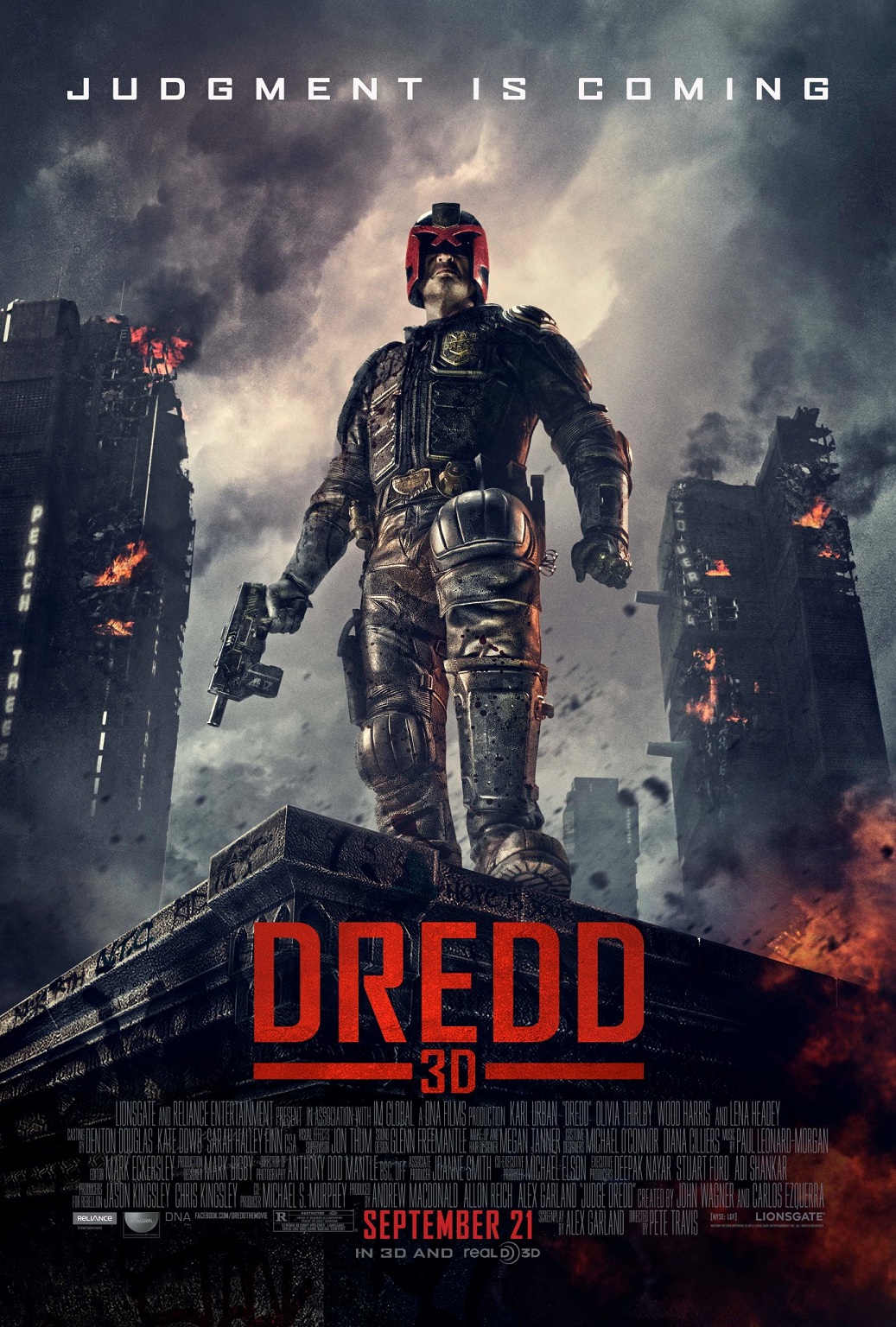
Dredd | review by Rafe McGregor

Dredd, by Pete Travis (Entertainment Film Distributors) 

Zero tolerance for the wretched of the Earth. 

Film form refers to the narrative, pictorial, and technological elements of a cinematic work and one of its functions is to configure the cinematic experience. The cinematic experience of Pete Travis’s Dredd is configured by a combination of cinematography and voice from the moment the film begins to the last few seconds before the end credits, providing three points of reference that structure the cinematic event. Mega City One is an imagined future urban sprawl on the eastern seaboard of the US in which over double the current population of the country is packed into less than two percent of its territory. The representation of urban space was created by applying computer-generated imagery to photography of contemporary Johannesburg, South Africa’s largest metropolitan area, itself plagued by extreme poverty and hyper-violence. The narrative opens with several aerial tracking shots of Mega City One during which Judge Dredd (played by Karl Urban) introduces a post-apocalyptic America, the megalopolis, mega-blocks (vertical slums), and the criminal justice system (in which the functions of police, jury, and judiciary are combined in the figure of the judge). As the camera tracks up the edifice of the Hall of Justice, Dredd concludes: ‘Only one thing fighting for order in the chaos: the men and women of the Hall of Justice…juries, executioners, judges.’ In the fifteenth minute (of ninety-five) there is a scene that will be familiar to police officers the world over, in which patrols depart the Hall of Justice for their tours of duty at the beginning of the shift. The camera focuses on Dredd and Cassandra Anderson (played by Olivia Thirlby), a trainee-judge, as they mount their Lawmaster motorbikes. Dredd informs Anderson of the daunting task ahead: ‘Twelve serious crimes a minute, seventeen thousand per day. We can respond to around six percent.’ The final scene of the film (the last forty-five seconds) returns to the opening, with two aerial shots of the megalopolis. There is a second voiceover from Dredd, which repeats part of the first: ‘Mega City One: eight hundred million people living in the ruin of the old world and the mega-structures of the new one. Only one thing fighting for order in the chaos: judges.’ The combination of reproduced reality with Dredd’s gravelly saw-cutting-through-bone voice configures a cinematic event in which zero tolerance policing is endorsed as a response to violent crime, his authoritative tone supplemented by pictorial and statistical evidence.

Friday, 23 October 2020

Judge Dredd, Vol. 1, by Duane Swierczynski and Nelson Daniel (IDW Publishing) | review by Stephen Theaker

My low expectations (inspired perhaps by memories of the underwhelming DC Comics version) were quickly proven wrong. Although this is a reboot series with its own continuity, it is absolutely within the spirit of the 2000 AD strip, with art that perfectly fits the tone. It begins an epic saga of cloning, kidnapping and robot rebellion that continues in subsequent volumes, while also featuring short back-up strips that show us one-off stories taking place against the background of those events. Stephen Theaker ***

Friday, 26 August 2016

Predator vs Judge Dredd vs Aliens: Incubus and Other Stories, by John Wagner, Andy Diggle, Henry Flint, Alcatena and chums (Rebellion/Dark Horse Books) | review by Stephen Theaker

Judge Dredd and his fellow lawmen here face two extraterrestrial threats from the silver screen. In the first story a Predator crashes in the Cursed Earth, and from there makes his or her way to Mega-City One, where four hundred million people are already losing their minds. The Predator quickly realises that the judges are the big game here, and begins to collect its gruesome trophies. A somewhat psychic descendant of Arnold Schwarzenegger’s character from the first film is called in to help in the search. Alcatena’s artwork is very appealing, but is maybe a bit cute for this story. The Aliens story that follows is much more memorable, perhaps because the Predator doesn’t offer much of a threat to Mega-City One. It kills a lot of people, but it’s essentially a nuisance – whereas the Aliens are a plague that threatens total extinction. Henry Flint’s art looks a lot like Carlos Ezquerra’s, so this feels like authentic Dredd from the beginning. The Mega-City offers a million dark places for an alien to hide and lay its eggs. A space pirate brought them here to conquer the city, but luckily another idiot thought he could breed them for use in fighting pits and got himself infected – his exploding chest and the thing that comes out of him gets Dredd on the case. Great use of Dredd, the Mega-City, and the aliens. ***

Monday, 17 December 2012

Dredd 3D – reviewed by Howard Watts

Dredd 3D certainly deserves its 18 rating. Now, I’m not a great fan of 3D – I find it false from a film POV, an augmented reality akin to Google’s project glass: https://plus.google.com/+projectglass/posts – a Sinclair C5 for the noggin, with apologies to William Gibson. Wearing those huge 3D glasses makes me feel like a participant at a Buggles convention, thankful for the darkness of the cinema. It’s not reality, and for me not how film should be presented. Dredd bears this out with abundance, many scenes not tailored specifically for the 3D effect suffering (as have other 3D films in recent years) from foreground distractions and blurry black artefacts.

Dredd is brutal, unrelenting, graphically violent on screen, implying it off. It’s full on – but lacks colour, favouring the grey tones of despair. The soundscape thunders around you, a marching drum of determination, punctuating its claustrophobic setting. Sight and hearing are bombarded – perhaps to the point of admitting, “too much!” Hardly a Buggles convention.

Friday, 23 November 2012

Drokk: Music Inspired by Mega-City One – reviewed by Stephen Theaker

As part of Portishead, Geoff Barrow has created four of my favourite albums of all time. Drokk: Music Inspired by Mega-City One (Invada UK, 56 mins), in collaboration with film and television composer Ben Salisbury, may be a side project, but it is very nearly as superb as his other work. This isn’t actually the soundtrack to the forthcoming Dredd, whose composer is Paul Leonard-Morgan. But it did apparently begin there, as exploratory sketches, and it says a lot for the music that although they didn’t end up working on the film, the musicians involved felt those ideas were too good to leave unexplored, and came back to finish them off.