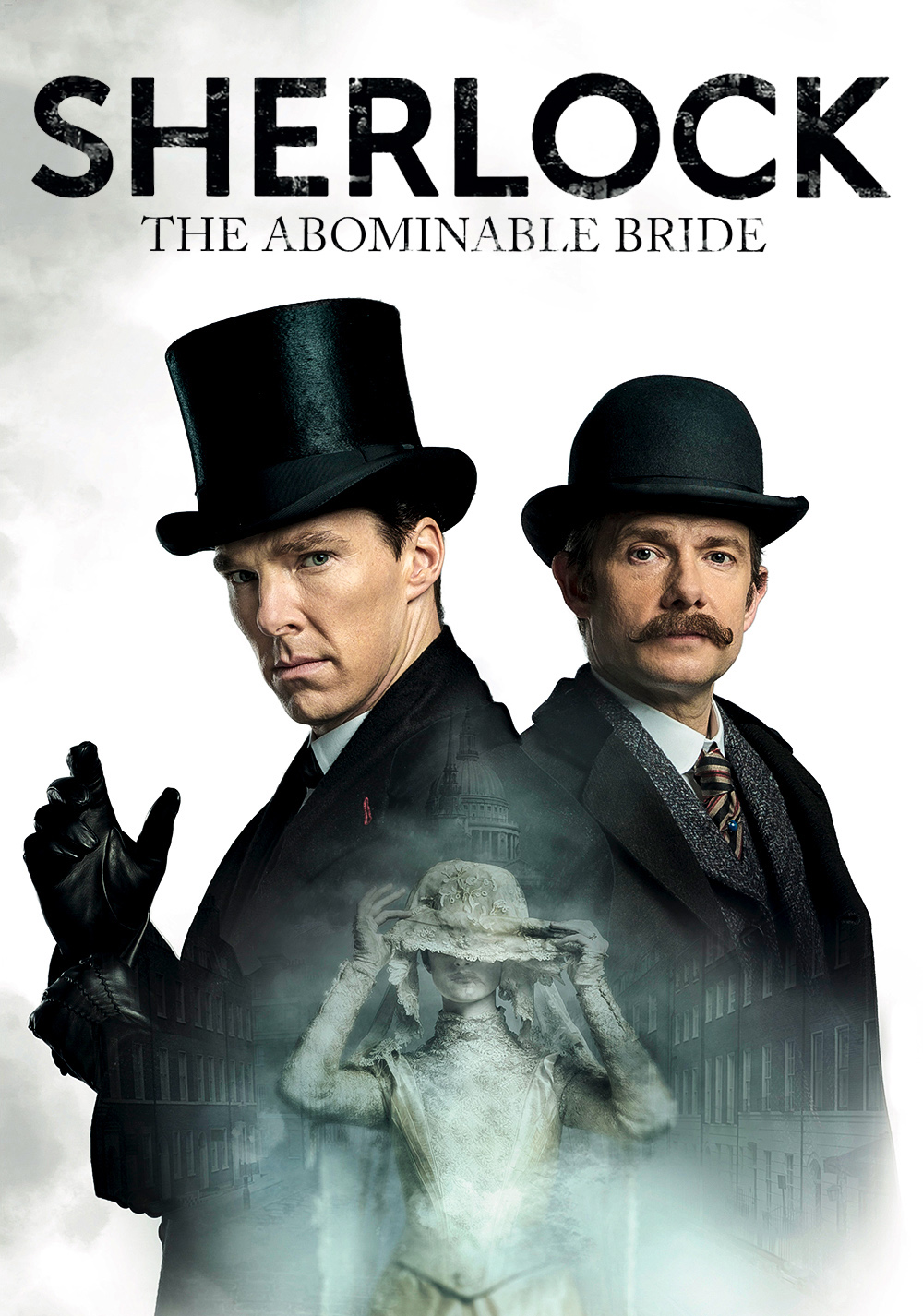
Like Conan Doyle, who famously tired of his creation, the BBC seem curiously reluctant to represent Sherlock Holmes on the small screen. Compare Sherlock, which began in 2010, with CBS’s Elementary, which began in 2012: the former has a total of thirteen episodes across four seasons (I’ll use the American term to distinguish an individual season from the series as a whole); the latter is, at the time of writing, in its fifth season and will have aired a total of 109 episodes by the time this review is in print. In addition to the British tendency to disguise mini-series as series, writers Mark Gatiss and Steven Moffat seem intent on frustrating our enjoyment of the Benedict Cumberbatch (Holmes) and Martin Freeman (Watson) partnership in a way that Robert Doherty does not with Jonny Lee Miller (Holmes) and Lucy Liu (Watson) in Elementary. Season 1 ended with Holmes and Watson about to blow up, season 2 with Holmes’ faked suicide leaving Watson bereft, and season 3 with Holmes exiled to certain death. Ominously, the final episode of season 4 is called “The Final Problem” and it is telling that Doyle’s story of the same name – his half-hearted attempt to kill off Holmes after 26 episodes – is the only original case to have inspired two of the TV adaptations.
Showing posts with label Mark Gatiss. Show all posts
Monday, 10 July 2017
Friday, 12 August 2016
Sherlock: The Abominable Bride, by Mark Gatiss and Steven Moffat (2entertain Ltd) | review by Rafe McGregor
Theaker’s Quarterly Fiction may seem an unlikely venue for a review of the first full-length Sherlock special, shown on all small screens and some big screens across the UK on New Year’s Day 2016. Three mini-seasons (of three episodes each) and one mini-special (of just over seven minutes) in, however, the world of Sherlock is already brim-full of superhuman beings. The eponymous protagonist refers to himself as “a high-functioning sociopath” (one of the series’ most-repeated phrases, suggesting sociopaths are usually low-functioning), but his superpowers include: reading an entire life history in a glance, disarming sword-wielding assassins without breaking a sweat, destroying international crime syndicates single-handedly, successfully masquerading as an extremist in Karachi, riding a motorbike safely at breakneck speed, instantly recovering from consuming vast quantities of Class A drugs… and returning from the dead. His nemesis, supervillain Moriarty, has his own list of powers: controlling Cockney serial killers, Chinese secret societies, and Eastern European paramilitaries; breaking into the Tower of London, the Bank of England, and Pentonville Prison simultaneously; resisting “enhanced interrogation” indefinitely… and returning from the dead (which is what the special is all about). Even Mycroft, whose powers are intellectual rather than physical, can follow his brother’s clandestine footsteps across Europe, masquerade as a Serbian soldier without detection, and take charge of a Tactical Firearms Command team. In fact, poor old Watson is the foil to at least four superhumans as “His Last Vow” (season 3, episode 3) reveals that Mrs Watson is a (semi-retired) super-villain-turned-hero, able to fire a handgun with one hundred percent accuracy, pass through multiple layers of physical security without trace, evade the joint efforts of NATO’s intelligence services, instantly access information beyond the combined capacity of MI5, MI6, and GCHQ… and waltz in a wedding dress. All of which to say that the BBC’s Sherlock is very much a mix of genres, alternating between detective stories in an urban fantasy setting and high fantasy in a tragic clash of good and evil – not to mention regular dashes of comedy.
Monday, 28 October 2013
Doctor Who and the Planet of the Daleks, read by Mark Gatiss, reviewed by Stephen Theaker
I’ve lost track of how often I’ve read the Target edition of Doctor Who and the Planet of the Daleks (AudioGO, digital audiobook, 3 hrs 3 mins; Audible purchase) by Terrance Dicks, but as soon as I saw this new reading by Mark Gatiss (with Dalek voices by Nicholas Briggs) it attracted the attention of my monthly Audible token. That voice! Imagine him reading this: “The cover illustration of this book portrays the third Doctor Who, whose physical appearance was altered by the Time Lords when they banished him to the planet Earth in the twentieth century.” In the first story of his fourth season, the third Doctor (with the help of his earlier selves) had won back the right to travel in time and space, but as usual flew straight into serious trouble. First came the drashigs, and then the incipient space war between the human and Draconian empires, a war engineered by the dastardly Daleks to pave the way for their invasion. This story begins with Jo Grant watching over the injured Doctor, the Tardis being sent by the Time Lords to Spiridon. She’ll soon venture out for help, and end up in the hands of its invisible inhabitants, but as the title suggests, this is no longer their planet. The Doctor will eventually wake and go looking for Jo, only to meet a squad of Thals, here to destroy a Dalek base at any cost.
Subscribe to:
Posts (Atom)