Showing posts with label Steven Spielberg. Show all posts

Friday, 20 June 2025

Happy Birthday, Bruce: Jaws @ 50! – Rafe McGregor


Fifty years ago today, Steven Spielberg’s Jaws (1975) was released into the wild, into the world, and into the film industry and its golden anniversary is being celebrated globally with much hype and fanfare, including here, at Theaker’s Quarterly Fiction (which, as we all know, is possibly the UK’s second longest-running sf/f fiction zine and approaching its own silver anniversary). I wrote about the film’s impact on me, on Hollywood, and on sharks in the wild (none of which were particularly good) in my review of Jon Turteltaub’s The Meg (2018) so I won’t say much about any of that here. I will say that for all that harm the film may have done, it is in my opinion – and quite literally – almost perfect as a work of cinema and entirely deserving of its 97% on the Tomatometer. If it were up to me, I’d push that to 99%, deducting 1% for Bruce, the mechanical shark named after Spielberg’s lawyer. The problem is that Bruce moves like a wind-up toy (which is essentially what he is) rather than whipping through the sea like a fish in…well, water. It turns out I’m not the only one to have problems with Bruce and Jon Harvey’s recent article in the Guardian reveals that the decision to show very little of the shark until the end was motivated by practical rather than artistic considerations. Let me say one thing in Bruce’s defence (it being his birthday): what he lacks in speed and suppleness, he almost makes up in menace and mass. One more thing about Jaws before I move on to thoughts about recent imitations and the Sharksploitation genre more broadly. A few months ago I read Peter Benchley’s much-maligned 1974 novel, on which the film is closely based, for the first time. I thought it was good – very good, actually. Where the film is let down a little by Bruce’s performance, the novel suffers a little more from Benchley’s inability to write convincing women but is otherwise a compelling and chilling read.

Since reviewing The Meg, I’ve watched a host of terrible shark movies I haven’t bothered to write about. Lowlights include John Pogue’s Deep Blue Sea 3 (2020), Ben Wheatley’s Meg 2: The Trench (2023), and Andrew Traucki’s The Reef: Stalked (2024), all of which provide ample evidence for the law of diminishing returns in film franchises. Meg doesn’t even deserve its 27% on the Tomatometer; how The Reef and Deep Blue Sea achieved 71% and 79% respectively is completely beyond me. (Perhaps the Tomatometer isn’t as reliable as I thought.) I have yet to see Matthew Holmes’ Fear Below or Sean Byrne’s Dangerous Animals, both of which were released this year and come highly recommended, but both of which raise immediate reservations. Fear Below looks very similar to Christian Sesma’s Into the Deep (2025, 27%), which deserves dishonourable mention with the three franchise films, and Dangerous Animals is being marketed as ‘shark plus serial killer’ (eye roll). I’ve also watched Martin Wilson’s Great White (2021), which can consider its 44% on the Tomatometer generous; Justin Lee’s Maneater (2024), a well-earned 17%; and Joachim Heden’s The Last Breath (2024, AKA Escape from the Deep), with a very generous 30%. Yes, filmmakers keep churning (chumming?) them out and I keep lapping them up. I blame Jaws. (For both the churning and the lapping).

One thing that has become tiresome over decades of watching movies in what is now called the Sharksploitation genre, much more so than the appalling use of CGI in most, is the way in which they all replicate and reinforce the (hu)man versus nature trope. I’d have hoped that by now, with nature collapsing all around us, this might seem a little too twentieth (or even nineteenth) century to continue to appeal to audiences. This doesn’t just apply to Sharksploitation, but to many other contemporary films and franchises, such as, for example, Baltasar Kormákur’s Beast (2022) and the Jurassic Park (now Jurassic World) media moneymaker. Jurassic World Rebirth, the seventh film, is due next month and will no doubt involve plenty of land, sea, and air lizard mincemeat. Though I won’t be around to witness it, I also wonder if by the time Jaws’ centenary comes around, the orca won’t have replaced the shark as our favourite cinematic sea monster. Orcas are much bigger and much clever than sharks, hunt in pods, and are increasingly encroaching on human-infested waters as ocean temperatures rise. They do look like they’re smiling rather than snarling when they open their (immensely strong) mouths though, which probably doesn’t make a lot of difference if you’re in the water with one but might make them less likely film fodder. I leave that for the future...in the present, it’s time to revisit the past with (yet) another viewing of what might just be Spielberg’s best.

Monday, 28 June 2021

Minority Report | review by Rafe McGregor

Steampunk criminology, paradoxical policing.

Minority Report, which was released in 2002, is set in Washington, D.C. in 2054, in the ninth year of PreCrime, a crime prevention programme. The programme originated with genetic experimentation conducted by Dr Iris Hineman (played by Lois Smith) for the purpose of healing the neurotrauma suffered by the children of women addicted to neuroin, a powerful opiate that was becoming popular in the illegal drug market. The intervention was unsuccessful, with most of the children dying, but unintentionally provided three of the survivors with the power of prevision. These ‘precogs’, pre-cognitives, developed the ability to envision murders – and only murders – up to four days in advance of their occurrence. This mutation was exploited by the District of Columbia’s criminal justice authorities, who use the precogs to drive an apparently perfect, albeit unverifiable, predictive policing programme under the directorship of Lamar Burgess (played by Max von Sydow). PreCrime is maintained by sequestering the precogs in a room called the ‘temple’ in police headquarters, where their neural activity is permanently monitored while they are kept in a state of semi-consciousness, semi-immersed in a tank of amniotic liquid. Their visions are projected onto a screen that police detectives use to solve the crime before it occurs and the programme involves both judicial and penal participants, with a judge and forensic expert witnessing the detection and detention by videolink and arrested suspects sent to the Department of Containment, where they are kept in a similar state of semi-consciousness to the precogs for the rest of their lives. PreCrime has been operational for six years and was an immediate success, reducing the murder rate in Washington, D.C. by ninety percent in its first month and one hundred percent ever since. The projected visions of all three of the precogs, Agatha (played by Samantha Morton) and identical twins Arthur and Dashiell (played by Michael and Matthew Dickman respectively), are apparently always complementary and the balance of probability of the available evidence suggests that they have always been accurate. Occasionally, the precogs see the same murder more than once, but these ‘echoes’ are easily identifiable and disregarded by the detectives and PreCrime is widely recognised as a perfect crime prevention programme.

The operational head of PreCrime is Chief John Anderton (played by Tom Cruise) and the narrative opens at a crucial stage of its development: despite opposition from the American Civil Liberties Union, the Attorney General is considering expanding it from a municipal to a national initiative and has sent a Justice Department agent, Danny Witwer (played by Colin Farrell), to subject it to a final scrutiny. The central plot of the film is set in motion when Anderton, who is a neuroin addict, is alerted to a future murder in which he is the perpetrator and the victim a man named Leo Crow (played by Mike Binder), who is unknown to him. The identification of Anderton as a murderer provides an exploration of the relationship between free will and determinism as he attempts to find Crow in order to discover why the murder has been predicted – but in doing so brings himself and Crow into close proximity, enabling the murder. Now that he has been identified as a perpetrator, Anderton is anxious to find out whether there have ever been any differences in the predictions of the three precogs and discovers that there have been times when Agatha has made predictions that differed from those of the twins. These are the ‘minority reports’ of the title and the film is based on Philip K. Dick’s 1956 short story, ‘The Minority Report’. While Dick is the most obvious inspiration, the ‘sprawl’ and the repeated use of the prefix neuro are both allusions to William Gibson’s Neuromancer (1984), the first novel in his Sprawl Trilogy. In Gibson’s dystopian novel, the Sprawl is an extended urban area on the eastern seaboard of the US, the Boston-Atlanta Metropolitan Axis. In Minority Report, the sprawl is a neglected, crime-ridden part of Washington, D.C. Spielberg’s acknowledgement of the influence of Gibson is a reminder of another of the latter’s works, The Difference Engine (1990), his collaboration with Bruce Sterling.

The novel is the canonical work of the steampunk genre, which Patrick Jagoda characterises as ‘alternative histories that frequently explore the rise of new technologies in Victorian England and throughout its global empire’. Like steampunk, Minority Report combines the old (Victorian setting and film noir style respectively) with the new (advanced technology in both) and this combination of the retrospective and the prospective is repeated in the central concept of the film, the PreCrime Programme. The desire to be able to predict all crime (or all of a particular type of crime) with perfect accuracy harks back to the positivist imperative of the nineteenth and early twentieth centuries, in which sociological, biological, and psychological variations of determinism aspired to be able to forecast human behaviour with mathematical certainty. The London of The Difference Engine features a ‘Central Statistics Bureau’ that is home to departments of ‘Quantitative Criminology’, ‘Deterrence Research’, and ‘Criminal Anthropometry’, all of which are aimed at the making of ‘utterly objective, entirely statistical investigations’ of social reality. The idea is that if crime can be predicted with accuracy, it can be prevented with certainty, producing a crime-free utopia. What elevates Minority Report above its achievement as a gripping and clever thriller is the logical paradox it identifies at the heart of all crime prevention programmes: the moment one combines prediction with policing, the prediction is falsified. The previsions would only be accurate if the murders were allowed to take place – but the whole point of employing the previsions in PreCrime is to alter the future they predict. The real-life paradox to which the fictional film alludes involves a second combination, between pre-emption and prosecution. Pre-inchoate offences, which have become increasingly popular since the beginning of the War on Terror, are concerned with pre-empting harmful conduct before the opportunity for its commission arises. But if an offence is not even in its initial stages, then the only means by which it can be called an offence is prediction. The paradox, which is legal rather than logical, is how anyone can justify prosecuting a suspect for such an offence. We can, it seems, have pre-emption or prosecution, but not both. What I find particularly interesting about Minority Report is that it was filmed in the spring of 2001, several months before the September 11 attacks that have produced so many changes to so many laws in so many countries ever since. *****

Wednesday, 5 October 2016

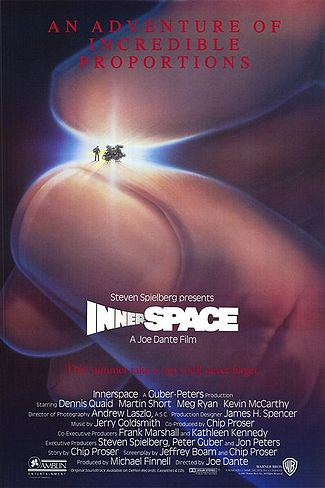
Innerspace, by Jeffrey Boam and Chip Proser (Warner Bros. et al.) | review by Jacob Edwards

Dir. Joe Dante. 1 July 1987 (Amblin Entertainment). Genre: SF Comedy. Ratings: 81% (Rotten Tomatoes) 6.7 (IMDB).

Obstreperous test pilot Tuck Pendleton (Dennis Quaid) volunteers for a miniaturisation experiment that should see him and his ship injected into the bloodstream of a laboratory rabbit. Instead, thanks to some industrial espionage gone badly wrong, he finds himself inside hypochondriac no-hoper Jack Putter (Martin Short). Aided by Pendleton’s ex-girlfriend, journalist Lydia Maxwell (Meg Ryan), and guided from within by Pendleton himself, Putter must overcome his inhibitions, thwart the villains and recover the microchip necessary to extract the ship before Pendleton’s oxygen runs out.