

Possibly the UK's second longest-running sf/f fiction zine.
Monday, 12 September 2011
Doctor Who: The Paradise of Death, by Barry Letts – reviewed


Friday, 9 September 2011
Juliet McKenna: "Everyone can promote equality in genre writing"
Juliet McKenna has blogged (here) for SFX - the gender balance of whose reviews she's been tracking on her blog (e.g. here) - about the disparity between the proportion of genre books written by women and the proportion of books reviewed that are written by women. She suggests:
I couldn't agree more. A month or two ago I started tracking the gender balance of books we were receiving - if it's working there should be a pie chart here to show where we currently stand:

At the time of writing (9 September 2011) the figure stands at 20.5%, so in theory at least 20.5% of my reviews would be of books by female writers and editors. I want to do a bit better than that, not least, as I've mentioned previously, because I'm unhappy with how few female writers have been appearing in the pages of our magazine.
So far the Even Stephens approach I've adopted - alternating my reviews between books by men, books by women (excluding comics for now) - seems to be working well. Apart from anything else, it makes choosing my next book that little bit easier.
It's interesting to note how it works against publishers who haven't published any books by women at all, and there are a few out there (for example...) - they're not in the running for half of my review slots.
"Every reviewer can check their personal choices of books, to make sure there’s balance. Each reviews editor can do the same; monthly, quarterly, annually. If balance is lacking, we can ask why without necessarily accusing anyone of sexism."
I couldn't agree more. A month or two ago I started tracking the gender balance of books we were receiving - if it's working there should be a pie chart here to show where we currently stand:
At the time of writing (9 September 2011) the figure stands at 20.5%, so in theory at least 20.5% of my reviews would be of books by female writers and editors. I want to do a bit better than that, not least, as I've mentioned previously, because I'm unhappy with how few female writers have been appearing in the pages of our magazine.
So far the Even Stephens approach I've adopted - alternating my reviews between books by men, books by women (excluding comics for now) - seems to be working well. Apart from anything else, it makes choosing my next book that little bit easier.
It's interesting to note how it works against publishers who haven't published any books by women at all, and there are a few out there (for example...) - they're not in the running for half of my review slots.
Obverse Quarterly 1: Bite-Sized Horror, ed. by Johnny Mains – reviewed by Stephen Theaker
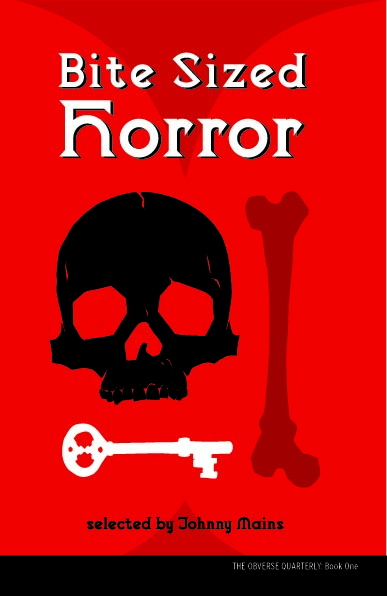
The two best stories bookend the collection, smartly ensuring that the book gives a good first impression, and sends the reader away happy. They were also, for me, the two stories in which one sensed most strongly a character to the writing; one could almost imagine the rest being written by a single author, but not these.
Monday, 5 September 2011
Doctor Who: The Perpetual Bond, by Simon Guerrier – reviewed by Stephen Theaker

Friday, 2 September 2011
The book I never wrote - on sale for $321.73!

Today, I was pleasantly surprised to see a paperback copy of Professor Challenger in Space, a book I self-published years ago, going for $321.73 here on Amazon! How pleasing for my vanity that someone thought it was worth that much, even if they were, sadly, quite mistaken.
But what's this? The third in that series, Rolnikov, Mad Knight of Uttar Pradesh, also on sale, from the same vendor, for the same price! To say that was a surprise would be an understatement, given that I never actually wrote the book - it is a bibliographic ghost, registered with the ISBN Agency, but never published.
So two things are clear. I need to write that book, else it'll haunt me for the rest of my life. Secondly, Mygrandmasgoodies is listing books for sale that he or she doesn't actually possess.
I confess, I was half-tempted to order it. I bet it would have been by far the best of my novels.
By the way, Professor Challenger in Space is available on Kindle for much less than $321.73 - $1.39 in the US, and 86p in the UK. Still overpriced, though!
Ventriloquism by Catherynne M. Valente, reviewed by Stephen Theaker

Monday, 29 August 2011
Stonewielder, Volume I, by Ian Cameron Esslemont - reviewed by Stephen Theaker

Friday, 26 August 2011
Journey into Space: The Red Planet, by Charles Chilton – reviewed by Stephen Theaker

The first eight episodes detail the journey from Earth to Mars, a trip punctuated by much eerier incidents than expected; this is science fiction in the vein of The Quatermass Experiment rather than Flash Gordon. "Orders must be obeyed without question at all times" is the refrain of James Whitaker, who gives everyone the willies, but from where do his orders come? By the time Jet Morgan (played by Andrew Faulds) and the surviving members of the expedition reach their destination they've been well and truly frightened, even if it barely shows behind their stiff upper lips. On Mars it gets stranger yet, with hallucinations and... humans? Yes, the people we meet on this ancient, worn-out Mars in the latter half of the serial are humans, snatched from Earth whenever the two planets were at their closest. Most are in trances, believing themselves still on Earth at the time they were snatched. The mysterious flying doctor, however, seems to know just where he is. But who is behind it all? And will the surviving astronauts really have to settle down to life on Mars?
Monday, 22 August 2011
Cowboys & Aliens – reviewed by Douglas J. Ogurek

A mangy-looking man (Daniel Craig) awakens in a setting typical of the early American Southwest. A strange metallic device is stuck on his wrist, and he remembers nothing. He makes his way to the dusty streets of Absolution, where locals recognize him as the outlaw Jake Lonergan, wanted for theft and murder. But there is something more threatening to the town (and to all of mankind) than Jake Lonergan.
Friday, 19 August 2011
Rise of the Planet of the Apes - reviewed by Jacob Edwards

A film that is produced by its writers is a bit like a self-published novel. It dispenses with those pesky editors and allows the authors an unusual, at times unhealthy amount of creative control. Theoretically, this could be wonderful (god complex knows how many movies have been scuppered by interfering bigwigs) but equally it can facilitate a merry, unrestrained hurling of plot confetti – a self-congratulatory, naive celebration in which the storyline is well and truly shredded.
Monday, 15 August 2011
Harry Potter and the Deathly Hallows, Part 2 – reviewed by Douglas J. Ogurek

This summer, Harry, Ron, and Hermione finish the saga that has ushered millions of children into adulthood, and bonded generations. This film, the eighth in the series, broke international box office records, raking in $476 million worldwide during its opening weekend.
Sunday, 14 August 2011
Are novels about to get shorter?
 Changes in the book market have always had a big effect on the length of novels: compare the novels in your collection from the 1850s, the 1950s and the 2010s to see what I mean. We're now well on the way to ebooks becoming the lead format for commercial fiction, and I think that's going to lead to another big change: shorter commercial novels. Here are a few reasons why:
- People shopping for Kindle books don't seem to compare books by length the way bookshop buyers do.
- Economies of scale in printing stop being an issue.
- Low pricing of ebooks - if a 200,000 word novel sells at the same price as a 30,000 word novella (e.g. I paid more or less the same price for UR and The Colorado Kid that I paid for Under the Dome), it makes sense for the author to produce shorter, more frequent books.
- Ebooks don't disappear from the shelves as quickly; you don't need to snap them up just in case it goes out of print. So it's in the interest of writers to write books that readers finish, rather than just collect, so that when your next book comes out they're ready to read it.
- Shorter books are less work for everyone involved, so if people can make the same money selling short books that they make selling long ones, they will.
That doesn't mean every book will be shorter, any more than every book is now long - the small press will carry on doing its own thing, as will authors who can set their own terms - but I think these factors will exert a powerful downward pressure on the length of commercial novels over the years to come.
Saturday, 13 August 2011
Received for review in early August 2011
Books received for review in recent days…

666 Charing Cross Road, by Paul Magrs (Headline Review, pb, 390pp). "From the creator of Brenda and Effie, Dr Who and Strange Boy comes an astonishing stand alone novel..." I don't think Paul Magrs actually created Doctor Who, but he's certainly given it a shot in the arm from time to time!


Creepy Presents: Bernie Wrightson, by Bernie Wrightson and others (Dark Horse, hb, 144pp). A collection of Swamp Thing artist Bernie Wrightson's artwork for Creepy and Eerie. Looks, erm, creepy!


Darkness Falling (Forever Twilight, Book 1), by Pete Crowther (Angry Robot, ebook, 9097ll). I'm a bit confused by this one, having previously reviewed another Forever Twilight Book One, Darkness, Darkness, which had some fantastic moments, but a bit too much slapping of hysterical women for my taste (i.e. any). A Kindle search of this one suggests it's an expansion of the novella (with slapping intact).


Dead Bad Things, by Gary McMahon (Angry Robot, ebook, 5313ll). A Thomas Usher novel. I've enjoyed everything I've read so far by Gary McMahon: Rain Dogs, Different Skins and What They Hear in the Dark. The previous book in the series, BFA nominee Pretty Little Dead Things, is currently available on Kindle for just 99p.


Debris, by Jo Anderton (Angry Robot, pb, 6999ll). Book One of the Veiled World Trilogy.


King's War, by Maurice Broaddus (Angry Robot, ebook, 5988ll). Volume III of the Knights of Breton Court.


Master of the House of Darts, by Aliette de Bodard (Angry Robot, ebook, 8083ll). Book 3 of the Obsidian and Blood series. Jenny Barber interviewed Aliette for Dark Horizons #57, and I liked the sound of her books. (The first half of the interview can be read on the BFS's website.)

Nowhere Hall, by Cate Gardner (Spectral Press, chapbook, 26pp). The third chapbook in the Spectral Press series. The super cover painting is by Daniele Serra.


Reign of the Nightmare Prince, by Mike Phillips (Journalstone, pb, ebook, 262pp). I've published some smashing stories by Mike in the past, including "The Free Dynamos and the Lone Island in the Sky" in TQF34.


Roil, by Trent Jamieson (Angry Robot, ebook, 5791ll). Book 1 of the Nightbound Land.


The Best American Comics 2011, by Alison Bechdel (ed.) (Houghton Mifflin Harcourt, pb, 342pp). Includes comics by Gabrielle Bell, Joe Sacco, Jaime Hernandez, Kate Beaton, Jeff Smith, Angie Wang and many more.


The Complete Major Bummer Super Slacktacular! by John Arcudi, Doug Mahnke and others (Dark Horse, tpb, 384pp). I missed this series when it first came out from DC, although I was reading a lot of comics in those days (at one point I read pretty much nothing but comics and Doctor Who novels for two years). I don't know whether this is supposed to be any good, but I've always fancied reading it.
If you have anything to send us for review, the info you need is here. Thanks in advance!
If you fancy reviewing books for us, do get in touch. Most of the titles we receive are in electronic formats (all but one of the books listed above, for example), and so we're unable to pass them on, but we usually have a dozen or so print books in hand from which you could choose.

666 Charing Cross Road, by Paul Magrs (Headline Review, pb, 390pp). "From the creator of Brenda and Effie, Dr Who and Strange Boy comes an astonishing stand alone novel..." I don't think Paul Magrs actually created Doctor Who, but he's certainly given it a shot in the arm from time to time!
Creepy Presents: Bernie Wrightson, by Bernie Wrightson and others (Dark Horse, hb, 144pp). A collection of Swamp Thing artist Bernie Wrightson's artwork for Creepy and Eerie. Looks, erm, creepy!
Darkness Falling (Forever Twilight, Book 1), by Pete Crowther (Angry Robot, ebook, 9097ll). I'm a bit confused by this one, having previously reviewed another Forever Twilight Book One, Darkness, Darkness, which had some fantastic moments, but a bit too much slapping of hysterical women for my taste (i.e. any). A Kindle search of this one suggests it's an expansion of the novella (with slapping intact).
Dead Bad Things, by Gary McMahon (Angry Robot, ebook, 5313ll). A Thomas Usher novel. I've enjoyed everything I've read so far by Gary McMahon: Rain Dogs, Different Skins and What They Hear in the Dark. The previous book in the series, BFA nominee Pretty Little Dead Things, is currently available on Kindle for just 99p.
Debris, by Jo Anderton (Angry Robot, pb, 6999ll). Book One of the Veiled World Trilogy.
King's War, by Maurice Broaddus (Angry Robot, ebook, 5988ll). Volume III of the Knights of Breton Court.
Master of the House of Darts, by Aliette de Bodard (Angry Robot, ebook, 8083ll). Book 3 of the Obsidian and Blood series. Jenny Barber interviewed Aliette for Dark Horizons #57, and I liked the sound of her books. (The first half of the interview can be read on the BFS's website.)

Nowhere Hall, by Cate Gardner (Spectral Press, chapbook, 26pp). The third chapbook in the Spectral Press series. The super cover painting is by Daniele Serra.
Reign of the Nightmare Prince, by Mike Phillips (Journalstone, pb, ebook, 262pp). I've published some smashing stories by Mike in the past, including "The Free Dynamos and the Lone Island in the Sky" in TQF34.
Roil, by Trent Jamieson (Angry Robot, ebook, 5791ll). Book 1 of the Nightbound Land.
The Best American Comics 2011, by Alison Bechdel (ed.) (Houghton Mifflin Harcourt, pb, 342pp). Includes comics by Gabrielle Bell, Joe Sacco, Jaime Hernandez, Kate Beaton, Jeff Smith, Angie Wang and many more.
The Complete Major Bummer Super Slacktacular! by John Arcudi, Doug Mahnke and others (Dark Horse, tpb, 384pp). I missed this series when it first came out from DC, although I was reading a lot of comics in those days (at one point I read pretty much nothing but comics and Doctor Who novels for two years). I don't know whether this is supposed to be any good, but I've always fancied reading it.
If you have anything to send us for review, the info you need is here. Thanks in advance!
If you fancy reviewing books for us, do get in touch. Most of the titles we receive are in electronic formats (all but one of the books listed above, for example), and so we're unable to pass them on, but we usually have a dozen or so print books in hand from which you could choose.
Friday, 12 August 2011
Kindle in the UK, almost a year in

The bigger Waterstone's in Birmingham already looks like a gift shop downstairs, although I suppose that's not just down to Kindle – it's Kindle on top of all the bookselling Amazon was already doing. It's always been hard for Waterstone's to compete with Amazon's wide range of books, its low prices, and (not a minor issue for me) the good condition of the books on sale. But I think Kindle's the straw that's prodding them over the edge.
It was very nice on holiday this past week to have The Guardian delivered to the Kindle first thing each morning, and that finished I had dozens of books and audiobooks on there to choose from. The free internet access came in very handy as well. On the iPad, I had a bunch of graphic novels, the British Library's brilliant 19th Century Books app, articles, stories and interviews in the McSweeney's app, and access if I needed it to hundreds more books stored in Dropbox (use this referral link to earn me bonus space!).
It was also very nice to know, given where I live and what was happening here while I was away, that a big chunk of my book collection would survive any fire.
A Thread of Truth, by Nina Allan - reviewed by John Greenwood

Small towns, and attempts to escape them, do seem to preoccupy Allan, and she admits in her Afterword that she is often drawn to the "somewhat baleful Victorian spa town". In the first story of the collection, "Amethyst" I felt as though we were in similar territory to that of "Bellony": a gently decaying tourist attraction where unhappy family secrets fester. "Amethyst" are a fictional folk-rock band whose sole hit single names the main street of the town, for reasons that remain obscure to two bored teenage girls trying to unravel the mystery. Allan captures very nicely a desperate adolescent quest to find some mystery in one’s provincial existence. It's also a story of life before the internet, when information about the world had limits: the girls have to get their alien conspiracy theories from the local newsagent. One of the girls is bewitched by the possibility that their drab town might hold a mystical secret, the other is repelled by it. The deadpan humour makes much of their contrasting outlooks:
"Lorna Samway's song wasn't really about aliens, at least not that I could see. A lot of the words weren't in proper sentences and it was hard to work out what they meant. If it was about anything at all it was probably about breaking up with a boyfriend." (p.19)
Monday, 8 August 2011
Doctor Who: Cobwebs, by Jonathan Morris – reviewed

Friday, 5 August 2011
Dragon’s Time, by Anne and Todd McCaffrey - reviewed by Stephen Theaker

That may seem a rather simplistic approach to time travel, but this isn’t the kind of book where people worry about stepping on butterflies. When Lorana’s dragon needs a bite to eat, she pops back "to a time when the game she wanted would be plentiful" (p. 150). Everyone’s concerned about "breaking time", but events always seem to play out the way they always did so there’s never really any need to worry about the consequences of their actions in the past.
Wednesday, 3 August 2011
New review of Theaker's Quarterly Fiction #37!

His approach to reviewing is an unusual one, part of his goal being to turn "leitmotifs into a gestalt" – i.e. noticing bits of stories (and other things he has read and experienced), making connections between them, and describing the total effect, the sometimes interesting results lying somewhere between reader-response analysis, free association and tweeting while reading.
Okay, so it's a little odd for someone to review a magazine about which they have complained at such length and in so many places – the issue contains a review of Lewis's book Weirdtongue, and an editorial discussing his ideas about giving books bad reviews, both of which led to much complaint from Lewis – but his conclusion that TQF37 is an "incredible set of stories" cannot be faulted…
Tuesday, 2 August 2011
The Book Addiction Test
 |
So I took this Internet Addiction Test, on which I scored a disappointing 55. Looks like I don't have a debilitating psychological problem. I'm just a bit lonely after working at home for so long, and hence pitifully desperate for human contact.
Then I wondered, what would be my results if I took the same test, but replaced "internet" and "online" with "reading", "email" with "bookshelf", and so on?
I scored 76.
My book addiction is 21 points worse than my internet addiction!
Four points more and the test would have concluded that "[reading] is causing significant problems in your life"!
Four points more and the test would have concluded that "[reading] is causing significant problems in your life"!
Monday, 1 August 2011
Falling Skies, by Paul Tobin and Juan Ferreyra – reviewed by Stephen Theaker

Subscribe to:
Posts (Atom)